Tawnymucklagh
DatedEst. 2500–2000 BCE
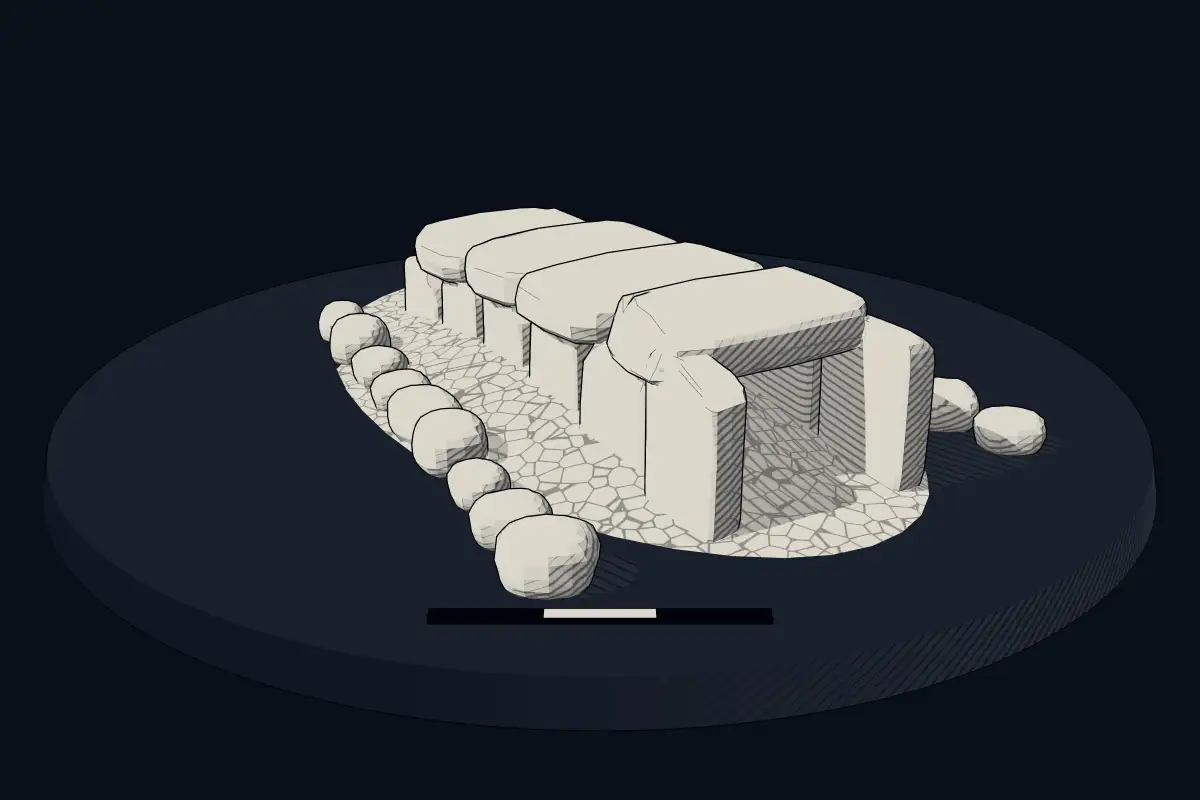
No licensed photograph yetWe have no photograph we may publish for this site, so the interpretive 3D view leads instead.
Overview
About this site
What the sources say
Das stark überwachsene Wedge Tomb von Tawnymucklagh (irisch Tamhnaigh na Muclach) ist auf der OS-Karte als „Hünengrab“ markiert. Es liegt auf einer Weide 600 m südöstlich von Monasteraden (Mainistir Réadáin), westlich des Lough Gara (Loch Uí Ghadhra) im County Sligo in Irland. Wedge Tombs (deutsch „Keilgräber“), früher auch „wedge-shaped gallery grave“ genannt, sind ganglose, mehrheitlich ungegliederte Megalithbauten der späten Jungsteinzeit und der frühen Bronzezeit.
Die West-Ost orientierte Megalithanlage befindet sich in einem niedrigen Hügel und misst etwa 10,0 m in der Länge und 8,0 m in der Breite und ist aus kleinen Orthostaten gebaut. Die 6,7 m lange Galerie wird durch einen zerbrochenen Trennstein in eine Vor- und Hauptkammer geteilt. Sie sind von den Resten der Außenwand umgeben.
Die 1,5 m lange Vorkammer wird durch zwei in situ erhaltene Tragsteine an
der Süd- und einen umgefallenen Stein an der Nordseite markiert. Die trapezoide Hauptkammer ist etwa 5,0 m lang und verjüngt sich in der Breite von 1,2 auf 0,9 m an der Rückseite. Erhalten sind sechs von vermutlich acht Tragsteinen im Norden und fünf im Süden. Alle Decksteine fehlen oder sind verlagert und als solche nicht erkennbar. Die Außenfassaden werden im Norden und Süden von sieben verbliebenen Steinen dargestellt. Es gibt umgefallene und stehende Steine im Bereich der Fassade.
Das Boulder Tomb von Clogher und Clogher Fort liegen westlich von Monasteraden im Townland Clogher.
Article in GermanRead on Wikipedia3 min readCC BY-SA 4.0
Where it sits in time
The site's dated range, placed against world reference points.
The scale is logarithmic: each step to the left is about ten times older than the last.
The full article
Tawnymucklagh: the whole story
In briefSources for this section
- Wikipedia (German): Wedge Tomb von TawnymucklaghCC BY-SA 4.0
Sources for this section
- Wikipedia (German): Wedge Tomb von TawnymucklaghCC BY-SA 4.0
Tawnymucklagh is a wedge tomb in County Sligo, Ireland, also known by the Irish name Tamhnaigh na Muclach. It stands on pasture 600 m southeast of Monasteraden, west of Lough Gara, and is marked on the OS map as a “Hünengrab.”
The monument lies in a low hill and is about 10.0 m long and 8.0 m wide. Built from small orthostats, it has a west-east orientation and a 6.7 m gallery divided by a broken partition stone into an antechamber and main chamber. The antechamber is 1.5 m long, while the trapezoidal main chamber is about 5.0 m long and narrows from 1.2 to 0.9 m across at the rear.
Six of perhaps eight surviving uprights remain on the north side of the main chamber, with five on the south. The outer walls are represented on the north and south by seven remaining stones, with both fallen and standing stones nearby. All capstone stones are missing or displaced and cannot be recognized as capstones.
The tomb is dated to 2500 BCE to 2000 BCE by typological estimate. Wedge tombs are chamber tombs associated with the late Neolithic and early Bronze Age. More generally, monuments of this kind in Ireland have a burial chamber that narrows at one end, and their gallery is entered without first passing through an antechamber or hallway. They were probably community burial places used by family or hamlet members.
No English Wikipedia article exists for it; the full text below is the German article "Wedge Tomb von Tawnymucklagh", shown in the original language.
Summary in EnglishSources for this section
- Wikipedia (German): Wedge Tomb von TawnymucklaghCC BY-SA 4.0
Sources for this section
- Wikipedia (German): Wedge Tomb von TawnymucklaghCC BY-SA 4.0
Tawnymucklagh is a wedge tomb in County Sligo, Ireland. Wikidata describes it as: wedge tomb in Tawnymucklagh, County Sligo. A typological estimate: 2500 BCE to 2000 BCE. No English Wikipedia article exists for it; the full text below is the German article "Wedge Tomb von Tawnymucklagh", shown in the original language.
How this page was madeSources for this section
- Wikipedia (German): Wedge Tomb von TawnymucklaghCC BY-SA 4.0
Sources for this section
- Wikipedia (German): Wedge Tomb von TawnymucklaghCC BY-SA 4.0
The summary at the top of this page was written by MiniMax-M3 (2026-11-08) from the cited Wikipedia article “Wedge Tomb von Tawnymucklagh”, translated from German. The numbers in it were checked automatically against the source text. The rest of the page is the article itself, the structured records and computed distances.
Tradition and region
About this kind of monument
Irish wedge tombs
A wedge tomb, or wedge-shaped gallery grave, is a type of Irish chamber tomb. It takes its name from the way the burial chamber narrows at one end, usually decreasing both in height and in width from west to east, which gives it a wedge shape in profile. An antechamber is separated from the burial area by a simple stone slab. Wedge tombs are one of the four categories of megalithic tomb described by the Irish scholars Seán Ó Nualláin and Rúaidhrí de Valera in their survey of 1961: court cairns, portal dolmens, wedge-shaped gallery graves and passage tombs.
A gallery grave is a megalithic tomb in which the main gallery is entered without first passing through an antechamber or hallway. The gallery graves of western Europe were probably community burial sites, in which family or hamlet members were laid to reinforce the sense of community. Gallery graves can be covered with an earthen mound or a cairn, and there are at least four major types: complex, transepted, segmented and wedge-shaped.
Wedge tombs were built between the Irish late Neolithic and the middle Bronze Age, about 2500 to 2000 BCE. Between 500 and 550 survive, mostly in the west and north-west of Ireland. A distinguishing feature is the double walling of the gallery. They were often covered by round, oval or D-shaped cairns, usually about 1.5 metres high, with a kerb, and are generally found on mountainsides, about three-quarters of the way up. The doorway generally faces west.
When visiting, look at how the walls narrow towards the back of the tomb and at the double wall of the gallery.
Paraphrased from Wikipedia: Wedge-shaped gallery grave, Wikipedia: Gallery grave, Wikipedia: Bell Beaker culture, Wikipedia: Passage grave · CC BY-SA 4.0
Lore
Evidence & Lore
What the sources actually support — and, kept apart, what has been claimed.
What the evidence supports
Dates
Est. 2500–2000 BCEHow this date was established: Type comparisonTypical range for wedge tombs in Ireland; this site has not been dated itself. Wedge tombs were built between the Irish late Neolithic and middle Bronze Ages about 2500 to 2000 BC.Source for this date
Where it stands
Ireland
The pin marks the monument itself — its exact point.
- Coordinates
- 53°56′20″ N, 8°29′32″ WFor a GPS or map app: 53.93889, -8.49222
Access is as our sources describe it; we have not visited the site to check.
Nearby
The closest sites in the Atlas, by straight line.
- DolmenClogher4000–3000 BCE
 Grabplatten von Carrowntemple
 Drumanone4000–3000 BCE
- Megalithic mound (tumulus with integral stones)Keshcorran Cairn3700–2900 BCE
 Carrowkeel Megalithic Cemetery2578–2477 BCE
 Achonry4000–3000 BCE
 Heapstown Cairn3050–2950 BCE
- Court tomb (court cairn)Moytirra East Court Tomb3750–2900 BCE


Sources
Every record behind this page, with the link it came from.
2 sources behind this page
- 01Wikidata Q26704920wikidata.org
- 02Source for this dateen.wikipedia.org
Report a correctionWrong date, name, photograph or source? Tell us and it will be put right.
Around this place
The ten nearest sites, by compass
Credit
Text, licence and sources
Text from the Wikipedia article "Wedge Tomb von Tawnymucklagh" (German), licensed CC BY-SA 4.0; authors are listed in the page history. Reused under CC BY-SA 4.0. Read on Wikipedia · Edit history and authors