
Megalithic mound (tumulus with integral stones)
Heapstown Cairn
Datedc. 3050–2950 BCE
Photo Wanfried-Dublin · CC BY-SA 4.0Source file on Wikimedia Commons

Overview
About this site
What the sources say
Heapstown Cairn (Irish: Carn Ochtriallach) is a large ancient cairn and protected National Monument in County Sligo, Ireland. It was built in the Neolithic, around 3000 BC, and is believed to cover a passage tomb. The cairn is one of the largest in Ireland and is near Carrowkeel Megalithic Cemetery.
Read on Wikipedia4 min readCC BY-SA 4.0
Age sources
How old this site is, and who says so.
Range across all claimsc. 3050–2950 BCE
EstimatedWhat this badge means
A reading of this site: what its style says, or a statement published about it.
- 3050–2950 BCEPublished sourceThe source places its construction around 3000 BC during the Neolithic. The source gives one year, so it is shown as a 100-year window (D-08).Source: en.wikipedia.org
- 3000 BCEWikipedia: Heapstown Cairn (infobox)Source: en.wikipedia.org
Where it sits in time
The site's dated range, placed against world reference points.
The scale is logarithmic: each step to the left is about ten times older than the last.
The full article
Heapstown Cairn: the whole story
In briefSources for this section
- Wikipedia (English): Heapstown CairnCC BY-SA 4.0
Sources for this section
- Wikipedia (English): Heapstown CairnCC BY-SA 4.0
Heapstown Cairn, in Irish Carn Ochtriallach, is a large ancient cairn and protected National Monument in County Sligo, Ireland. It was built in the Neolithic, around 3000 BC, and is believed to cover a passage tomb. It is one of the largest cairns in Ireland and lies near Carrowkeel Megalithic Cemetery.
The cairn stands on a low hill immediately west of the River Unshin and north of Lough Arrow, 2.1 km (1.3 mi) north-west of Ballindoon Friary. It is in the townland of Heapstown, an English translation of the Irish name Baile an Chairn, meaning townland of the cairn or heap. It was formerly anglicized Ballincarn.
The cairn is about 60 m (200 ft) wide and about 6 m (20 ft) high. It is made of locally quarried chunks of limestone mixed with blocks of red sandstone, with a kerb of huge limestone blocks around the edge. It has been extensively quarried on all sides except the south-east, which probably contains an undiscovered passage grave beneath the cairn. Passage grave-style megalithic art was found on a south-facing kerbstone in 1998. It is similar to Miosgán Meadhbha (Maeve's Cairn), also in County Sligo.
In 1837, when it was illustrated by George Petrie, it stood to its full height and had a standing stone on top. By the time William Wakeman illustrated it in 1878, much of the stone had been removed for road-building.
Medieval tales explain the name. In the Second Battle of Moytura, the Fomorians, on a suggestion from the warrior Ochtriallach, fill the Well of Sláine with stones to keep their enemies, the Tuatha Dé Danann, from its healing herbs, so the cairn is known as Ochtriallach's cairn. In another medieval tale, it was the burial mound of prince Ailill mac Echach Mugmedóin, brother of Niall of the Nine Hostages.
It is in the townland of Heapstown, which is an English translation of the Irish name Baile an Chairn, meaning "townland of the cairn or heap".
SettingSources for this section
- Wikipedia (English): Heapstown CairnCC BY-SA 4.0
Sources for this section
- Wikipedia (English): Heapstown CairnCC BY-SA 4.0
Heapstown Cairn is located on a low hill immediately west of the River Unshin and north of Lough Arrow, 2.1 km (1.3 mi) northwest of Ballindoon Friary. It is in the townland of Heapstown, which is an English translation of the Irish name Baile an Chairn, meaning "townland of the cairn or heap". It was formerly anglicized Ballincarn.
Folklore and legendsSources for this section
- Wikipedia (English): Heapstown CairnCC BY-SA 4.0
Sources for this section
- Wikipedia (English): Heapstown CairnCC BY-SA 4.0
Heapstown Cairn is thought to have been built c. 3000 BC, during the Neolithic era, and is believed to enclose a passage grave like those at the Carrowkeel Megalithic Cemetery, 5 km (3.1 mi) SSE of Heapstown.
One account of the cairn's construction is given in the medieval tale of the Second Battle of Moytura. Dian Cecht, healer of the divine Tuatha Dé Danann, puts healing herbs into the Well of Sláine, and the Tuatha Dé Danann drink from it. The Fomorians, on a suggestion from the warrior Ochtriallach, fill the well with stones to keep their enemies from using it. Thus it is known as Carn Ochtriallach "Ochtriallach's cairn". In another medieval tale, it was the burial mound of prince Ailill mac Echach Mugmedóin, brother of Niall of the Nine Hostages.
In 1837, when it was illustrated by George Petrie, it stood to its full height and had a standing stone on top. However, much of the stone was removed for road-building by the time it was illustrated by William Wakeman in 1878.
DescriptionSources for this section
- Wikipedia (English): Heapstown CairnCC BY-SA 4.0
Sources for this section
- Wikipedia (English): Heapstown CairnCC BY-SA 4.0
The cairn is about 60 m (200 ft) wide and about 6 m (20 ft) high, and is composed of locally quarried chunks of limestone mixed with blocks of red sandstone. There is a kerb of huge limestone blocks around the edge of the cairn. The monument has been extensively quarried on all sides except the southeast, which probably contains an undiscovered passage grave beneath the cairn. Passage grave-style megalithic art was found on a south-facing kerbstone in 1998. Heapstown Cairn is similar to Miosgán Meadhbha (Maeve's Cairn), also in County Sligo.
How this page was madeSources for this section
- Wikipedia (English): Heapstown CairnCC BY-SA 4.0
Sources for this section
- Wikipedia (English): Heapstown CairnCC BY-SA 4.0
The summary at the top of this page was written by Claude Sonnet 5.5 (2026-11-06) from the cited Wikipedia article “Heapstown Cairn”. The numbers in it were checked automatically against the source text. The rest of the page is the article itself, the structured records and computed distances.
Tradition and region
About this kind of monument
Irish cairns and barrows
Ireland's hilltop cairns are among its most conspicuous monuments. Many of the great cairns are Neolithic passage tombs, built around 3000 BCE on hilltops: Heapstown Cairn in County Sligo is believed to cover a passage tomb and sits near the Carrowkeel cemetery, and Queen Maeve's Cairn on the summit of Knocknarea, about 55 metres across and 10 metres high, is the largest cairn in Ireland outside Brú na Bóinne. The latter has not been excavated, but its flat top and kerbstones are typical of a passage tomb.
Many cairns have not been excavated, and the large ones are dated by comparison with excavated passage tombs.
Folklore is rich. Medieval tales say that Heapstown Cairn is Carn Ochtriallach, built when the Fomorians filled a well of healing with stones in the story of the Second Battle of Moytura, and another tale makes it the burial mound of the prince Ailill. Knocknarea is Miosgán Meadhbha, Meadhbh's heap. In Ireland it is traditional to carry a stone up from the bottom of a hill to add to a cairn, and a Scottish Gaelic blessing says "I'll put a stone on your cairn". These are traditions, not evidence of who is buried.
When visiting, look for cairns on summits, for kerbstones at the base, and for the dip left by antiquarian digging. Visitor erosion of Maeve's Cairn has caused concern, so please keep to the paths.
Paraphrased from Wikipedia: Cairn, Wikipedia: Heapstown Cairn, Wikipedia: Knocknarea, Wikipedia: Mound of the Hostages, Wikipedia: Tumulus · CC BY-SA 4.0
From the article
Dated moments in the story
See it in 3D
An interpretive reconstruction of the monument, standing on the real ground at its exact point, under the sun for that place and season. Drag to look around it.
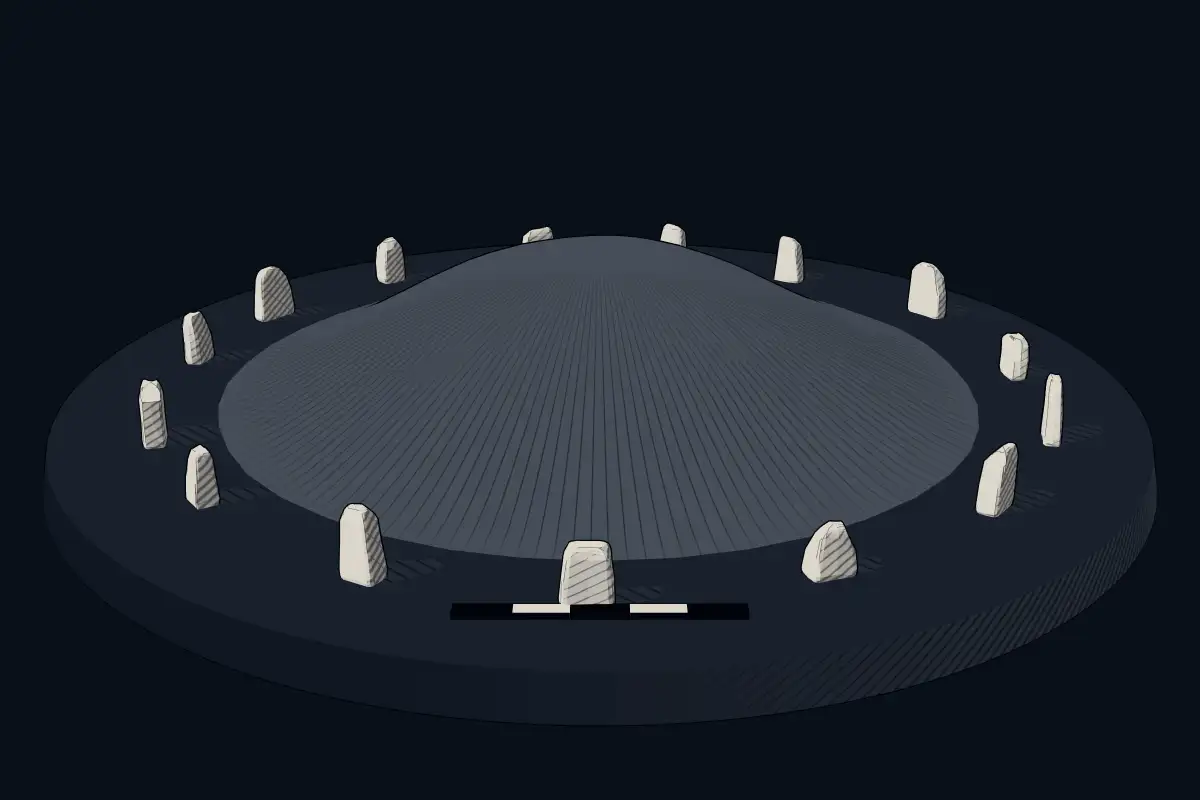
The reconstruction is ours, not a survey: it shows what a monument of this type looks like, at the size the record gives for this one.
Photographs
1 photograph, each with its author and licence
Lore
Evidence & Lore
What the sources actually support — and, kept apart, what has been claimed.
What the evidence supports
Dates
3050–2950 BCEHow this date was established: Stated by the sourceThe source places its construction around 3000 BC during the Neolithic. The source gives one year, so it is shown as a 100-year window (D-08).Source for this date
Measured facts
- Mainstream position
- The mainstream account identifies Heapstown as a Neolithic cairn built around 3000 BC and probably covering a passage tomb.Source: Mainstream position
- Location
- County Sligo, IrelandSource: Location
- Heritage designation
- National Monument of IrelandSource: Heritage designation
- Monument type
- Large ancient cairn believed to cover a passage tombSource: Monument type
- Nearby cemetery
- Carrowkeel Megalithic CemeterySource: Nearby cemetery
- Irish name
- Carn OchtriallachSource: Irish name
- Stone removal
- Much stone was removed for road building before 1878Source: Stone removal
Alternative claims
Alternative claims about this site, kept in their own block and labelled with where they stand.
The cairn's name and construction are linked to Ochtriallach, who proposed filling the Well of Sláine with stones.
The cairn was the burial mound of prince Ailill mac Echach Mugmedóin.
UntestedSource for this claim: The cairn was the burial mound of prince Ailill mac Echach Mugmedóin.
Where it stands
Ireland
The pin marks the monument itself — its exact point.
- Coordinates
- 54°05′42″ N, 8°20′55″ WFor a GPS or map app: 54.09503, -8.34850
Access is as our sources describe it; we have not visited the site to check.
Nearby
The closest sites in the Atlas, by straight line.
 Carrickglass Dolmen4000–3000 BCE
- Court tomb (court cairn)Moytirra East Court Tomb3750–2900 BCE
 Carrowkeel Megalithic Cemetery2578–2477 BCE
- Megalithic mound (tumulus with integral stones)Keshcorran Cairn3700–2900 BCE
- Court tomb (court cairn)Carricknagat Megalithic Tombs3750–2900 BCE
 Giant's grave4000–3000 BCE
 Drumanone4000–3000 BCE
 Cloghagadaide


Sources
Every record behind this page, with the link it came from.
2 sources behind this page
- 01Wikidata Q1592353wikidata.org
- 02Wikipedia (en)en.wikipedia.org
Image files
- Heapstown Co. Sligo 2019.jpgWanfried-DublinCC BY-SA 4.0
Report a correctionWrong date, name, photograph or source? Tell us and it will be put right.
Lore, kept apart
Legends and claims
These are stories and claims reported by the sources. They are not evidence, and they never stand in for the dating above.
- Tradition
Heapstown Cairn is thought to have been built c.
Heapstown Cairn is thought to have been built c. 3000 BC, during the Neolithic era, and is believed to enclose a passage grave like those at the Carrowkeel Megalithic Cemetery, 5 km (3.1 mi) SSE of Heapstown. One account of the cairn's construction is given in the medieval tale of the Second Battle of Moytura. Dian Cecht, healer of the divine Tuatha Dé Danann, puts healing herbs into the Well of Sláine, and the Tuatha Dé Danann drink from it. The Fomorians, on a suggestion from the warrior Ochtriallach, fill the well with stones to keep their enemies from using it. Thus it is known as Carn Ochtriallach "Ochtriallach's cairn". In another medieval tale, it was the burial mound of prince Ailill mac Echach Mugmedóin, brother of Niall of the Nine Hostages. In 1837, when it was illustrated by George Petrie, it stood to its full height and had a standing stone on top. However, much of the stone was removed for road-building by the time it was illustrated by William Wakeman in 1878.
Source - Tested: not supported
The cairn's name and construction are linked to Ochtriallach, who proposed filling the Well of Sláine with stones.
Source - Tested: not supported
The cairn was the burial mound of prince Ailill mac Echach Mugmedóin.
Source
Around this place
The ten nearest sites, by compass
Credit
Text, licence and sources
Text from the Wikipedia article "Heapstown Cairn" (English), licensed CC BY-SA 4.0; authors are listed in the page history. Reused under CC BY-SA 4.0. Read on Wikipedia · Edit history and authors
- Wikipedia (English): Heapstown CairnCC BY-SA 4.0
- Wikidata Q1592353CC0