Megalithic mound (tumulus with integral stones)
Keshcorran Cairn
DatedEst. 3700–2900 BCE
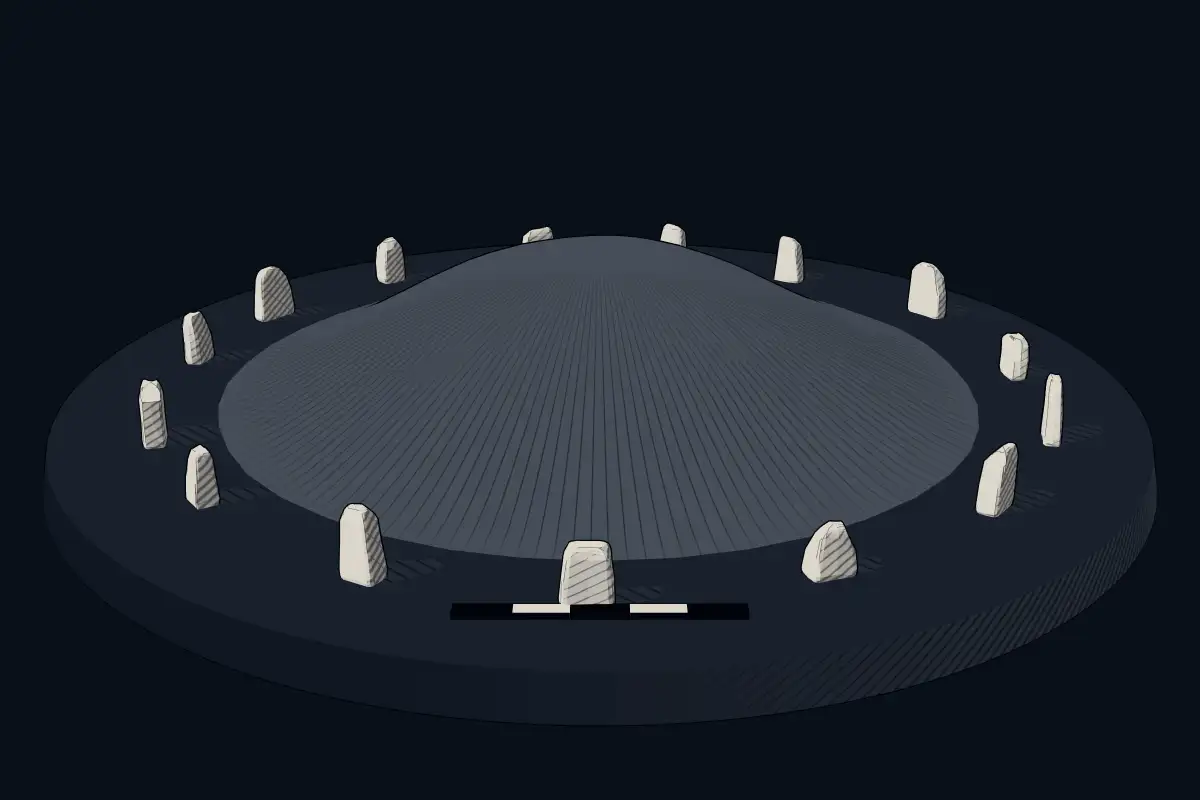
No licensed photograph yetWe have no photograph we may publish for this site, so the interpretive 3D view leads instead.
Overview
About this site
What the sources say
Der 359 m hoch gelegene Kesh Corran Cairn (auch Keshcorran; irisch Céis Chorainn) liegt in den Bricklieve Mountains unweit von Keash, Carrowkeel und Ballymote im County Sligo in Irland.
Article in GermanRead on Wikipedia3 min readCC BY-SA 4.0
Where it sits in time
The site's dated range, placed against world reference points.
The scale is logarithmic: each step to the left is about ten times older than the last.
The full article
Keshcorran Cairn: the whole story
In briefSources for this section
- Wikipedia (German): Kesh Corran CairnCC BY-SA 4.0
Sources for this section
- Wikipedia (German): Kesh Corran CairnCC BY-SA 4.0
Kesh Corran Cairn, also called Keshcorran or Céis Chorainn, is a megalithic mound in the Bricklieve Mountains, near Keash, Carrowkeel and Ballymote in County Sligo, Ireland. It stands at 359 m and is known locally as “The Pinnacle.”
The mound is over 5 m high and about 30 m across. It sits on a platform at the northern end of an oval enclosure measuring 206 × 168 m. A smaller D-shaped enclosure at the southern end contains the remains of a small hut. The cairn is covered with vegetation and probably contains a passage tomb.
It belongs to a group of large late Neolithic and early Bronze Age cairns in County Sligo that includes Heapstown and the cairn on Knocknarea. A typological estimate dates Kesh Corran Cairn to 3700 BCE to 2900 BCE. Nearby stone cists, another cairn with a stone cist, a possible hut complex, a large double-banked enclosure, a massive “megalithic” wall structure and a Wedge Tomb suggest a ritual complex.
For people in Keash, the site is the setting for an annual festival on the last Sunday in July. These “Garland-” or “Reek-Sunday” events continue the celebrations of the Celtic Lughnasa. Monuments of this kind in Ireland are often conspicuous hilltop cairns, although many have not been excavated and are dated by comparison with excavated passage tombs.
No English Wikipedia article exists for it; the full text below is the German article "Kesh Corran Cairn", shown in the original language.
Summary in EnglishSources for this section
- Wikipedia (German): Kesh Corran CairnCC BY-SA 4.0
Sources for this section
- Wikipedia (German): Kesh Corran CairnCC BY-SA 4.0
Keshcorran Cairn is a megalithic mound (tumulus with integral stones) in Ireland. A typological estimate: 3700 BCE to 2900 BCE. No English Wikipedia article exists for it; the full text below is the German article "Kesh Corran Cairn", shown in the original language.
BeschreibungSources for this section
- Wikipedia (German): Kesh Corran CairnCC BY-SA 4.0
Sources for this section
- Wikipedia (German): Kesh Corran CairnCC BY-SA 4.0
Der Cairn (lokal „The Pinnacle“ genannt), gehört zu einer Gruppe großer spätneolitisch-frühbronzezeitlicher Cairns im County Sligo, zu denen u. a. der nahe Heapstown und der Cairn auf dem Knocknarea gehört. Der Kesh Corran Cairn liegt auf dem Gipfel, was selten ist. Der Keshcorran ist über 5 m hoch und besitzt einen Durchmesser von etwa 30 m. Er befindet sich auf einer Plattform am nördlichen Ende einer ovalen Einhegung von 206 × 168 m mit einer kleineren D-förmigen Einhegung am südlichen Ende, in der sich ein kleineres Hüttenfundament enthalten hat. Der Cairn birgt wahrscheinlich ein Passage tomb und ist von Vegetation bedeckt. Dies steht in Gegensatz zu den in Sichtweite liegenden Cairns von Carrowkeel.
Zwei Steinkisten, ein Cairn mit einer Steinkiste, ein möglicher Hüttenkomplex, eine große doppeltumwallte Einhegung, eine massive „megalithische“ Mauerstruktur und ein Wedge Tomb in der Nähe, deuten auf einen Ritualkomplex.
Für die Einheimischen der Ortschaft Keash ist der Platz die Bühne für das jährliche Festival am letzten Sonntag im Juli. Diese „Garland-“ oder „Reek-Sonntag“-Veranstaltungen sind die Fortsetzung der Feierlichkeiten zum keltischen Lughnasa.
How this page was madeSources for this section
- Wikipedia (German): Kesh Corran CairnCC BY-SA 4.0
Sources for this section
- Wikipedia (German): Kesh Corran CairnCC BY-SA 4.0
The summary at the top of this page was written by MiniMax-M3 (2026-11-08) from the cited Wikipedia article “Kesh Corran Cairn”, translated from German. The numbers in it were checked automatically against the source text. The rest of the page is the article itself, the structured records and computed distances.
Tradition and region
About this kind of monument
Irish cairns and barrows
Ireland's hilltop cairns are among its most conspicuous monuments. Many of the great cairns are Neolithic passage tombs, built around 3000 BCE on hilltops: Heapstown Cairn in County Sligo is believed to cover a passage tomb and sits near the Carrowkeel cemetery, and Queen Maeve's Cairn on the summit of Knocknarea, about 55 metres across and 10 metres high, is the largest cairn in Ireland outside Brú na Bóinne. The latter has not been excavated, but its flat top and kerbstones are typical of a passage tomb.
Many cairns have not been excavated, and the large ones are dated by comparison with excavated passage tombs.
Folklore is rich. Medieval tales say that Heapstown Cairn is Carn Ochtriallach, built when the Fomorians filled a well of healing with stones in the story of the Second Battle of Moytura, and another tale makes it the burial mound of the prince Ailill. Knocknarea is Miosgán Meadhbha, Meadhbh's heap. In Ireland it is traditional to carry a stone up from the bottom of a hill to add to a cairn, and a Scottish Gaelic blessing says "I'll put a stone on your cairn". These are traditions, not evidence of who is buried.
When visiting, look for cairns on summits, for kerbstones at the base, and for the dip left by antiquarian digging. Visitor erosion of Maeve's Cairn has caused concern, so please keep to the paths.
Paraphrased from Wikipedia: Cairn, Wikipedia: Heapstown Cairn, Wikipedia: Knocknarea, Wikipedia: Mound of the Hostages, Wikipedia: Tumulus · CC BY-SA 4.0
See it in 3D
An interpretive reconstruction of the monument, standing on the real ground at its exact point, under the sun for that place and season. Drag to look around it.
The reconstruction is ours, not a survey: it shows what a monument of this type looks like, at the size the record gives for this one.
Lore
Evidence & Lore
What the sources actually support — and, kept apart, what has been claimed.
What the evidence supports
Dates
Est. 3700–2900 BCEHow this date was established: Type comparisonTypical range for megalithic mounds in Ireland; this site has not been dated itself. Megalithic construction in Ireland is placed at c. 3700 BC (Knockiveagh) and c. 3400 BC at Newgrange; court cairns continued to be built and enlarged until 2900 BC.Source for this date
Where it stands
Ireland
The pin marks the monument itself — its exact point.
- Coordinates
- 54°03′44″ N, 8°26′19″ WFor a GPS or map app: 54.06208, -8.43863
Access is as our sources describe it; we have not visited the site to check.
Nearby
The closest sites in the Atlas, by straight line.


Sources
Every record behind this page, with the link it came from.
2 sources behind this page
- 01Wikidata Q17576792wikidata.org
- 02Source for this dateen.wikipedia.org
Report a correctionWrong date, name, photograph or source? Tell us and it will be put right.
Around this place
The ten nearest sites, by compass
Credit
Text, licence and sources
Text from the Wikipedia article "Kesh Corran Cairn" (German), licensed CC BY-SA 4.0; authors are listed in the page history. Reused under CC BY-SA 4.0. Read on Wikipedia · Edit history and authors
- Wikipedia (German): Kesh Corran CairnCC BY-SA 4.0
- Wikidata Q17576792CC0