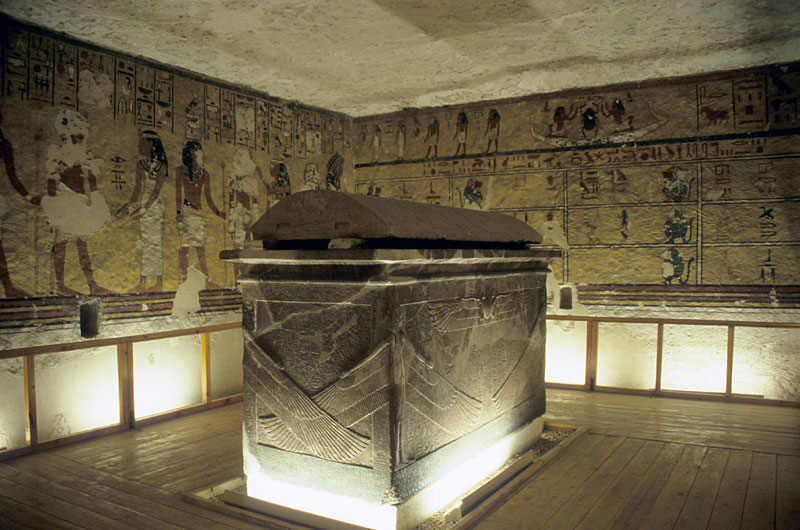
WV23
Also known asKV23
DatedEst. 1539–1075 BCE
Photo Roland Unger · CC BY-SA 3.0Source file on Wikimedia Commons
Overview
About this site
What the sources say
Tomb WV23, also known as KV23, was the burial place of Ay, a pharaoh of the Eighteenth Dynasty, in the Western Valley of the Kings near modern-day Luxor. The tomb was discovered in 1816 by Giovanni Belzoni. Its architecture is similar to the royal tomb of Akhenaten at Amarna, with a straight descending corridor leading to a "well chamber" that has no shaft. This leads to the burial chamber, which contains the reconstructed sarcophagus, which was smashed in antiquity. The tomb was anciently desecrated, with many instances of Ay's image or name erased from the wall paintings. Its decoration is similar in content and colour to that of the tomb of Tutankhamun (KV62), with a few differences. On the eastern wall there is a depiction of a fishing and fowling scene, which is not shown in other royal tombs, normally appearing in burials of nobility.
Read on Wikipedia10 min readCC BY-SA 4.0
Where it sits in time
The site's dated range, placed against world reference points.
The scale is logarithmic: each step to the left is about ten times older than the last.
The full article
WV23: the whole story
In briefSources for this section
- Wikipedia (English): WV23CC BY-SA 4.0
Sources for this section
- Wikipedia (English): WV23CC BY-SA 4.0
Tomb WV23, also known as KV23, was the burial place of Ay, a pharaoh of the Eighteenth Dynasty, in the Western Valley of the Kings near modern-day Luxor. Ay ruled during the late Eighteenth Dynasty of the New Kingdom. He had been a vizier under Tutankhamun and later succeeded him as king. He was likely an old man when he took the throne and ruled for only four years. The tomb is thought to have been originally intended for Tutankhamun.
The tomb consists of an entrance stair, two sloping corridors separated by a set of stairs, and three chambers. Its plan is more similar to the royal tomb of Akhenaten at Amarna than to any earlier royal tomb: it has a straight axis, a well chamber with no well, and a pillared hall used as the burial chamber, which sits offset to one side of the axis. Beyond it is a small undecorated canopic chamber. The corridors are wider than those of the earlier WV22.
Only the burial chamber is decorated, as was standard for the time. The scheme is similar in content and colour to that of the tomb of Tutankhamun (KV62), with a few differences. On the eastern wall is a fishing and fowling scene, which is not shown in other royal tombs and normally appears in the burials of nobility.
Ay's burial seems to have been a relatively modest affair. No trace was found of the canopic chest or its shrine, of faience or stone ushabti, or of gilded burial shrines. The tomb was anciently desecrated, probably in a sanctioned attack in the reigns of his successor Horemheb or the early Ramesside pharaohs. The sarcophagus was smashed, the names and images of Ay and Tey were erased, and the valuables were thoroughly looted. The red granite sarcophagus lid, decorated with two pairs of wedjat-eyes flanking a central column of text, was found intact, lying upside down against the east wall. Egyptologist Otto Schaden suggests it may never have been placed on the box.
Giovanni Belzoni found the tomb by chance in 1816, after probing a pile of stones with his cane and discovering a void beneath. Within two hours the entrance had been cleared. John Gardiner Wilkinson visited in 1835 and Karl Richard Lepsius in 1845, who noted that Ay's name was studiously erased almost everywhere. The sarcophagus was deliberately damaged in the late nineteenth century, moved to the Egyptian Museum in Cairo, and returned to the tomb in the early 1980s. In 1972 the tomb was fully excavated and cleared by the University of Minnesota Egyptian Expedition.
History and datingSources for this section
- Wikipedia (English): WV23CC BY-SA 4.0
Sources for this section
- Wikipedia (English): WV23CC BY-SA 4.0
Burial
Ay ruled as pharaoh during the late Eighteenth Dynasty of the New Kingdom. He was a vizier under Tutankhamun, and later succeeded him as king. Ay was likely an old man when he became king and only ruled for four years. He was buried in WV23, a tomb in the Western Valley of the Kings thought to have been originally intended for Tutankhamun.
Ay's burial was a relatively modest affair as no trace was found of the canopic chest or its shrine, nor were any trace of faience or stone ushabti; also absent was any sign of the gilded burial shrines that presumably surrounded the sarcophagus. The Egyptologist Otto Schaden suggests that they may have been entirely removed or never placed in the tomb. The sarcophagus lid may never have been placed on the box. Instead, the sarcophagus may have been covered with a pall covered in gilded copper rosettes, as was found in the tomb of Tutankhamun.
Ay's burial was likely vandalised in a sanctioned attack in the reigns of his successor Horemheb or the early Ramesside pharaohs, though Horemheb's treatment of Ay's monuments makes him the most likely culprit. At this time the sarcophagus was smashed, the names and images of Ay and Tey removed, and all the valuables thoroughly looted. The contents of KV58 likely originated from WV23, as Ay's name occurs more frequently than that of Tutankhamun. They were either deposited there by robbers, or purposefully during the dismantling of the royal burials. Nicholas Reeves and Richard Wilkinson see this as support of the theory that the body of Ay was cached in KV57, the tomb of Horemheb, at that time. Schaden considers that the body of Ay may be the rewrapped "yellow skeleton" interred with later mummies in WV25.
Discovery
In 1816, WV23 was discovered by chance by the Italian explorer Giovanni Belzoni. After visiting WV22, the tomb of Amenhotep III, he moved further into the valley "to examine the various places where water descends from the desert into the valleys after rain" and upon finding an isolated pile of stones, probed the depth with his cane. Finding that there was a deep void under the rocks, he hired workmen and returned the following day. The tomb proved to be just below the surface, and within two hours the entrance had been cleared. Belzoni considered the tomb a modest find:
I cannot boast of having made a great discovery in this tomb, though it contains several curious and singular painted figures on the walls; and from its extent, and part of a sarcophagus remaining in the centre of a large chamber, have reason to suppose, that it was the burial-place of some person of distinction.
Later visitors
The tomb was visited by the early Egyptologist John Gardiner Wilkinson, who noted in his 1835 publication that the tomb "contains a broken sarcophagus and some bad fresco painting of peculiarly short and graceless proportions." Karl Richard Lepsius visited the tomb in 1845 and noted too the destroyed sarcophagus and commented that Ay's name was "everywhere studiously erased, with the exception of a few traces on the walls, as well as upon the sarcophagus." He also copied some of the wall paintings and made notes regarding the sarcophagus box. The sarcophagus, which had been damaged in antiquity not long after the burial of Ay, was deliberately damaged in the late nineteenth century and was subsequently moved to Egyptian Museum in Cairo before being returned to the tomb in the early 1980s.
Excavation and contents
In 1972 the tomb was fully excavated and cleared by the University of Minnesota Egyptian Expedition (UMEE). Excavation began immediately outside the tomb in an attempt to locate foundation deposits in the hope that they would shed light on the theory proposed by Reginald Engelbach that the tomb was begun for Tutankhamun; despite an extensive search, none were discovered. It was found that the drystone wall on the northern side of the entrance, thought to be a later addition, proved to be contemporary with the tomb's construction as it served the very real purpose of retaining quarried limestone chippings. Schaden stated that its removal prompted "a mass of limestone dust and chips [to] literally flow down the stairs towards the door of the tomb."
Finds in the first corridor proved to be a mix of ancient and modern; the ancient finds consisted of a cornice from a small shrine or box, a small wooden beard, pieces of gold foil, and a fragmentary hieratic ostracon. The second set of stairs proved to be relatively free of debris but were in such poor condition that they were partially rebuilt with cement for safety. Darkened layers of fill at the far end of the second corridor indicated periods of flooding, although some thin smudges may suggest the presence of decayed wood. The second corridor contained a wooden hand from a statuette, and five discs of gilded copper embossed with rosette and star patterns crumpled into a ball. The doorway between the second corridor and the well-chamber was sealed in antiquity, as parts of the blocking were found there. The well chamber contained fill 119 centimetres (47 in) deep by the doorway, and yielded another gilded copper rosette, half of a human pelvis, another ushabti beard, a wooden leg from a statuette, and some pottery of Roman or Coptic date.
No trace of blocking remained between the well chamber and the burial chamber. Inside the burial chamber the fill was uneven, with a gradual slope away from the door, and a depression in the centre from the removal of the sarcophagus; debris was piled against the walls. Hoping that the area close to the walls remained undisturbed, the centre of the chamber was cleared before excavating along the walls.
Many fragments of the sarcophagus box were encountered, but none of the lid; the lid was instead found intact, lying upside down against the east wall. Made of red granite, it has a vaulted shape with flat sides; the decoration is incised and infilled with green pigment. The top of the lid features two pairs of wedjat-eyes flanking a central column of text. The lid was found in the expected orientation, with the head end aligned to the north. However, the fragments of the sarcophagus found on the floor indicate that the box was oriented in the opposite direction, with the head to the south. The cartouches on the lid are entirely intact and the lid has no significant damage, suggesting that it was not toppled from atop the box. Schaden suggests that the lid may never have been put in place, and was instead left resting against the wall.
One section of alabaster teeth for a couch or bed, presumably Taweret-shaped, were found, indicating that Ay was interred with at least one funerary couch. Other finds included a piece of a coffin, part of a coffin-shaped lid, and the hand of a statuette, all of wood; more parts of a human skeleton were also encountered, along with an inscribed meat jar fragment.
The final chamber contained more fragments of the sarcophagus, further human bones, and the missing part of the meat jar inscription. The meat jar records that it contained "pressed meat for The Bull which was made [or prepared] as cargo for the nšmt-boat" and once formed part of the provisions for Ay's burial.
DescriptionSources for this section
- Wikipedia (English): WV23CC BY-SA 4.0
Sources for this section
- Wikipedia (English): WV23CC BY-SA 4.0
The tomb consists of an entrance stair, two sloping corridors separated by a set of stairs, and three chambers. The plan of the tomb is more similar to the tomb of Akhenaten at Amarna than it is to any earlier royal tomb; it has a straight axis, a well chamber with no well, and a pillared hall which was used as the burial chamber. The burial chamber is also offset to one side of the axis. Beyond the burial chamber is a small undecorated canopic chamber. The tomb is constructed on a large scale, as corridors are wider than those of the earlier WV22. Slots for beams used to lower the sarcophagus in the corridor make a reappearance for the first time since KV20.
DecorationSources for this section
- Wikipedia (English): WV23CC BY-SA 4.0
Sources for this section
- Wikipedia (English): WV23CC BY-SA 4.0
Only the burial chamber is decorated, as was standard for the time. The decorative scheme is similar to that seen in KV62, the tomb of Tutankhamun; several scenes are identical. Both tombs were possibly decorated by the same artists. Figures of the four sons of Horus appear for the first time in a royal tomb, above the doorway to the small canopic chamber. The west wall is decorated with a scene depicting Ay hunting in the marshes accompanied by his wife Tey; this is a unique occurrence for a New Kingdom royal tomb. All images of Ay, as well as Tey, were thoroughly defaced, along with the removal of the cartouches of both Ay and Tey. Only a figure of the king's ka escaped erasure, possibly due to the figure bearing a slightly different title.
How this page was madeSources for this section
- Wikipedia (English): WV23CC BY-SA 4.0
Sources for this section
- Wikipedia (English): WV23CC BY-SA 4.0
The summary at the top of this page was written by Claude Sonnet 5.5 (2026-11-06) from the cited Wikipedia article “WV23”. The numbers in it were checked automatically against the source text. The rest of the page is the article itself, the structured records and computed distances.
Tradition and region
About this kind of monument
Rock-cut tombs of Egypt
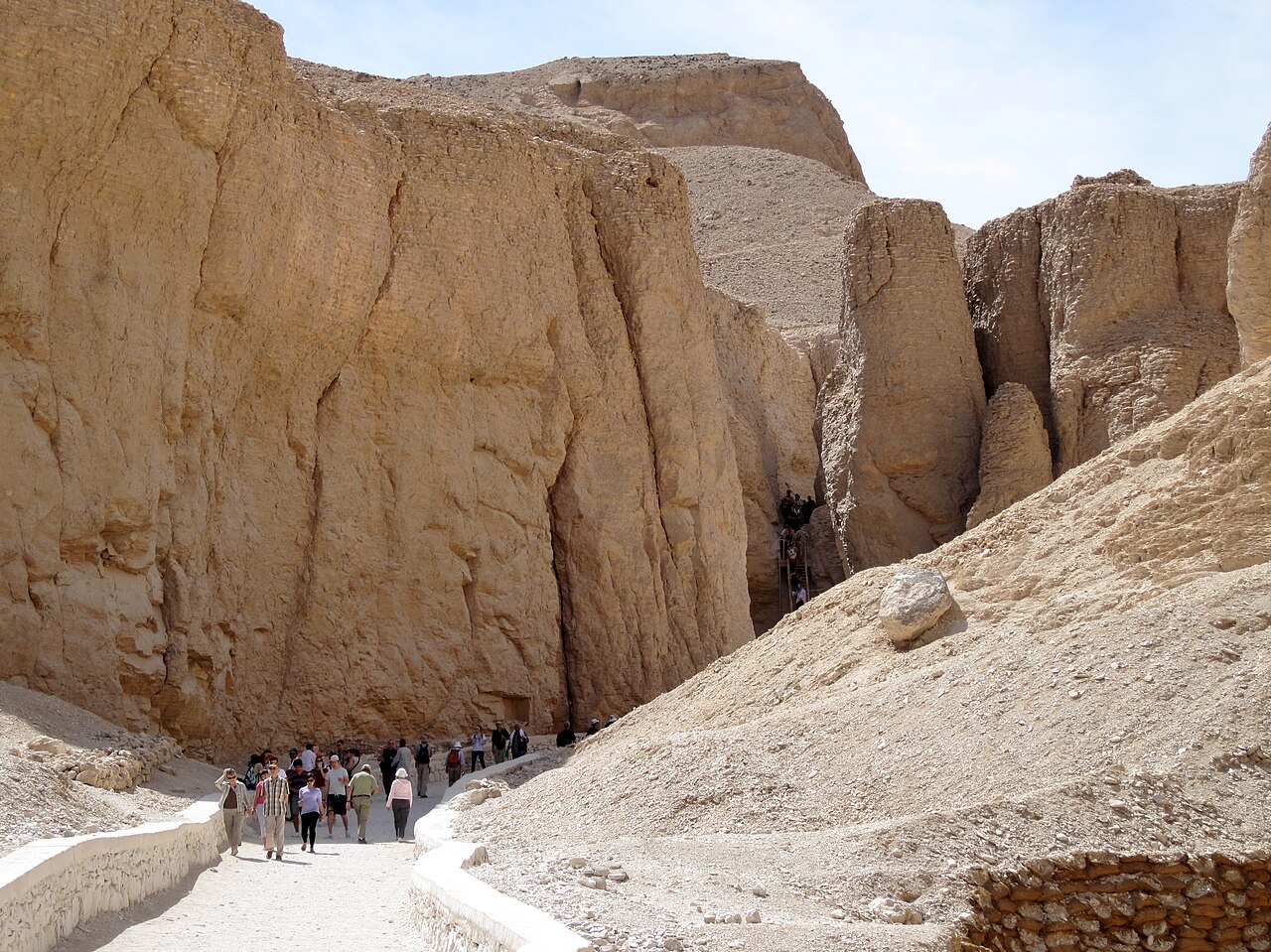
Egypt has some of the best-known rock-cut tombs in the world. In the Valley of the Kings, on the west bank of the Nile opposite Thebes, tombs were excavated for pharaohs and powerful nobles of the New Kingdom, for a period of nearly 500 years from the Eighteenth to the Twentieth Dynasty. The valley has two main sections, the East Valley where most royal tombs lie and the West Valley, known as the Valley of the Monkeys, and it is known to contain 65 tombs and chambers. It gained great attention after the discovery of the tomb of Tutankhamun in 1922, and became a UNESCO World Heritage Site in 1979 with the rest of the Theban Necropolis.
Much earlier, Beni Hasan in Middle Egypt is an ancient funerary site cut into the limestone cliffs on the east bank of the Nile about 20 kilometres south of Minya. In the Middle Kingdom it was the principal cemetery of the sixteenth nome of Upper Egypt, the Oryx nome, and its monumental tombs were cut roughly halfway up the cliff, overlooking the valley. Rock-cut tombs are also found at Deir el-Medina, between the Valley of the Kings and the Valley of the Queens.
The mastaba is a different tradition: a flat-roofed rectangular tomb with sloping sides, built of mudbrick or limestone, which marked the burial sites of eminent Egyptians in the Early Dynastic Period and Old Kingdom. The mastaba was built above ground and the rock-cut tomb into the cliff.
Egyptian tombs are among the best dated monuments in the Atlas, because the dynasty or reign of the king or noble who owned them is known.
When visiting, remember that access to many tombs is limited.
Paraphrased from Wikipedia: Valley of the Kings, Wikipedia: Beni Hasan, Wikipedia: Rock-cut tomb, Wikipedia: Mastaba · CC BY-SA 4.0
From the article
Dated moments in the story
- 1816
The tomb was discovered in 1816 by Giovanni Belzoni.
Source - 1816
Schaden considers that the body of Ay may be the rewrapped "yellow skeleton" interred with later mummies in WV25. In 1816, WV23 was discovered by chance by the Italian explorer Giovanni Belzoni.
Source - 1972
The sarcophagus, which had been damaged in antiquity not long after the burial of Ay, was deliberately damaged in the late nineteenth century and was subsequently moved to Egyptian Museum in Cairo before being returned to the tomb in the early 1980s. In 1972 the tomb was fully excavated and cleared by the...
Source
Photographs
8 photographs, each with its author and licence
More photographs
Lore
Evidence & Lore
What the sources actually support — and, kept apart, what has been claimed.
What the evidence supports
Dates
Est. 1539–1075 BCEHow this date was established: Type comparisonTypical range for hypogeums in Egypt; this site has not been dated itself. The Valley was used for primary burials from approximately 1539 BC to 1075 BC.Source for this date
Where it stands
Egypt
The pin marks the monument itself — its exact point.
- Coordinates
- 25°45′00″ N, 32°36′51″ EFor a GPS or map app: 25.75000, 32.61430
Access is as our sources describe it; we have not visited the site to check.
Nearby
The closest sites in the Atlas, by straight line.




Sources
Every record behind this page, with the link it came from.
3 sources behind this page
- 01Wikidata Q2706226wikidata.org
- 02Source for this dateen.wikipedia.org
- 03Wikipedia: WV23en.wikipedia.org
Image files
- ThebesKV23Chamber.jpgRoland UngerCC BY-SA 3.0
- Ay Tomb, Valley of the King (52624283772).jpgFabio Achilli from Milano, ItalyCC BY 2.0
- Ay Tomb, Valley of the King (52625229030).jpgFabio Achilli from Milano, ItalyCC BY 2.0
- Painted Hieroglyphs in the Tomb of Ay.jpgFabio AchiliCC BY 2.0
- Painted relief from Ay's WV23 tomb.jpgFabio AchiliCC BY 2.0
- WV23 by Mutnedjmet.jpgkairoinfo4u: MutnedjmetCC BY-SA 2.0
- KV23 Ay.jpgR.F.MorganCC BY-SA 3.0
- ThebesKV23Entrance.jpgRoland UngerCC BY-SA 3.0
Report a correctionWrong date, name, photograph or source? Tell us and it will be put right.
Around this place
The ten nearest sites, by compass
Credit
Text, licence and sources
Text from the Wikipedia article "WV23" (English), licensed CC BY-SA 4.0; authors are listed in the page history. Reused under CC BY-SA 4.0. Read on Wikipedia · Edit history and authors
- Wikipedia (English): WV23CC BY-SA 4.0
- Wikidata Q2706226CC0