Overview
About this site
Overview
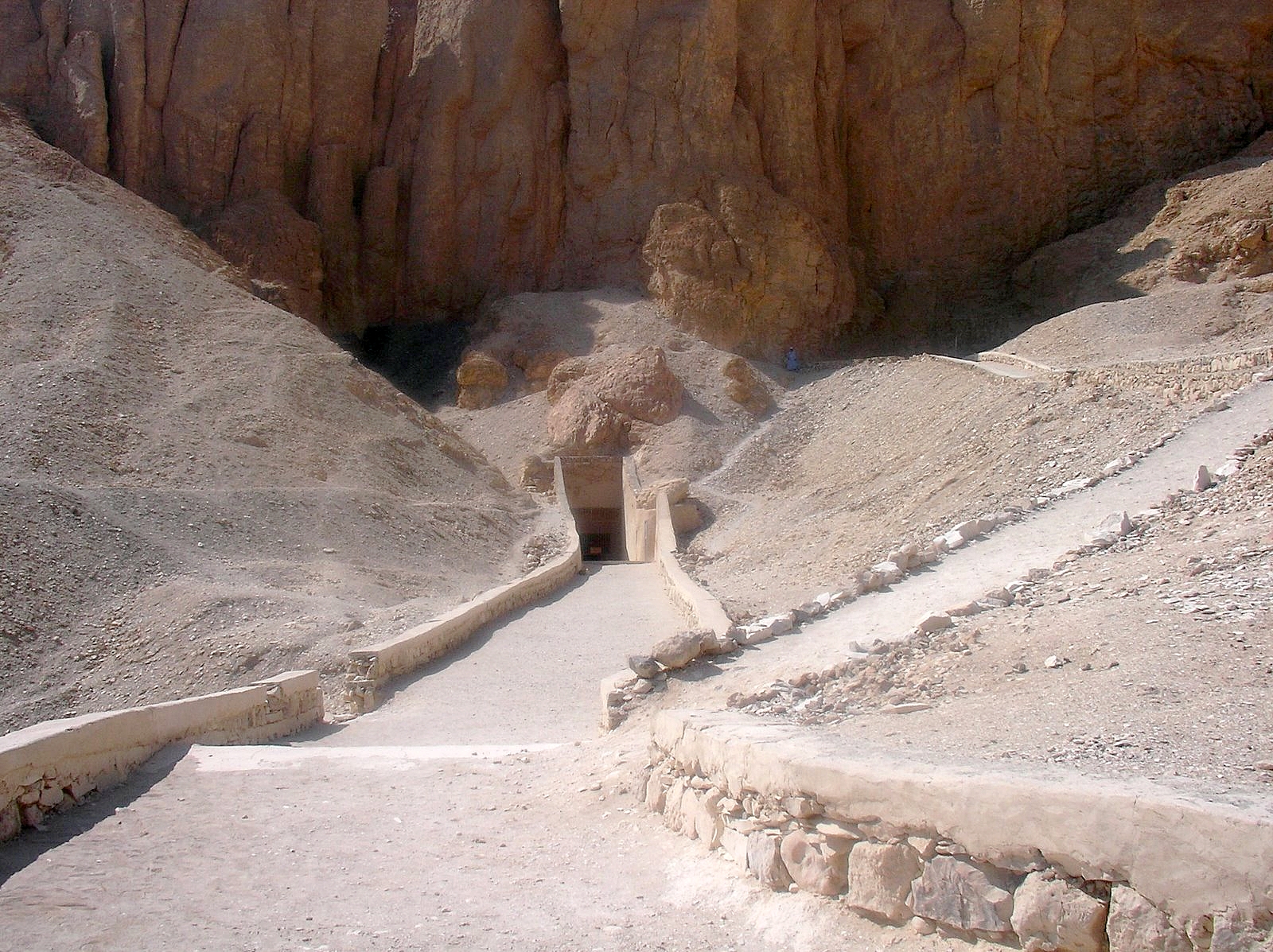
Tomb KV19 is a rock-cut tomb in a side branch of the Valley of the Kings, Egypt. It was intended as the burial place of Prince Ramesses Sethherkhepshef, better known as the pharaoh Ramesses VIII, but was later used instead for the burial of Prince Mentuherkhepshef, a son of Ramesses IX who predeceased his father.
Although the tomb is incomplete and was used as it stood, its decoration is considered to be of the highest quality.
Read on Wikipedia4 min readCC BY-SA 4.0
Where it sits in time
The site's dated range, placed against world reference points.
The scale is logarithmic: each step to the left is about ten times older than the last.
Article
KV19
Its layout is simple, a single corridor; quarrying had barely progressed into a second corridor when work stopped.
DescriptionSources for this section
- Wikipedia (English): KV19CC BY-SA 4.0
Sources for this section
- Wikipedia (English): KV19CC BY-SA 4.0
The tomb lies under the cliffs on the eastern side of the Valley of the Kings, between the tombs of Thutmose IV (KV43) and Hatshepsut (KV20). Its layout is simple, a single corridor; quarrying had barely progressed into a second corridor when work stopped. At the end of the corridor an oblong pit was sunk into the floor to receive the burial, and it was covered with limestone slabs. The quarrying style and projected layout date the tomb to the Twentieth Dynasty. Its location and the size of the corridor suggest that it was initiated for a king, but traces of an original inscription on the door jambs reveal that it was intended for Ramesses VIII when he was a prince.
The exterior surfaces of the tomb are plastered and undecorated. Inside, the door jambs are completely covered by three columns of black hieroglyphs, and below them on each side is a pair of rearing cobras spitting fire. Those on the right side are named as Isis and Nephthys, and those on the left as Serket and Neith. The interior decoration is executed on a fine white plaster background. The two halves of a door are painted on either side of the entrance: the left leaf carries the hieratic text of Chapter 139 of the Book of the Dead, and the right has Chapter 123 with two extra lines. The length of the corridor is painted with seven scenes on each side, and the ceiling is plain white. The paintings are in the finest Ramesside style, and the overall scheme is similar to that seen in the tombs of princes in the Valley of the Queens.
In some places, signs of the change of ownership from Setherkhepeshef (Seth Is with His Strong Arm) to Mentuherkhepeshef (Montu Is with His Strong Arm) can still be seen, as traces of the Seth animal appear underneath the falcon symbol for Montu. Mentuherkhepeshef is shown with the sidelock of youth on his wig, wearing a fine translucent robe. On the left wall he makes offerings to Osiris, Ptah-Tatenen, Khonsemweset-Neferhotep, Bastet, Imseti, Qebehsenuef and Amun-Ra; on the right wall he makes offerings to Ptah, Thoth, Banebdjedet, Hapi, Duamutef, Meretseger and Sekhmet. As an adult son, he appears alone before the gods rather than being escorted by his father.
ExcavationsSources for this section
- Wikipedia (English): KV19CC BY-SA 4.0
Sources for this section
- Wikipedia (English): KV19CC BY-SA 4.0
Giovanni Battista Belzoni rediscovered the tomb on 9 October 1817 and briefly described it, making special mention of the decoration. It was later visited by explorers and researchers including Jean-François Champollion, Karl Richard Lepsius and Eugène Lefébure. In 1903 Howard Carter excavated in front of the tomb and discovered KV60.
Edward R. Ayrton excavated KV19 in 1906. He noted in his report that the tomb had never been fully cleared, and at that time only the porch was visible, the rest being covered by debris. The tomb was found to be half filled with large blocks. Ayrton concluded that they could not have been washed in by accident, since a high drystone wall stood only 3 feet (0.91 m) from the door.
FindsSources for this section
- Wikipedia (English): KV19CC BY-SA 4.0
Sources for this section
- Wikipedia (English): KV19CC BY-SA 4.0
Few portable artefacts were recovered. They comprised ostraca naming Ramesses IV and Ramesses X, faience items inscribed with the name of Ramesses IV from a foundation deposit, and parts of a large stela dedicated by a necropolis workman named Hay. Because part of the stela was recovered from a Coptic midden in front of the tomb of Ramesses IV (KV2), Ayrton theorised that the items from that king's foundation deposit had been moved to KV19 as a result of robber activity.
The burial pit contained broken pottery vessels and the upper part of a mummy, possibly that of Mentuherkhepshef himself. Earlier visitors had found the tomb to contain intrusive burials of a later, Twenty-second Dynasty date. Ayrton also noted numerous graffiti scratched into the walls. One, on the right side, records the name of a hitherto unknown Scribe in the Place of Truth, Ptahemwia. Of two graffiti on the left wall, one names the tomb's owner and the other names the Overseer of the Workshop of the Mansion of Gold, Ser-[Dje]huty.
Tradition and region
About this kind of monument
Rock-cut tombs of Egypt
Egypt has some of the best-known rock-cut tombs in the world. In the Valley of the Kings, on the west bank of the Nile opposite Thebes, tombs were excavated for pharaohs and powerful nobles of the New Kingdom, for a period of nearly 500 years from the Eighteenth to the Twentieth Dynasty. The valley has two main sections, the East Valley where most royal tombs lie and the West Valley, known as the Valley of the Monkeys, and it is known to contain 65 tombs and chambers. It gained great attention after the discovery of the tomb of Tutankhamun in 1922, and became a UNESCO World Heritage Site in 1979 with the rest of the Theban Necropolis.
Much earlier, Beni Hasan in Middle Egypt is an ancient funerary site cut into the limestone cliffs on the east bank of the Nile about 20 kilometres south of Minya. In the Middle Kingdom it was the principal cemetery of the sixteenth nome of Upper Egypt, the Oryx nome, and its monumental tombs were cut roughly halfway up the cliff, overlooking the valley. Rock-cut tombs are also found at Deir el-Medina, between the Valley of the Kings and the Valley of the Queens.
The mastaba is a different tradition: a flat-roofed rectangular tomb with sloping sides, built of mudbrick or limestone, which marked the burial sites of eminent Egyptians in the Early Dynastic Period and Old Kingdom. The mastaba was built above ground and the rock-cut tomb into the cliff.
Egyptian tombs are among the best dated monuments in the Atlas, because the dynasty or reign of the king or noble who owned them is known.
When visiting, remember that access to many tombs is limited.
Paraphrased from Wikipedia: Valley of the Kings, Wikipedia: Beni Hasan, Wikipedia: Rock-cut tomb, Wikipedia: Mastaba · CC BY-SA 4.0
From the article
Dated moments in the story
- 1817
The tomb was rediscovered on 9 October 1817 by Giovanni Battista Belzoni, who briefly described it, making special mention of the decoration: The painted figures on the walls are so perfect, that they are the best adapted of any I ever saw so give a correct and clear idea of the Egyptian taste.
Source - 1903
In 1903 Howard Carter excavated in front of this tomb, discovering KV60. KV19 was excavated by Edward R.
Source - 1906
Ayrton in 1906. He notes in his report that the tomb had never been fully cleared, and resolved to end his 1905–1906 fieldwork season with its excavation.
Source
Photographs
4 photographs, each with its author and licence
More photographs
Lore
Evidence & Lore
What the sources actually support — and, kept apart, what has been claimed.
What the evidence supports
Dates
Est. 3600–2500 BCEHow this date was established: Type comparisonTypological estimate, not a date for this site: a hypogeum in North Africa is normally dated between 3600 BCE and 2500 BCE (Atlas typological table).Source for this date
Measured facts
- Location
- a side branch of the Valley of the KingsSource: Location
- Intended occupant
- Prince Ramesses Sethherkhepshef, better known as Ramesses VIIISource: Intended occupant
- Later occupant
- Prince Mentuherkhepshef, son of Ramesses IXSource: Later occupant
- Rediscovery
- 9 October 1817Source: Rediscovery
- Excavation
- 1906Source: Excavation
- Decorative quality
- considered to be of the highest qualitySource: Decorative quality
- Culture
- Ancient EgyptSource: Culture
- Length
- 38.68 metreSource: Length
Where it stands
Egypt
The pin marks the monument itself — its exact point.
- Coordinates
- 25°45′00″ N, 32°36′51″ EFor a GPS or map app: 25.75000, 32.61430
Access is as our sources describe it; we have not visited the site to check.
Nearby
The closest sites in the Atlas, by straight line.


Sources
Every record behind this page, with the link it came from.
2 sources behind this page
- 01Wikidata Q1719126wikidata.org
- 02Wikipedia (en)en.wikipedia.org
Image files
- Grabeingang-Tal der Könige-Aegypten.jpgHaloorangePublic domain
- Tomb KV19 (Kairoinfo4u).jpgKairoinfo4u photographer: MannaCC BY-SA 2.0
- Banebdjed Tomb KV19.jpgTomb_KV19_(Kairoinfo4u).jpg : Kairoinfo4u photographer: MannaCC BY-SA 2.0
- KV19 Montuherkepeshef.jpgR.F.MorganCC BY-SA 3.0
Report a correctionWrong date, name, photograph or source? Tell us and it will be put right.
Around this place
The ten nearest sites, by compass
Credit
Text, licence and sources
Adapted from the Wikipedia article "KV19" (English), licensed CC BY-SA 4.0; authors are listed in the page history. Reused under CC BY-SA 4.0. Read on Wikipedia · Edit history and authors
- Wikipedia (English): KV19CC BY-SA 4.0
- Wikidata Q1719126CC0