
Overview
About this site
Overview
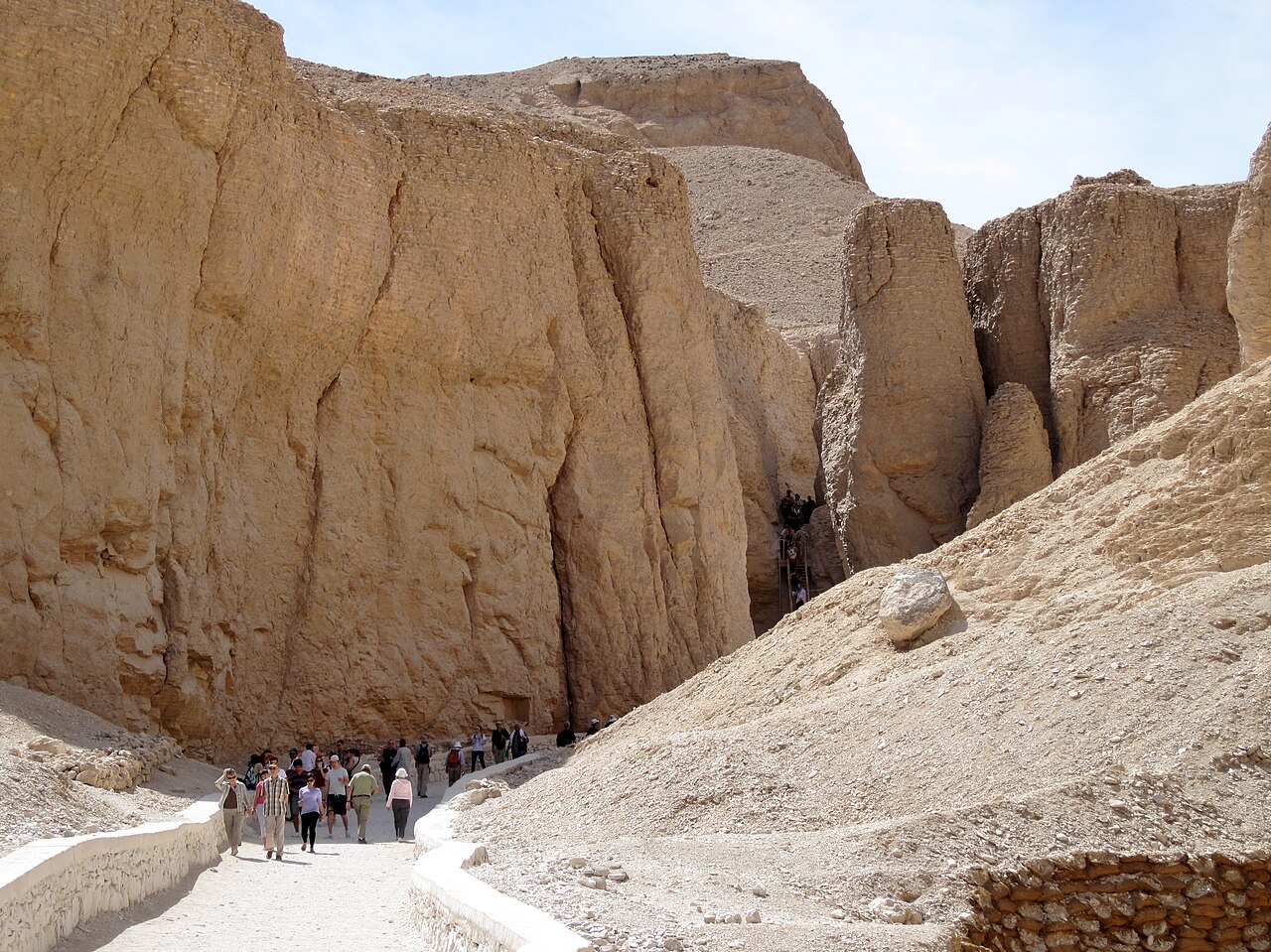
KV15 is a tomb in the Valley of the Kings, Egypt, used for the burial of Pharaoh Seti II of the Nineteenth Dynasty. It was dug into the base of a near-vertical cliff face at the head of a wadi running southwest from the main part of the Valley, and it was left largely unfinished.
Read on Wikipedia3 min readCC BY-SA 4.0
Where it sits in time
The site's dated range, placed against world reference points.
The scale is logarithmic: each step to the left is about ten times older than the last.
Article
KV15
A short entry corridor is followed by three corridor segments, which end in a well room that lacks a well, as the well was never dug.
DescriptionSources for this section
- Wikipedia (English): KV15CC BY-SA 4.0
Sources for this section
- Wikipedia (English): KV15CC BY-SA 4.0
The tomb runs along a northwest-to-southeast axis. A short entry corridor is followed by three corridor segments, which end in a well room that lacks a well, as the well was never dug. This connects with a four-pillared hall and another stretch of corridor that was converted into a burial chamber.
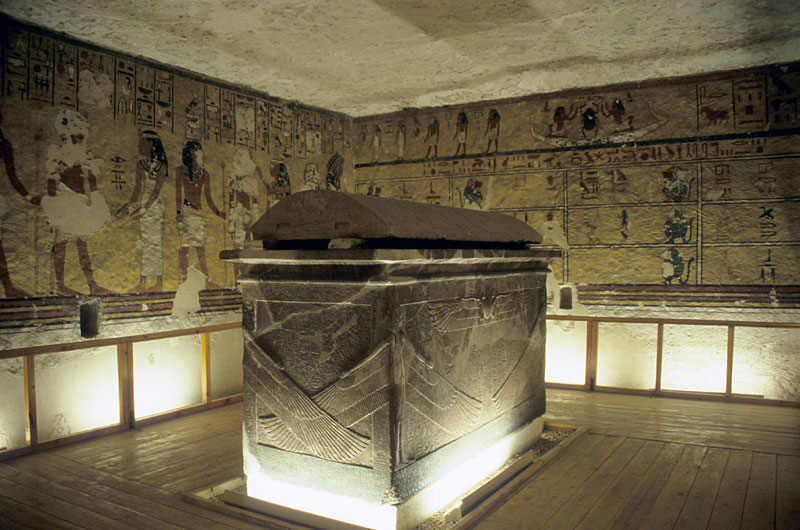
The walls and ceiling of the burial chamber were plastered and painted with Anubis jackals and two rows of deities, representing the followers of Ra and Osiris, above a lower row of mummy-like figures. The winged goddess Nut appears along the length of the ceiling, and what may be a representation of the Ba of Ra is painted above her head. The paintings are conventional depictions drawn from the Litany of Re, the Amduat and the Book of Gates. Wall paintings in the well room are more unusual and show the king in shrines in a number of different manifestations, for instance on the back of a panther or on a papyrus skiff. The objects shown in the paintings are reflected in the finds made in the tomb of Tutankhamun. In places the tomb preserves hastily drawn artists' concepts for future decoration.
HistorySources for this section
- Wikipedia (English): KV15CC BY-SA 4.0
Sources for this section
- Wikipedia (English): KV15CC BY-SA 4.0
Relatively little is known about the history of the tomb. Seti II was buried there, but he may originally have been buried with his wife Tausert in her tomb, KV14, and subsequently moved to the hastily finished but mostly unfinished KV15, perhaps by the later pharaoh Setnakhte, who took over KV14 for his own tomb. Seti's name appears to have been carved, erased and then re-carved. The usurper Amenmesse was likely responsible for the erasures, while Tausert or Seti II's agents may have had the name restored. Seti's mummy was later moved to the mummy cache in tomb KV35, and only the lid of his sarcophagus remains in KV15.
Seti II had only 4 years to complete his royal tomb, since he lost control of Thebes and Upper Egypt to Amenmesse sometime between his 2nd and 5th regnal year, and he is unattested in Upper Egypt during this time. His reign lasted less than 6 regnal years. This accounts for the unfinished state of the tomb.
Research historySources for this section
- Wikipedia (English): KV15CC BY-SA 4.0
Sources for this section
- Wikipedia (English): KV15CC BY-SA 4.0
KV15 is known to have been opened in antiquity, since there are 59 examples of Greek and Latin graffiti on the walls. Richard Pococke investigated it as early as 1738, but it was not until the arrival of Howard Carter in 1903-04 that the tomb was properly cleared. After Carter began to excavate the tomb of Tutankhamun (KV62) in 1922, KV15 was used by his assistants Alfred Lucas and Arthur Mace as a makeshift laboratory for the cleaning and restoration of KV62's artefacts before their transport to the Cairo Museum.
VisitingSources for this section
- Wikipedia (English): KV15CC BY-SA 4.0
Sources for this section
- Wikipedia (English): KV15CC BY-SA 4.0
The tomb is open to tourists, with improved flooring, handrails and lighting.
Tradition and region
About this kind of monument
Rock-cut tombs of Egypt
Egypt has some of the best-known rock-cut tombs in the world. In the Valley of the Kings, on the west bank of the Nile opposite Thebes, tombs were excavated for pharaohs and powerful nobles of the New Kingdom, for a period of nearly 500 years from the Eighteenth to the Twentieth Dynasty. The valley has two main sections, the East Valley where most royal tombs lie and the West Valley, known as the Valley of the Monkeys, and it is known to contain 65 tombs and chambers. It gained great attention after the discovery of the tomb of Tutankhamun in 1922, and became a UNESCO World Heritage Site in 1979 with the rest of the Theban Necropolis.
Much earlier, Beni Hasan in Middle Egypt is an ancient funerary site cut into the limestone cliffs on the east bank of the Nile about 20 kilometres south of Minya. In the Middle Kingdom it was the principal cemetery of the sixteenth nome of Upper Egypt, the Oryx nome, and its monumental tombs were cut roughly halfway up the cliff, overlooking the valley. Rock-cut tombs are also found at Deir el-Medina, between the Valley of the Kings and the Valley of the Queens.
The mastaba is a different tradition: a flat-roofed rectangular tomb with sloping sides, built of mudbrick or limestone, which marked the burial sites of eminent Egyptians in the Early Dynastic Period and Old Kingdom. The mastaba was built above ground and the rock-cut tomb into the cliff.
Egyptian tombs are among the best dated monuments in the Atlas, because the dynasty or reign of the king or noble who owned them is known.
When visiting, remember that access to many tombs is limited.
Paraphrased from Wikipedia: Valley of the Kings, Wikipedia: Beni Hasan, Wikipedia: Rock-cut tomb, Wikipedia: Mastaba · CC BY-SA 4.0
From the article
Dated moments in the story
- 1738
Richard Pococke investigated it as early as 1738, but it was not until the arrival of Howard Carter in 1903–04 that the tomb was properly cleared.
Source - 1922
After Carter began to excavate the nearby tomb of Tutankhamun (KV62) in 1922, KV15 was used by his assistants Alfred Lucas and Arthur Mace as a makeshift laboratory for the cleaning and restoration of KV62's artifacts before their transport to the Cairo Museum.
Source
Photographs
8 photographs, each with its author and licence
More photographs
Lore
Evidence & Lore
What the sources actually support — and, kept apart, what has been claimed.
What the evidence supports
Dates
Est. 1539–1075 BCEHow this date was established: Type comparisonTypical range for hypogeums in Egypt; this site has not been dated itself. The Valley was used for primary burials from approximately 1539 BC to 1075 BC.Source for this date
Where it stands
Egypt
The pin marks the monument itself — its exact point.
- Coordinates
- 25°45′00″ N, 32°36′51″ EFor a GPS or map app: 25.75000, 32.61430
Access is as our sources describe it; we have not visited the site to check.
Nearby
The closest sites in the Atlas, by straight line.






Sources
Every record behind this page, with the link it came from.
3 sources behind this page
- 01Wikidata Q2184354wikidata.org
- 02Source for this dateen.wikipedia.org
- 03Wikipedia: KV15en.wikipedia.org
Image files
- 1197 v. Chr. starb der Pharao Seti II. 01.jpgHolger Uwe SchmittCC BY-SA 4.0
- 1197 v. Chr. starb der Pharao Seti II. 02.jpgHolger Uwe SchmittCC BY-SA 4.0
- KV15 Tomb of Seti II (9794867555).jpgGary Todd from Xinzheng, ChinaCC0
- KV15 Tomb of Seti II (9794913296).jpgGary Todd from Xinzheng, ChinaCC0
- KV15 Tomb of Seti II (9794952553).jpgGary Todd from Xinzheng, ChinaCC0
- KV15 Tomb of Seti II (9794956073).jpgGary Todd from Xinzheng, ChinaCC0
- KV15 Tomb of Seti II (9794870205).jpgGary Todd from Xinzheng, ChinaCC0
- Grabplan Sethos II.jpgOlaf TauschCC BY 3.0
Report a correctionWrong date, name, photograph or source? Tell us and it will be put right.
Around this place
The ten nearest sites, by compass
Credit
Text, licence and sources
Adapted from the Wikipedia article "KV15" (English), licensed CC BY-SA 4.0; authors are listed in the page history. Reused under CC BY-SA 4.0. Read on Wikipedia · Edit history and authors
- Wikipedia (English): KV15CC BY-SA 4.0
- Wikidata Q2184354CC0