
Overview
About this site
What the sources say
The tomb of Amenhotep II, also known by its tomb number, KV35, was the burial place of Amenhotep II, a pharaoh of the 18th Dynasty of Egypt, in the Valley of the Kings in Qena, Egypt. Later, it was used as a cache for other royal mummies. It was discovered by Victor Loret in March 1898.
Read on Wikipedia5 min readCC BY-SA 4.0
Where it sits in time
The site's dated range, placed against world reference points.
The scale is logarithmic: each step to the left is about ten times older than the last.
The full article
KV35: the whole story
In briefSources for this section
- Wikipedia (English): Tomb of Amenhotep IICC BY-SA 4.0
Sources for this section
- Wikipedia (English): Tomb of Amenhotep IICC BY-SA 4.0
The tomb of Amenhotep II, KV35, was the burial place of Amenhotep II, a pharaoh of the 18th Dynasty of Egypt, in the Valley of the Kings. Later it served as a cache for other royal mummies. Victor Loret discovered it in March 1898.
It has the bent dog-leg axis typical of early 18th Dynasty tombs, though several features are unusual. A steep corridor leads down from the entrance past a deep well, intended to throw off tomb robbers, first adapted in the tomb of his father and predecessor Thutmose III and later incorporated in the tombs of other pharaohs. Beyond the well lie a rectangular antechamber and the burial chamber.
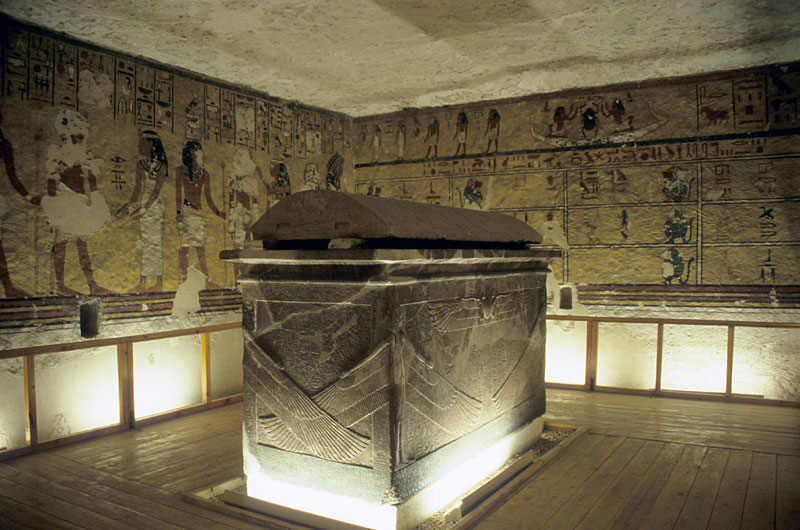
The rectangular burial chamber is divided into upper and lower pillared sections, with the cartouche-shaped royal sarcophagus in the lower part. This style became standard for royal burials in the later New Kingdom. Four smaller side chambers open from it, and one was the burial of his son Webensenu, who died as a child. His canopic jars and shabtis were found there too.
Only the burial chamber is decorated, in a style found elsewhere in the valley only in KV34, the tomb of Thutmose III. On a yellow-tinged background intended to resemble aged papyrus, the Amduat is traced with the deities as simple, almost naive stick figures, with text in the cursive hieroglyphic book hand used more commonly for sacred texts on papyrus.
During the Third Intermediate Period the tomb became a mummy cache, and mummies were identified by inscriptions on their wrappings. Besides Amenhotep II in his original sarcophagus, the side chamber held Thutmose IV, Amenhotep III, Merneptah, Seti II, Siptah, Ramesses IV, Ramesses V and Ramesses VI, and Tiye, identified in February 2010 through DNA testing as the Elder Lady. All the kings' mummies found in KV35 are on display in the Royal Mummies Gallery of the National Museum of Egyptian Civilization in Cairo, moved there in 2021.
History and datingSources for this section
- Wikipedia (English): Tomb of Amenhotep IICC BY-SA 4.0
Sources for this section
- Wikipedia (English): Tomb of Amenhotep IICC BY-SA 4.0
It has a bent dog-leg shape axis, typical of the layout of early 18th Dynasty tombs, but several features make this tomb unusual. First, A steep corridor leads down from the entrance past a deep well. The well, intended to throw off potential tomb robbers, was first adapted in the tomb of Amenhotep II's father and predecessor, Thutmose III, and would also be incorporated to the tombs of later pharaohs. Passing across the well leads to a rectangle antechamber, and beyond it is the burial chamber.
The burial chamber is rectangular and divided into upper and lower pillared sections, with the lower part holding the cartouche-shaped royal sarcophagus of the king. This style of burial chamber became standard for royal burials in the later New Kingdom. In the burial chamber, there stand four smaller side chambers. One of them was used as the burial of his son Webensenu, who died as a child and was buried with him in the tomb. His canopic jars and shabtis were found in the tomb as well.
Only the burial chamber of the tomb is decorated, albeit in an unusual style that, other than KV34 (the tomb of Amenhotep II's father, Thutmose III), is not found elsewhere in the Valley of the Kings. On a yellow-tinged background (intended to resemble aged papyrus), the Amduat is traced, depicting the ancient Egyptian deities as simple (almost naive) stick figures, with text written in the cursive hieroglyphic book hand used more commonly for sacred texts on papyrus.
Later the tomb was used as a mummy cache. Mummies belonging to the following individuals were relocated here during the Third Intermediate Period and were identified by inscriptions on their burial wrappings:
Amenhotep II (the original tomb owner found in his original sarcophagus)
Side Chamber:
Thutmose IV
Amenhotep III
Merneptah
Seti II
Siptah
Ramesses IV
Ramesses V
Ramesses VI
Tiye, who was identified as the so-called Elder Lady in February 2010 via DNA testing.
A prince, identified by some as Webensenu, son of Amenhotep II, whose canopic jars were found in the tomb, or Thutmose, the elder son of Amenhotep III and Tiye
The Younger Lady who, in June 2003, was controversially claimed to be Nefertiti by British Egyptologist Joann Fletcher, whereas Egyptologist Zahi Hawass believed it to be Kiya, another wife of Amenhotep IV who is thought by some to be the birth mother of Tutankhamun. Some believed this mummy to be a male. However, with DNA testing, this mummy was shown in February 2010 to be a woman, the mother of Tutankhamun, and the daughter of Amenhotep III and Tiye (making her both the sister and wife of Akhenaten). Her name, however, remains unknown, leaving open the possibility that she is likely either Nebetiah or Beketaten.
An "unknown woman D" in an upturned lid of a coffin inscribed for Setnakhte (may be queen Tausret).
A body on a boat that was later stolen or destroyed at the start of the twentieth century (may be Setnakhte).
Two skulls were found in the well and an anonymous arm was found with the above "Younger Lady."
All the kings' mummies discovered in KV35, and the "Elder Lady" (labelled as Queen Tiye), are on display at the Royal Mummies Gallery of the National Museum of Egyptian Civilization in Cairo, having been moved there in 2021 during the Pharaohs' Golden Parade.
How this page was madeSources for this section
- Wikipedia (English): Tomb of Amenhotep IICC BY-SA 4.0
Sources for this section
- Wikipedia (English): Tomb of Amenhotep IICC BY-SA 4.0
The summary at the top of this page was written by Claude Sonnet 5.5 (2026-11-06) from the cited Wikipedia article “Tomb of Amenhotep II”. The numbers in it were checked automatically against the source text. The rest of the page is the article itself, the structured records and computed distances.
Tradition and region
About this kind of monument
Rock-cut tombs of Egypt
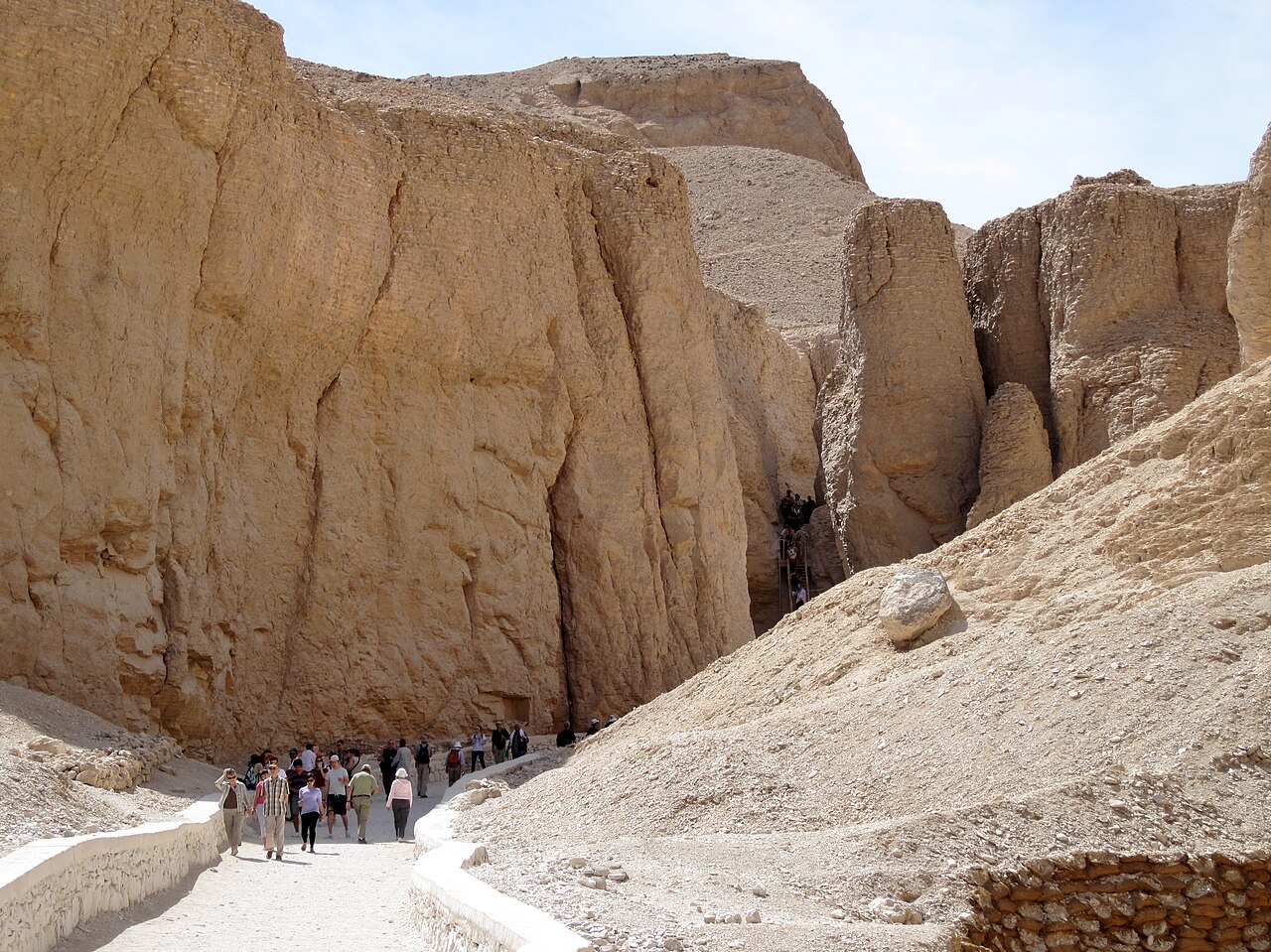
Egypt has some of the best-known rock-cut tombs in the world. In the Valley of the Kings, on the west bank of the Nile opposite Thebes, tombs were excavated for pharaohs and powerful nobles of the New Kingdom, for a period of nearly 500 years from the Eighteenth to the Twentieth Dynasty. The valley has two main sections, the East Valley where most royal tombs lie and the West Valley, known as the Valley of the Monkeys, and it is known to contain 65 tombs and chambers. It gained great attention after the discovery of the tomb of Tutankhamun in 1922, and became a UNESCO World Heritage Site in 1979 with the rest of the Theban Necropolis.
Much earlier, Beni Hasan in Middle Egypt is an ancient funerary site cut into the limestone cliffs on the east bank of the Nile about 20 kilometres south of Minya. In the Middle Kingdom it was the principal cemetery of the sixteenth nome of Upper Egypt, the Oryx nome, and its monumental tombs were cut roughly halfway up the cliff, overlooking the valley. Rock-cut tombs are also found at Deir el-Medina, between the Valley of the Kings and the Valley of the Queens.
The mastaba is a different tradition: a flat-roofed rectangular tomb with sloping sides, built of mudbrick or limestone, which marked the burial sites of eminent Egyptians in the Early Dynastic Period and Old Kingdom. The mastaba was built above ground and the rock-cut tomb into the cliff.
Egyptian tombs are among the best dated monuments in the Atlas, because the dynasty or reign of the king or noble who owned them is known.
When visiting, remember that access to many tombs is limited.
Paraphrased from Wikipedia: Valley of the Kings, Wikipedia: Beni Hasan, Wikipedia: Rock-cut tomb, Wikipedia: Mastaba · CC BY-SA 4.0
From the article
Dated moments in the story
- 1898
It was discovered by Victor Loret in March 1898.
Source - 2010
However, with DNA testing, this mummy was shown in February 2010 to be a woman, the mother of Tutankhamun, and the daughter of Amenhotep III and Tiye (making her both the sister and wife of Akhenaten).
Source - 2021
Two skulls were found in the well and an anonymous arm was found with the above "Younger Lady." All the kings' mummies discovered in KV35, and the "Elder Lady" (labelled as Queen Tiye), are on display at the Royal Mummies Gallery of the National Museum of Egyptian Civilization in Cairo, having been moved there in...
Source
Photographs
7 photographs, each with its author and licence
More photographs
Lore
Evidence & Lore
What the sources actually support — and, kept apart, what has been claimed.
What the evidence supports
Dates
Est. 3600–2500 BCEHow this date was established: Type comparisonTypological estimate, not a date for this site: a hypogeum in North Africa is normally dated between 3600 BCE and 2500 BCE (Atlas typological table).Source for this date
Measured facts
- Mainstream position
- DNA testing showed that the Younger Lady was a woman, the mother of Tutankhamun and a daughter of Amenhotep III and Tiye, although her name remains unknown.Source: Mainstream position
- Tomb owner
- Amenhotep II, pharaoh of the 18th DynastySource: Tomb owner
- Location
- Valley of the Kings, Qena, EgyptSource: Location
- Discovery
- found by Victor Loret in March 1898Source: Discovery
- Layout
- bent dog-leg axis with a steep corridor, deep well, antechamber, and pillared burial chamberSource: Layout
- Decoration
- the Amduat on a yellow-tinged background in cursive hieroglyphic book handSource: Decoration
- Later use
- cache for royal mummies during the Third Intermediate PeriodSource: Later use
- Culture
- Ancient EgyptSource: Culture
- Length
- 91.87 metreSource: Length
Alternative claims
Alternative claims about this site, kept in their own block and labelled with where they stand.
The Younger Lady mummy was Nefertiti.
Tested: not supportedSource for this claim: The Younger Lady mummy was Nefertiti.
Where it stands
Egypt
The pin marks the monument itself — its exact point.
- Coordinates
- 25°45′00″ N, 32°36′51″ EFor a GPS or map app: 25.75000, 32.61430
Access is as our sources describe it; we have not visited the site to check.
Nearby
The closest sites in the Atlas, by straight line.





Sources
Every record behind this page, with the link it came from.
2 sources behind this page
- 01Wikidata Q1633253wikidata.org
- 02Wikipedia (en)en.wikipedia.org
Image files
- Raum des Sarkophags KV35.jpgIgnatiCC BY-SA 3.0
- Tal der Könige.jpgRolfcosarCC BY-SA 4.0
- Valley of the Kings panorama (450021688).jpgEndlisnisCC BY 2.0
- Valley of the Kings 2.jpgZezinho68CC BY-SA 4.0
- Királyok völgye (keleti völgy középső részének sírjai).jpgKingtut at Hungarian WikipediaCC BY-SA 3.0
- KV35.jpgR.F.MorganCC BY-SA 3.0
- Sarkophag KV35.jpgIgnatiCC BY-SA 3.0
Report a correctionWrong date, name, photograph or source? Tell us and it will be put right.
Lore, kept apart
Legends and claims
These are stories and claims reported by the sources. They are not evidence, and they never stand in for the dating above.
- Tested: not supported
The Younger Lady mummy was Nefertiti.
Source
Around this place
The ten nearest sites, by compass
Credit
Text, licence and sources
Text from the Wikipedia article "Tomb of Amenhotep II" (English), licensed CC BY-SA 4.0; authors are listed in the page history. Reused under CC BY-SA 4.0. Read on Wikipedia · Edit history and authors
- Wikipedia (English): Tomb of Amenhotep IICC BY-SA 4.0
- Wikidata Q1633253CC0