
WV22
Also known asKV22
DatedEst. 1539–1075 BCE
Photo Utente:Hotepibre · CC BY-SA 4.0Source file on Wikimedia Commons
Overview
About this site
Overview
Tomb WV22, also known as KV22, is the rock-cut burial place of Amenhotep III, a pharaoh of the Eighteenth Dynasty, in the western arm of the Valley of the Kings, Egypt. It is unique in having two subsidiary burial chambers for the pharaoh's wives Tiye and Sitamen, the latter also his daughter.
Prosper Jollois and Édouard de Villiers du Terrage, engineers with Napoleon's expedition to Egypt, officially discovered the tomb in August 1799, though it had probably been open for some time. Howard Carter carried out the first documented clearance in 1915, and since 1989 a Japanese team from Waseda University has excavated and conserved the tomb.
Read on Wikipedia7 min readCC BY-SA 4.0
Where it sits in time
The site's dated range, placed against world reference points.
The scale is logarithmic: each step to the left is about ten times older than the last.
Article
WV22
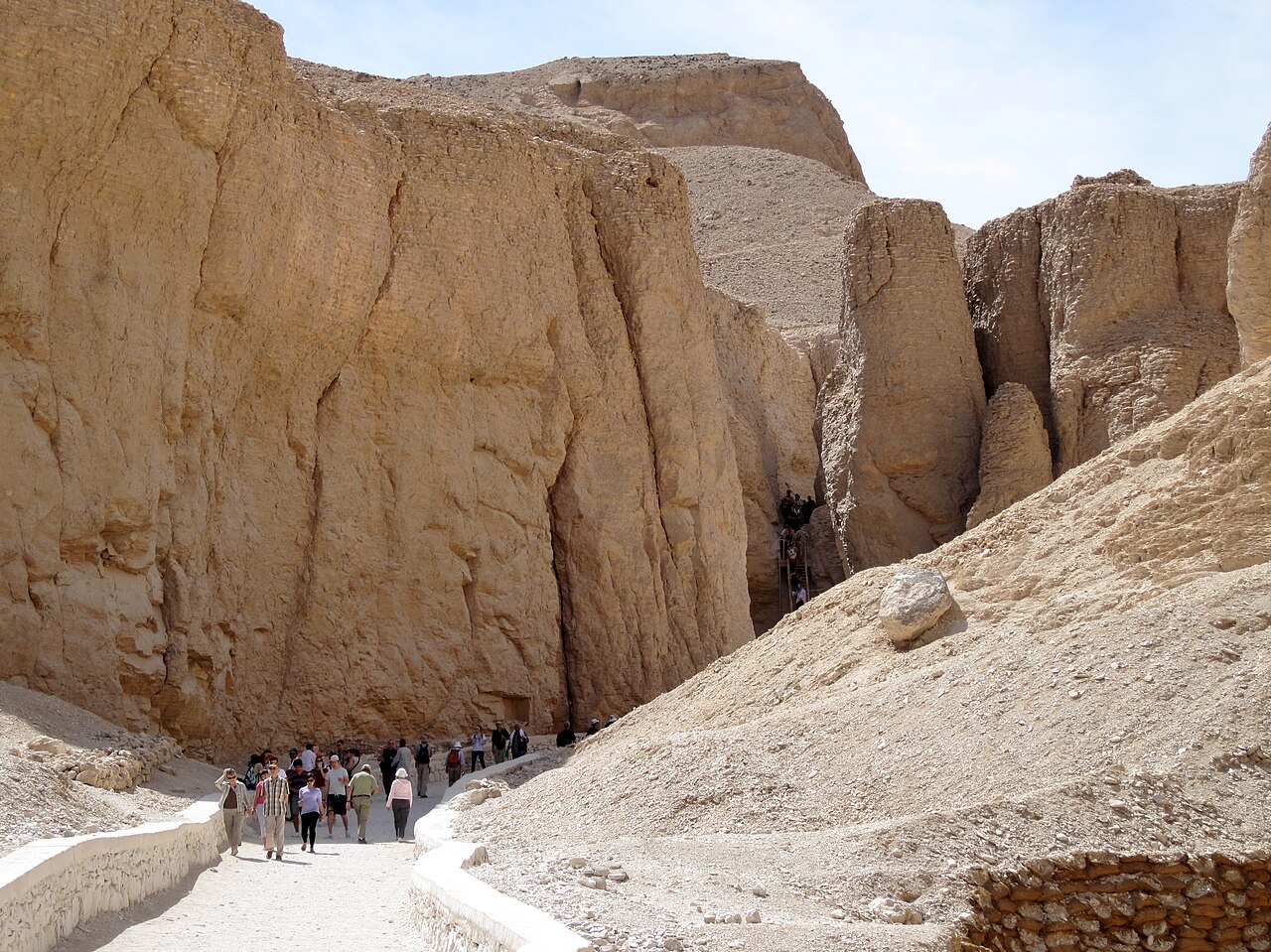
Unlike earlier tombs, it is not cut into the solid rock at the cliff base but into the talus slope away from it.
DescriptionSources for this section
- Wikipedia (English): WV22CC BY-SA 4.0
Sources for this section
- Wikipedia (English): WV22CC BY-SA 4.0
The tomb is situated in a bay on the east side of the wadi, 2 kilometres (1.2 mi) from the entrance to the Western Valley. Unlike earlier tombs, it is not cut into the solid rock at the cliff base but into the talus slope away from it. Sixty metres (200 ft) to the south lies WVA, which, judging from jar sealings and the types of pottery found there, probably functioned as a storeroom for overflow from WV22.
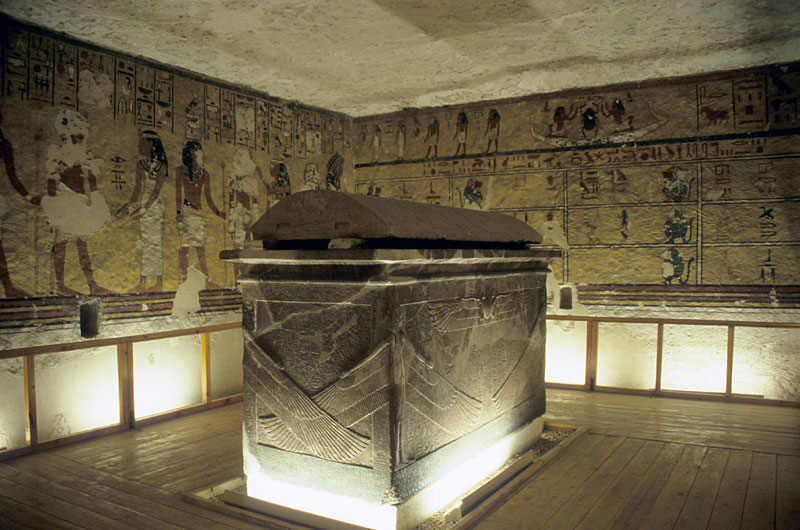
The tomb is 85 metres (279 ft) long and generally follows the layout of KV43, the tomb of Amenhotep's father Thutmose IV, with some changes. Two descending corridors separated by stairs lead to a well chamber, the shaft of which is 7.5 metres (25 ft) deep. The well chamber opens to the west from the base of the shaft, and seems to have been expanded to the west because the chisel marks in this section differ from those elsewhere in the chamber. On the other side of the well chamber a pillared hall leads to another descending passageway and stair; uniquely, there is no doorway separating these elements. The square antechamber leads onto the pillared burial chamber with its sarcophagus emplacement, and a rectangular pit at the southern end of the chamber was likely for the king's canopic equipment.
Three small side rooms lead off the burial chamber, together with two larger chambers each with a single pillar and an additional side chamber. One of these suites seems always to have been intended for the burial of a queen, while the other seems to have been a fourth side chamber enlarged after the fact, judging from chisel marks and the position of the magical niches. The expansion is presumably due to Sitamun's elevation to Great Royal Wife late in Amenhotep III's reign. The burial chamber has eleven magical niches, five of which are cut into the walls and columns surrounding the sarcophagus emplacement.
Research historySources for this section
- Wikipedia (English): WV22CC BY-SA 4.0
Sources for this section
- Wikipedia (English): WV22CC BY-SA 4.0
The tomb was first noted in August 1799 by Édouard de Villiers du Terrage and Prosper Jollois, who mapped it and made drawings of some of the ushabti found there, published in Description de l'Egypte; it is possible that the traveller William George Browne knew it several years earlier. John Gordon visited in 1804 and carved his name at the entrance. Jean-François Champollion and L'Hôte visited in 1828 as part of the Franco-Tuscan Expedition of 1828-1829, and Champollion was the first to identify the owner of the tomb as Amenhotep III. Karl Richard Lepsius visited in 1849 and copied parts of the Amduat in the burial chamber. Countless tourists visited during the nineteenth century, many of whom carried off souvenirs.
ExcavationsSources for this section
- Wikipedia (English): WV22CC BY-SA 4.0
Sources for this section
- Wikipedia (English): WV22CC BY-SA 4.0
The first excavation was carried out on behalf of Theodore M. Davis sometime between 1905 and 1914, but the details of this clearance are unknown. Howard Carter investigated the tomb on behalf of Lord Carnarvon between 8 February and 8 March 1915. Digging in the water course below the tomb yielded fragments of faience, glass and the foot of an ushabti inscribed for Tiye. Outside the entrance Carter found five intact foundation deposits placed in holes cut into the rock, two on each side and one in the centre. They contained calf heads placed on top of groups of miniature vessels of pottery and alabaster containing food remains, model tools such as chisels and adzes, and blue faience plaques bearing the names of Thutmose IV, which indicates that construction was initiated for this king. Inside the tomb Carter's finds from the well shaft included the hub of a wooden chariot wheel, a faience bracelet plaque and fragments of Third Intermediate Period coffins. In the burial chamber he found fragments of the king's calcite canopic chest.
In September 1989 the Waseda University Egypt Archaeological Mission began a re-clearance to create a precise plan and elevation of the tomb. Excavation outside the entrance located Carter's spoil heap, and re-investigation uncovered many small items, including pieces of a lotus-shaped collar terminal from the same artefact as fragments at Highclere Castle that Carter had recovered from the well shaft, together with fragmentary jar labels, wooden labels and a wooden uraeus body from a statue. Another foundation deposit was uncovered outside the entrance; unlike the earlier ones it seems to have been placed on the surface, in a rush basket containing small pottery vessels, a carved wooden knot and a wooden rocker, with a calf head on top.
Inside the tomb the antechamber was relatively clear, with only 50 centimetres (20 in) of fill. The enlarged side chamber for Sitamun contained a large spoil heap hemmed in by a stone wall, likely from Davis's excavation. Sieving yielded pieces of painted plaster, fragmentary pottery and stone vessels, and wooden objects. Finds included two yellow faience faces from ushabti, lapis lazuli inlays and amulets, a lapis uraeus head with inlaid eyes set in gold surrounds, and pieces of wooden and stone ushabti for Amenhotep III.
FindsSources for this section
- Wikipedia (English): WV22CC BY-SA 4.0
Sources for this section
- Wikipedia (English): WV22CC BY-SA 4.0
Amenhotep III died in Year 38 or 39 of his reign and was interred with burial goods similar to those of Tutankhamun. He was likely buried inside nested wooden coffins and possibly fitted with a gold mask. The coffins and mummy lay within a large cartouche-shaped sarcophagus of granite rather than the usual quartzite, the first use of this stone for a royal burial in the Eighteenth Dynasty. Only the lid remains, some 3 metres (9.8 ft) long and broken into two main pieces. The sarcophagus trough is missing, and was likely removed for reuse during the official emptying of the royal valley in the Third Intermediate Period. Fragments of the calcite canopic chest show winged goddesses standing astride each corner, and the stoppers took the shape of the king's head wearing a nemes-headdress. The king was equipped with over eighty ushabti, many of them in stone and the most numerous in wood, including imported woods such as ebony and cedar.
It is clear from the fragmentary remains that the tomb was thoroughly robbed in antiquity. The gold fittings had been stripped from the coffins, and a mass of inlays and gold foil was found cached near KV36, the tomb of Maiherpri, by Carter in 1902. Fragments of intrusive Third Intermediate Period burials found by Carter in the well include one coffin belonging to a man named Padihor and another belonging to a woman whose name is lost but whose mother was Tabesheribet.
Despite the preparations for the burials of Tiye and Sitamun, it is doubtful that they were ever buried in the suites intended for them. Both apparently outlived Amenhotep and were buried elsewhere. The badly damaged mummy of Amenhotep III was moved from the tomb and restored in Year 13 of Smendes, and was ultimately found cached in KV35, the tomb of Amenhotep II.
ConservationSources for this section
- Wikipedia (English): WV22CC BY-SA 4.0
Sources for this section
- Wikipedia (English): WV22CC BY-SA 4.0
The walls and ceilings of the burial chamber, antechamber and well shaft are completely decorated, and the decoration follows the tombs of Amenhotep II (KV35) and Thutmose IV (KV43) but is much finer in quality. The burial chamber carries complete and abridged versions of the Amduat painted on a yellow-tinged background, with the figures drawn as simple stick figures. From the time of discovery the decoration has been in poor condition: the paintings are damaged by salt efflorescence, and sections of plaster have detached from the underlying rock, especially on the lower portions of walls. Several images of the pharaoh's head were cut out in 1828 and can be seen today in the Louvre. The tomb was opened to visitors on October 4, 2025, having previously been closed for restoration.
ContextSources for this section
- Wikipedia (English): WV22CC BY-SA 4.0
Sources for this section
- Wikipedia (English): WV22CC BY-SA 4.0
Rock-cut tombs in the Valley of the Kings, on the west bank of the Nile opposite Thebes, were excavated for pharaohs and powerful nobles of the New Kingdom over a period of nearly 500 years, from the Eighteenth to the Twentieth Dynasty. The valley has two main sections, the East Valley where most royal tombs lie and the West Valley, and is known to contain 65 tombs and chambers.
Tradition and region
About this kind of monument
Rock-cut tombs of Egypt
Egypt has some of the best-known rock-cut tombs in the world. In the Valley of the Kings, on the west bank of the Nile opposite Thebes, tombs were excavated for pharaohs and powerful nobles of the New Kingdom, for a period of nearly 500 years from the Eighteenth to the Twentieth Dynasty. The valley has two main sections, the East Valley where most royal tombs lie and the West Valley, known as the Valley of the Monkeys, and it is known to contain 65 tombs and chambers. It gained great attention after the discovery of the tomb of Tutankhamun in 1922, and became a UNESCO World Heritage Site in 1979 with the rest of the Theban Necropolis.
Much earlier, Beni Hasan in Middle Egypt is an ancient funerary site cut into the limestone cliffs on the east bank of the Nile about 20 kilometres south of Minya. In the Middle Kingdom it was the principal cemetery of the sixteenth nome of Upper Egypt, the Oryx nome, and its monumental tombs were cut roughly halfway up the cliff, overlooking the valley. Rock-cut tombs are also found at Deir el-Medina, between the Valley of the Kings and the Valley of the Queens.
The mastaba is a different tradition: a flat-roofed rectangular tomb with sloping sides, built of mudbrick or limestone, which marked the burial sites of eminent Egyptians in the Early Dynastic Period and Old Kingdom. The mastaba was built above ground and the rock-cut tomb into the cliff.
Egyptian tombs are among the best dated monuments in the Atlas, because the dynasty or reign of the king or noble who owned them is known.
When visiting, remember that access to many tombs is limited.
Paraphrased from Wikipedia: Valley of the Kings, Wikipedia: Beni Hasan, Wikipedia: Rock-cut tomb, Wikipedia: Mastaba · CC BY-SA 4.0
From the article
Dated moments in the story
- 1799
It was officially discovered in August 1799 by Prosper Jollois and Édouard de Villiers du Terrage, engineers with Napoleon's expedition to Egypt but had probably been open for some time.
Source - 1799
60 metres (200 ft) south of the tomb is WVA which, based on jar sealings and the types of pottery found there, likely functioned as a storeroom for overflow from WV22. The tomb was first noted in August 1799 by Édouard de Villiers du Terrage and Prosper Jollois, engineers in Napoleon's expedition; it is possible it...
Source - 1804
The tomb was visited in 1804 by a John Gordon who carved his name at the entrance.
Source - 1828
Several images of the pharaoh's head were cut out in 1828 and can be seen today in the Louvre.
Source - 1828
Jean-François Champollion and L'Hôte visited in 1828 as part of the Franco-Tuscan Expedition of 1828–1829, leaving graffiti to that effect in chamber I; Champollion was the first to identify the owner of the tomb as Amenhotep III.
Source - 1828
The tomb was visited by countless tourists during the nineteenth century, many of whom carried off souvenirs of their visit; at some point between 1828 and 1829, several portraits of the king were cut from the walls by the Franco-Tuscan Expedition and are now in the Louvre.
Source - 1828
Further damage was inflicted to the tomb when portions of decoration were cut out by the Franco-Tuscan Expedition of 1828–1829, followed by countless of tourists taking souvenirs of the walls during the nineteenth century.
Source - 1849
Karl Richard Lepsius visited in 1849 and copied parts of the Amduat in the burial chamber.
Source - 1902
A mass of inlays and gold foil were carried to the main valley and found cached near KV36, the tomb of Maiherpri, by Carter in 1902. The sarcophagus box is missing and no fragments of it were found in the course of the excavation.
Source - 1905
Davis sometime between 1905 and 1914 but the details of this clearance are unknown.
Source - 1915
The first documented clearance was carried out by Howard Carter in 1915. Since 1989, a Japanese team from Waseda University led by Sakuji Yoshimura and Jiro Kondo has excavated and conserved the tomb.
Source - 1915
Howard Carter investigated the tomb on behalf of Lord Carnarvon between 8 February and 8 March 1915. Carter's interest in the tomb stemmed from his purchase of three bracelet plaques bearing the names of Amenhotep III and Tiye on the antiquities market in 1912, possible strays from Davis' excavation.
Source - 1989
He also investigated the burial chamber, where fragments of the king's calcite canopic chest were found. In September 1989 the Waseda University Egypt Archaeological Mission began a re-clearance to create a precise plan and elevation of the tomb.
Source - 2025
The tomb was opened to visitors on October 4, 2025, having previously been closed for restoration.
Source
Photographs
1 photograph, each with its author and licence
Lore
Evidence & Lore
What the sources actually support — and, kept apart, what has been claimed.
What the evidence supports
Dates
Est. 1539–1075 BCEHow this date was established: Type comparisonTypical range for hypogeums in Egypt; this site has not been dated itself. The Valley was used for primary burials from approximately 1539 BC to 1075 BC.Source for this date
Where it stands
Egypt
The pin marks the monument itself — its exact point.
- Coordinates
- 25°45′00″ N, 32°36′51″ EFor a GPS or map app: 25.75000, 32.61430
Access is as our sources describe it; we have not visited the site to check.
Nearby
The closest sites in the Atlas, by straight line.





Sources
Every record behind this page, with the link it came from.
3 sources behind this page
- 01Wikidata Q2480865wikidata.org
- 02Source for this dateen.wikipedia.org
- 03Wikipedia: WV22en.wikipedia.org
Image files
- KV22.pngUtente:HotepibreCC BY-SA 4.0
Report a correctionWrong date, name, photograph or source? Tell us and it will be put right.
Around this place
The ten nearest sites, by compass
Credit
Text, licence and sources
Adapted from the Wikipedia article "WV22" (English), licensed CC BY-SA 4.0; authors are listed in the page history. Reused under CC BY-SA 4.0. Read on Wikipedia · Edit history and authors
- Wikipedia (English): WV22CC BY-SA 4.0
- Wikidata Q2480865CC0