.jpg/1920px-Kir%C3%A1lyok_v%C3%B6lgye_(keleti_v%C3%B6lgy_k%C3%B6z%C3%A9ps%C5%91_r%C3%A9sz%C3%A9nek_s%C3%ADrjai).jpg 1920w)
KV57
DatedEst. 1539–1075 BCE
Photo Kingtut at Hungarian Wikipedia · CC BY-SA 3.0Source file on Wikimedia Commons
Overview
About this site
Overview
Tomb KV57 is the royal tomb of Horemheb, the last pharaoh of the Eighteenth Dynasty, in the Valley of the Kings, Egypt. It was located by Edward Ayrton in February 1908 for Theodore Davis.
The tomb differs from earlier Eighteenth Dynasty royal tombs in having a straightened axis and painted reliefs instead of murals, and the Book of Gates appears in it for the first time. It contained the remains of several burials, none of them conclusively belonging to Horemheb.
Read on Wikipedia4 min readCC BY-SA 4.0
Where it sits in time
The site's dated range, placed against world reference points.
The scale is logarithmic: each step to the left is about ten times older than the last.
Article
KV57
The tomb consists of a descending entrance stair, a sloping passageway leading to another descending stair, and another passageway that ends in a well shaft.
DescriptionSources for this section
- Wikipedia (English): KV57CC BY-SA 4.0
Sources for this section
- Wikipedia (English): KV57CC BY-SA 4.0
The tomb consists of a descending entrance stair, a sloping passageway leading to another descending stair, and another passageway that ends in a well shaft. Beyond the well chamber is the first pillared hall. A staircase cut into the floor on the left side of the hall, originally sealed, leads to another descending passage and, via another flight of steps, the antechamber. Beyond it is the pillared burial chamber, surrounded by storerooms, with the floor at the far end lowered to create a crypt.
The layout is transitional between the dog-leg style of earlier Eighteenth Dynasty tombs and the straight axis tombs of the Nineteenth Dynasty, and is known as a jogged axis. Some novel features are not seen again, such as the ramp at the top of the stairs leading to the crypt around the sarcophagus, the second set of stairs in this area, and the burial below the floor in one of the storerooms.
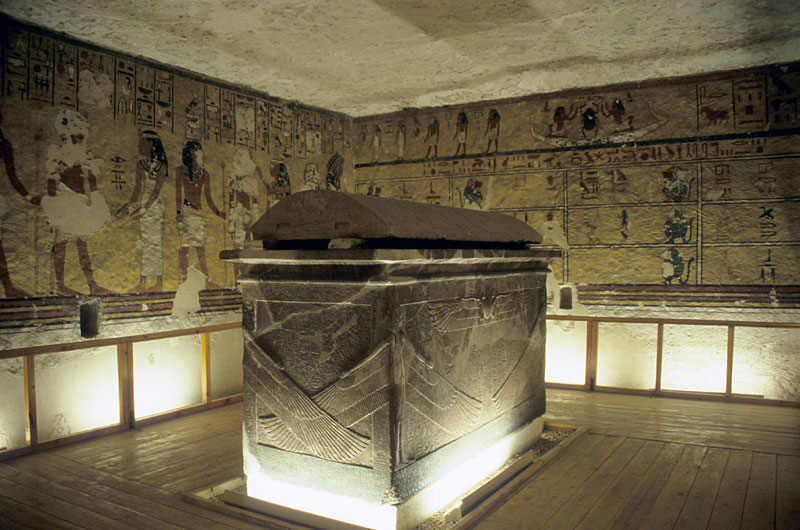
As with earlier tombs, the decoration is confined to three walls of the well chamber, the antechamber and the burial chamber, but for the first time in a royal tomb the walls are decorated with painted bas-reliefs. Much of the decoration in the burial chamber is unfinished, preserving the process from gridded preliminary sketches through carving to painting. The burial chamber uses scenes from the Book of Gates instead of the Amduat for the first time.
ExcavationsSources for this section
- Wikipedia (English): KV57CC BY-SA 4.0
Sources for this section
- Wikipedia (English): KV57CC BY-SA 4.0
After the discovery of the Gold Tomb (KV56) in January 1908, clearance of the valley floor continued westward. On 25 February 1908 signs of a tomb were encountered, and a day later the stairway was exposed, choked almost entirely with sand and debris washed down by flash-flooding. Ayrton crawled inside and found a hieratic inscription naming Horemheb. A more formal entry occurred on 29 February. Little is known of the actual excavation and clearance, as Ayrton's report, which Davis described as exhaustive, was not included in Davis' publication and has since been lost.
Between 2006 and 2007 the tomb was re-excavated in a project led by Geoffrey Thorndike Martin, which cleared debris left by the original excavation, which had piled it into side rooms instead of removing it from the tomb.
FindsSources for this section
- Wikipedia (English): KV57CC BY-SA 4.0
Sources for this section
- Wikipedia (English): KV57CC BY-SA 4.0
The largest object remaining in the tomb is the red granite sarcophagus, found with its lid broken but otherwise intact, in the form of a rectangular pylon with cavetto cornice and torus moulding and with protective goddesses on each corner. It appeared to be supported by six wooden figures of deities placed in niches in the floor. Much of what else remained was broken by looting in antiquity: small pieces of inscribed cedar coffin wood, a smashed alabaster canopic chest, parts of four miniature lion-headed embalming tables, broken life-sized guardian statues, three large Anubis statues, and wooden statues of a leopard, falcons, a swan and a germinating Osiris figure. Several wooden statues are now in the British Museum. Other finds included magical bricks, model boats, parts of chairs, pall rosettes, a head rest, beads and alabaster vases.
Grafton Elliot Smith determined that the remains from the side chambers were those of two women, the skulls on the floor of the burial chamber belonged to a man and two women, and the sarcophagus contained the bones of a single person of uncertain sex. Their identities are unknown. Nicholas Reeves suggests that Horemheb is among the remains.
HistorySources for this section
- Wikipedia (English): KV57CC BY-SA 4.0
Sources for this section
- Wikipedia (English): KV57CC BY-SA 4.0
Black ink graffiti recorded by Alan Gardiner name the Army-Scribe Butehamun and others, and one records, in Year 6, an action concerning the burial of King Djoserkheper(u)re Setepenre by the Vizier, General and Chief Herihor. This has been interpreted as recording the first restoration of the burial, or less likely the transfer of the body of Ay from his mutilated tomb to KV57.
ContextSources for this section
- Wikipedia (English): KV57CC BY-SA 4.0
Sources for this section
- Wikipedia (English): KV57CC BY-SA 4.0
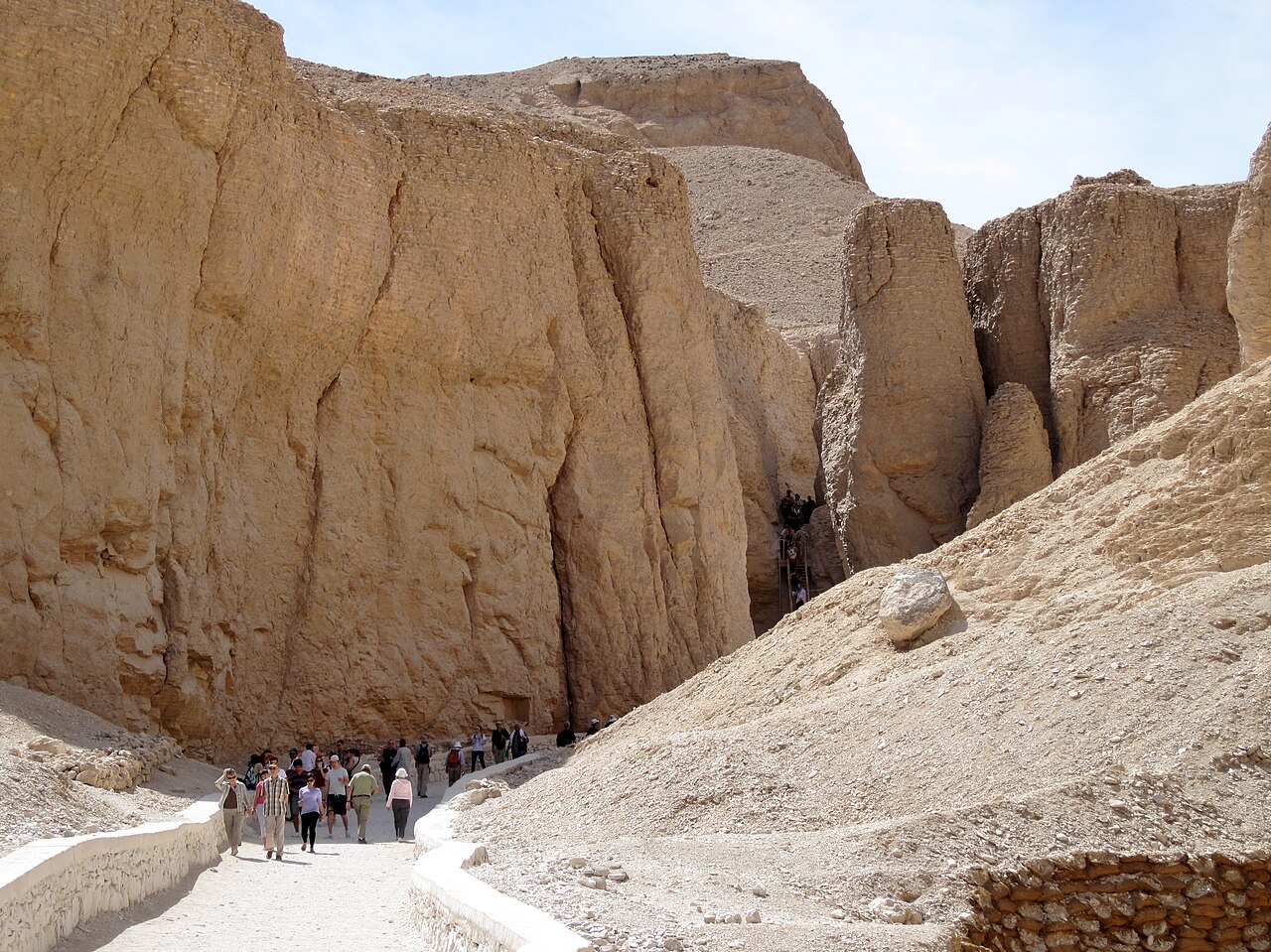
The Valley of the Kings lies on the west bank of the Nile opposite Thebes. Tombs there were excavated for pharaohs and powerful nobles of the New Kingdom over a period of nearly 500 years, from the Eighteenth to the Twentieth Dynasty. It became a UNESCO World Heritage Site in 1979 with the rest of the Theban Necropolis.
Tradition and region
About this kind of monument
Rock-cut tombs of Egypt
Egypt has some of the best-known rock-cut tombs in the world. In the Valley of the Kings, on the west bank of the Nile opposite Thebes, tombs were excavated for pharaohs and powerful nobles of the New Kingdom, for a period of nearly 500 years from the Eighteenth to the Twentieth Dynasty. The valley has two main sections, the East Valley where most royal tombs lie and the West Valley, known as the Valley of the Monkeys, and it is known to contain 65 tombs and chambers. It gained great attention after the discovery of the tomb of Tutankhamun in 1922, and became a UNESCO World Heritage Site in 1979 with the rest of the Theban Necropolis.
Much earlier, Beni Hasan in Middle Egypt is an ancient funerary site cut into the limestone cliffs on the east bank of the Nile about 20 kilometres south of Minya. In the Middle Kingdom it was the principal cemetery of the sixteenth nome of Upper Egypt, the Oryx nome, and its monumental tombs were cut roughly halfway up the cliff, overlooking the valley. Rock-cut tombs are also found at Deir el-Medina, between the Valley of the Kings and the Valley of the Queens.
The mastaba is a different tradition: a flat-roofed rectangular tomb with sloping sides, built of mudbrick or limestone, which marked the burial sites of eminent Egyptians in the Early Dynastic Period and Old Kingdom. The mastaba was built above ground and the rock-cut tomb into the cliff.
Egyptian tombs are among the best dated monuments in the Atlas, because the dynasty or reign of the king or noble who owned them is known.
When visiting, remember that access to many tombs is limited.
Paraphrased from Wikipedia: Valley of the Kings, Wikipedia: Beni Hasan, Wikipedia: Rock-cut tomb, Wikipedia: Mastaba · CC BY-SA 4.0
From the article
Dated moments in the story
- 1908
The tomb was located by Edward Ayrton in February 1908 for Theodore Davis.
Source - 1908
KV57 was discovered in February 1908 by Edward Ayrton who was excavating on behalf of Theodore Davis.
Source - 1908
After the discovery and excavation of the 'Gold Tomb' (KV56) in January 1908, the clearance of the valley floor continued westward, following the rockface.
Source - 1908
On 25 February 1908 signs of a tomb were encountered and a day later the stairway was exposed, choked almost entirely with sand and debris.
Source - 2006
Little is known of the actual excavation and clearance of the tomb as Davis mentions Ayrton had prepared an "exhaustive report" which could not be included due to the size of Davis' publication, and has since been lost. Between 2006 and 2007 the tomb was re-excavated in a project led by Geoffrey Thorndike Martin.
Source
Photographs
4 photographs, each with its author and licence
More photographs
Lore
Evidence & Lore
What the sources actually support — and, kept apart, what has been claimed.
What the evidence supports
Dates
Est. 1539–1075 BCEHow this date was established: Type comparisonTypical range for hypogeums in Egypt; this site has not been dated itself. The Valley was used for primary burials from approximately 1539 BC to 1075 BC.Source for this date
Where it stands
Egypt
The pin marks the monument itself — its exact point.
- Coordinates
- 25°45′00″ N, 32°36′51″ EFor a GPS or map app: 25.75000, 32.61430
Access is as our sources describe it; we have not visited the site to check.
Nearby
The closest sites in the Atlas, by straight line.





Sources
Every record behind this page, with the link it came from.
3 sources behind this page
- 01Wikidata Q947481wikidata.org
- 02Source for this dateen.wikipedia.org
- 03Wikipedia: KV57en.wikipedia.org
Image files
- Királyok völgye (keleti völgy középső részének sírjai).jpgKingtut at Hungarian WikipediaCC BY-SA 3.0
- Horemheb canopic chest.jpgEdward R. Ayrton (1882-1914)Public domain
- Horemheb seated god statue.jpgInternet Archive identifier : the-tombs-of-harmhabi-and-touatankhamanPublic domain
- Horemheb canopic jar head 02.jpgInternet Archive identifier : the-tombs-of-harmhabi-and-touatankhamanPublic domain
Report a correctionWrong date, name, photograph or source? Tell us and it will be put right.
Around this place
The ten nearest sites, by compass
Credit
Text, licence and sources
Adapted from the Wikipedia article "KV57" (English), licensed CC BY-SA 4.0; authors are listed in the page history. Reused under CC BY-SA 4.0. Read on Wikipedia · Edit history and authors
- Wikipedia (English): KV57CC BY-SA 4.0
- Wikidata Q947481CC0