Overview
About this site
Overview
KV42 (Kings Valley 42) is an ancient Egyptian tomb in the Valley of the Kings near Luxor, Egypt. It was constructed for Hatshepsut-Meryetre, the wife of Thutmose III, but she was not buried in it.
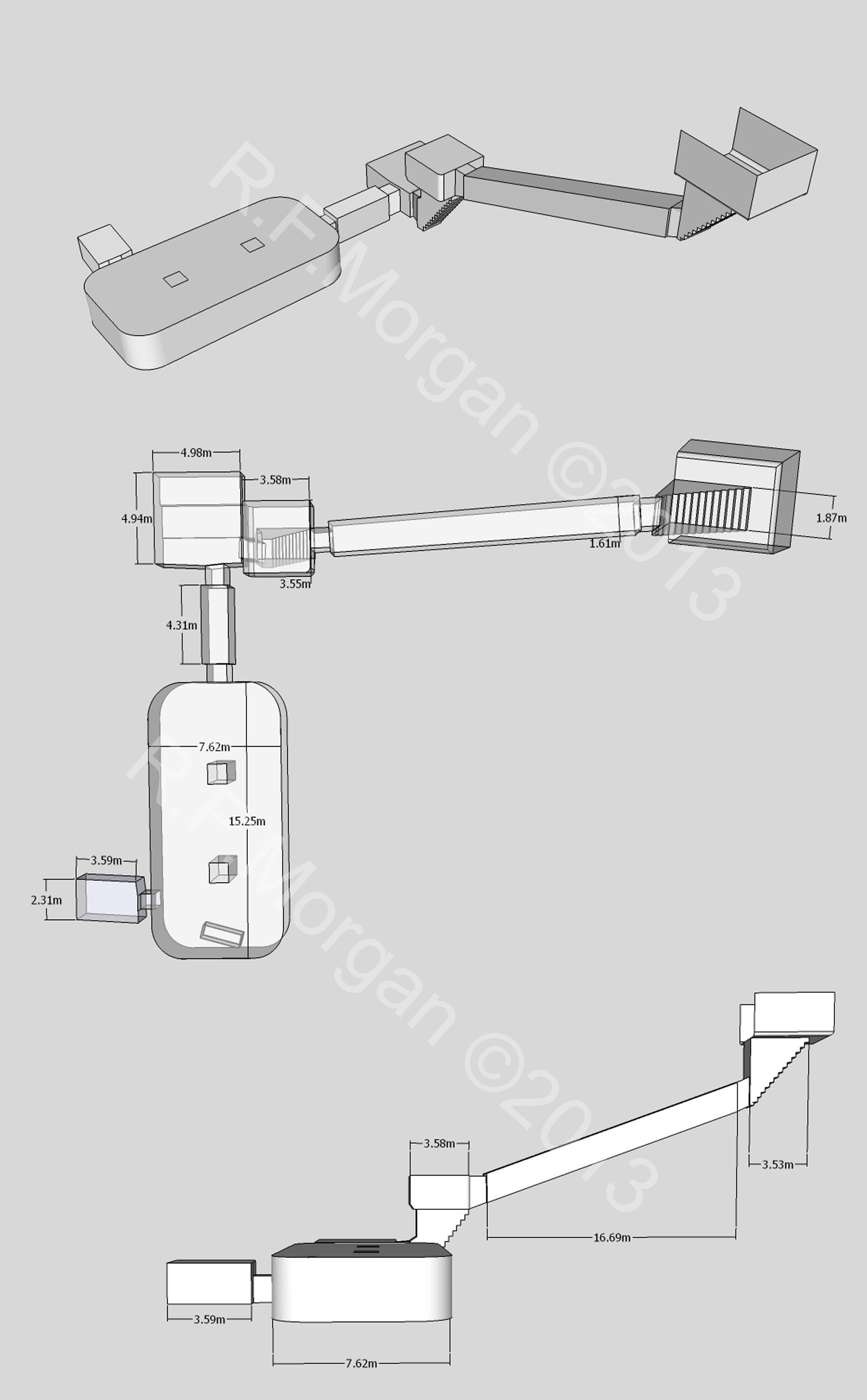
It may have been reused by Sennefer, a mayor of Thebes during the reign of Amenhotep II, and by several members of his family. The tomb has a cartouche-shaped burial chamber, like other early Eighteenth Dynasty tombs.
Read on Wikipedia3 min readCC BY-SA 4.0
Where it sits in time
The site's dated range, placed against world reference points.
The scale is logarithmic: each step to the left is about ten times older than the last.
Article
KV42
The tomb was uncovered by two local Copts, Chinouda Macarios and Boutros Andraos, in late 1900.
ExcavationsSources for this section
- Wikipedia (English): KV42CC BY-SA 4.0
Sources for this section
- Wikipedia (English): KV42CC BY-SA 4.0
The tomb was uncovered by two local Copts, Chinouda Macarios and Boutros Andraos, in late 1900. Howard Carter doubted that the secret was their own, as the site had been discovered by and known to Monsieur Loret some eighteen months previously. Excavation began on 27 November 1900, and the blocking in the doorway was officially taken down on 9 December. It was immediately apparent that the tomb had suffered ancient robbing and had been inundated with water. The funerary furniture, vases and canopic jars lay mashed on the ground of the passages and chambers.
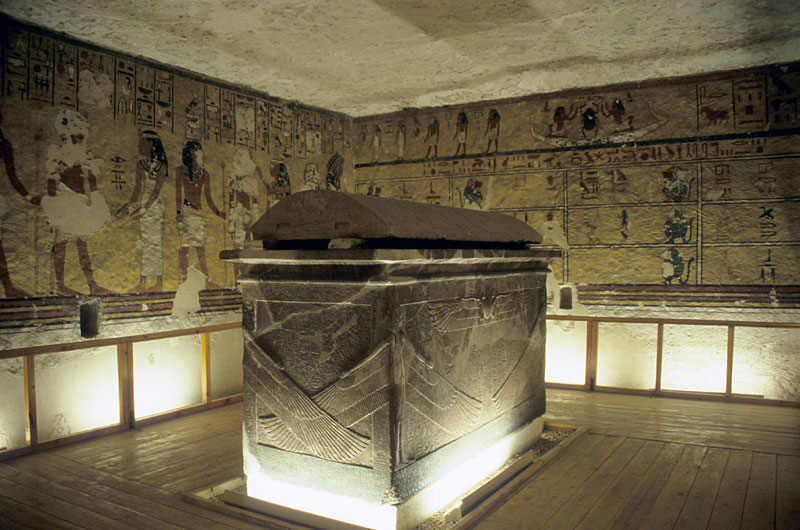
The cartouche-shaped burial chamber contained an unfinished stone sarcophagus. The tomb held a set of well-preserved canopic jars belonging to Sentnay, the wife of Sennefer, and fragmentary jars and an alabaster offering table inscribed for a woman named Baketra, who bore the title royal ornament. Four canopic jar lids in the form of bearded heads were found, which Carter suggested belonged to Sennefer. Analysis of embalming balm from two of the jars identified a complex blend of plant oils, beeswax, fat, bitumen, and resins, many of them imported into Egypt. Only the burial chamber was decorated; part of the ceiling is covered with yellow stars on a blue background.
Carter suggested that the tomb was robbed for its metal during the Twenty-second Dynasty. A graffito at the entrance records that work was begun on the tomb by the necropolis team, which may record the uncovering and emptying of the tomb on the orders of Piankh, the High Priest of Amun.
InterpretationSources for this section
- Wikipedia (English): KV42CC BY-SA 4.0
Sources for this section
- Wikipedia (English): KV42CC BY-SA 4.0
There is no agreement on the original owner of the tomb. The unfinished quartzite sarcophagus is seen as an indication that it may at some point have been intended for Thutmose II, but no trace of royal funerary equipment was found, making it doubtful that the tomb was ever used for a royal burial. Foundation deposits discovered by Carter in 1921 point to Queen Merytre-Hatshepsut as the intended owner.
Carter ascribed the tomb to Sennefer on the evidence of the canopic jars and model vessels inscribed for him and Sentnay. Catherine Roehrig proposed that Sentnay, royal nurse of Amenhotep II, was re-interred in KV42 as part of a cache, possibly as late as the 21st Dynasty, while Nicholas Reeves sees the surviving blocking and storage jars as proof of a primary burial. Marianne Eaton-Krauss considers it highly unlikely that Sennefer and Sentnay were granted the tomb by Amenhotep II.
Tradition and region
About this kind of monument
Rock-cut tombs of Egypt
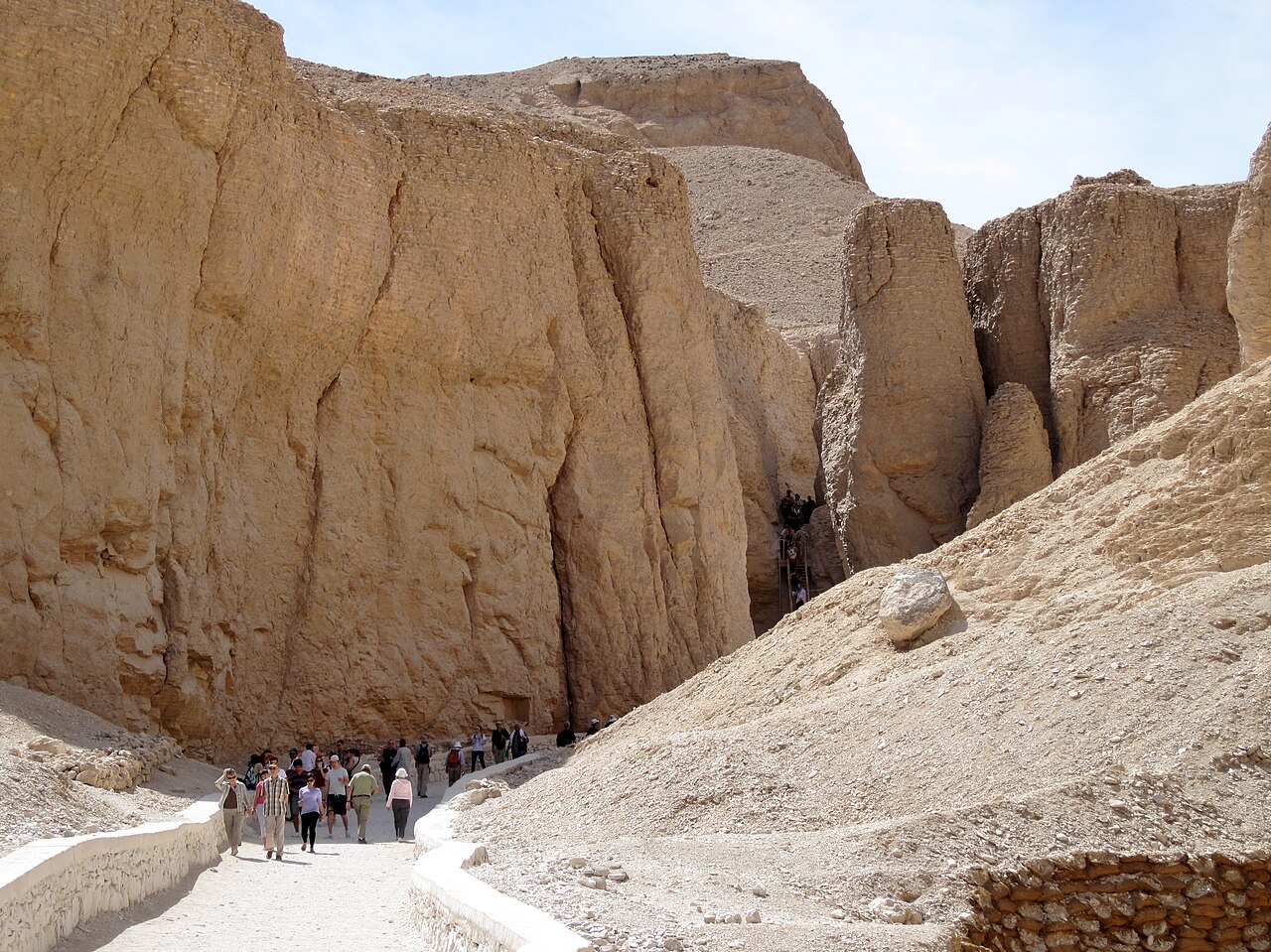
Egypt has some of the best-known rock-cut tombs in the world. In the Valley of the Kings, on the west bank of the Nile opposite Thebes, tombs were excavated for pharaohs and powerful nobles of the New Kingdom, for a period of nearly 500 years from the Eighteenth to the Twentieth Dynasty. The valley has two main sections, the East Valley where most royal tombs lie and the West Valley, known as the Valley of the Monkeys, and it is known to contain 65 tombs and chambers. It gained great attention after the discovery of the tomb of Tutankhamun in 1922, and became a UNESCO World Heritage Site in 1979 with the rest of the Theban Necropolis.
Much earlier, Beni Hasan in Middle Egypt is an ancient funerary site cut into the limestone cliffs on the east bank of the Nile about 20 kilometres south of Minya. In the Middle Kingdom it was the principal cemetery of the sixteenth nome of Upper Egypt, the Oryx nome, and its monumental tombs were cut roughly halfway up the cliff, overlooking the valley. Rock-cut tombs are also found at Deir el-Medina, between the Valley of the Kings and the Valley of the Queens.
The mastaba is a different tradition: a flat-roofed rectangular tomb with sloping sides, built of mudbrick or limestone, which marked the burial sites of eminent Egyptians in the Early Dynastic Period and Old Kingdom. The mastaba was built above ground and the rock-cut tomb into the cliff.
Egyptian tombs are among the best dated monuments in the Atlas, because the dynasty or reign of the king or noble who owned them is known.
When visiting, remember that access to many tombs is limited.
Paraphrased from Wikipedia: Valley of the Kings, Wikipedia: Beni Hasan, Wikipedia: Rock-cut tomb, Wikipedia: Mastaba · CC BY-SA 4.0
From the article
Dated moments in the story
- 1900
The tomb was uncovered by two local Copts, Chinouda Macarios and Boutros Andraos, in late 1900; they obtained an excavation permit through their statement that they knew the location of a tomb.
Source - 1900
However, Howard Carter notes in his report that "I doubt the secret was really their own, as the site was discovered by and known to Monsieur Loret some eighteen months previously, and probably their informations was obtained from his workmen." The excavation commenced on 27 November 1900 and the blocking in the...
Source - 1921
The discovery of foundation deposits by Carter in 1921 point to the intended owner being Queen Merytre-Hatshepsut.
Source
Photographs
3 photographs, each with its author and licence
More photographs
Lore
Evidence & Lore
What the sources actually support — and, kept apart, what has been claimed.
What the evidence supports
Dates
Est. 3600–2500 BCEHow this date was established: Type comparisonTypological estimate, not a date for this site: a hypogeum in North Africa is normally dated between 3600 BCE and 2500 BCE (Atlas typological table).Source for this date
Measured facts
- Intended occupant
- Hatshepsut-Meryetre, wife of Thutmose IIISource: Intended occupant
- Original burial
- Hatshepsut-Meryetre was not buried in the tombSource: Original burial
- Possible later occupants
- Sennefer, mayor of Thebes, and several family membersSource: Possible later occupants
- Burial chamber shape
- Cartouche-shapedSource: Burial chamber shape
- Culture
- Ancient EgyptSource: Culture
- Length
- 58.18 metreSource: Length
Where it stands
Egypt
The pin marks the monument itself — its exact point.
- Coordinates
- 25°45′00″ N, 32°36′51″ EFor a GPS or map app: 25.75000, 32.61430
Access is as our sources describe it; we have not visited the site to check.
Nearby
The closest sites in the Atlas, by straight line.





Sources
Every record behind this page, with the link it came from.
2 sources behind this page
- 01Wikidata Q1719155wikidata.org
- 02Wikipedia (en)en.wikipedia.org
Image files
Report a correctionWrong date, name, photograph or source? Tell us and it will be put right.
Around this place
The ten nearest sites, by compass
Credit
Text, licence and sources
Adapted from the Wikipedia article "KV42" (English), licensed CC BY-SA 4.0; authors are listed in the page history. Reused under CC BY-SA 4.0. Read on Wikipedia · Edit history and authors
- Wikipedia (English): KV42CC BY-SA 4.0
- Wikidata Q1719155CC0