.jpg/1920px-Valley_of_the_Kings_panorama_(450021688).jpg 1920w)
Overview
About this site
What the sources say
The tomb of Maiherpri, also known by its tomb number, KV36 is the burial place of the noble Maiherpri of the Eighteenth Dynasty in the Valley of the Kings, Egypt.
Rediscovered on 30 March 1899 by Victor Loret in his second season in the Valley of the Kings, the tomb was found to be substantially undisturbed, but as it has for a long time not been properly published, it is not as well known as other burials in the valley. All the objects found were taken to the Egyptian Museum in Cairo where they were published in the Catalogue General (short: CG). The only source for the arrangement of the objects in the burial chamber was a short article by Georg Schweinfurth. He visited the tomb briefly before its contents were brought to Cairo. However, recently the notebooks of Loret were found and published, providing a detailed list and description of the objects found and their arrangement in the tomb chamber.
Read on Wikipedia10 min readCC BY-SA 4.0
Where it sits in time
The site's dated range, placed against world reference points.
The scale is logarithmic: each step to the left is about ten times older than the last.
The full article
KV36: the whole story
In briefSources for this section
- Wikipedia (English): Tomb of MaiherpriCC BY-SA 4.0
Sources for this section
- Wikipedia (English): Tomb of MaiherpriCC BY-SA 4.0
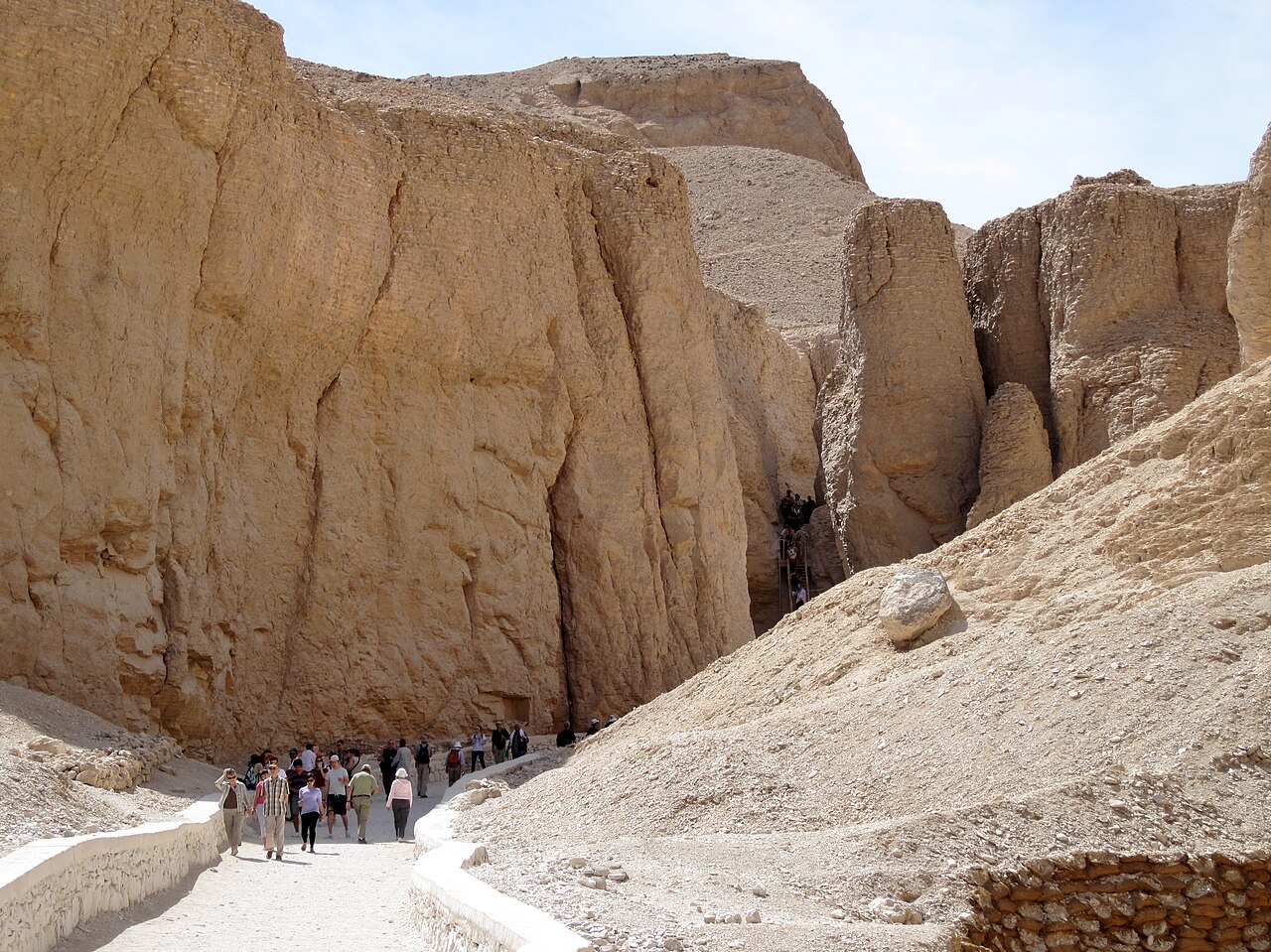
The tomb of Maiherpri, known by its number KV36, is the burial place of the noble Maiherpri of the Eighteenth Dynasty in the Valley of the Kings, Egypt. It lies between the tombs of Amenhotep II (KV35) and Bay (KV13), cut into the valley floor opposite the entrance of the wadi that contains the tomb of Thutmose III (KV34). It is a small shaft tomb with a chamber at the bottom on its west side, 3.90 m (12.8 ft) long and 4.10 m (13.5 ft) wide, and the burial chamber was undecorated, as with all burial chambers of non-royals in the valley.
Little is known about Maiherpri, who does not appear in sources outside the tomb. Two titles appear on his objects: child of the nursery and fan-bearer on the Right Side of the King. His Book of the Dead also calls him companion of the King. His mummy showed that he was a young man, aged 25-30 years, when he died. He is generally thought to have been buried in the mid-Eighteenth Dynasty, between the reigns of Hatshepsut and Amenhotep III.
Victor Loret rediscovered the tomb on 30 March 1899, in approximately the 16th test pit, and entered the burial chamber the next day. It had been robbed at least once in antiquity, with thieves taking clothing, jewellery, metal vessels and cosmetics, but it still held much of its furnishings. A black-painted and gilded sarcophagus sat close to the north wall with a canopic chest at its foot, and food offerings, bouquets and large jars were scattered about. Everything was packed into 16 crates by 7 April 1899 and sent to the Egyptian Museum in Cairo.
Very little was known about the excavation until the early 2000s, because Loret never published on it. In 2004 a collection of his notes and photographs preserved in the University of Milan and the Institut de France was published, providing a detailed list of the objects and their arrangement.
KV36 was the first reasonably intact tomb discovered in the Valley of the Kings, and despite the ancient robbery it still contained over 100 items. Maiherpri was buried with archery equipment, including two leather quivers with Near Eastern decoration, over 50 arrows and two leather wrist guards. Two ornate leather dog collars were also found, one with a design of horses separated by lotuses and another with gazelles hunted by lions or dogs.
History and datingSources for this section
- Wikipedia (English): Tomb of MaiherpriCC BY-SA 4.0
Sources for this section
- Wikipedia (English): Tomb of MaiherpriCC BY-SA 4.0
Burial and robbery
Little is known about Maiherpri as he does not appear in sources outside the tomb. Only two titles appear on the objects within the burial: "child of the kap (nursery)" and "fan-bearer on the Right Side of the King". His Book of the Dead also calls him "companion of the King" and "one who follows the King on his marches to the Northern and Southern foreign countries." Examination of his mummy showed that he was a young man when he died, aged 25-30 years.
He is generally thought to have been buried during the mid-Eighteenth Dynasty, between the reigns of Hatshepsut and Amenhotep III. More specific arguments by the Egyptologists Catharine Roehrig and Christian Orsenigo place his interment in the reigns of Hatshepsut and Thutmose III, while writer Dennis C. Forbes considers him a contemporary of Thutmose IV or Amenhotep III.
Maiherpri's tomb was robbed at least once in antiquity. Thieves targeted easily recyclable objects such as clothing and fabric, jewellery, metal vessels, and cosmetics. Vases of oils were investigated but had gone rancid by the time of the robbery and were left in the tomb. His coffins were opened and his mummy was looted of the valuables included in the wrappings. Robbers may have also stolen furniture such as boxes, chests and beds as these were absent from the KV36 but found in more intact contemporary tombs; they seem to have stashed a small box inscribed for Maiherpri and containing two leather loincloths in a cleft above KV36, which was discovered on 26 February 1903 by Howard Carter during his clearance of the area around the tomb.
Discovery and clearance
KV36 was discovered in 1899 during the second season of excavations by the French Egyptologist Victor Loret. The then-director of the Antiquities Service focused his work in the southern Valley of the Kings, opening test pits or trenches to the bedrock (sondage) in likely-looking locations. A map of the valley annotated by him indicates approximately 15 test excavations were sunk in the general vicinity of KV36 prior to its discovery.
The tomb was discovered on 30 March 1899 in approximately the 16th test pit, cut into the gravel near the base of the cliffs to the south of the tomb of Amenhotep II. At the base of the shaft was a partial blocking closing the door of the chamber. Loret entered the burial chamber on 31 March 1899; it was immediately apparent the tomb had been robbed but still contained much of its furnishings and burial equipment. The large black-painted and gilded sarcophagus sat close to the north wall with a canopic chest at its foot; Loret read the name "Maiherpri" on the sarcophagus' gold inscription. Food offerings and bouquets were piled in the corner and large jars were clustered against the far wall. A large coffin lay overturned in the middle of the room. The rest of the space was strewn with various objects and personal belongings including ceramic and alabaster vessels, archery equipment, and two dog collars.
The tomb was recorded and cleared quickly for fear of robbery, with everything packed into 16 crates by 7 April 1899. At least five photographs were taken of individual objects but none are known that show the chamber as it was discovered. The contents of KV36 were transported from the Valley of the Kings to the Egyptian Museum in Cairo which was housed in the former palace of Khedive Isma'il Pasha; when the new museum building opened in 1902 in Tahrir Square, they were displayed in their own large gallery on the second floor.
Very little was known about KV36's excavation until the early 2000s. Loret never published on the discovery and resigned as director of the Antiquities Service at the end of 1899. In 2004, a collection of his notes and photographs preserved in the University of Milan, Italy and the Institut de France, Paris were published. Prior to this, the only records available of the tomb's discovery and arrangement of its contents was an account written in 1900 by Georg Schweinfurth who visited the tomb during its clearance, and a list of contents published in 1902 by Georges Daressy in a volume of Catalogue général des antiquités égyptiennes du Musée du Caire.
DescriptionSources for this section
- Wikipedia (English): Tomb of MaiherpriCC BY-SA 4.0
Sources for this section
- Wikipedia (English): Tomb of MaiherpriCC BY-SA 4.0
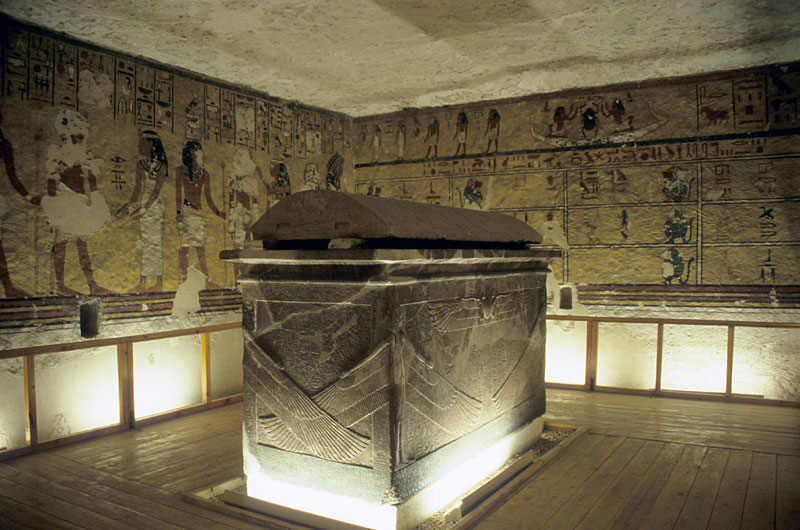
KV36 is located in the Valley of the Kings between the tombs of Amenhotep II (KV35) and Bay (KV13), cut into the floor of the valley opposite the entrance of the wadi that contains the tomb of Thutmose III (KV34). The tomb of Maiherpri is a small shaft tomb with a chamber at the bottom on its west side. The burial chamber was undecorated, as with all burial chambers of non-royals in the Valley of the Kings. It is 3.90 m (12.8 ft) long and 4.10 m (13.5 ft) wide with an area of 15.30 m2 (164.7 sq ft).
Burial goodsSources for this section
- Wikipedia (English): Tomb of MaiherpriCC BY-SA 4.0
Sources for this section
- Wikipedia (English): Tomb of MaiherpriCC BY-SA 4.0
KV36 was the first reasonably intact tomb discovered in the Valley of the Kings. Despite the tomb being robbed in antiquity, it still contained over 100 items. Maiherpri was buried with archery equipment including two leather quivers with Near Eastern decoration, over 50 arrows, and two leather wrist guards; bows were absent, possibly looted by ancient tomb robbers. Orsenigo suggests that these were used for sport hunting rather than warfare based on Maiherpri's lack of military titles.
Also included were two ornate leather dog collars. One has a design of horses separated by lotuses and has a scalloped green border. The other has a design of gazelles being hunted by lions or dogs and was once gilded. It bears a two line inscription identifying the dog it belonged to: "tesem of his house, She-of-Thebes" (ṯsm n pr=f tꜣ-n.t-niw.t). The name is transcribed as Ta-ent-niuwt or Tantanuit. Based on these collars, Maiherpri may have been the caretaker of the king's hunting dogs.
BurialSources for this section
- Wikipedia (English): Tomb of MaiherpriCC BY-SA 4.0
Sources for this section
- Wikipedia (English): Tomb of MaiherpriCC BY-SA 4.0
Maiherpri's body was interred in a set of three coffins. The outermost (CG 24001) is a 2.81 metres (9.2 ft) long rectangular sarcophagus made of black-painted wood with gilded inscriptions and decoration. Inside were two nested human-shaped (anthropoid) coffins (CG 24002 and 24004). The outer was also black with gilded decoration, while the inner was entirely gilded; both have curled false beards. There is a third anthropoid coffin (CG 24003) made of untreated wood with gilded inscriptions, which was found overturned next to the sarcophagus with its lid placed next to the box. This caused some confusion and discussion in Egyptology. It seems that this 'extra' coffin was intended as the innermost one, but was actually too big to fit into the set and was therefore left unused next to it. Parallels have been drawn to the burial of Tutankhamun, where the foot of his outermost coffin was slightly too large for the sarcophagus. There the coffin was shortened directly in the tomb chamber, while in the burial of Maiherpri his mummy was placed into the second coffin of his set.
The mummy of Maiherpri was adorned with a black and gold cartonnage mummy mask (Cairo GC 24097). The mask completely covers his head and shoulders and is similar in style to that of Hatnofer, the mother of Senenmut, buried in the reign of Hatshepsut. Maiherpri's mummy was disturbed by robbers in antiquity, who sliced through the bandages in search of valuables. The body was formally unwrapped by Georges Daressy on 22 March 1901. He noted that the method of bandaging was entirely horizontal strips with minimal padding; he estimated the body was wrapped in 60 layers of fabric. Pieces of jewellery missed by the robbers included bracelets, pieces of a beaded collar, a scarab, and isolated beads of carnelian and gold. Thieves also missed the gold plate covering the embalming incision.
Maiherpri's mummy measures 1.64 m (5.4 ft) tall. He lies on his back with his legs extended. His hands are positioned over the front of his thighs; the right hand is flat while the left is clenched. His head was shaved and wore a tightly curled wig which was glued to his scalp. Daressy considered his dark skin tone to be unchanged by embalming, identifying him as Upper Egyptian or Nubian. He also noted a resemblance to Thutmose IV, as both have the "Thutmosid" overbite. Daressy estimated Maiherpri died in his 20s.
How this page was madeSources for this section
- Wikipedia (English): Tomb of MaiherpriCC BY-SA 4.0
Sources for this section
- Wikipedia (English): Tomb of MaiherpriCC BY-SA 4.0
The summary at the top of this page was written by Claude Sonnet 5.5 (2026-11-06) from the cited Wikipedia article “Tomb of Maiherpri”. The numbers in it were checked automatically against the source text. The rest of the page is the article itself, the structured records and computed distances.
Tradition and region
About this kind of monument
Rock-cut tombs of Egypt
Egypt has some of the best-known rock-cut tombs in the world. In the Valley of the Kings, on the west bank of the Nile opposite Thebes, tombs were excavated for pharaohs and powerful nobles of the New Kingdom, for a period of nearly 500 years from the Eighteenth to the Twentieth Dynasty. The valley has two main sections, the East Valley where most royal tombs lie and the West Valley, known as the Valley of the Monkeys, and it is known to contain 65 tombs and chambers. It gained great attention after the discovery of the tomb of Tutankhamun in 1922, and became a UNESCO World Heritage Site in 1979 with the rest of the Theban Necropolis.
Much earlier, Beni Hasan in Middle Egypt is an ancient funerary site cut into the limestone cliffs on the east bank of the Nile about 20 kilometres south of Minya. In the Middle Kingdom it was the principal cemetery of the sixteenth nome of Upper Egypt, the Oryx nome, and its monumental tombs were cut roughly halfway up the cliff, overlooking the valley. Rock-cut tombs are also found at Deir el-Medina, between the Valley of the Kings and the Valley of the Queens.
The mastaba is a different tradition: a flat-roofed rectangular tomb with sloping sides, built of mudbrick or limestone, which marked the burial sites of eminent Egyptians in the Early Dynastic Period and Old Kingdom. The mastaba was built above ground and the rock-cut tomb into the cliff.
Egyptian tombs are among the best dated monuments in the Atlas, because the dynasty or reign of the king or noble who owned them is known.
When visiting, remember that access to many tombs is limited.
Paraphrased from Wikipedia: Valley of the Kings, Wikipedia: Beni Hasan, Wikipedia: Rock-cut tomb, Wikipedia: Mastaba · CC BY-SA 4.0
From the article
Dated moments in the story
- 1899
Rediscovered on 30 March 1899 by Victor Loret in his second season in the Valley of the Kings, the tomb was found to be substantially undisturbed, but as it has for a long time not been properly published, it is not as well known as other burials in the valley.
Source - 1899
The tomb was discovered on 30 March 1899 in approximately the 16th test pit, cut into the gravel near the base of the cliffs to the south of the tomb of Amenhotep II.
Source - 1899
Loret entered the burial chamber on 31 March 1899; it was immediately apparent the tomb had been robbed but still contained much of its furnishings and burial equipment.
Source - 1899
The tomb was recorded and cleared quickly for fear of robbery, with everything packed into 16 crates by 7 April 1899. At least five photographs were taken of individual objects but none are known that show the chamber as it was discovered.
Source - 1899
Loret never published on the discovery and resigned as director of the Antiquities Service at the end of 1899. In 2004, a collection of his notes and photographs preserved in the University of Milan, Italy and the Institut de France, Paris were published.
Source - 1900
Prior to this, the only records available of the tomb's discovery and arrangement of its contents was an account written in 1900 by Georg Schweinfurth who visited the tomb during its clearance, and a list of contents published in 1902 by Georges Daressy in a volume of Catalogue général des antiquités égyptiennes du...
Source - 1901
The body was formally unwrapped by Georges Daressy on 22 March 1901. He noted that the method of bandaging was entirely horizontal strips with minimal padding; he estimated the body was wrapped in 60 layers of fabric.
Source - 1902
The contents of KV36 were transported from the Valley of the Kings to the Egyptian Museum in Cairo which was housed in the former palace of Khedive Isma'il Pasha; when the new museum building opened in 1902 in Tahrir Square, they were displayed in their own large gallery on the second floor.
Source
Photographs
2 photographs, each with its author and licence
More photographs
Lore
Evidence & Lore
What the sources actually support — and, kept apart, what has been claimed.
What the evidence supports
Dates
Est. 3600–2500 BCEHow this date was established: Type comparisonTypological estimate, not a date for this site: a hypogeum in North Africa is normally dated between 3600 BCE and 2500 BCE (Atlas typological table).Source for this date
Measured facts
- Burial place
- Noble Maiherpri of the Eighteenth DynastySource: Burial place
- Location
- Valley of the Kings, EgyptSource: Location
- Rediscovery
- 30 March 1899 by Victor LoretSource: Rediscovery
- Found condition
- Substantially undisturbedSource: Found condition
- Objects
- Taken to the Egyptian Museum in Cairo and published in the Catalogue GeneralSource: Objects
- Tomb arrangement source
- Loret's recently found and published notebooksSource: Tomb arrangement source
- Culture
- Ancient EgyptSource: Culture
- Length
- 6.34 metreSource: Length
Where it stands
Egypt
The pin marks the monument itself — its exact point.
- Coordinates
- 25°45′00″ N, 32°36′51″ EFor a GPS or map app: 25.75000, 32.61430
Access is as our sources describe it; we have not visited the site to check.
Nearby
The closest sites in the Atlas, by straight line.





Sources
Every record behind this page, with the link it came from.
2 sources behind this page
- 01Wikidata Q1300297wikidata.org
- 02Wikipedia (en)en.wikipedia.org
Image files
- Valley of the Kings panorama (450021688).jpgEndlisnisCC BY 2.0
- KV36.jpgR.F.MorganCC BY-SA 3.0
Report a correctionWrong date, name, photograph or source? Tell us and it will be put right.
Around this place
The ten nearest sites, by compass
Credit
Text, licence and sources
Text from the Wikipedia article "Tomb of Maiherpri" (English), licensed CC BY-SA 4.0; authors are listed in the page history. Reused under CC BY-SA 4.0. Read on Wikipedia · Edit history and authors
- Wikipedia (English): Tomb of MaiherpriCC BY-SA 4.0
- Wikidata Q1300297CC0