
MegalithFringe site
Serpent Mound
Also known asGreat Serpent Mound
Datedc. 300 BCE–1100 CE
Photo Niagara66 · CC BY-SA 4.0Source file on Wikimedia Commons
Overview
About this site
Overview
The Great Serpent Mound is a 1,348-feet-long (411m), four-feet-high precontact effigy mound in Peebles, Ohio, United States. It was built on a bluff above Ohio Brush Creek in Adams County, on the Serpent Mound crater plateau, and is the largest serpent effigy known in the world.
Its date and builders have been disputed: radiocarbon dating published in 2014 attributed it to the Adena in 300 BCE, but this attribution has been challenged. It is a National Historic Landmark and a tentative World Heritage Site.
Read on Wikipedia5 min readCC BY-SA 4.0
Where it sits in time
The site's dated range, placed against world reference points.
The scale is logarithmic: each step to the left is about ten times older than the last.
Article
Serpent Mound
It conforms to the surrounding land and winds back and forth for more than eight hundred feet, with its tail coiling in seven areas.
DescriptionSources for this section
- Wikipedia (English): Serpent MoundCC BY-SA 4.0
Sources for this section
- Wikipedia (English): Serpent MoundCC BY-SA 4.0
Serpent Mound is made up of three parts and extends over 1,348 ft (411 m), varying from 9 in (23 cm) to more than 3 ft (91 cm) in height and between 22 and 24 ft (6.7 and 7.3 m) in width. It conforms to the surrounding land and winds back and forth for more than eight hundred feet, with its tail coiling in seven areas. A triple-coiled tail ends the structure. The mound is made mainly of yellowish clay and ash, with a layer of rocks and soil reinforcing the outer layer.
E. G. Squier and Edwin Hamilton Davis interpreted the head as an open-mouthed serpent nearly engulfing an east-facing hollow oval feature 120 feet (37 m) long, which they believed might represent an egg. The archaeologist J.P. McLean identified the mound instead as the body of a frog. The western side of the effigy features a triangular mound approximately 31.6 ft (9.6 m) at its base and long axis. The mound lies within a meteorite impact structure, the Serpent Mound crater, which is around 8.7 miles (14 km) in diameter and was formed 252-330 million years ago; its topographic expression has been completely erased by erosion.
DatingSources for this section
- Wikipedia (English): Serpent MoundCC BY-SA 4.0
Sources for this section
- Wikipedia (English): Serpent MoundCC BY-SA 4.0
Throughout the 20th century, anthropologists and archaeologists disputed whether the Adena or Fort Ancient cultures created the mound. In 2014 radiocarbon dating determined that it was built in 300 BCE by the Adena, a date corroborated in 2019, and it was found that the mound was rebuilt or repaired around 1100 CE during the Fort Ancient period.
These dates were challenged by the archaeologist Brad Lepper, who noted that the material dated was organic sediment and not charcoal, and that the samples came from soil cores and not an exposed stratigraphic profile. Peter Steen Henriksen and colleagues have shown that such dates can be as much as 3,000 years older than the actual age of a mound. Lepper argues that the Adena are not known to have built effigy mounds or used serpent symbolism, whereas the Fort Ancient culture built the Alligator Effigy Mound in Granville, Ohio, and frequently depicted serpents. Lepper and colleagues concluded that the best available data indicated construction by the Fort Ancient culture.
In 1996 a team of Robert V. Fletcher and Terry L. Cameron, under the supervision of Bradley T. Lepper, reopened a trench created by Frederic Ward Putnam more than 100 years earlier. Of three pieces of charcoal, two yielded a date of ca. 1070 CE, within the Fort Ancient culture, and the third dated to 2920+/-65 years BP but came from a core sample below the cultural modification level. Charcoal from an ash bed near the conical mound excavated in 2011 was dated between the years of 1041 and 1211 CE, again to the Fort Ancient culture.
InterpretationSources for this section
- Wikipedia (English): Serpent MoundCC BY-SA 4.0
Sources for this section
- Wikipedia (English): Serpent MoundCC BY-SA 4.0
According to Brad Lepper, Serpent Mound may depict a Dhegihan Siouan origin story of the Great Serpent Toothy Mouth, lord of the Beneath World, who impregnated the First Woman. Woodward and McDonald note a rich body of folk and scientific lore about the effigy: some people with Christian affinity considered it the mark of God indicating the location of the Garden of Eden, and New Age pilgrims today find power and enlightenment there. From an assumed construction date around 1070 AD, some archaeologists have speculated that the appearance of Halley's Comet in 1066 could have influenced its construction.
Astronomical alignmentSources for this section
- Wikipedia (English): Serpent MoundCC BY-SA 4.0
Sources for this section
- Wikipedia (English): Serpent MoundCC BY-SA 4.0
In 1987 Clark and Marjorie Hardman published findings that the oval-to-head area of the serpent is aligned to the summer solstice sunset and the coiled tail to the winter solstice sunrise. The three curves of the serpent possibly align with the summer solstice sunrise, the equinox and the winter solstice sunrise, or alternatively with important moonrises in the lunar cycle. However, the lines of sight are too short and vague to determine the actual alignment.
Research historySources for this section
- Wikipedia (English): Serpent MoundCC BY-SA 4.0
Sources for this section
- Wikipedia (English): Serpent MoundCC BY-SA 4.0
Squier and Davis published the first survey in 1848, in Ancient Monuments of the Mississippi Valley, commissioned by the Smithsonian Institution. Frederic Ward Putnam of the Peabody Museum at Harvard returned in 1886, excavated the burial sequence of the Serpent Mound and two nearby conical mounds over four years, and restored the mounds. A conical mound excavated by Putnam in 1890 yielded artifacts of a principal burial of the Adena, along with nine intrusive burials. In 1901 Clinton Cowen surveyed and mapped the mound and the area around it. Excavation of the mound uncovered pipes, points and earspools from the Hopewell culture and gorgets and points from the Adena culture.
ConservationSources for this section
- Wikipedia (English): Serpent MoundCC BY-SA 4.0
Sources for this section
- Wikipedia (English): Serpent MoundCC BY-SA 4.0
When Putnam visited the Midwest in 1885 he found that plowing and development were destroying many mounds. In 1886, with help from a group of wealthy women in Boston headed by Alice C. Fletcher, he raised funds to purchase 60 acres (0.24 km2) at the site, which also included three conical mounds, a village site and a burial place. In 1900 the land was granted to the Ohio State Archaeological and Historical Society, a predecessor of the present Ohio History Connection, which maintains the site. The mound became a National Historic Landmark in 1966, and in 2008 the United States Department of State submitted it to the list of tentative UNESCO World Heritage Sites. In 2012 a group calling themselves light warriors vandalized the mound by running and jumping on its surface and burying quartz in and around it, and after another act of vandalism in 2015 more security cameras were installed.
ContextSources for this section
- Wikipedia (English): Serpent MoundCC BY-SA 4.0
Sources for this section
- Wikipedia (English): Serpent MoundCC BY-SA 4.0
Eastern North America has many earthen mounds, built over several thousand years by Native American peoples. They are earthworks of piled soil and served as graves, platforms and symbols. The Adena culture of the Early Woodland period, centred on Ohio, built burial mounds and shared a ceremonial system, and the Hopewell tradition raised burial mounds and geometric enclosures.
Tradition and region
About this kind of monument
Native American earthen mounds
Eastern North America has many earthen mounds, built over several thousand years by Native American peoples. They are not megaliths, but earthworks of piled soil, and they served as graves, platforms and symbols. The Adena culture of the Early Woodland period, from 500 BCE to 100 CE and centred on Ohio, built burial mounds and shared a ceremonial system. The Hopewell tradition, a network of cultures from 100 BCE to 500 CE, exchanged goods from Lake Ontario to Florida and raised burial mounds and geometric enclosures. The Mississippian period, from the end of the tenth century to the sixteenth, brought maize farming, large towns, and platform mounds on which temples and chiefs' houses stood.
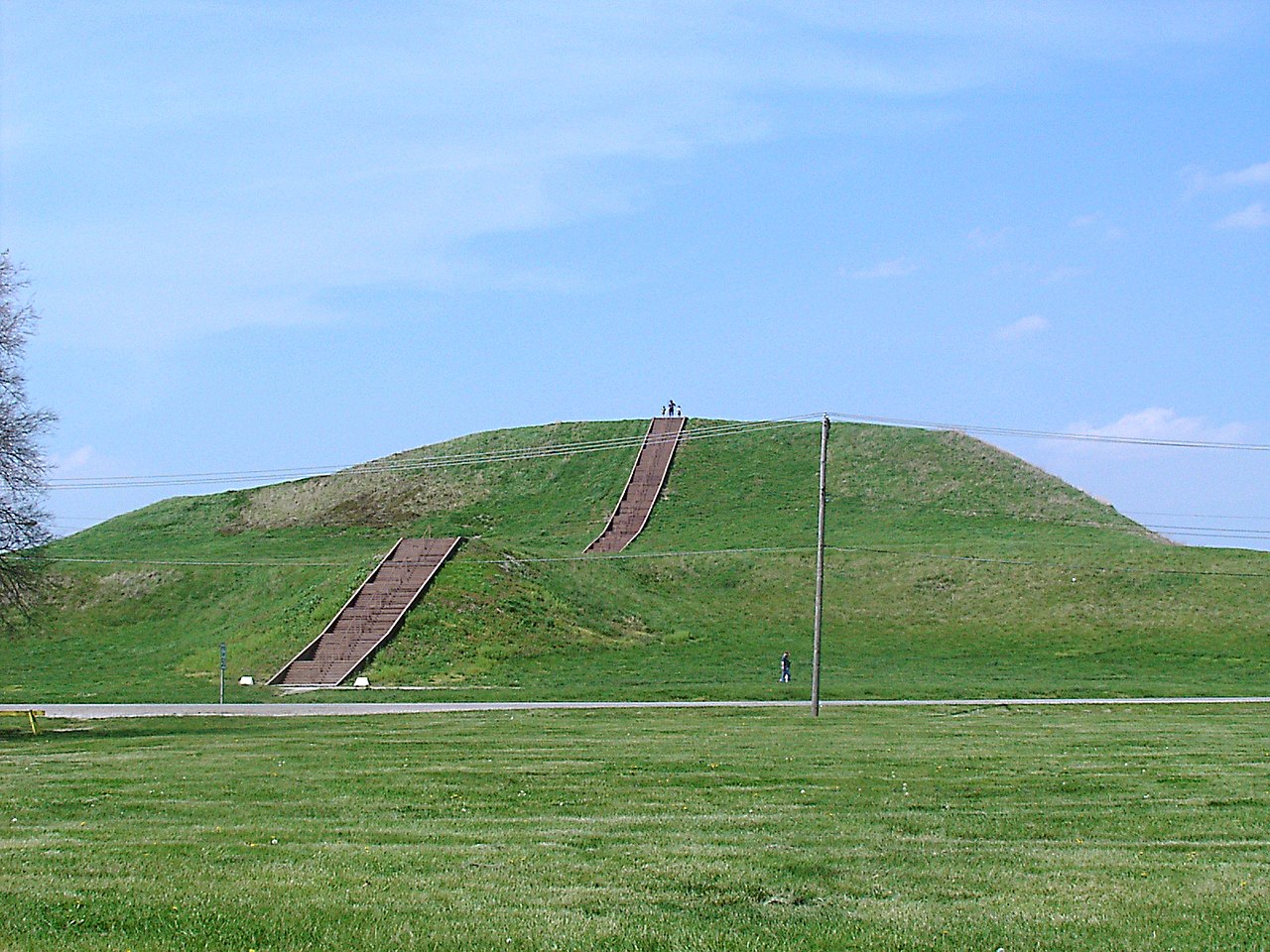
The grandest is Monks Mound at Cahokia, Illinois, the largest pre-Columbian earthwork in the Americas. Its construction began between 900 and 955 CE; it is about 30 metres high and 291 metres long including the access ramp, with a base about the size of the Great Pyramid of Giza. Effigy mounds are mounds shaped as animals or symbols; the effigy mound builders are mainly associated with 550 to 1200 CE, though radiocarbon dating puts the origin of some as far back as 320 BCE. The Great Serpent Mound in Ohio, 411 metres long and about 1.2 metres high, is the largest serpent effigy known, surveyed in 1848 by Squier and Davis.
Mounds are dated by radiocarbon dating of charcoal and by pottery; many were levelled by farming and by antiquarian digging. Nineteenth-century theories of a vanished race of Mound Builders have no support: the mounds were raised by Native American peoples.
When visiting, remember that many mounds are sacred places. Look for platform tops, the flat summits of mounds that held buildings, and for the ramps and plazas around them.
Paraphrased from Wikipedia: Adena culture, Wikipedia: Hopewell tradition, Wikipedia: Mississippian culture, Wikipedia: Serpent Mound, Wikipedia: Monks Mound, Wikipedia: Effigy mound, Wikipedia: Poverty Point, Wikipedia: Mound Builders · CC BY-SA 4.0
From the article
Dated moments in the story
- 800 BCE
The Woodland period (800 BCE–1200 CE) is known for its rich ritual and artistic life and well-developed villages.
Source - 800 BCE
This period is often referred to as the Early Woodland period, ranging between 800 BCE and 1 CE.
Source - 300 BCE
In 2014, radiocarbon dating determined the mound was built in 300 BCE by the Adena peoples.
Source - 1100
This date was corroborated in 2019. Additionally, it was found that the mound was rebuilt or repaired around 1100 CE during the Fort Ancient period.
Source - 1211
The wood charcoal from within the remnant bed was carbon-dated back to the time of the Fort Ancient Culture, between the years of 1041 and 1211 CE.
Source - 1750
The Adena Mound site became the "type site" of the regional culture that is used by anthropologists. The Fort Ancient Culture refers to the peoples who predominantly inhabited land near the Ohio River valley in a culture that flourished from 1000 to 1750 CE.
Source - 1848
Squier and Edwin Hamilton Davis, were featured in their 1848 study Ancient Monuments of the Mississippi Valley, commissioned by the Smithsonian Institution.
Source - 1886
In 1886, with help from a group of wealthy women in Boston headed by Alice C.
Source - 1886
After raising funds to purchase the site, Frederic Ward Putnam returned to Serpent Mound in 1886. He worked for four years to excavate the burial sequence contents of both the Serpent Mound and two nearby conical mounds.
Source - 1890
The excavations focused on three sides of the conical mound that had been excavated previously by Putnam in 1890. In addition to these concentrations of artifacts, an ashy soil horizon was excavated north of the conical mound, where archaeologists were able to uncover many prehistoric artifacts.
Source - 1900
In 1900, the land and its ownership were granted to the Ohio State Archaeological and Historical Society (a predecessor of the present Ohio History Connection).
Source - 1900
Given the results found through carbon dating, burials in the conical mound dated to the Early Woodland and Fort Ancient periods, suggestive of ritual reuse of the circum mound area and ash bed. In 1900, the site was given to the Ohio History Society, now known as the Ohio History Connection.
Source - 1966
The United States Department of the Interior designated the mound as a National Historic Landmark in 1966. It is maintained by the Ohio History Connection, a nonprofit organization dedicated to preserving historical sites in Ohio.
Source - 1966
In 1966, Serpent Mound was added as a National Historic Landmark to the National Register of Historic Places.
Source
Photographs
5 photographs, each with its author and licence
More photographs
Lore
Evidence & Lore
What the sources actually support — and, kept apart, what has been claimed.
What the evidence supports
Dates
300 BCE–1100 CEHow this date was established: Radiocarbon datingRadiocarbon dates and later archaeological evidence were used to distinguish the mound's original construction from its rebuilding.Source for this date
Measured facts
- Mainstream position
- Radiocarbon evidence supports an Adena origin in 300 BCE, while the mound was rebuilt or repaired around 1100 CE during the Fort Ancient period.Source: Mainstream position
- Length
- 1,348 feet (411 m)Source: Length
- Height
- four feetSource: Height
- Location
- Peebles, Ohio, United StatesSource: Location
- Cultural attribution
- Adena construction, with later Fort Ancient rebuilding or repairSource: Cultural attribution
- National Historic Landmark
- designated in 1966Source: National Historic Landmark
- Maintainer
- Ohio History ConnectionSource: Maintainer
- Heritage designation
- National Historic Landmark, National Register of Historic Places listed place, Tentative World Heritage SiteSource: Heritage designation
Alternative claims
Alternative claims about this site, kept in their own block and labelled with where they stand.
The mound may depict a Dhegihan Siouan origin story involving the Great Serpent "Toothy Mouth."
Some people with Christian affinity regarded the earthen serpent as a mark of God indicating the location of the Garden of Eden and serving as a reminder of God's moral authority.
The appearance of Halley's Comet in 1066 could have influenced the mound's construction.
Where it stands
United States
The pin marks the monument itself — its exact point.
- Coordinates
- 39°01′33″ N, 83°25′50″ WFor a GPS or map app: 39.02586, -83.43044
Access is as our sources describe it; we have not visited the site to check.
Nearby
The closest sites in the Atlas, by straight line.




Sources
Every record behind this page, with the link it came from.
3 sources behind this page
- 01Wikidata Q968802wikidata.org
- 02Fringe claim sourceen.wikipedia.org
- 03Fringe claim sourceen.wikipedia.org
Image files
Report a correctionWrong date, name, photograph or source? Tell us and it will be put right.
Lore, kept apart
Legends and claims
These are stories and claims reported by the sources. They are not evidence, and they never stand in for the dating above.
- Tested: not supported
The mound may depict a Dhegihan Siouan origin story involving the Great Serpent "Toothy Mouth."
Source - Tested: not supported
Some people with Christian affinity regarded the earthen serpent as a mark of God indicating the location of the Garden of Eden and serving as a reminder of God's moral authority.
Source - Tested: not supported
The appearance of Halley's Comet in 1066 could have influenced the mound's construction.
Source
Around this place
The ten nearest sites, by compass
Credit
Text, licence and sources
Adapted from the Wikipedia article "Serpent Mound" (English), licensed CC BY-SA 4.0; authors are listed in the page history. Reused under CC BY-SA 4.0. Read on Wikipedia · Edit history and authors
- Wikipedia (English): Serpent MoundCC BY-SA 4.0
- Wikidata Q968802CC0
- Fringe claim sourceCC BY-SA 4.0