
Megalithic mound (tumulus with integral stones)
Serpent Mounds
Photo Yoho2001 · CC BY-SA 3.0Source file on Wikimedia Commons
Overview
About this site
What the sources say
Les tumulus Serpent sont un site archéologique et funéraire situé à Keene en Ontario, en surplomb du lac Rice, dans le comté de Peterborough.
Ce site funéraire est situé dans le Parc provincial Serpent Mounds, un parc provincial actuellement non-opérationnel qui a été cédé aux Hiawatha, tribu des Mississaugas, qui ont continué à exploiter le site.
Il a été reconnu en tant que lieu historique national du Canada en 1982.
Article in FrenchRead on Wikipedia3 min readCC BY-SA 4.0
The full article
Serpent Mounds: the whole story
In briefSources for this section
- Wikipedia (French): Tumulus SerpentCC BY-SA 4.0
Sources for this section
- Wikipedia (French): Tumulus SerpentCC BY-SA 4.0
Serpent Mounds is an archaeological and funerary site at Keene in Ontario, Canada, overlooking Lake Rice in Peterborough County. It lies within Serpent Mounds Provincial Park, a provincial park that is currently non-operational and was ceded to the Hiawatha, a Mississauga tribe, who continued to use the site. It was recognized as a national historic site of Canada in 1982.
The site consists of nine distinct funerary tumuli. The largest is sinuous in shape, about 60 m long, 8 m wide and 1.8 m at its highest point. It is surrounded by eight smaller oval or round tumuli, often called “the serpent’s eggs.” Although the record classifies the site as a megalithic mound with integral stones, the wider tradition describes earthworks of piled soil rather than megaliths.
The site was first explored in the late nineteenth century by the archaeologist David Boyle. It is dated between 50 BC and 300 AD and is linked with the Point Peninsula culture, a cultural period that spread across present-day Ontario and the State of New York from 600 BC to 700 AD during the sylvicole period.
Serpent Mounds is unique in Canada. The name comes from the winding shape of the largest tumulus and the accompanying oval mounds known as the serpent’s eggs. The site appears in a list of heritage places in Peterborough County, alongside the Great Serpent Mound in Ohio, USA.
No English Wikipedia article exists for it; the full text below is the French article "Tumulus Serpent", shown in the original language.
Summary in EnglishSources for this section
- Wikipedia (French): Tumulus SerpentCC BY-SA 4.0
Sources for this section
- Wikipedia (French): Tumulus SerpentCC BY-SA 4.0
Serpent Mounds is a megalithic mound (tumulus with integral stones) in Peterborough County, Canada. Wikidata describes it as: burial mounds in Peterborough County, Ontario, Canada. No English Wikipedia article exists for it; the full text below is the French article "Tumulus Serpent", shown in the original language.
DescriptionSources for this section
- Wikipedia (French): Tumulus SerpentCC BY-SA 4.0
Sources for this section
- Wikipedia (French): Tumulus SerpentCC BY-SA 4.0
Le site est un groupement de neuf tumulus funéraires distincts, le plus important étant de forme sinueuse et long d'environ 60 m, large de 8 m et d'une hauteur maximale de 1,8 m. Celui-ci est entouré de huit autres tumulus de forme ovale ou ronde, souvent appelés « les oeufs du serpent ». Le site a été exploré initialement à la fin du XIXe siècle par l'archéologue David Boyle (en). Il est daté entre l'an 50 av. J.-C. et l'an 300 apr. J.-C. C'est un site unique en son genre au Canada, qui est associé à la culture de Point Peninsula (en), une période culturelle amérindienne qui s'est étendue sur l'Ontario et l'État de New York actuels de 600 av. J.-C. à 700 apr. J.-C., durant la période sylvicole.
How this page was madeSources for this section
- Wikipedia (French): Tumulus SerpentCC BY-SA 4.0
Sources for this section
- Wikipedia (French): Tumulus SerpentCC BY-SA 4.0
The summary at the top of this page was written by MiniMax-M3 (2026-11-08) from the cited Wikipedia article “Tumulus Serpent”, translated from French. The numbers in it were checked automatically against the source text. The rest of the page is the article itself, the structured records and computed distances.
Tradition and region
About this kind of monument
Native American earthen mounds
Eastern North America has many earthen mounds, built over several thousand years by Native American peoples. They are not megaliths, but earthworks of piled soil, and they served as graves, platforms and symbols. The Adena culture of the Early Woodland period, from 500 BCE to 100 CE and centred on Ohio, built burial mounds and shared a ceremonial system. The Hopewell tradition, a network of cultures from 100 BCE to 500 CE, exchanged goods from Lake Ontario to Florida and raised burial mounds and geometric enclosures. The Mississippian period, from the end of the tenth century to the sixteenth, brought maize farming, large towns, and platform mounds on which temples and chiefs' houses stood.
The grandest is Monks Mound at Cahokia, Illinois, the largest pre-Columbian earthwork in the Americas. Its construction began between 900 and 955 CE; it is about 30 metres high and 291 metres long including the access ramp, with a base about the size of the Great Pyramid of Giza. Effigy mounds are mounds shaped as animals or symbols; the effigy mound builders are mainly associated with 550 to 1200 CE, though radiocarbon dating puts the origin of some as far back as 320 BCE. The Great Serpent Mound in Ohio, 411 metres long and about 1.2 metres high, is the largest serpent effigy known, surveyed in 1848 by Squier and Davis.
Mounds are dated by radiocarbon dating of charcoal and by pottery; many were levelled by farming and by antiquarian digging. Nineteenth-century theories of a vanished race of Mound Builders have no support: the mounds were raised by Native American peoples.
When visiting, remember that many mounds are sacred places. Look for platform tops, the flat summits of mounds that held buildings, and for the ramps and plazas around them.
Paraphrased from Wikipedia: Adena culture, Wikipedia: Hopewell tradition, Wikipedia: Mississippian culture, Wikipedia: Serpent Mound, Wikipedia: Monks Mound, Wikipedia: Effigy mound, Wikipedia: Poverty Point, Wikipedia: Mound Builders · CC BY-SA 4.0
From the article
Dated moments in the story
- 600 CE
C'est un site unique en son genre au Canada, qui est associé à la culture de Point Peninsula (en), une période culturelle amérindienne qui s'est étendue sur l'Ontario et l'État de New York actuels de 600 av.
Source - 1982
Il a été reconnu en tant que lieu historique national du Canada en 1982.
Source
See it in 3D
An interpretive reconstruction of the monument, standing on the real ground at its exact point, under the sun for that place and season. Drag to look around it.
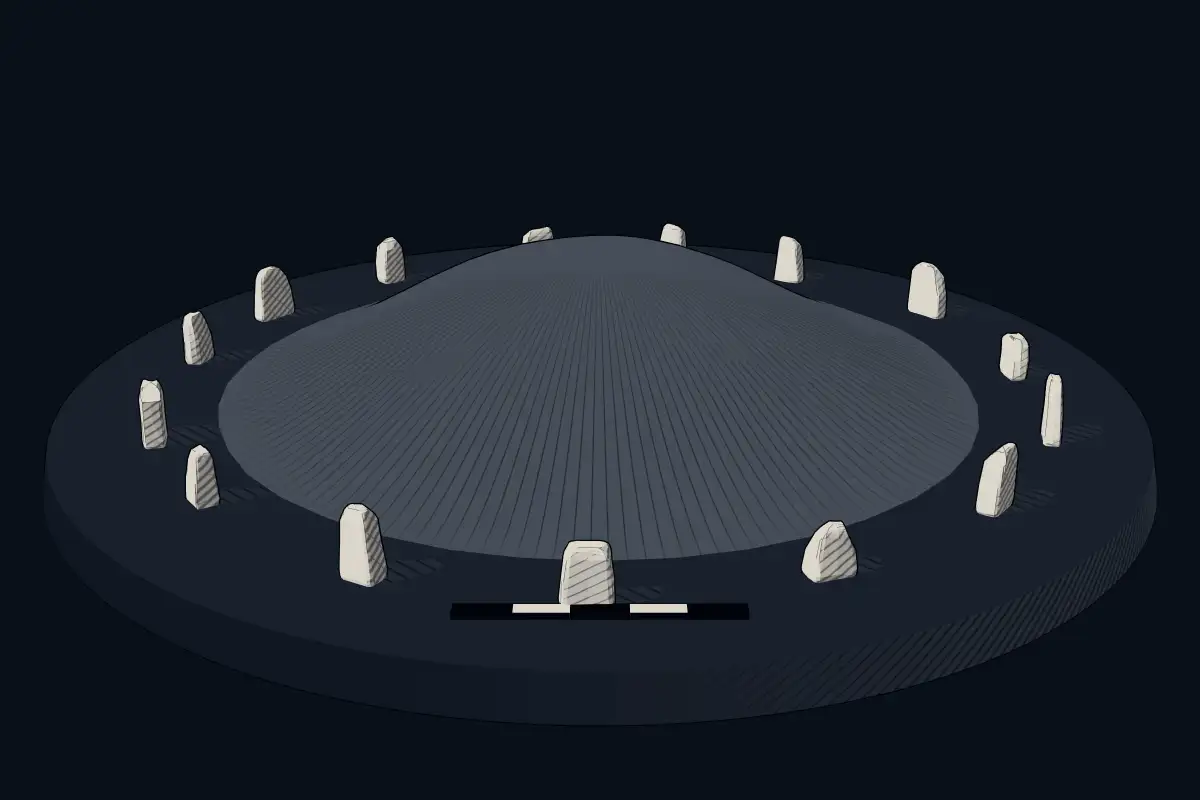
The reconstruction is ours, not a survey: it shows what a monument of this type looks like, at the size the record gives for this one.
Photographs
1 photograph, each with its author and licence
Where it stands
Canada
The pin marks the monument itself — its exact point.
- Coordinates
- 44°12′40″ N, 78°09′25″ WFor a GPS or map app: 44.21110, -78.15690
Access is as our sources describe it; we have not visited the site to check.
Nearby
The closest sites in the Atlas, by straight line.


Sources
Every record behind this page, with the link it came from.
1 source behind this page
- 01Wikidata Q7455094wikidata.org
Image files
Report a correctionWrong date, name, photograph or source? Tell us and it will be put right.
Credit
Text, licence and sources
Text from the Wikipedia article "Tumulus Serpent" (French), licensed CC BY-SA 4.0; authors are listed in the page history. Reused under CC BY-SA 4.0. Read on Wikipedia · Edit history and authors
- Wikipedia (French): Tumulus SerpentCC BY-SA 4.0
- Wikidata Q7455094CC0