
Lapa da Meruje
DatedEst. 4000–3000 BCE
Photo AJFAlmeida · CC BY-SA 4.0Source file on Wikimedia Commons

Overview
About this site
What the sources say
Le Dolmen de Lapa de Meruge est un dolmen situé dans la freguesia de Cambra e Carvalhal de Vermilhas (pt), sur le territoire de la municipalité de Vouzela (district de Viseu, Portugal).
Il ne bénéficie pas actuellement d'un classement de protection.
Article in FrenchRead on Wikipedia3 min readCC BY-SA 4.0
Where it sits in time
The site's dated range, placed against world reference points.
The scale is logarithmic: each step to the left is about ten times older than the last.
The full article
Lapa da Meruje: the whole story
In briefSources for this section
- Wikipedia (French): Dolmen de Lapa de MerugeCC BY-SA 4.0
Sources for this section
- Wikipedia (French): Dolmen de Lapa de MerugeCC BY-SA 4.0
The Dolmen de Lapa de Meruge is a dolmen in the freguesia of Cambra e Carvalhal de Vermilhas, in the municipality of Vouzela, district of Viseu, Portugal. It does not currently have a protection designation. Two nearby sites are Anta da Arca and the dolmen de Malhada do Cambarinho.
The monument has a polygonal chamber made up of 6 orthostates, topped by a roof slab measuring 3,2 × 2,8 m. A tumulus covers almost the whole structure, and the pillars of the access passage remain visible. The site was partly backfilled after excavation, but the monument can still be viewed from a platform on the east side.
Archaeological excavations were carried out from 2016 to 2018 by students from the Universidade do Algarve and the Universidade Nova de Lisboa, together with local volunteers. A trench was first dug to the south, revealing the original passage, which was then cleared. The passage and chamber were later excavated more deeply. The dating of 4000 BCE to 3000 BCE is a typological estimate.
Dolmens are the type of monument more commonly called antas in the Évora area of the Alentejo, where some of the largest examples in Iberia stand. Research on the Great Dolmen of Zambujeiro, dated to between 4000 and 3000 BCE, recovered slate tablets, necklaces, crosiers, copper objects, ceramics and carinated bowls, suggesting that such tombs were used over generations.
No English Wikipedia article exists for it; the full text below is the French article "Dolmen de Lapa de Meruge", shown in the original language.
Summary in EnglishSources for this section
- Wikipedia (French): Dolmen de Lapa de MerugeCC BY-SA 4.0
Sources for this section
- Wikipedia (French): Dolmen de Lapa de MerugeCC BY-SA 4.0
Lapa da Meruje is a dolmen in Cambra e Carvalhal de Vermilhas, Portugal. A typological estimate: 4000 BCE to 3000 BCE. No English Wikipedia article exists for it; the full text below is the French article "Dolmen de Lapa de Meruge", shown in the original language.
DescriptionSources for this section
- Wikipedia (French): Dolmen de Lapa de MerugeCC BY-SA 4.0
Sources for this section
- Wikipedia (French): Dolmen de Lapa de MerugeCC BY-SA 4.0
Des fouilles archéologiques ont été réalisés par des étudiants de l'Universidade do Algarve et de l'Universidade Nova de Lisboa, ainsi que par des bénévoles locaux de 2016 à 2018.
Ce monument mégalithique est composé d'une chambre polygonale de 6 orthostates et une dalle de toit de 3,2 × 2,8 m. Le tumulus recouvre la quasi-totalité du monument et les piliers du couloir d'accèssont visibles.
Une tranchée a d'abord été creusée au sud, puis le passage d'origine a été dégagé. Le passage et la chambre ont été partiellement creusés plus profondément. La zone est aujourd'hui partiellement recouverte, mais peut être observée depuis une plateforme à l'est du dolmen.
A proximité se trouvent l'Anta da Arca et le dolmen de Malhada do Cambarinho.
How this page was madeSources for this section
- Wikipedia (French): Dolmen de Lapa de MerugeCC BY-SA 4.0
Sources for this section
- Wikipedia (French): Dolmen de Lapa de MerugeCC BY-SA 4.0
The summary at the top of this page was written by MiniMax-M3 (2026-11-08) from the cited Wikipedia article “Dolmen de Lapa de Meruge”, translated from French. The numbers in it were checked automatically against the source text. The rest of the page is the article itself, the structured records and computed distances.
Tradition and region
About this kind of monument
Portuguese antas of the Alentejo
Around Évora, in the Alentejo, megalithic tombs are called antas, and some of the largest in Iberia stand here. The Great Dolmen of Zambujeiro, near Valverde in the municipality of Évora, is considered one of the biggest such structures in Iberia. Research has dated it to between 4000 and 3000 BCE, concurrent with the megalithic building of the Évora region, and it is linked to the Great Dolmen of Comenda da Igreja at Montemor-o-Novo. Henrique Leonor Pina excavated it in 1965, and although his methods caused some controversy, the work recovered slate tablets, necklaces, crosiers, copper objects, ceramics and carinated bowls. The Portuguese government declared it a national monument in 1971.
The finds show that the tombs were used for generations: slate tablets, personal ornaments and copper objects in the chambers reach into the Chalcolithic, so one anta can carry evidence for several centuries of burial custom. Excavated anta chambers are the main source for dating, since the stones themselves cannot be dated.
Nearby, the Almendres Cromlech is a large group of standing stones, a reminder that the Alentejo's megalithic landscape also includes open-air stone enclosures and single menhirs, not only tombs.
The Atlas's records here include small antas, some reduced to a few standing slabs, and many lack a secure excavation date. They are labelled with a typological range.
When visiting, look for the chamber and the passage that leads to it, and for the way the monument sits in its field. Check access in advance.
Paraphrased from Wikipedia: Great Dolmen of Zambujeiro, Wikipedia: Great Dolmen of Comenda da Igreja, Wikipedia: Almendres Cromlech, Wikipedia: Dolmen · CC BY-SA 4.0
From the article
Dated moments in the story
- 2016
Des fouilles archéologiques ont été réalisés par des étudiants de l'Universidade do Algarve et de l'Universidade Nova de Lisboa, ainsi que par des bénévoles locaux de 2016 à 2018. Ce monument mégalithique est composé d'une chambre polygonale de 6 orthostates et une dalle de toit de 3,2 × 2,8 m.
Source
See it in 3D
An interpretive reconstruction of the monument, standing on the real ground at its exact point, under the sun for that place and season. Drag to look around it.
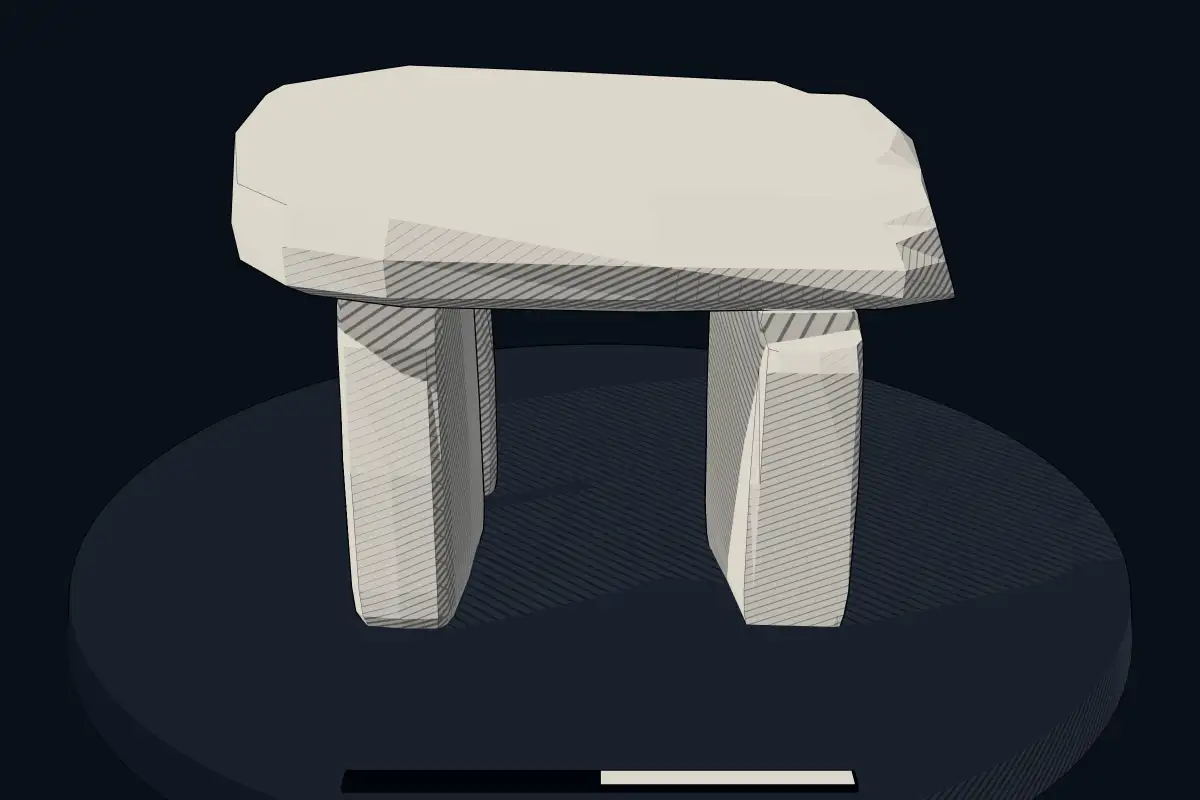
The reconstruction is ours, not a survey: it shows what a monument of this type looks like, at the size the record gives for this one.
Photographs
1 photograph, each with its author and licence
Lore
Evidence & Lore
What the sources actually support — and, kept apart, what has been claimed.
What the evidence supports
Dates
Est. 4000–3000 BCEHow this date was established: Type comparisonTypical range for dolmens in Portugal; this site has not been dated itself. Most dolmens date from the Late Neolithic period (4000-3000 BCE); megalithic tombs at Algarve in Portugal date to c. 2500 BC.Source for this date
Where it stands
Portugal
The pin marks the monument itself — its exact point.
- Coordinates
- 40°38′27″ N, 8°08′22″ WFor a GPS or map app: 40.64092, -8.13932
Access is as our sources describe it; we have not visited the site to check.
Nearby
The closest sites in the Atlas, by straight line.
- Megalithic mound (tumulus with integral stones)Mamoa 1 do Vale d´Anta
- Menhir (standing stone)Estela Menir da Caparrosa2800–1800 BCE
 Dólmen da Malhada do Cambarinho4000–3000 BCE
 Anta da Arca4000–3000 BCE
 Antelas dolmen4000–3000 BCE
- DolmenAnta do Repilau4000–3000 BCE
 Anta da Lameira do Fojo 14000–3000 BCE
 Monumentos Megalíticos do Chão de Redondo 1 e 2


Sources
Every record behind this page, with the link it came from.
2 sources behind this page
- 01Wikidata Q86660479wikidata.org
- 02Source for this dateen.wikipedia.org
Image files
- Dólmen da Lapa de Meruge.jpgAJFAlmeidaCC BY-SA 4.0
Report a correctionWrong date, name, photograph or source? Tell us and it will be put right.
Around this place
The ten nearest sites, by compass
- Mamoa 1 do Vale d´Anta2.4 km NE
- Estela Menir da Caparrosa4.6 km E
- Dólmen da Malhada do Cambarinho4.6 km N
- Anta da Arca7.3 km SW
- Antelas dolmen12 km NW
- Anta do Repilau14 km NE
- Anta da Lameira do Fojo 115 km NE
- Monumentos Megalíticos do Chão de Redondo 1 e 215 km W
- anta da Capela dos Mouros15 km W
- Dolmén ou Mamoa 1 do Juncal18 km N
Credit
Text, licence and sources
Text from the Wikipedia article "Dolmen de Lapa de Meruge" (French), licensed CC BY-SA 4.0; authors are listed in the page history. Reused under CC BY-SA 4.0. Read on Wikipedia · Edit history and authors