

Overview
About this site
Overview
The Anta da Arca is a megalithic monument at Paranho de Arca, in the former parish of Arca, Oliveira de Frades, Portugal. It is a dolmen with a large irregular polygonal chamber, dated to the Chalcolithic and classified as a National Monument by decree of 16 June 1910.
It has no corridor and no mound (mamoa), which distinguishes it from the dolmens of the Beira Alta.
Read on Wikipedia3 min readCC BY-SA 4.0
Where it sits in time
The site's dated range, placed against world reference points.
The scale is logarithmic: each step to the left is about ten times older than the last.
Article
Anta da Arca
5, between Águeda and Caramulo, with access on the left at Paranho de Arca along about 50 m of dirt track.
DescriptionSources for this section
- Wikipedia (Portuguese): Anta da ArcaCC BY-SA 4.0
Sources for this section
- Wikipedia (Portuguese): Anta da ArcaCC BY-SA 4.0
The monument stands on the EN230 at km 48.5, between Águeda and Caramulo, with access on the left at Paranho de Arca along about 50 m of dirt track.
The Anta da Arca is thought to have been built in the late Chalcolithic. Its chamber is polygonal and irregular and is formed of five or seven orthostats (esteios) with a cover. Several of the orthostats are already broken, which makes the original structure hard to interpret, but three are complete and support a large slab that covers the interior. The chamber is large, measuring 4.5 m in length, 3.75 m in width and 2.65 m in height. The slab has rounded edges and measures approximately 4.20 m by 3.20 m.
In the region, the only other dolmen without a corridor is the Anta de Pera de Moço in the municipality of Guarda. It is possible that the Anta da Arca originally had a corridor whose stones were lost and reused in neighbouring buildings. A typological estimate in the catalogue places the monument between 4000 and 3000 BCE.
Research historySources for this section
- Wikipedia (Portuguese): Anta da ArcaCC BY-SA 4.0
Sources for this section
- Wikipedia (Portuguese): Anta da ArcaCC BY-SA 4.0
The monument is mentioned in the Diccionario Geographico (1747-1752) of Luís Cardoso and in the Memórias Paroquiais of 1758. The latter describes it as a large flat slab of coarse stone suspended in the air over three other upright stones of the same kind, and states that it is called the Pedra da Arqua, a name it has always kept as far as human memory reaches.
The first scientific mention was made by José Leite de Vasconcelos in an article of 1898 in O Arqueólogo Português. He stated his intention to explore the anta, which took place only in 1921.
FolkloreSources for this section
- Wikipedia (Portuguese): Anta da ArcaCC BY-SA 4.0
Sources for this section
- Wikipedia (Portuguese): Anta da ArcaCC BY-SA 4.0
According to a legend, the anta was built by an enchanted moura (Moorish woman), who arrived carrying the slab on her head while she spun. She is said to appear on St John's Night displaying a treasure of gold objects hidden in the anta, and visitors who admire the gold more than her eyes are turned to dust. It is also said that the treasure can be obtained by praying to São Cipriano, but attempts to do so have failed.
The motif of a supernatural moura who builds and inhabits dolmens, including the detail of the spindle, is a tradition of medieval origin that is very popular in Portugal, Galicia and other regions of the Iberian Peninsula.
Tradition and region
About this kind of monument
Portuguese antas of the Alentejo
Around Évora, in the Alentejo, megalithic tombs are called antas, and some of the largest in Iberia stand here. The Great Dolmen of Zambujeiro, near Valverde in the municipality of Évora, is considered one of the biggest such structures in Iberia. Research has dated it to between 4000 and 3000 BCE, concurrent with the megalithic building of the Évora region, and it is linked to the Great Dolmen of Comenda da Igreja at Montemor-o-Novo. Henrique Leonor Pina excavated it in 1965, and although his methods caused some controversy, the work recovered slate tablets, necklaces, crosiers, copper objects, ceramics and carinated bowls. The Portuguese government declared it a national monument in 1971.
The finds show that the tombs were used for generations: slate tablets, personal ornaments and copper objects in the chambers reach into the Chalcolithic, so one anta can carry evidence for several centuries of burial custom. Excavated anta chambers are the main source for dating, since the stones themselves cannot be dated.
Nearby, the Almendres Cromlech is a large group of standing stones, a reminder that the Alentejo's megalithic landscape also includes open-air stone enclosures and single menhirs, not only tombs.
The Atlas's records here include small antas, some reduced to a few standing slabs, and many lack a secure excavation date. They are labelled with a typological range.
When visiting, look for the chamber and the passage that leads to it, and for the way the monument sits in its field. Check access in advance.
Paraphrased from Wikipedia: Great Dolmen of Zambujeiro, Wikipedia: Great Dolmen of Comenda da Igreja, Wikipedia: Almendres Cromlech, Wikipedia: Dolmen · CC BY-SA 4.0
From the article
Dated moments in the story
- 1747
A Anta da Arca é mencionada no Diccionario Geographico (1747-1752) de Luís Cardoso e também nas Memórias Paroquiais de 1758, onde é descrita como "hum grande Lapam de pedra groça suspensa no ar sobre outra tres pedras postas ao alto, que sam da mesma qualidade de pedra groça e muar", e se indica que "tem por nome a...
Source - 1898
Porém, a primeira menção científica ao monumento foi realizada por José Leite de Vasconcelos num artigo de 1898, publicado n'O Arqueólogo Português.
Source - 1910
Datada do período Calcolítico, a anta foi classificada como Monumento Nacional por decreto de 16 de Junho de 1910.
Source - 1921
Ali, Leite de Vasconcelos revela sua intenção de explorar a anta, o que ocorreria apenas em 1921.
Source
See it in 3D
An interpretive reconstruction of the monument, standing on the real ground at its exact point, under the sun for that place and season. Drag to look around it.
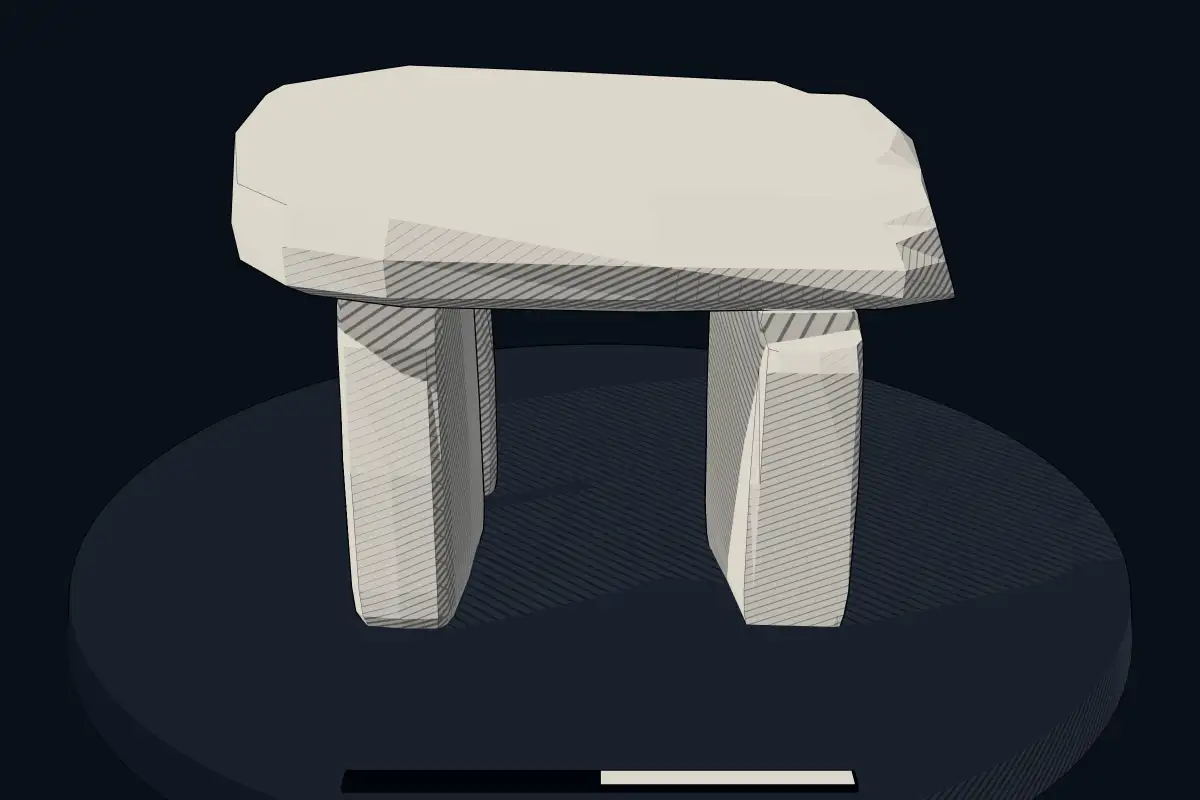
The reconstruction is ours, not a survey: it shows what a monument of this type looks like, at the size the record gives for this one.
Photographs
3 photographs, each with its author and licence
More photographs


Lore
Evidence & Lore
What the sources actually support — and, kept apart, what has been claimed.
What the evidence supports
Dates
Est. 4000–3000 BCEHow this date was established: Type comparisonTypical range for dolmens in Portugal; this site has not been dated itself. Most dolmens date from the Late Neolithic period (4000-3000 BCE); megalithic tombs at Algarve in Portugal date to c. 2500 BC.Source for this date
Where it stands
Portugal
The pin marks the monument itself — its exact point.
- Coordinates
- 40°36′28″ N, 8°12′49″ WFor a GPS or map app: 40.60770, -8.21350
Access is as our sources describe it; we have not visited the site to check.
Nearby
The closest sites in the Atlas, by straight line.
 Lapa da Meruje4000–3000 BCE
- Megalithic mound (tumulus with integral stones)Mamoa 1 do Vale d´Anta
 Monumentos Megalíticos do Chão de Redondo 1 e 2
- Menhir (standing stone)Estela Menir da Caparrosa2800–1800 BCE
 Dólmen da Malhada do Cambarinho4000–3000 BCE
 Antelas dolmen4000–3000 BCE
 anta da Capela dos Mouros4000–3000 BCE
 Monumentos Megalíticos do Souto do Coval


Sources
Every record behind this page, with the link it came from.
2 sources behind this page
- 01Wikidata Q16490862wikidata.org
- 02Source for this dateen.wikipedia.org
Image files
- Anta de Arca.JPGAlta FalisaCC BY-SA 4.0
- AntaArca-1898-1.jpgJosé Leite de Vasconcelos (1858-1941)Public domain
- Dólmen do Espírito Santo da Arca.jpgAJFAlmeidaCC BY-SA 4.0
Report a correctionWrong date, name, photograph or source? Tell us and it will be put right.
Lore, kept apart
Legends and claims
These are stories and claims reported by the sources. They are not evidence, and they never stand in for the dating above.
- Tradition
Segundo uma lenda, a anta foi construída por uma moura encantada, que chegou ao local carregando a pedra da laje sobre a cabeça enquanto fiava.
Segundo uma lenda, a anta foi construída por uma moura encantada, que chegou ao local carregando a pedra da laje sobre a cabeça enquanto fiava. A moura aparece na Noite de São João exibindo um tesouro de objectos de ouro, que se encontra escondido na anta. Aqueles visitantes que admirem mais os objectos de ouro que os olhos da moura são transformados em pó. Conta-se também que o tesouro da anta pode ser obtido rezando a São Cipriano, mas que as tentativas de consegui-lo falharam. O motivo folclórico de uma moura sobrenatural que constrói e habita dólmens, incluindo o detalhe da roca de fiar, é uma tradição de origem medieval muito popular em Portugal, Galiza e outras regiões da Península.
Source
Around this place
The ten nearest sites, by compass
- Lapa da Meruje7.3 km NE
- Mamoa 1 do Vale d´Anta9.6 km NE
- Monumentos Megalíticos do Chão de Redondo 1 e 210 km NW
- Estela Menir da Caparrosa11 km E
- Dólmen da Malhada do Cambarinho11 km NE
- Antelas dolmen12 km N
- anta da Capela dos Mouros12 km NW
- Monumentos Megalíticos do Souto do Coval19 km NW
- Anta de Arquinha da Moura21 km SE
- Anta da Arquinha da Moura21 km SE
Credit
Text, licence and sources
Adapted from the Wikipedia article "Anta da Arca" (Portuguese), licensed CC BY-SA 4.0; authors are listed in the page history. Reused under CC BY-SA 4.0. Read on Wikipedia · Edit history and authors
- Wikipedia (Portuguese): Anta da ArcaCC BY-SA 4.0
- Wikidata Q16490862CC0