.jpg/1920px-2026.07.14.Cloghcor.PortalTomb_(1).jpg 1920w)
Portal Tomb von Cloghcor
DatedEst. 4000–3000 BCE
Photo Wanfried-Dublin · CC BY 4.0Source file on Wikimedia Commons

Overview
About this site
Overview
The portal tomb of Cloghcor stands in the townland of Cloghcor (Irish An Chloch Chorr), on a meadow on a rise above Drumcliff Bay, Ireland. Portal tombs are a type of Neolithic chamber tomb, and this one is estimated, by type, to date to between 4000 and 3000 BCE.
Two tall portal stones and a displaced capstone remain. On older maps the monument is also marked as Druid's Altar.
Read on Wikipedia2 min readCC BY-SA 4.0
Where it sits in time
The site's dated range, placed against world reference points.
The scale is logarithmic: each step to the left is about ten times older than the last.
Article
Portal Tomb von Cloghcor
From it there are good views of Knocknarea to the south and Ben Bulben to the east, and as far as the mountains of Donegal to the north-west and Mayo to the south-west.
SettingSources for this section
- Wikipedia (German): Portal Tomb von CloghcorCC BY-SA 4.0
Sources for this section
- Wikipedia (German): Portal Tomb von CloghcorCC BY-SA 4.0
The tomb lies on a rise 400 m from Drumcliff Bay. From it there are good views of Knocknarea to the south and Ben Bulben to the east, and as far as the mountains of Donegal to the north-west and Mayo to the south-west. The position is unusual for a portal tomb, since these monuments are normally found in a hollow or on low ground near running water.
DescriptionSources for this section
- Wikipedia (German): Portal Tomb von CloghcorCC BY-SA 4.0
Sources for this section
- Wikipedia (German): Portal Tomb von CloghcorCC BY-SA 4.0
Although the design is relatively simple and the monument is no longer complete, it makes an imposing impression. The two large portal stones are about 2.50 metres high. They narrow inwards from 1.30 to 0.60 metres, which forms a funnel-like entrance.
The large capstone is 3.40 metres long, and its width tapers from 2.00 to 0.85 metres. It has slipped and is no longer in its original position. No further stones are visible on the eastern side, but more stones can be seen to the west. One of these carries decoration, which was recognised only in 2020.
ContextSources for this section
- Wikipedia (German): Portal Tomb von CloghcorCC BY-SA 4.0
Sources for this section
- Wikipedia (German): Portal Tomb von CloghcorCC BY-SA 4.0
Ireland has about 172 dolmens, a form of single-chamber portal tomb, and they are among the best known monuments of the Neolithic farmers who built them. Poulnabrone in the Burren, County Clare, with three portal stones carrying a heavy horizontal capstone, is the best known. Such monuments were built as tombs.
Tradition and region
About this kind of monument
Irish portal tombs
Ireland has about 172 dolmens, a form of single-chamber portal tomb, and they are among the best known monuments of the Neolithic farmers who built them more than five thousand years ago. Poulnabrone dolmen in the Burren, County Clare, is the best known: three portal stones carry a heavy horizontal capstone, and it stands on one of the highest points of an unusual limestone, or karst, landscape formed some 350 million years ago. It dates to the early Neolithic, with estimates between 3800 and 3200 BCE. The name Poll na Brón means "hole of the quernstone".
Brownshill Dolmen, three kilometres east of Carlow, is a very large portal tomb with three large uprights; its capstone is estimated to weigh 150 tonnes and is reputed to be the heaviest in Europe. It was built between 4000 and 3000 BCE and is a National Monument. These dolmens were built as tombs, and the capstones were once hidden under a mound of stones or earth that has since gone.
Folklore: at Proleek in County Louth, local legend says that the dolmen was carried there by the Scottish giant Para Buidhe Mór Mhac Seoidin, who challenged the hero Fionn mac Cumhaill to combat. Fionn poisoned a nearby river, Para drank from it, and the giant was buried at the site. A wedge-shaped gallery grave called the Giant's Grave lies about 90 metres to the south-east. The tale is traditional.
When visiting, look at how the portal stones frame the entrance and how the capstone slopes down towards the back, and note that some tombs stand close to roads.
Paraphrased from Wikipedia: Poulnabrone dolmen, Wikipedia: Brownshill Dolmen, Wikipedia: Proleek Dolmen, Wikipedia: Portal dolmen, Wikipedia: Dolmen · CC BY-SA 4.0
From the article
Dated moments in the story
- 2020
Diese wurden erst 2020 erkannt.
Source
See it in 3D
An interpretive reconstruction of the monument, standing on the real ground at its exact point, under the sun for that place and season. Drag to look around it.
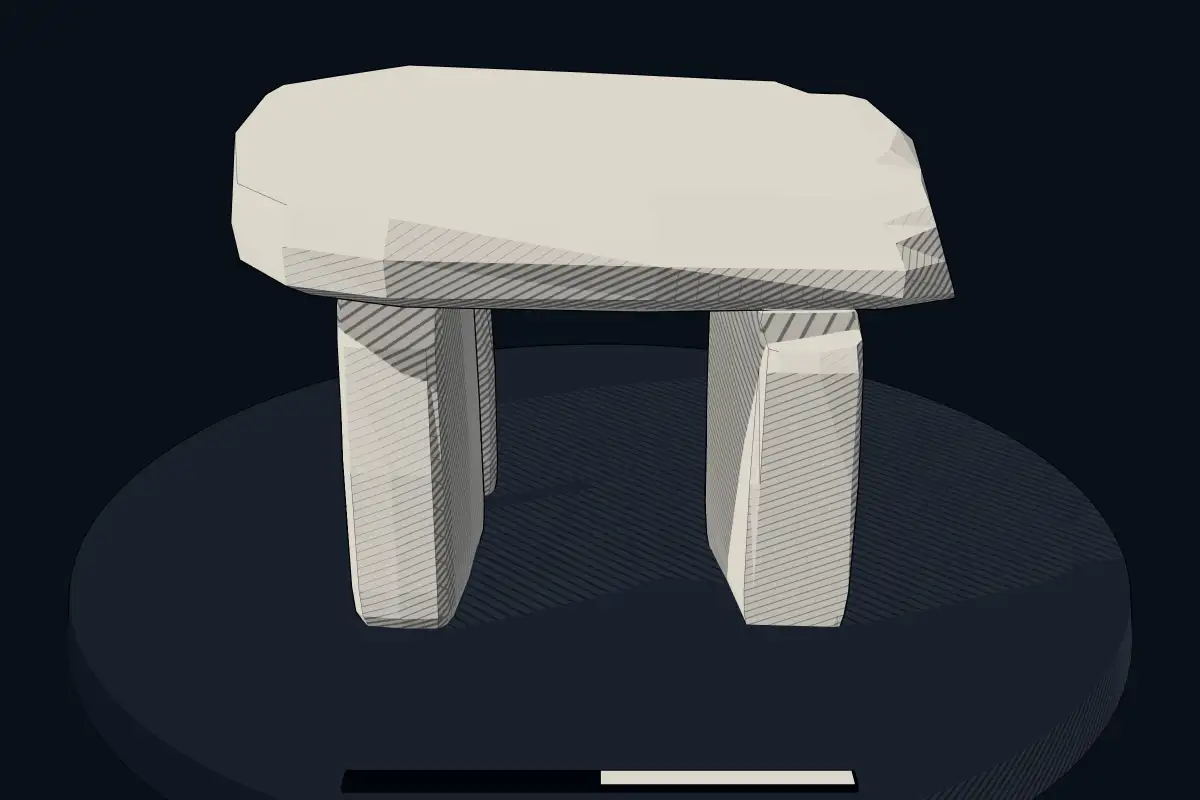
The reconstruction is ours, not a survey: it shows what a monument of this type looks like, at the size the record gives for this one.
Photographs
1 photograph, each with its author and licence
Lore
Evidence & Lore
What the sources actually support — and, kept apart, what has been claimed.
What the evidence supports
Dates
Est. 4000–3000 BCEHow this date was established: Type comparisonTypical range for dolmens in Ireland; this site has not been dated itself. Irish portal tombs are dolmens and most date from the Late Neolithic period (4000-3000 BCE).Source for this date
Where it stands
Ireland
The pin marks the monument itself — its exact point.
- Coordinates
- 54°20′29″ N, 8°37′02″ WFor a GPS or map app: 54.34131, -8.61735
Access is as our sources describe it; we have not visited the site to check.
Nearby
The closest sites in the Atlas, by straight line.
 Streedagh
- Wedge tombCoolbeg2500–2000 BCE
- Court tomb (court cairn)Cummeen Court Cairn3750–2900 BCE
 Knocknarea passage tombs3400–2900 BCE
 Queen Maeves Tomb Knocknarea3700–2900 BCE
 Miosgán Médhbh3050–2950 BCE
- Court tomb (court cairn)Gortnaleck Court Tomb3750–2900 BCE
- Passage tomb (passage grave)Carrowmore Megalithic Cemetery W-M 9a3400–2900 BCE


Sources
Every record behind this page, with the link it came from.
2 sources behind this page
- 01Wikidata Q140701160wikidata.org
- 02Source for this dateen.wikipedia.org
Image files
- 2026.07.14.Cloghcor.PortalTomb (1).jpgWanfried-DublinCC BY 4.0
Report a correctionWrong date, name, photograph or source? Tell us and it will be put right.
Around this place
The ten nearest sites, by compass
Credit
Text, licence and sources
Adapted from the Wikipedia article "Portal Tomb von Cloghcor" (German), licensed CC BY-SA 4.0; authors are listed in the page history. Reused under CC BY-SA 4.0. Read on Wikipedia · Edit history and authors