Coolbeg
DatedEst. 2500–2000 BCE
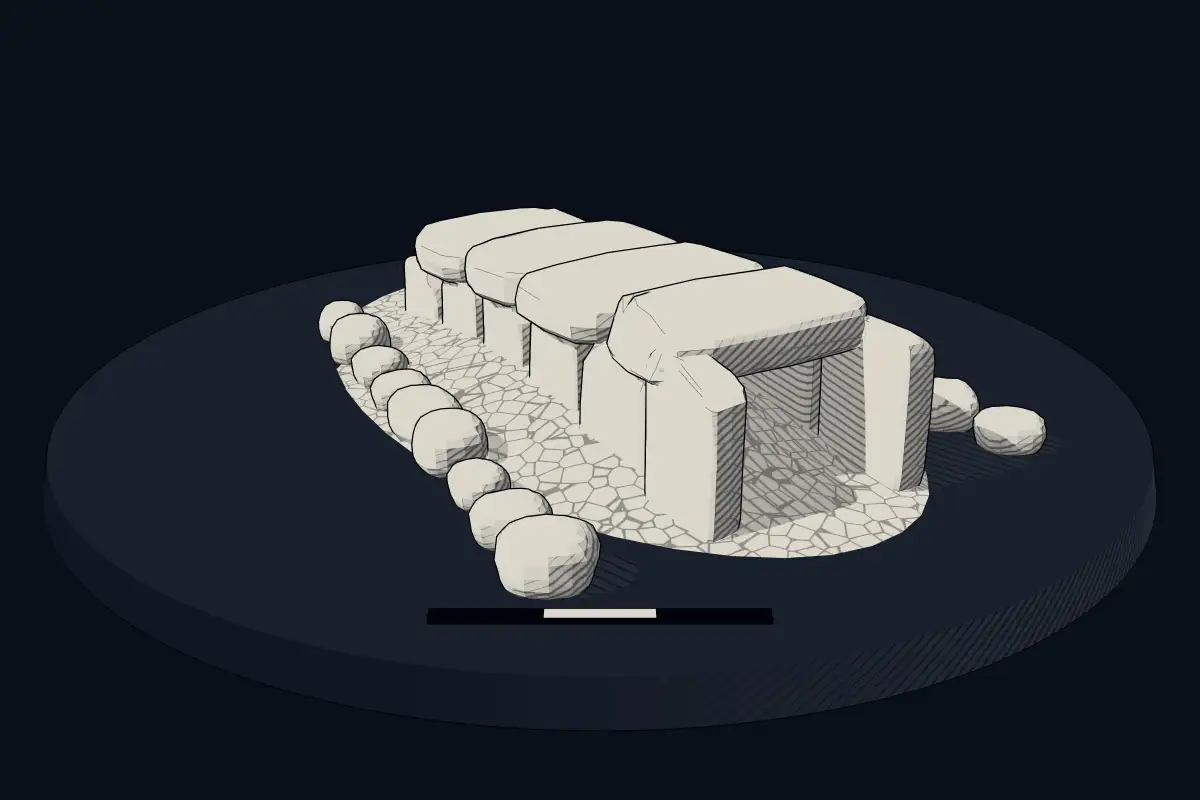
No licensed photograph yetWe have no photograph we may publish for this site, so the interpretive 3D view leads instead.
Overview
About this site
Overview
Coolbeg (Irish An Chúil Bheag) is a large wedge tomb north-west of Drumcliff in County Sligo, Ireland, about 200 m west of the bridge over the Owney River, beside a group of cherry trees. The catalogue gives a typological estimate of 2500 to 2000 BCE.
The chamber is about seven metres long and is almost without capstones.
Read on Wikipedia2 min readCC BY-SA 4.0
Where it sits in time
The site's dated range, placed against world reference points.
The scale is logarithmic: each step to the left is about ten times older than the last.
Article
Coolbeg
DescriptionSources for this section
- Wikipedia (German): CoolbegCC BY-SA 4.0
Sources for this section
- Wikipedia (German): CoolbegCC BY-SA 4.0
The chamber, which is almost without capstones, is about seven metres long. The surviving limestone capstone bears a single cup mark. Remains of the antechamber, of the facade (about one metre high) and some stones of the double wall survive in situ. The stones at the west end of the monument are about one metre high and decrease to 0.3 m at the east end.
Research historySources for this section
- Wikipedia (German): CoolbegCC BY-SA 4.0
Sources for this section
- Wikipedia (German): CoolbegCC BY-SA 4.0
William Gregory Wood-Martin (1847–1917), an antiquarian from Sligo, claimed that one of the edge stones on the north side was decorated with cup-and-ring markings. These can no longer be made out and may have been erased by weathering. If Wood-Martin’s statement is correct, this would be an unusual feature for a wedge tomb.
NameSources for this section
- Wikipedia (German): CoolbegCC BY-SA 4.0
Sources for this section
- Wikipedia (German): CoolbegCC BY-SA 4.0
Cool Beg is also the name of a court tomb in Donegal.
Wedge tombs are double-walled, passage-less and mostly unsegmented megalithic structures of the late Neolithic and early Bronze Age.
ContextSources for this section
- Wikipedia (German): CoolbegCC BY-SA 4.0
Sources for this section
- Wikipedia (German): CoolbegCC BY-SA 4.0
Wedge tombs are double-walled, passage-less and mostly unsegmented megalithic structures of the late Neolithic and early Bronze Age. A wedge tomb takes its name from the way the burial chamber narrows at one end, usually decreasing both in height and in width from west to east. Wedge tombs are one of the four categories of Irish megalithic tomb described by Seán Ó Nualláin and Rúaidhrí de Valera in their survey of 1961, alongside court cairns, portal dolmens and passage tombs.
Tradition and region
About this kind of monument
Irish wedge tombs
A wedge tomb, or wedge-shaped gallery grave, is a type of Irish chamber tomb. It takes its name from the way the burial chamber narrows at one end, usually decreasing both in height and in width from west to east, which gives it a wedge shape in profile. An antechamber is separated from the burial area by a simple stone slab. Wedge tombs are one of the four categories of megalithic tomb described by the Irish scholars Seán Ó Nualláin and Rúaidhrí de Valera in their survey of 1961: court cairns, portal dolmens, wedge-shaped gallery graves and passage tombs.
A gallery grave is a megalithic tomb in which the main gallery is entered without first passing through an antechamber or hallway. The gallery graves of western Europe were probably community burial sites, in which family or hamlet members were laid to reinforce the sense of community. Gallery graves can be covered with an earthen mound or a cairn, and there are at least four major types: complex, transepted, segmented and wedge-shaped.
Wedge tombs were built between the Irish late Neolithic and the middle Bronze Age, about 2500 to 2000 BCE. Between 500 and 550 survive, mostly in the west and north-west of Ireland. A distinguishing feature is the double walling of the gallery. They were often covered by round, oval or D-shaped cairns, usually about 1.5 metres high, with a kerb, and are generally found on mountainsides, about three-quarters of the way up. The doorway generally faces west.
When visiting, look at how the walls narrow towards the back of the tomb and at the double wall of the gallery.
Paraphrased from Wikipedia: Wedge-shaped gallery grave, Wikipedia: Gallery grave, Wikipedia: Bell Beaker culture, Wikipedia: Passage grave · CC BY-SA 4.0
From the article
Dated moments in the story
- 1847
Der Antiquitätenhändler William Gregory Wood-Martin (1847–1917) aus Sligo behauptete, dass einer der Randsteine auf der Nordseite eine Dekoration aus Cup-and-Ring-Markierungen hatte.
Source
Lore
Evidence & Lore
What the sources actually support — and, kept apart, what has been claimed.
What the evidence supports
Dates
Est. 2500–2000 BCEHow this date was established: Type comparisonTypical range for wedge tombs in Ireland; this site has not been dated itself. Wedge tombs were built between the Irish late Neolithic and middle Bronze Ages about 2500 to 2000 BC.Source for this date
Where it stands
Ireland
The pin marks the monument itself — its exact point.
- Coordinates
- 54°19′44″ N, 8°30′16″ WFor a GPS or map app: 54.32892, -8.50456
Access is as our sources describe it; we have not visited the site to check.
Nearby
The closest sites in the Atlas, by straight line.
- Court tomb (court cairn)Cummeen Court Cairn3750–2900 BCE
- Court tomb (court cairn)Gortnaleck Court Tomb3750–2900 BCE
 Abbeyquarter North Tomb3400–2900 BCE
 Portal Tomb von Cloghcor4000–3000 BCE
- Passage tomb (passage grave)Carrowmore Megalithic Cemetery W-M 9a3400–2900 BCE
- CistKnocknashammer Cist
- Megalithic mound (tumulus with integral stones)Carns Cairn3700–2900 BCE
 Listoghil3095–1955 BCE


Sources
Every record behind this page, with the link it came from.
2 sources behind this page
- 01Wikidata Q1129685wikidata.org
- 02Source for this dateen.wikipedia.org
Report a correctionWrong date, name, photograph or source? Tell us and it will be put right.
Around this place
The ten nearest sites, by compass
Credit
Text, licence and sources
Adapted from the Wikipedia article "Coolbeg" (German), licensed CC BY-SA 4.0; authors are listed in the page history. Reused under CC BY-SA 4.0. Read on Wikipedia · Edit history and authors
- Wikipedia (German): CoolbegCC BY-SA 4.0
- Wikidata Q1129685CC0