Carrowmore Megalithic Cemetery W-M 9a
DatedEst. 3400–2900 BCE
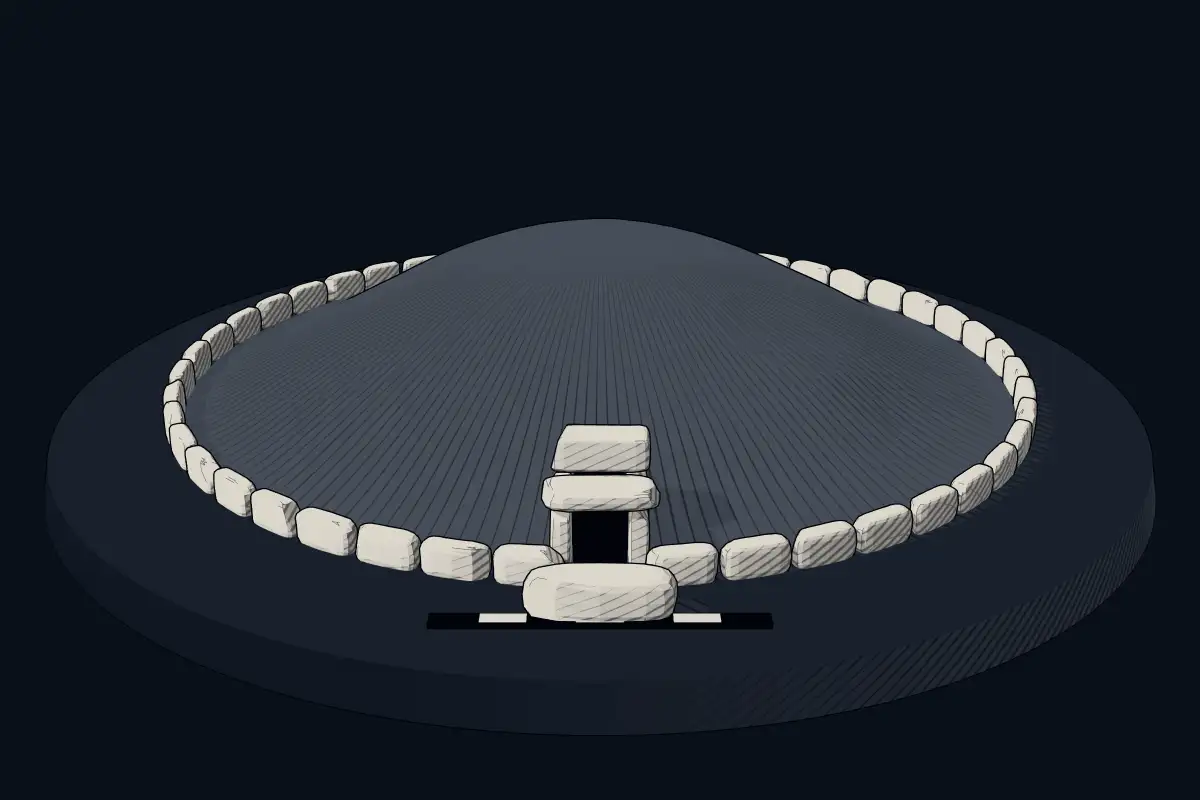
No licensed photograph yetWe have no photograph we may publish for this site, so the interpretive 3D view leads instead.
Overview
About this site
Overview
Carrowmore Megalithic Cemetery W-M 9a is a passage tomb in County Sligo, Ireland. It lies at 54.2563° N, 8.5154° W.
Catalogue recordSources and licences
Where it sits in time
The site's dated range, placed against world reference points.
The scale is logarithmic: each step to the left is about ten times older than the last.
Article
Carrowmore Megalithic Cemetery W-M 9a
ContextSources for this section
- en.wikipedia.orgCC BY-SA 4.0
- en.wikipedia.orgCC BY-SA 4.0
- en.wikipedia.orgCC BY-SA 4.0
- en.wikipedia.orgCC BY-SA 4.0
- en.wikipedia.orgCC BY-SA 4.0
- en.wikipedia.orgCC BY-SA 4.0
- en.wikipedia.orgCC BY-SA 4.0
- en.wikipedia.orgCC BY-SA 4.0
- en.wikipedia.orgCC BY-SA 4.0
Sources for this section
- en.wikipedia.orgCC BY-SA 4.0
- en.wikipedia.orgCC BY-SA 4.0
- en.wikipedia.orgCC BY-SA 4.0
- en.wikipedia.orgCC BY-SA 4.0
- en.wikipedia.orgCC BY-SA 4.0
- en.wikipedia.orgCC BY-SA 4.0
- en.wikipedia.orgCC BY-SA 4.0
- en.wikipedia.orgCC BY-SA 4.0
- en.wikipedia.orgCC BY-SA 4.0
A passage tomb is a burial chamber covered in earth or stone, with a narrow access passage made of large stones. The type is found along the Atlantic seaboard of Europe, and in Ireland and Britain passage tombs often lie in large clusters, called cemeteries. Ireland has four great ones, known as the "big four": Brú na Bóinne in the Boyne Valley, Loughcrew, Carrowkeel and Carrowmore, each with its own character. Most were built in the fourth millennium BCE. The regional background, “Irish and British passage tombs”, is given below.
DatingSources for this section
- en.wikipedia.orgCC BY-SA 4.0
Sources for this section
- en.wikipedia.orgCC BY-SA 4.0
No scientific date has been published for this site. Monuments of this type in Ireland are generally dated 3400 BCE to 2900 BCE; the site itself may fall inside or outside that range.
The passage grave of Newgrange in Ireland belongs to the megalithic constructions of c. 3400 BC.
Setting
12 other recorded monuments lie within 10 km (2 within 1 km, 8 within 5 km), 3 of them of the same type. In County Sligo, Ireland, 4 of the 23 recorded monuments are of this type.
The nearest recorded monuments are Listoghil (0.9 km south, passage tomb); Knocknashammer Cist (1.0 km south-east, cist); Cummeen Court Cairn (2.4 km north, court tomb); Abbeyquarter North Tomb (3.8 km east, passage tomb).
ProtectionSources for this section
Sources for this section
No heritage designation is recorded for the site.
Tradition and region
About this kind of monument
Irish and British passage tombs
A passage tomb is a burial chamber covered in earth or stone, with a narrow access passage made of large stones. The type is found along the Atlantic seaboard of Europe, and in Ireland and Britain passage tombs often lie in large clusters, called cemeteries. Ireland has four great ones, known as the "big four": Brú na Bóinne in the Boyne Valley, Loughcrew, Carrowkeel and Carrowmore, each with its own character. Most were built in the fourth millennium BCE.
The Boyne Valley is the heart of the tradition. Brú na Bóinne in County Meath comprises at least ninety monuments, dominated by Newgrange, Knowth and Dowth, built in the 32nd century BCE. Newgrange, built around 3100 BCE, is older than Stonehenge and the Egyptian pyramids. It has a façade of white quartz cobbles ringed by engraved kerbstones, and is aligned so that the rising sun on the winter solstice shines through a "roofbox" above the entrance and floods the inner chamber. Knowth, a large passage tomb surrounded by 17 smaller ones, holds the largest assemblage of megalithic art in Europe and is ringed by 127 kerbstones. Dowth has mostly been left as a ruin, with a crater from an 1847 excavation.
Across the Irish Sea, Bryn Celli Ddu on Anglesey is considered one of the finest passage tombs in Wales. Visitors can go through its stone passage into the chamber, and the site was once a henge with a stone circle; it may have been used to mark the summer solstice. Barclodiad y Gawres, "the giantess's apronful", on the same island is a cruciform passage grave with decorated stones.
When visiting, look at the kerbstones for carved spirals and lozenges, at the direction of the passage, and at the quartz and other stones that came from far away.
Paraphrased from Wikipedia: Passage grave, Wikipedia: Newgrange, Wikipedia: Knowth, Wikipedia: Brú na Bóinne, Wikipedia: Dowth, Wikipedia: Bryn Celli Ddu, Wikipedia: Barclodiad y Gawres, Wikipedia: Loughcrew, Wikipedia: Carrowmore · CC BY-SA 4.0
Lore
Evidence & Lore
What the sources actually support — and, kept apart, what has been claimed.
What the evidence supports
Dates
Est. 3400–2900 BCEHow this date was established: Type comparisonTypical range for passage tombs in Ireland; this site has not been dated itself. The passage grave of Newgrange in Ireland belongs to the megalithic constructions of c. 3400 BC.Source for this date
Where it stands
Ireland
The pin marks the monument itself — its exact point.
- Coordinates
- 54°15′23″ N, 8°30′55″ WFor a GPS or map app: 54.25628, -8.51538
Access is as our sources describe it; we have not visited the site to check.
Nearby
The closest sites in the Atlas, by straight line.
 Listoghil3095–1955 BCE
- CistKnocknashammer Cist
- Court tomb (court cairn)Cummeen Court Cairn3750–2900 BCE
 Abbeyquarter North Tomb3400–2900 BCE
 Queen Maeves Tomb Knocknarea3700–2900 BCE
 Miosgán Médhbh3050–2950 BCE
 Knocknarea passage tombs3400–2900 BCE
- Megalithic mound (tumulus with integral stones)Carns Cairn3700–2900 BCE


Sources
Every record behind this page, with the link it came from.
2 sources behind this page
- 01Wikidata Q33093088wikidata.org
- 02Source for this dateen.wikipedia.org
Report a correctionWrong date, name, photograph or source? Tell us and it will be put right.
Around this place
The ten nearest sites, by compass
Credit
Text, licence and sources
Compiled from open records (Wikidata, CC0; OpenStreetMap, ODbL) and a regional background article based on Wikipedia (CC BY-SA 4.0).
- Wikidata Q33093088CC0
- en.wikipedia.orgCC BY-SA 4.0
- en.wikipedia.orgCC BY-SA 4.0
- en.wikipedia.orgCC BY-SA 4.0
- en.wikipedia.orgCC BY-SA 4.0
- en.wikipedia.orgCC BY-SA 4.0
- en.wikipedia.orgCC BY-SA 4.0
- en.wikipedia.orgCC BY-SA 4.0
- en.wikipedia.orgCC BY-SA 4.0
- en.wikipedia.orgCC BY-SA 4.0
- en.wikipedia.orgCC BY-SA 4.0