Knocknashammer Cist
Also known asCloverhill Cist
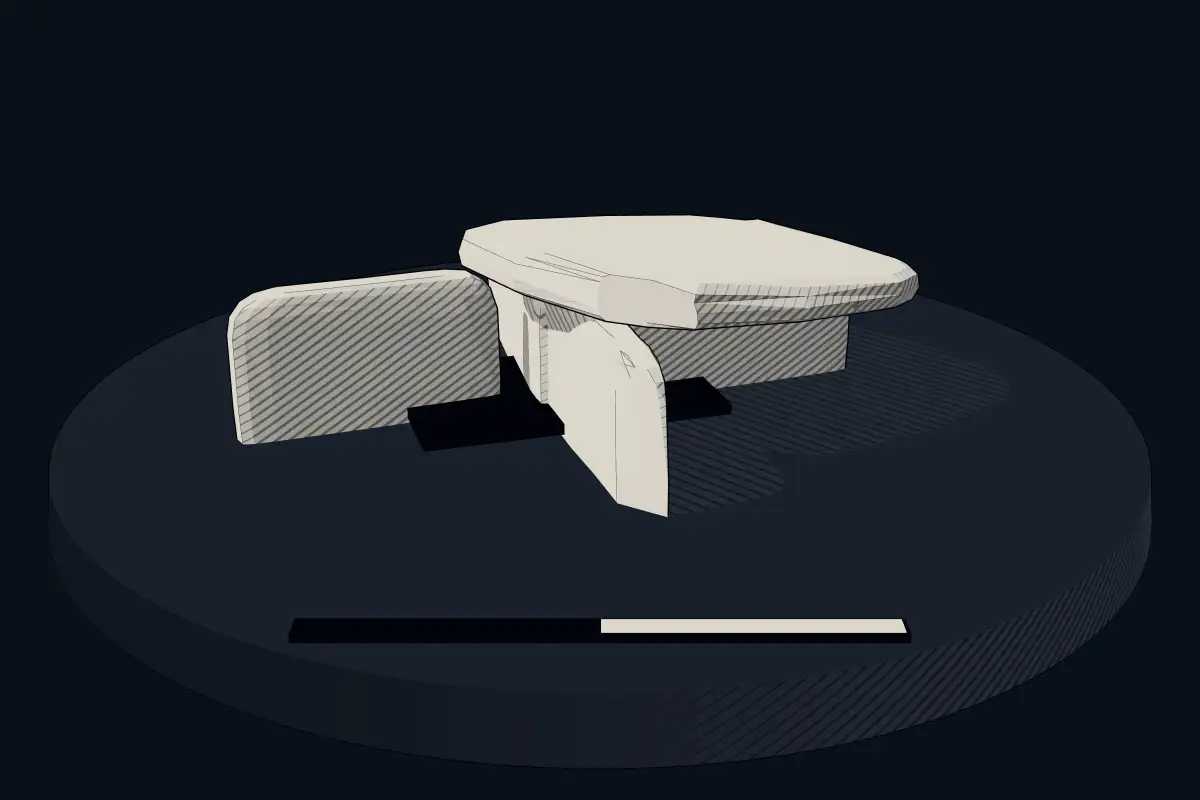
No licensed photograph yetWe have no photograph we may publish for this site, so the interpretive 3D view leads instead.
Overview
About this site
What the sources say
Das kleine Passage Tomb von Cloverhill (auch Knocknashammer, irisch Cnoc na Seamar, deutsch „Kleehügel“) liegt etwa 3,3 km südwestlich von Sligo im County Sligo in Irland. Seine Nähe zum Komplex vom Carrowmore suggeriert einen Zusammenhang (es ist als Carrowmore Tomb 30A registriert), der allerdings nicht besteht. Es ist die einzige mit Felsritzungen versehene Megalithanlage im County.
Die Gravuren auf den rechten Steinen wurden im eleganten, keltischen La-Tène-Stil geritzt, der mindestens 2000 Jahre später als die Anlagen von Carrowmore entstand, und zeigen keines der charakteristischen Motive der anderen Passage tombs auf der Insel. Die Gravuren auf dem linken Stein zeigen das klassische Cup-and-Ring-Markierungs-Design der älteren, megalithischen Kunst.
Einige Autoritäten akzeptieren es daher als ein Teil der irischen Passage-tomb-Tradition, andere tun es nicht. Vielleicht wurde eine Dekoration erst in keltischen Zeiten hinzugefügt.
Cloverhills Ursprung ist unklar, aber es könnte in die Jungsteinzeit (4000–2500 v. Chr.) datieren und mit der Passage-Tomb-Tradition verbunden sein. Es ist jedoch später entstanden als die Masse der anderen Denkmäler von Carrowmore. Es fehlen der äußere Aufbau und alle Decksteine. Berichte von Antiquaren des 19. Jahrhunderts erwähnen die Anwesenheit eines Steinbodens, eines großen Decksteins über der Kammer und eines niedrigen Rundhügels, aber davon existieren keine Spuren mehr. Cloverhill liegt in einer relativ kleinen ovalen Grube am Hang eines flachen Hügels und besteht aus neun etwa 0,8 m hohen Steinen. Die Kammer misst 1,8 m × 1,0 m. Ein leicht abgewinkelter Stein und ein Lücke zwischen den Orthostaten bildet den Eingang zu der Kammer.
Der Sligoer Antiquar William Gregory Wood-Martin (1847–1917), der die Anlage vor 1888 ausgrub, berichtet, dass bereits zuvor Grabungen stattgefunden hatten, bei denen verbrannten Knochen und Keramik gefunden worden seien.
Article in GermanRead on Wikipedia3 min readCC BY-SA 4.0
The full article
Knocknashammer Cist: the whole story
In briefSources for this section
- Wikipedia (German): CloverhillCC BY-SA 4.0
Sources for this section
- Wikipedia (German): CloverhillCC BY-SA 4.0
Knocknashammer Cist, also called Cloverhill Cist, is a small passage tomb about 3,3 km southwest of Sligo in County Sligo, Ireland. Although its proximity to the Carrowmore complex suggests a connection, it is registered as Carrowmore Tomb 30A but is not considered part of Carrowmore. It is the only megalithic monument in County Sligo with rock carvings.
The surviving monument consists of nine stones, each about 0,8 m high, set in a relatively small oval hollow on the side of a low hill. The chamber measures 1,8 m × 1,0 m, with an entrance formed by one slightly angled stone and a gap between the upright stones. Its outer structure and capstones are missing. Antiquarians reported a stone floor, a large capstone above the chamber and a low round mound, but no traces of these remain.
Carvings on the right-hand stones were made in the elegant Celtic La-Tène style, at least 2000 years later than the Carrowmore monuments, and do not show the characteristic motifs of other passage tombs on the island. The left-hand stone bears the classic cup-and-ring design associated with older megalithic art. Because of these differing carvings, some authorities accept Cloverhill as part of the Irish passage-tomb tradition, while others do not; the carvings may have been added during the Celtic period.
Cloverhill’s origin is uncertain, but it may date to the Late Neolithic (4000–2500 v. Chr.) and belong to the passage-tomb tradition. It was, however, built later than most of the other Carrowmore monuments. Before William Gregory Wood-Martin excavated it before 1888, earlier digging had reportedly revealed burnt bones and pottery.
Wikidata describes it as: cist burial in the townland of Knocknashammer or Cloverhill, County Sligo.
Summary in EnglishSources for this section
- Wikipedia (German): CloverhillCC BY-SA 4.0
Sources for this section
- Wikipedia (German): CloverhillCC BY-SA 4.0
Knocknashammer Cist is a cist in County Sligo, Ireland. Wikidata describes it as: cist burial in the townland of Knocknashammer or Cloverhill, County Sligo. No English Wikipedia article exists for it; the full text below is the German article "Cloverhill", shown in the original language.
How this page was madeSources for this section
- Wikipedia (German): CloverhillCC BY-SA 4.0
Sources for this section
- Wikipedia (German): CloverhillCC BY-SA 4.0
The summary at the top of this page was written by MiniMax-M3 (2026-11-07) from the cited Wikipedia article “Cloverhill”, translated from German. The numbers in it were checked automatically against the source text. The rest of the page is the article itself, the structured records and computed distances.
Tradition and region
About this kind of monument
British and Irish cists
In Britain and Ireland a cist is a small stone-built coffin-like box used to hold the dead, and it is one of the commonest finds in prehistoric graves. A cist may once have been covered by a cairn or a long barrow, and several are sometimes found together in the same cairn or barrow. Ornaments found in excavated cists point to the wealth or prominence of the person buried. The centre of a round barrow, which in Britain was mostly built between 2200 and 1100 BCE, may hold a stone cist or a cut grave, and the burial may be an inhumation or a cremation placed in a vessel.
The Bell Beaker phenomenon, which reached Britain and Ireland in the late Neolithic, brought individual burials, often under tumuli and with weapons, in place of the collective burials of the earlier Neolithic. Cists of this period are therefore often single graves. The Food Vessel culture of the Early Bronze Age used slab cists, and some of their stones carry cup and ring marks.
Kilmartin Glen in Argyll is the richest area, with numerous cists among its prehistoric monuments, including a linear cemetery of five burial cairns that runs for more than three miles. Several of its cairns and many natural rocks are decorated with cup and ring marks. More than 800 ancient monuments lie within ten kilometres of the village, 150 of them prehistoric.
The Atlas's cists are dated by their position in a barrow, by the pottery or ornaments found with the burial, and by radiocarbon dating of surviving bone. Where none is known, it gives a broad Neolithic to Bronze Age range.
When visiting, look for the slabs set on edge around a pit, and for the cap stone that may have fallen aside.
Paraphrased from Wikipedia: Cist, Wikipedia: Round barrow, Wikipedia: Kilmartin Glen, Wikipedia: Bell Beaker culture · CC BY-SA 4.0
From the article
Dated moments in the story
- 2500 BCE
Cloverhills Ursprung ist unklar, aber es könnte in die Jungsteinzeit (4000–2500 v. Chr.) datieren und mit der Passage-Tomb-Tradition verbunden sein.
Source - 1847
Der Sligoer Antiquar William Gregory Wood-Martin (1847–1917), der die Anlage vor 1888 ausgrub, berichtet, dass bereits zuvor Grabungen stattgefunden hatten, bei denen verbrannten Knochen und Keramik gefunden worden seien.
Source - 2000
Die Gravuren auf den rechten Steinen wurden im eleganten, keltischen La-Tène-Stil geritzt, der mindestens 2000 Jahre später als die Anlagen von Carrowmore entstand, und zeigen keines der charakteristischen Motive der anderen Passage tombs auf der Insel.
Source
See it in 3D
An interpretive reconstruction of the monument, standing on the real ground at its exact point, under the sun for that place and season. Drag to look around it.
The reconstruction is ours, not a survey: it shows what a monument of this type looks like, at the size the record gives for this one.
Where it stands
Ireland
The pin marks the monument itself — its exact point.
- Coordinates
- 54°14′58″ N, 8°30′22″ WFor a GPS or map app: 54.24943, -8.50610
Access is as our sources describe it; we have not visited the site to check.
Nearby
The closest sites in the Atlas, by straight line.
 Listoghil3095–1955 BCE
- Passage tomb (passage grave)Carrowmore Megalithic Cemetery W-M 9a3400–2900 BCE
- Court tomb (court cairn)Cummeen Court Cairn3750–2900 BCE
 Abbeyquarter North Tomb3400–2900 BCE
- Megalithic mound (tumulus with integral stones)Carns Cairn3700–2900 BCE
 Queen Maeves Tomb Knocknarea3700–2900 BCE
 Miosgán Médhbh3050–2950 BCE
 Knocknarea passage tombs3400–2900 BCE


Sources
Every record behind this page, with the link it came from.
1 source behind this page
- 01Wikidata Q1102731wikidata.org
Report a correctionWrong date, name, photograph or source? Tell us and it will be put right.
Around this place
The ten nearest sites, by compass
Credit
Text, licence and sources
Text from the Wikipedia article "Cloverhill" (German), licensed CC BY-SA 4.0; authors are listed in the page history. Reused under CC BY-SA 4.0. Read on Wikipedia · Edit history and authors
- Wikipedia (German): CloverhillCC BY-SA 4.0
- Wikidata Q1102731CC0