
Menhir del Castellà
Also known asmenhir de Roques Blanques
DatedEst. 4000–3000 BCE
Photo Clemens Schmillen · CC BY-SA 4.0Source file on Wikimedia Commons
Overview
About this site
What the sources say
El Menhir del Castellà o de Roques Blanques és un menhir situat al terme municipal d'Espolla, (Alt Empordà), inclòs a l'Inventari del Patrimoni Arqueològic i Paleontològic de Catalunya.
Situat vers el nord-oest del centre urbà, a uns 2 km, però actualment la pista d'accés ha quedat molt malmesa. Forma part dels Dòlmens d'Espolla i està situat en un lloc amb gran presència de menhirs, però que ja estan al terme municipal de Sant Climent Sescebes (Menhir de la Murtra, Menhir de Vilartolí…).
Es tracta d'un menhir de granit fins al 1989 caigut segurament a causa de l'erosió del terreny provocada per les pluges al llarg dels anys. Les seves mides són: 3,45 / 0,90 / 0,75 metres i té un pes aproximat de 3600 kg. Va ser identificat per Joan Calverol i Puquet l'any 1971 i fou publicat per Lluís Esteva l'any 1974 i 1977. En el solstici d'estiu de 1988 fou redreçat i es va publicar un pòster commemoratiu amb els Dòlmens d'Espolla.
Article in CatalanRead on Wikipedia3 min readCC BY-SA 4.0
Where it sits in time
The site's dated range, placed against world reference points.
The scale is logarithmic: each step to the left is about ten times older than the last.
The full article
Menhir del Castellà: the whole story
In briefSources for this section
- Wikipedia (Catalan): Menhir del CastellàCC BY-SA 4.0
Sources for this section
- Wikipedia (Catalan): Menhir del CastellàCC BY-SA 4.0
The Menhir del Castellà, also known as the menhir de Roques Blanques, is a menhir in the municipal district of Espolla, Alt Empordà, Spain. It lies about 2 km north-west of Espolla’s urban centre, although the access track is now badly damaged. It forms part of the Dòlmens d’Espolla in an area containing numerous menhirs.
The monument is a granite standing stone measuring 3,45 / 0,90 / 0,75 metres and weighing approximately 3600 kg. It had certainly fallen by 1989, probably because prolonged rain erosion weakened the ground beneath it. The stone was re-erected during the summer solstice of 1988, and a commemorative poster featuring the Dòlmens d’Espolla was published.
The Menhir del Castellà is dated by typological estimate to 4000 BCE to 3000 BCE. It was identified by Joan Calverol i Puquet in 1971 and published by Lluís Esteva in 1974 and 1977. It is included in the Inventari del Patrimoni Arqueològic i Paleontològic de Catalunya.
Monuments of this kind in Spain include many megalithic tombs, with examples extending from Andalusia in the south to Galicia in the north-west. At Antequera in Andalusia, the Dolmen of Menga is dated to about 3750 to 3650 BCE and measures 27.5 metres long, 6 metres wide and 3.5 metres high. It was built with thirty-two megaliths, the largest weighing about 180 tonnes, and forms part of the Antequera Dolmens Site, a UNESCO World Heritage Site since 2016.
No English Wikipedia article exists for it; the full text below is the Catalan article "Menhir del Castellà", shown in the original language.
Summary in EnglishSources for this section
- Wikipedia (Catalan): Menhir del CastellàCC BY-SA 4.0
Sources for this section
- Wikipedia (Catalan): Menhir del CastellàCC BY-SA 4.0
Menhir del Castellà is a dolmen in Espolla, Spain. A typological estimate: 4000 BCE to 3000 BCE. No English Wikipedia article exists for it; the full text below is the Catalan article "Menhir del Castellà", shown in the original language.
How this page was madeSources for this section
- Wikipedia (Catalan): Menhir del CastellàCC BY-SA 4.0
Sources for this section
- Wikipedia (Catalan): Menhir del CastellàCC BY-SA 4.0
The summary at the top of this page was written by MiniMax-M3 (2026-11-08) from the cited Wikipedia article “Menhir del Castellà”, translated from Catalan. The numbers in it were checked automatically against the source text. The rest of the page is the article itself, the structured records and computed distances.
Tradition and region
About this kind of monument
Dolmens of Andalusia, Extremadura and Galicia
Spain has a great many megalithic tombs, and the Atlas's Spanish dolmens run from Andalusia in the south to Galicia in the north-west. The finest are at Antequera in Andalusia, where the Dolmen of Menga, dated to about 3750 to 3650 BCE, is among the largest ancient megalithic structures in Europe. It is 27.5 metres long, 6 metres wide and 3.5 metres high, built with thirty-two megaliths, the largest weighing about 180 tonnes. After the chamber was finished it was covered with soil and built up into the hill seen today; when it was opened in the nineteenth century archaeologists found the skeletons of several hundred people. The Dolmen of Viera stands 70 metres away, and the tholos of El Romeral lies about 4 kilometres off; the three were inscribed as the Antequera Dolmens Site, a UNESCO World Heritage Site, in 2016.
In the south-west, the Dolmen de Soto at Trigueros in Huelva province is a Neolithic tomb estimated to date between 3000 and 2500 BCE, one of about 200 Neolithic burial sites in the province. It was found in 1922 when its owner, Armando de Soto Morillas, wanted to build a house; the German archaeologist Hugo Obermaier found eight bodies in a fetal position with artefacts, and its engraved and painted uprights have been studied more recently.
In Galicia and Portugal a dolmen is an anta, and in Catalan-speaking areas dolmens have folk names such as cova (cave), caixa (crate or coffin), taula (table) and arca (chest). These names are tradition: they record what people made of the monuments, not what they were built for.
When visiting Menga, look at the great capstones from inside the corridor, and at the way the mound was built up over the chamber.
Paraphrased from Wikipedia: Dolmen of Menga, Wikipedia: Dolmen of Viera, Wikipedia: Antequera Dolmens Site, Wikipedia: Dolmen de Soto, Wikipedia: Dolmen · CC BY-SA 4.0
From the article
Dated moments in the story
- 1971
Va ser identificat per Joan Calverol i Puquet l'any 1971 i fou publicat per Lluís Esteva l'any 1974 i 1977. En el solstici d'estiu de 1988 fou redreçat i es va publicar un pòster commemoratiu amb els Dòlmens d'Espolla.
Source - 1989
Es tracta d'un menhir de granit fins al 1989 caigut segurament a causa de l'erosió del terreny provocada per les pluges al llarg dels anys.
Source
See it in 3D
An interpretive reconstruction of the monument, standing on the real ground at its exact point, under the sun for that place and season. Drag to look around it.
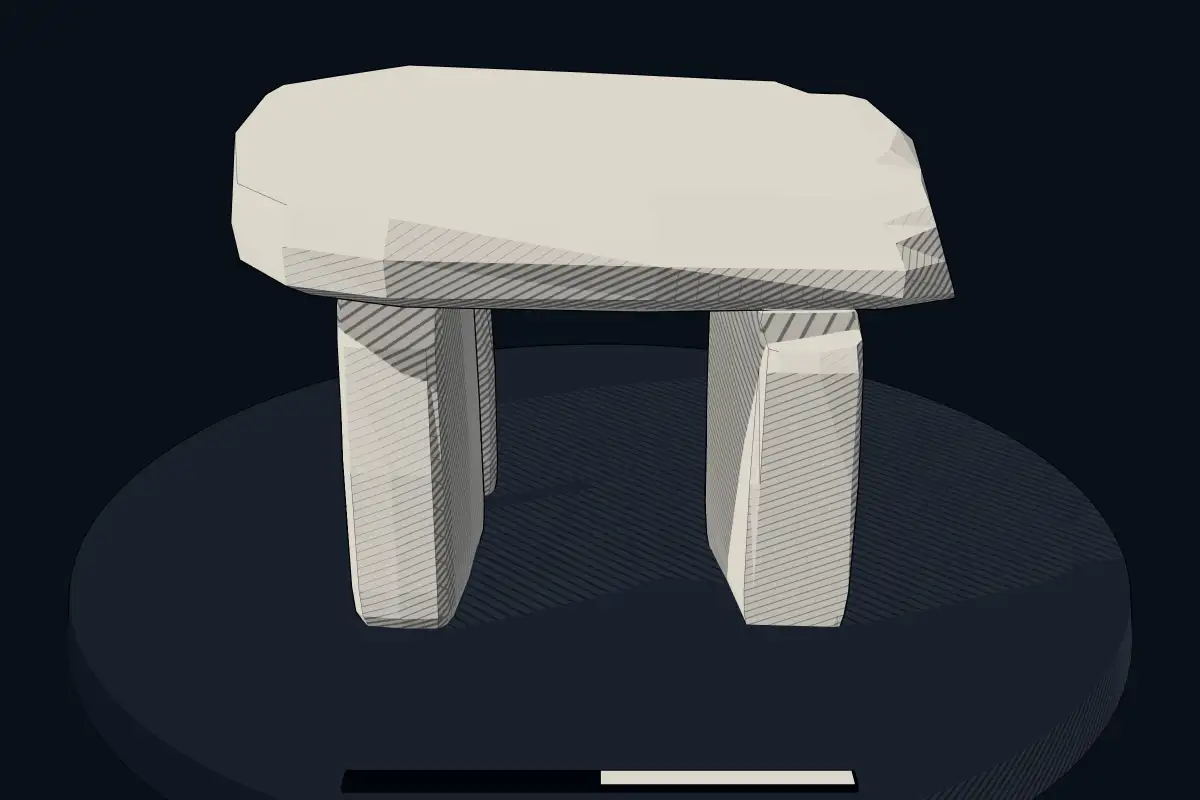
The reconstruction is ours, not a survey: it shows what a monument of this type looks like, at the size the record gives for this one.
Photographs
1 photograph, each with its author and licence
Lore
Evidence & Lore
What the sources actually support — and, kept apart, what has been claimed.
What the evidence supports
Dates
Est. 4000–3000 BCEHow this date was established: Type comparisonTypical range for dolmens in Spain; this site has not been dated itself. Most dolmens date from the Late Neolithic period (4000-3000 BCE); the Dolmen of Menga in Andalusia dates to about 3750-3650 BCE.Source for this date
Where it stands
Spain
The pin marks the monument itself — its exact point.
- Coordinates
- 42°24′44″ N, 2°58′46″ EFor a GPS or map app: 42.41210, 2.97936
Access is as our sources describe it; we have not visited the site to check.
Nearby
The closest sites in the Atlas, by straight line.


Sources
Every record behind this page, with the link it came from.
2 sources behind this page
- 01Wikidata Q18004758wikidata.org
- 02Source for this dateen.wikipedia.org
Image files
- Menhir del Castellà (Espolla).jpgClemens SchmillenCC BY-SA 4.0
Report a correctionWrong date, name, photograph or source? Tell us and it will be put right.
Around this place
The ten nearest sites, by compass
- Salt d'en Peió0.9 km NW
- Dolmen de Fontanilles1.0 km W
- Menhir de la Murtra1.1 km S
- Dolmen de la Gutina1.7 km S
- Dolmen de les Morelles1.8 km NE
- Dolmen d'Arreganyats1.8 km NE
- Dolmen de Tires Llargues1.9 km S
- Dolmen de la Gutina/Puig del Pal1.9 km S
- Menhir de Vilartolí2.2 km SW
- menhir de Santa Fe dels Solers2.4 km SW
Credit
Text, licence and sources
Text from the Wikipedia article "Menhir del Castellà" (Catalan), licensed CC BY-SA 4.0; authors are listed in the page history. Reused under CC BY-SA 4.0. Read on Wikipedia · Edit history and authors
- Wikipedia (Catalan): Menhir del CastellàCC BY-SA 4.0
- Wikidata Q18004758CC0