
Menhir de la Murtra
DatedEst. 2800–1800 BCE
Photo Maria Alabau i Janer · CC BY-SA 4.0Source file on Wikimedia Commons

Overview
About this site
What the sources say
El menhir de la Murtra, también conocido como Piedra Gentil, Piedra Murtra o menhir de la Piedra Murtra, es un monolito de piedra arenisca situado en el municipio español de San Clemente Sasebas (Gerona), en un paraje conocido como La Murtra, del que toma su nombre. Sus dimensiones son de 3,25 m de alto por 1,30 m de ancho y 0,43 de grosor.
Fue citado por vez primera en 1879 por Antonio Balmaña. En junio del mismo año una comisión del Centro Excursionista de Cataluña, formada por Cèsar August Torras, Ursino Mitjans y Esteve Sunyer, lo visitó y realizó varios dibujos y croquis. Nunca ha sido excavado científicamente. Por el tipo arquitectónico del menhir y principalmente por la cronología de los sepulcros megalíticos del entorno se puede deducir que fue construido entre el 3500 y el 3000 a. C.
Article in SpanishRead on Wikipedia3 min readCC BY-SA 4.0
Where it sits in time
The site's dated range, placed against world reference points.
The scale is logarithmic: each step to the left is about ten times older than the last.
The full article
Menhir de la Murtra: the whole story
In briefSources for this section
- Wikipedia (Spanish): Menhir de la MurtraCC BY-SA 4.0
Sources for this section
- Wikipedia (Spanish): Menhir de la MurtraCC BY-SA 4.0
The Menhir de la Murtra, also known as Piedra Gentil, Piedra Murtra or the menhir of the Piedra Murtra, is a sandstone monolith in the Spanish municipality of San Clemente Sasebas, in the province of Girona, at a place called La Murtra, from which it takes its name. It is 3.25 m high, 1.30 m wide and 0.43 thick.
It was first mentioned in 1879 by Antonio Balmaña. In June of the same year a commission of the Centro Excursionista de Cataluña, made up of Cèsar August Torras, Ursino Mitjans and Esteve Sunyer, visited it and made several drawings and sketches. The menhir has never been scientifically excavated.
From the architectural type of the menhir, and mainly from the chronology of the megalithic tombs around it, it can be deduced that it was built between 3500 and 3000 BC. The catalogue record, by contrast, gives a typological estimate of 2800 to 1800 BCE, so the date should be treated as an estimate rather than a firm fact.
Beyond this, little is recorded about the stone. Menhirs of the western European megalithic type are relatively unusual in Spain compared with dolmens, but they are common sights in the northern half of the country, where at least 500 have been reported. They are particularly common in the Basque Country, Navarre, northern Burgos and Palencia, Cantabria and the Pyrenees, usually standing alone or in small groups in elevated places. Most appear to date back to the Stone Age, and they are not usually associated with burials.
No English Wikipedia article exists for it; the full text below is the Spanish article "Menhir de la Murtra", shown in the original language.
Summary in EnglishSources for this section
- Wikipedia (Spanish): Menhir de la MurtraCC BY-SA 4.0
Sources for this section
- Wikipedia (Spanish): Menhir de la MurtraCC BY-SA 4.0
Menhir de la Murtra is a menhir (standing stone) in Sant Climent Sescebes, Spain. Wikidata describes it as: megalith in Sant Climent Sescebes, Spain. A typological estimate: 2800 BCE to 1800 BCE. No English Wikipedia article exists for it; the full text below is the Spanish article "Menhir de la Murtra", shown in the original language.
How this page was madeSources for this section
- Wikipedia (Spanish): Menhir de la MurtraCC BY-SA 4.0
Sources for this section
- Wikipedia (Spanish): Menhir de la MurtraCC BY-SA 4.0
The summary at the top of this page was written by Claude Sonnet 5.5 (2026-11-06) from the cited Wikipedia article “Menhir de la Murtra”, translated from Spanish. The numbers in it were checked automatically against the source text. The rest of the page is the article itself, the structured records and computed distances.
Tradition and region
About this kind of monument
Iberian menhirs
In Spain menhirs of the western European megalithic type are relatively unusual compared with dolmens, but are common sights in the northern half of the country, where at least 500 have been reported. They are particularly common in the Basque Country, Navarre, northern Burgos and Palencia, Cantabria and the Pyrenees, usually standing alone or in small groups (cromlechs) in elevated places. Most appear to date back to the Stone Age. They are not usually associated with burials, though at the Menhir of Cuesta del Molino in Burgos burials were made at least 2,000 years after the menhir was raised. The Arlobi menhir is one of the most recent examples.
Portugal's highest concentration is in the Alentejo, where the Menhir of Meada is the largest on the Iberian Peninsula. The Menhir of Outeiro, near Reguengos de Monsaraz in the district of Évora, is the second largest in Portugal: a granite monolith 5.6 metres high, about a metre across and an estimated eight tonnes. It was found lying on its side in 1969 by Henrique Leonor Pina and José Pires Gonçalves and re-erected about 1970, and was classified as a national monument in 1971. A hollow in its top has been read as a urethra, so that the stone is taken as phallic; that is an interpretation, not a fact.
The Almendres Cromlech near Évora is the largest group of structured menhirs on the Iberian Peninsula, and one of the largest in Europe. It belongs to the "megalithic universe of Évora", with parallels in the Portela de Mogos cromlech. Its beginnings have been put as far back as the sixth millennium BCE, which would make it extremely early, and it was rediscovered in 1966 by Henrique Leonor Pina.
When visiting, look for stones on high ground and note which way they face.
Paraphrased from Wikipedia: Menhir, Wikipedia: Menhir of Outeiro, Wikipedia: Almendres Cromlech, Wikipedia: List of menhirs · CC BY-SA 4.0
From the article
Dated moments in the story
- 1879
El menhir de la Murtra, también conocido como Piedra Gentil, Piedra Murtra o menhir de la Piedra Murtra, es un monolito de piedra arenisca situado en el municipio español de San Clemente Sasebas (Gerona), en un paraje conocido como La Murtra, del que toma su nombre. Sus dimensiones son de 3,25 m de alto por 1,30 m...
Source
See it in 3D
An interpretive reconstruction of the monument, standing on the real ground at its exact point, under the sun for that place and season. Drag to look around it.
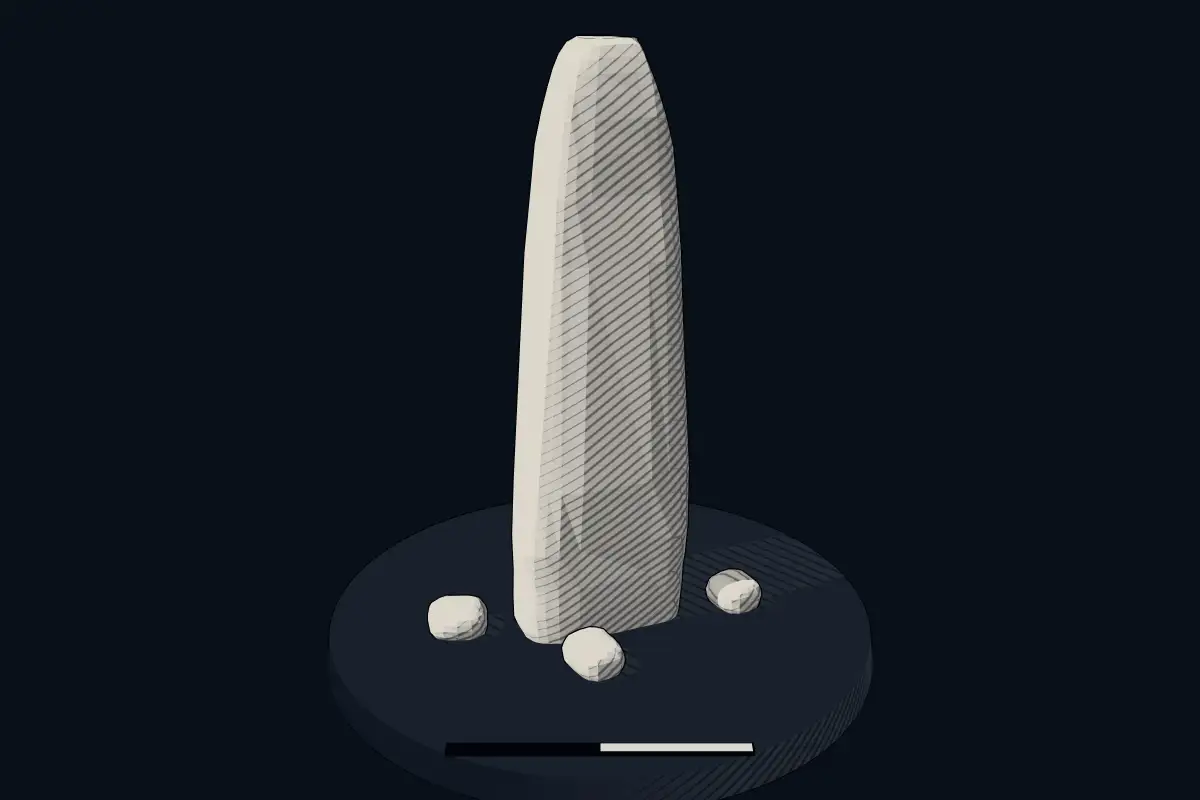
The reconstruction is ours, not a survey: it shows what a monument of this type looks like, at the size the record gives for this one.
Photographs
3 photographs, each with its author and licence
More photographs


Lore
Evidence & Lore
What the sources actually support — and, kept apart, what has been claimed.
What the evidence supports
Dates
Est. 2800–1800 BCEHow this date was established: Type comparisonTypical range for menhirs in Spain; this site has not been dated itself. Standing stones are associated with the Beaker people of the European late Neolithic and early Bronze Age c. 2800-1800 BC.Source for this date
Where it stands
Spain
The pin marks the monument itself — its exact point.
- Coordinates
- 42°24′09″ N, 2°58′40″ EFor a GPS or map app: 42.40254, 2.97779
Access is as our sources describe it; we have not visited the site to check.
Nearby
The closest sites in the Atlas, by straight line.
 Dolmen de la Gutina4000–3000 BCE
 Dolmen de Tires Llargues4000–3000 BCE
- DolmenDolmen de la Gutina/Puig del Pal4000–3000 BCE
 Menhir del Castellà4000–3000 BCE
 Dolmen de Fontanilles4000–3000 BCE
 Menhir de Vilartolí2800–1800 BCE
 Dolmen del Prat Tancat4000–3000 BCE
- Menhir (standing stone)menhir de Santa Fe dels Solers2800–1800 BCE


Sources
Every record behind this page, with the link it came from.
2 sources behind this page
- 01Wikidata Q11692046wikidata.org
- 02Source for this dateen.wikipedia.org
Image files
- Menhir de la Murtra, Sant Climent Sescebes.jpgMaria Alabau i JanerCC BY-SA 4.0
- Menhirs de la Mutra. 6.jpgGas Mountain TeamCC BY-SA 4.0
- Menhir de la Murtra.jpgEmporda profundCC BY-SA 3.0
Report a correctionWrong date, name, photograph or source? Tell us and it will be put right.
Around this place
The ten nearest sites, by compass
- Dolmen de la Gutina0.7 km S
- Dolmen de Tires Llargues0.9 km S
- Dolmen de la Gutina/Puig del Pal1.0 km SE
- Menhir del Castellà1.1 km N
- Dolmen de Fontanilles1.2 km NW
- Menhir de Vilartolí1.4 km SW
- Dolmen del Prat Tancat1.5 km S
- menhir de Santa Fe dels Solers1.7 km SW
- Salt d'en Peió1.7 km N
- Dolmen de la Cabana Arqueta2.1 km SE
Credit
Text, licence and sources
Text from the Wikipedia article "Menhir de la Murtra" (Spanish), licensed CC BY-SA 4.0; authors are listed in the page history. Reused under CC BY-SA 4.0. Read on Wikipedia · Edit history and authors
- Wikipedia (Spanish): Menhir de la MurtraCC BY-SA 4.0
- Wikidata Q11692046CC0