
Dolmen de Tires Llargues
DatedEst. 4000–3000 BCE
Photo Clemens Schmillen · CC BY-SA 4.0Source file on Wikimedia Commons

Overview
About this site
What the sources say
El Dolmen de Tires Llargues és un jaciment arqueològic megalític que es troba a Sant Climent Sescebes,
(Alt Empordà), inclòs a l'Inventari del Patrimoni Arqueològic i Paleontològic de Catalunya.
Article in CatalanRead on Wikipedia5 min readCC BY-SA 4.0
Where it sits in time
The site's dated range, placed against world reference points.
The scale is logarithmic: each step to the left is about ten times older than the last.
The full article
Dolmen de Tires Llargues: the whole story
In briefSources for this section
- Wikipedia (Catalan): Dolmen de Tires LlarguesCC BY-SA 4.0
Sources for this section
- Wikipedia (Catalan): Dolmen de Tires LlarguesCC BY-SA 4.0
The Dolmen de Tires Llargues is a megalithic archaeological site at Sant Climent Sescebes in the Alt Empordà, Spain. It is listed in the Inventari del Patrimoni Arqueològic i Paleontològic de Catalunya. The site stands on a small rise in flat, uncultivated land, close to the vinya de Tires Llargues, with an olive tree and a few holm oaks nearby.
This is a Middle Neolithic passage grave made of rough granite. Its burial chamber is subcircular, with eight surviving supports, while the roof has not been preserved. Inside, the chamber measures 2.1 metres long, 1.7 metres wide and 1.3 metres high. A mixed entrance passage built with dry-stone walls and slabs of local granite and quartz extends for 2.4 metres.
The dolmen was discovered in 1981 by Lluís Torres, owner of the property, while hunting. Joan Carles Torres excavated that year and recovered material from the chamber. Júlia Chinchilla and Josep Tarrús excavated it in 1983 and 1987, finding numerous archaeological materials in the passage and a few in the chamber. The finds include pottery, flint arrowhead and flake, and necklace beads.
Architectural evidence places the monument in the first phase of the Alt Empordà-Rosselló passage graves, during the first half of the fourth millennium BCE. The recorded dating is 4000 BCE to 3000 BCE. Finds from the Middle Neolithic, final Neolithic, Copper Age and Bronze Age show that the grave was reused over a long period, as was common among passage graves in the Albera.
No English Wikipedia article exists for it; the full text below is the Catalan article "Dolmen de Tires Llargues", shown in the original language.
Summary in EnglishSources for this section
- Wikipedia (Catalan): Dolmen de Tires LlarguesCC BY-SA 4.0
Sources for this section
- Wikipedia (Catalan): Dolmen de Tires LlarguesCC BY-SA 4.0
Dolmen de Tires Llargues is a dolmen in Sant Climent Sescebes, Spain. A typological estimate: 4000 BCE to 3000 BCE. No English Wikipedia article exists for it; the full text below is the Catalan article "Dolmen de Tires Llargues", shown in the original language.
AccèsSources for this section
- Wikipedia (Catalan): Dolmen de Tires LlarguesCC BY-SA 4.0
Sources for this section
- Wikipedia (Catalan): Dolmen de Tires LlarguesCC BY-SA 4.0
Per accedir al jaciment cal prendre el camí de Vilartolí que surt al nord del carrer d'Espolla de Sant Climent Sescebes. Passats 2,2 Km s'arriba al mas Torres, on cal trencar a la dreta passant pel mig del mas i prendre el camí que surt al nord en direcció a llevant. Passats 160 metres el camí tomba en direcció sud i 30 metres més endavant s'arriba a un trencant. En aquest punt cal prendre el camí de l'esquerra i seguir-lo uns 150 metres fins a trobar un trencant a l'esquerra. Cal continuar per aquest camí en direcció nord-est uns 180 metres fins a trobar una petita elevació erma, a tocar la vinya de Tires Llargues, on hi ha el dolmen, uns 40 metres més amunt. El jaciment se situa dalt d'un petit turó amb alguna alzina i alguna olivera isolada enmig d'una zona planera erma amb alguna vinya conreada.
DescripcióSources for this section
- Wikipedia (Catalan): Dolmen de Tires LlarguesCC BY-SA 4.0
Sources for this section
- Wikipedia (Catalan): Dolmen de Tires LlarguesCC BY-SA 4.0
Es tracta d'un sepulcre de corredor del Neolític mig fet de granit ibastit en terreny pla. Aquest dolmen va ser descobert pel Sr. Lluís Torres, propietari de la finca, mentre anava de cacera l'any 1981. Joan Carles Torres hi va efectuar excavacions l'any 1981, recuperant materials a la cambra. L'any 1983 i 1987 fou excavat per Júlia Chinchilla i Josep Tarrús, que també hi varen trobar nombrosos materials arqueològics al corredor i uns pocs a la cambra.
La cambra és subcircular amb vuit suports conservats i amb coberta que no s'ha conservat. Les seves dimensions internes són 2,1 metres de longitud per 1,7 metres d'amplada i 1,3 metres d'alçada. L'accés a la cambra es fa per un corredor mixt, fet amb murs de pedra seca i lloses de roques locals (granit i quars) amb una longitud de 2,4 metres, una amplada mitjana de 0,8 metres i una alçada màxima conservada de 0,65 metres.
El túmul de secció circular té un diàmetre d'uns 8 o 9 metres i està fet per un reompliment de blocs grans i mitjans lligats amb terra. La massa tumular estava sostinguda per un anell extern de contenció format per grans blocs.
TroballesSources for this section
- Wikipedia (Catalan): Dolmen de Tires LlarguesCC BY-SA 4.0
Sources for this section
- Wikipedia (Catalan): Dolmen de Tires LlarguesCC BY-SA 4.0
Durant l'excavació es va recuperar 53 fragments ceràmics a mà i 2 a torn dins de la cambra. En el corredor es va recuperar 234 fragments ceràmics a mà, 2 a torn, 2 eines de sílex i 2 peces de collaret. En superfície i en el túmul van aparèixer 50 fragments ceràmics a mà. Del material, cal destacar una punta de sageta lanceolada sobre sílex, un resquill de sílex, així com 3 denes de collaret en diferents roques. Aquests materials pertanyen a diferents moments crono-culturals, cosa usual en els sepulcres de corredor de l'Albera, que són reutilitzats durant molt de temps. L'anàlisi del material permet observar tres grups diferents: neolític mitjà-neolític final, calcolític i bronze. També es va localitzar un nivell de cremació directament sobre la roca mare del corredor i de la cambra, interpretat com un paleosòl.
CronologiaSources for this section
- Wikipedia (Catalan): Dolmen de Tires LlarguesCC BY-SA 4.0
Sources for this section
- Wikipedia (Catalan): Dolmen de Tires LlarguesCC BY-SA 4.0
Pel tipus arquitectònic es pot deduir que pertany a la primera fase dels sepulcres de corredor de l'Alt Empordà-Rosselló, és a dir, de la primera meitat del IV mil·lenni aC.
How this page was madeSources for this section
- Wikipedia (Catalan): Dolmen de Tires LlarguesCC BY-SA 4.0
Sources for this section
- Wikipedia (Catalan): Dolmen de Tires LlarguesCC BY-SA 4.0
The summary at the top of this page was written by MiniMax-M3 (2026-11-07) from the cited Wikipedia article “Dolmen de Tires Llargues”, translated from Catalan. The numbers in it were checked automatically against the source text. The rest of the page is the article itself, the structured records and computed distances.
Tradition and region
About this kind of monument
Dolmens of Andalusia, Extremadura and Galicia
Spain has a great many megalithic tombs, and the Atlas's Spanish dolmens run from Andalusia in the south to Galicia in the north-west. The finest are at Antequera in Andalusia, where the Dolmen of Menga, dated to about 3750 to 3650 BCE, is among the largest ancient megalithic structures in Europe. It is 27.5 metres long, 6 metres wide and 3.5 metres high, built with thirty-two megaliths, the largest weighing about 180 tonnes. After the chamber was finished it was covered with soil and built up into the hill seen today; when it was opened in the nineteenth century archaeologists found the skeletons of several hundred people. The Dolmen of Viera stands 70 metres away, and the tholos of El Romeral lies about 4 kilometres off; the three were inscribed as the Antequera Dolmens Site, a UNESCO World Heritage Site, in 2016.
In the south-west, the Dolmen de Soto at Trigueros in Huelva province is a Neolithic tomb estimated to date between 3000 and 2500 BCE, one of about 200 Neolithic burial sites in the province. It was found in 1922 when its owner, Armando de Soto Morillas, wanted to build a house; the German archaeologist Hugo Obermaier found eight bodies in a fetal position with artefacts, and its engraved and painted uprights have been studied more recently.
In Galicia and Portugal a dolmen is an anta, and in Catalan-speaking areas dolmens have folk names such as cova (cave), caixa (crate or coffin), taula (table) and arca (chest). These names are tradition: they record what people made of the monuments, not what they were built for.
When visiting Menga, look at the great capstones from inside the corridor, and at the way the mound was built up over the chamber.
Paraphrased from Wikipedia: Dolmen of Menga, Wikipedia: Dolmen of Viera, Wikipedia: Antequera Dolmens Site, Wikipedia: Dolmen de Soto, Wikipedia: Dolmen · CC BY-SA 4.0
From the article
Dated moments in the story
- 1981
Lluís Torres, propietari de la finca, mentre anava de cacera l'any 1981. Joan Carles Torres hi va efectuar excavacions l'any 1981, recuperant materials a la cambra.
Source - 1983
L'any 1983 i 1987 fou excavat per Júlia Chinchilla i Josep Tarrús, que també hi varen trobar nombrosos materials arqueològics al corredor i uns pocs a la cambra.
Source
See it in 3D
An interpretive reconstruction of the monument, standing on the real ground at its exact point, under the sun for that place and season. Drag to look around it.
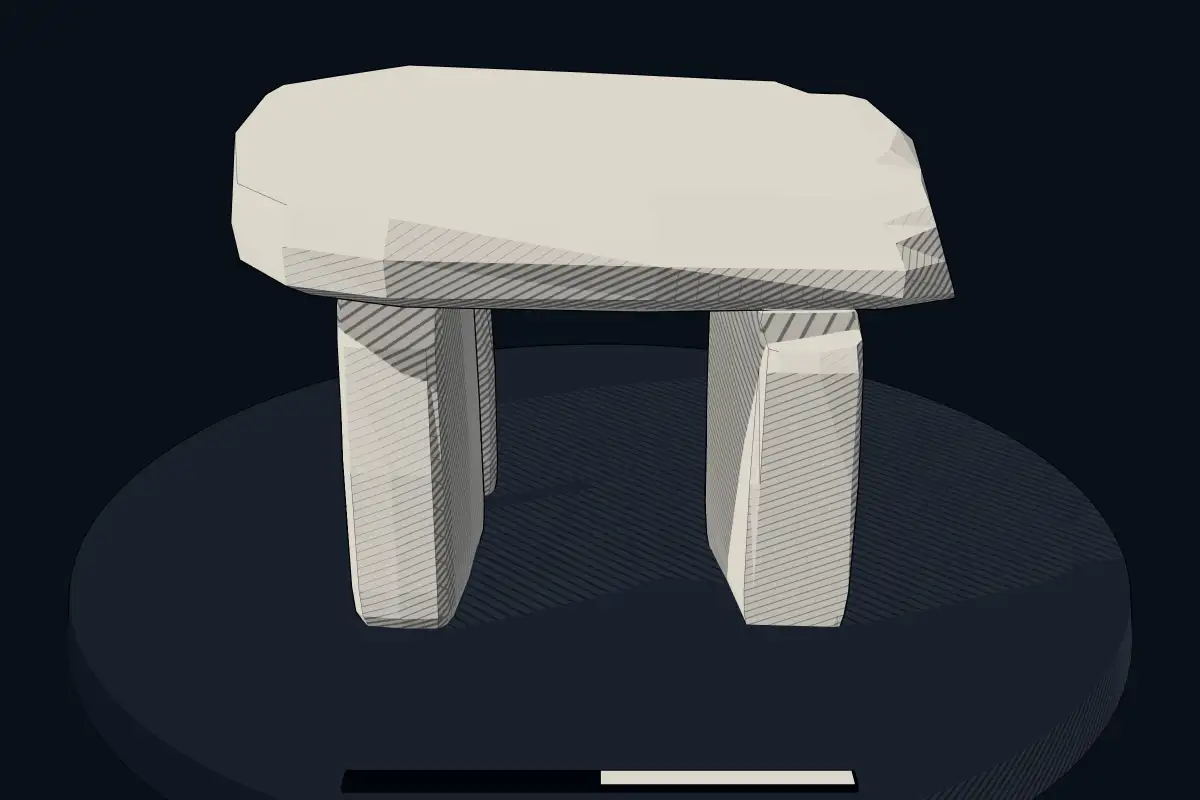
The reconstruction is ours, not a survey: it shows what a monument of this type looks like, at the size the record gives for this one.
Photographs
1 photograph, each with its author and licence
Lore
Evidence & Lore
What the sources actually support — and, kept apart, what has been claimed.
What the evidence supports
Dates
Est. 4000–3000 BCEHow this date was established: Type comparisonTypical range for dolmens in Spain; this site has not been dated itself. Most dolmens date from the Late Neolithic period (4000-3000 BCE); the Dolmen of Menga in Andalusia dates to about 3750-3650 BCE.Source for this date
Where it stands
Spain
The pin marks the monument itself — its exact point.
- Coordinates
- 42°23′41″ N, 2°58′43″ EFor a GPS or map app: 42.39484, 2.97863
Access is as our sources describe it; we have not visited the site to check.
Nearby
The closest sites in the Atlas, by straight line.
 Dolmen de la Gutina4000–3000 BCE
- DolmenDolmen de la Gutina/Puig del Pal4000–3000 BCE
 Dolmen del Prat Tancat4000–3000 BCE
 Menhir de la Murtra2800–1800 BCE
 Menhir de Vilartolí2800–1800 BCE
- DolmenDolmen de la Cabana Arqueta4000–3000 BCE
- Menhir (standing stone)menhir de Santa Fe dels Solers2800–1800 BCE
 Dolmen de Fontanilles4000–3000 BCE


Sources
Every record behind this page, with the link it came from.
2 sources behind this page
- 01Wikidata Q11917567wikidata.org
- 02Source for this dateen.wikipedia.org
Image files
- Dolmen de Tires Llargues.jpgClemens SchmillenCC BY-SA 4.0
Report a correctionWrong date, name, photograph or source? Tell us and it will be put right.
Around this place
The ten nearest sites, by compass
- Dolmen de la Gutina0.2 km NE
- Dolmen de la Gutina/Puig del Pal0.6 km E
- Dolmen del Prat Tancat0.6 km S
- Menhir de la Murtra0.9 km N
- Menhir de Vilartolí1.3 km W
- Dolmen de la Cabana Arqueta1.4 km SE
- menhir de Santa Fe dels Solers1.6 km W
- Dolmen de Fontanilles1.9 km NW
- Menhir del Castellà1.9 km N
- Salt d'en Peió2.6 km N
Credit
Text, licence and sources
Text from the Wikipedia article "Dolmen de Tires Llargues" (Catalan), licensed CC BY-SA 4.0; authors are listed in the page history. Reused under CC BY-SA 4.0. Read on Wikipedia · Edit history and authors