
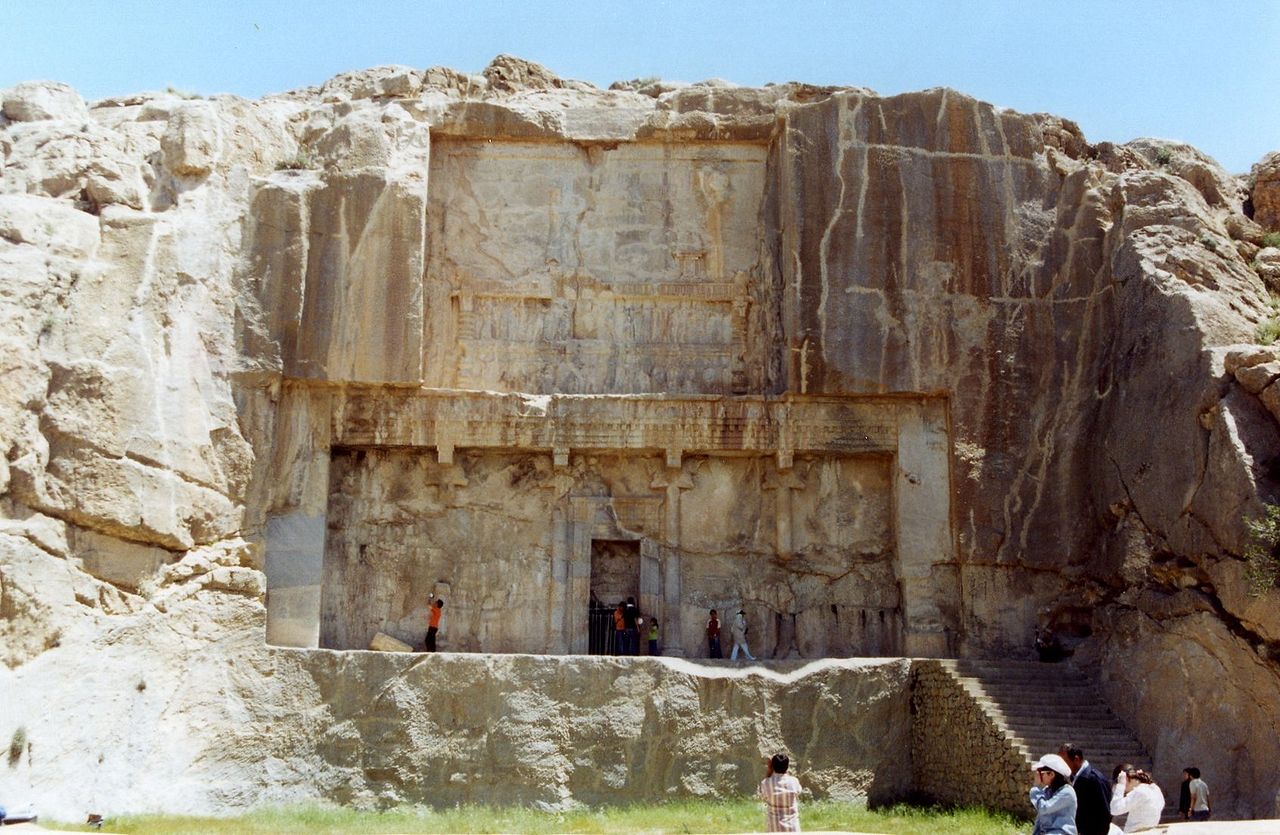
Tomb of Darius II
Photo Diego Delso · CC BY-SA 4.0Source file on Wikimedia Commons
Overview
About this site
Overview
Tomb of Darius II is a hypogeum in Marvdasht County, Iran. It lies at 29.9889° N, 52.8738° E.
Catalogue recordSources and licences
Article
Tomb of Darius II
ContextSources for this section
- en.wikipedia.orgCC BY-SA 4.0
- en.wikipedia.orgCC BY-SA 4.0
- en.wikipedia.orgCC BY-SA 4.0
Sources for this section
- en.wikipedia.orgCC BY-SA 4.0
- en.wikipedia.orgCC BY-SA 4.0
- en.wikipedia.orgCC BY-SA 4.0
A rock-cut tomb is a burial chamber cut into a naturally occurring rock formation, usually into a cliff or sloping rock face, though it may also go downward in flat ground. It was a common burial form for the wealthy in ancient times in several parts of the world. A hypogeum, literally "underground", is a subterranean temple or tomb that often has niches for cremated remains or loculi for buried ones. The regional background, “Rock-cut tombs of Anatolia and Iran”, is given below.
Dating
No date has been published for this site.
Setting
7 other recorded monuments lie within 10 km (4 within 1 km, 4 within 5 km), 6 of them of the same type. In Marvdasht County, Iran, 7 of the 8 recorded monuments are of this type.
The nearest recorded monuments are Tomb of Artaxerxes I (0.0 km east, hypogeum); Tomb of Darius I (0.1 km east, hypogeum); Naqsh-e Rustam (0.1 km east, other / unclassified); Tomb of Xerxes I (0.2 km east, hypogeum).
ProtectionSources for this section
Sources for this section
Heritage status: Iranian National Heritage.
Tradition and region
About this kind of monument
Rock-cut tombs of Anatolia and Iran
A rock-cut tomb is a burial chamber cut into a naturally occurring rock formation, usually into a cliff or sloping rock face, though it may also go downward in flat ground. It was a common burial form for the wealthy in ancient times in several parts of the world. A hypogeum, literally "underground", is a subterranean temple or tomb that often has niches for cremated remains or loculi for buried ones.
Important clusters are found in Iran and Turkey. At Naqsh-e Rostam, about 13 kilometres north-west of Persepolis in Fars province, the cliff face holds the tombs of four Achaemenid kings, notably Darius the Great and his son Xerxes, and a series of rock reliefs cut over more than a millennium from the Elamites and Achaemenids to the Sasanians. Other notable clusters are at Myra in Lycia, in south-west Turkey, at Petra in Jordan, where the Nabataeans cut tombs, and in ancient Israel.
The tombs of kings can be dated through the rulers they name, but an uninscribed rock-cut chamber in the countryside can only be assigned a broad range, since a cut chamber holds no material that can be dated by itself.
Folklore: the name Naqsh-e Rostam means "mural of Rostam", after the legendary hero of Iranian tradition, though the reliefs are the work of Elamite, Achaemenid and Sasanian kings.
When visiting, look at the façades and the position of the tombs high on the rock face.
Paraphrased from Wikipedia: Rock-cut tomb, Wikipedia: Hypogeum, Wikipedia: Naqsh-e Rustam · CC BY-SA 4.0
Photographs
8 photographs, each with its author and licence
More photographs
Where it stands
Iran
The pin marks the monument itself — its exact point.
- Coordinates
- 29°59′20″ N, 52°52′26″ EFor a GPS or map app: 29.98892, 52.87381
Access is as our sources describe it; we have not visited the site to check.
Nearby
The closest sites in the Atlas, by straight line.




Sources
Every record behind this page, with the link it came from.
2 sources behind this page
- 01Wikidata Q5952161wikidata.org
- 02Wikipedia: Tomb of Darius IIen.wikipedia.org
Image files
- Darius II soldiers with labels.jpgDiego DelsoCC BY-SA 4.0
- Naqsh-e Rustam 2.jpgدرفش کاویانیCC BY-SA 3.0
- Naghsh-e rostam, Irán, 2016-09-24, DD 16.jpgDiego DelsoCC BY-SA 4.0
- Tomb of Darius II, Naqsh-e Rustam 02.jpgBernard GagnonCC BY-SA 4.0
- Irnp111-Grobowce Naqsh-E Rustam.jpgWojciech KocotCC BY-SA 4.0
- Naghsh Rostam detail.jpgBernd81CC BY-SA 4.0
- Naqsh-e Rostam, Iran (48098801982).jpgCarole Raddato from Frankfurt, GermanyCC BY-SA 2.0
- Naqsh-e Rostam, Iran (48098802797).jpgCarole Raddato from Frankfurt, GermanyCC BY-SA 2.0
Report a correctionWrong date, name, photograph or source? Tell us and it will be put right.
Around this place
The ten nearest sites, by compass
Credit
Text, licence and sources
Compiled from open records (Wikidata, CC0; OpenStreetMap, ODbL) and a regional background article based on Wikipedia (CC BY-SA 4.0).
- Wikidata Q5952161CC0
- en.wikipedia.orgCC BY-SA 4.0
- en.wikipedia.orgCC BY-SA 4.0
- en.wikipedia.orgCC BY-SA 4.0