
MegalithFringe site
Naqsh-e Rustam
Also known asNaqsh-e Rostam · Naghsh-e Rostam · Naghsh-e Rustam
Datedc. 550–330 BCE
Photo Diego Delso · CC BY-SA 4.0Source file on Wikimedia Commons
Overview
About this site
What the sources say
Naqsh-e Rostam (Persian: نقش رستم, lit. 'Mural of Rostam', Persian: [ˌnæɣʃeɾosˈtæm]) is an ancient archeological site and necropolis located about 13 km northwest of Persepolis, in Fars province, Iran. A collection of ancient Iranian rock reliefs are cut into the face of the mountain and the mountain contains the final resting place of four Achaemenid kings, notably king Darius the Great and his son, Xerxes. This site is of great significance to the history of Iran and to Iranians, as it contains various archeological sites carved into the rock wall through time for more than a millennium from the Elamites and Achaemenids to the Sasanians. It lies a few hundred meters from Naqsh-e Rajab, with a further four Sasanian rock reliefs, three celebrating kings and one a high priest.
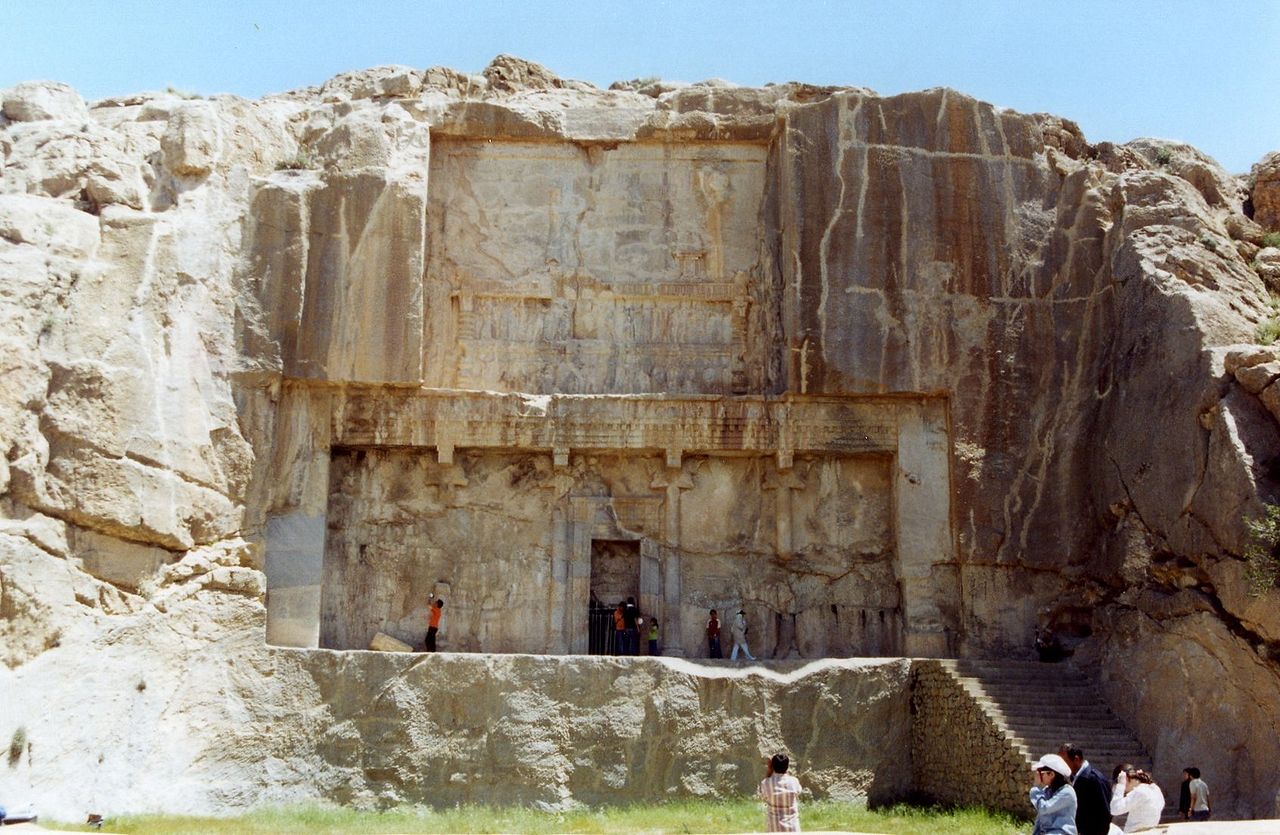
Naqsh-e Rostam is the necropolis of the Achaemenid dynasty (c. 550–330 BC), with four large tombs cut high into the cliff face. These have mainly architectural decoration, but the facades include large panels over the doorways, each very similar in content, with figures of the king being invested by a god, above a zone with rows of smaller figures bearing tribute, with soldiers and officials. The three classes of figures are sharply differentiated in size. The entrance to each tomb is at the center of each cross, which opens onto a small chamber, where the king lay in a sarcophagus. The tombs were looted extensively following the conquest of Persia by Alexander the Great.
Well below the Achaemenid tombs, near ground level, are rock reliefs with large figures of Sasanian kings, some meeting gods, others in combat. The most famous shows the Sasanian king Shapur I on horseback, with the Roman Emperor Valerian bowing to him in submission, and Philip the Arab (an earlier emperor who paid Shapur tribute) holding Shapur's horse, while the dead Emperor Gordian III, killed in battle, lies beneath it (other identifications have been suggested). This commemorates the Battle of Edessa in AD 260, when Valerian became the only Roman Emperor who was captured as a prisoner of war, a lasting humiliation for the Romans. The placing of these reliefs clearly suggests the Sassanid intention to link themselves with the glories of the earlier Achaemenid Empire.
Read on Wikipedia10 min readCC BY-SA 4.0
Where it sits in time
The site's dated range, placed against world reference points.
The scale is logarithmic: each step to the left is about ten times older than the last.
The full article
Naqsh-e Rustam: the whole story
In briefSources for this section
- Wikipedia (English): Naqsh-e RostamCC BY-SA 4.0
Sources for this section
- Wikipedia (English): Naqsh-e RostamCC BY-SA 4.0
Naqsh-e Rostam is an ancient archaeological site and necropolis about 13 km northwest of Persepolis, in Fars province, Iran. Rock reliefs are cut into the face of the mountain, which contains the final resting place of four Achaemenid kings, notably Darius the Great and his son Xerxes. The site carries carvings made over more than a millennium, from the Elamites and Achaemenids to the Sasanians, and lies a few hundred meters from Naqsh-e Rajab, with a further four Sasanian rock reliefs.
The oldest relief dates to the Elamite period but has been almost completely erased. It originally occupied a space 7 by 2.5 meters and was carved over in the Sasanian period to create the relief of Bahram II, leaving only faint traces of the earlier composition. Another severely damaged relief near the investiture scene of Narseh has been tentatively dated to the Elamite period.
The Achaemenid necropolis (c. 550–330 BC) has four large tombs cut high into the cliff face, identical in design. Each has an upper register showing the king holding a bow before a fire altar and a figure emerging from a winged disk, standing on a platform supported by two rows of 15 figures representing provinces of the empire. The middle register depicts a faux-portico of an Achaemenid palace with double-protome bull's head capitals, and the bottom register is left bare. Only the tomb of Darius carries an extensive inscription, parts DNa and DNb, which allows it to be attributed to him; it is assumed to be the oldest and the model for the others. The other three are believed to be those of Xerxes I (c. 486–465 BC), Artaxerxes I (c. 465–424 BC) and Darius II (c. 423–404 BC), though that matching is somewhat speculative. The tombs were looted extensively following the conquest of Persia by Alexander the Great.
Ka'ba-ye Zartosht, meaning the Cube of Zoroaster, is a 5th-century B.C Achaemenid square tower, a copy of a sister building at Pasargadae. Several theories exist about its purpose.
Well below the tombs, near ground level, are seven over-life sized Sasanian rock reliefs. They include the investiture of Ardashir I, who receives the ring of kingship from Ohrmazd, and the most famous, the triumph of Shapur I over the Roman emperors Valerian and Philip the Arab. It commemorates the Battle of Edessa in AD 260, when Valerian became the only Roman Emperor captured as a prisoner of war. Further reliefs of Bahram II include a grandee relief and equestrian scenes, and the placing of the Sasanian carvings suggests an intention to link themselves with the glories of the earlier Achaemenid Empire.
DescriptionSources for this section
- Wikipedia (English): Naqsh-e RostamCC BY-SA 4.0
Sources for this section
- Wikipedia (English): Naqsh-e RostamCC BY-SA 4.0
Elamite rock reliefs
The oldest relief at Naqsh-e Rostam dates back to the Elamite period, although it has been almost completely erased. Originally occupying a space 7 by 2.5 meters in area, the relief was carved over in the Sasanian period to create the 'grandee' or 'audience' relief of Bahram II, leaving only faint traces of the pre-existing Elamite composition. One figure from the pre-existing relief, likely a king of the Neo-Elamite period, was integrated into the newer Sasanian composition, appearing on the far right-hand side of the relief alongside later depictions of Sasanian officials. To the left of the preserved figure, beneath the busts of the Sasanian officials, are two partially-preserved figures sitting on thrones of coiled snakes, and on the far left side of the relief is the preserved head of a female figure wearing a mural crown.
Though it is severely damaged, another relief near the investiture scene of Narseh, which depicts a faint image of a man with unusual headgear, has been tentatively dated to the Elamite period.
Achaemenid tombs
Four tombs belonging to Achaemenid kings are carved out of the rock face at a considerable height above the ground. The four tombs are identical in terms of design and accompanying relief decoration. In the upper register each tomb includes an elaborate relief depicting the king holding a bow and paying homage to a fire altar and a figure emerging from a winged disk, often identified as the Zoroastrian fravahar. The king and the altar stand on an elevated platform supported by two rows of 15 figures, each identified by a short inscription as representing a different province within the empire, with minor differences in their attire to correspond with the national dress of the corresponding region. Two other figures stand next to the base of the platform, and a further six figures stand in niches carved along the edges of the scene (three on either side). The wider middle register depicts a faux-portico of an Achaemenid palace, with double-protome bull's head capitals. The bottom register is left bare.
Tomb of Darius the Great
The tomb of Darius is the only tomb to include an extensive inscription on its facade, where it appears to the left of the king, divided into two main parts referred to as DNa and DNb, allowing it to be confidently attributed to Darius, who refers to himself by name within the text of the inscriptions. It is assumed to be the oldest of the four, and presumably served as the model for the three subsequent Achaemenid tombs cut at the site.
Other tombs
The other three tombs are believed to be those of Xerxes I (c. 486–465 BC), Artaxerxes I (c. 465–424 BC), and Darius II (c. 423–404 BC) respectively. The order of the tombs in Naqsh-e Rostam follows (left to right): Darius II, Artaxerxes I, Darius I, Xerxes I. The matching of the other kings to tombs is somewhat speculative; the relief figures are not intended as individualized portraits.
Darius I inscription
An inscription by Darius I, from c.490 BCE, generally referred to as the "DNa inscription" in scholarly works, appears in the top left corner of the facade of his tomb. It mentions the conquests of Darius I and his various achievements during his life. Its exact date is not known, but it can be assumed to be from the last decade of his reign. Like several other inscriptions by Darius, the territories controlled by the Achaemenid Empire are specifically listed, which formed the largest empire during antiquity. His empire encompassed Macedon and Thrace in Europe, Egypt in North Africa, Babylon and Assyria in Mesopotamia, the steppes of Eurasia, Bactria in Central Asia, up to Gandhara and the Indus in the Indian Subcontinent which were annexed during the Achaemenid conquest of the Indus Valley.
Darius I inscription(DNa inscription)
DNf inscription.
There are various and contradictory reports about how this inscription was discovered. According to Mrs. Khadija Totunchi, she took a photo of this inscription in 2017. But she did not find a suitable person to translate and read the inscription. Also, according to Ebrahim Rustaei, in 2018, in cooperation with Abdul Majid Arfai, he presented an article about the inscription to the International Conference on History and Culture of Southern Iran (Historical Persia), in which a reading of the inscription was presented. However, this reading is very basic and has many flaws. But finally, the DNf petroglyph, which had been hidden in the shade and under algae and sediments for 2500 years, was officially and scientifically recorded by Mojtaba Doroodi and Soheil Delshad in February 2019.[2]
Babylonian Transliteration: 1- [mx-x-x(-x) LÚ
pa-id-di-iš-ḫu]-ri-iš ˹a˺-˹na˺ m da-a-ri-i̭a-˹muš˺ LUGAL i-GA-ir-ra-bi
Translation (based on the Babylonian version): [Personal Name, Pati]schorian, invokes blessing upon Darius the King.
Ka'ba-ye Zartosht
Ka'ba-ye Zartosht (meaning the "Cube of Zoroaster") is a 5th-century B.C Achaemenid square tower. The structure is a copy of a sister building at Pasargadae, the "Prison of Solomon" (Zendān-e Solaymān).
Several theories exist regarding the purpose of the Ka'ba-ye Zartosht structure.
Sasanian reliefs
Seven over-life sized rock reliefs at Naqsh-e Rostam depict monarchs of the Sasanian era.
Investiture relief of Ardashir I, c. 226–242
The founder of the Sassanid Empire is seen being handed the ring of kingship by Ohrmazd.
Triumph of Shapur I, c. 241–272
The most famous of the Sassanid rock reliefs, and depicts the victory of Shapur I over two Roman emperors, Valerian and Philip the Arab. Behind the king stands Kirtir, the mūbadān mūbad ('high priest'), the most powerful of the Zoroastrian Magi during the history of Iran.
In an inscription, Shapur I claims possession of the territory of the Kushans (Kūšān šahr) as far as "Purushapura" (Peshawar), suggesting he controlled Bactria and areas as far as the Hindu-Kush or even south of it:
I, the Mazda-worshipping lord, Shapur, king of kings of Iran and An-Iran… (I) am the Master of the Domain of Iran (Ērānšahr) and possess the territory of Persis, Parthian… Hindestan, the Domain of the Kushan up to the limits of Paškabur and up to Kash, Sughd, and Chachestan.
"Grandee" relief of Bahram II, c. 276–293
On each side of the king, who is depicted with an oversized sword, figures face the king.
Two equestrian reliefs of Bahram II, c. 276–293
The first equestrian relief, located immediately below the fourth tomb (perhaps that of Darius II), depicts the king battling a mounted Roman enemy. The second equestrian relief, located immediately below the tomb of Darius I, is divided into two registers, an upper and a lower one. In the upper register, the king appears to be forcing a Roman enemy, probably Roman emperor Carus from his horse. In the lower register, the king is again battling a mounted enemy wearing a headgear shaped as an animal's head, thought to be the vanquished Indo-Sassanian ruler Hormizd I Kushanshah.
Investiture of Narseh, c. 293–303
In this relief, the king is depicted as receiving the ring of kingship from a female figure that is frequently assumed to be the divinity Aredvi Sura Anahita.
Equestrian relief of Hormizd II, c 303–309
This relief is below tomb 3 (perhaps that of Artaxerxes I) and depicts Hormizd forcing an enemy (perhaps Papak of Armenia) from his horse.
ArchaeologySources for this section
- Wikipedia (English): Naqsh-e RostamCC BY-SA 4.0
Sources for this section
- Wikipedia (English): Naqsh-e RostamCC BY-SA 4.0
In 1923, the German archaeologist Ernst Herzfeld made casts of the inscriptions on the tomb of Darius the Great. Since 1946, these casts have been held in the archives of the Freer Gallery of Art and the Arthur M. Sackler Gallery, Smithsonian Institution, in Washington, DC.
Naqsh-e Rostam was excavated for several seasons between 1936 and 1939 by a team from the Oriental Institute of the University of Chicago, led by Erich Schmidt.
How this page was madeSources for this section
- Wikipedia (English): Naqsh-e RostamCC BY-SA 4.0
Sources for this section
- Wikipedia (English): Naqsh-e RostamCC BY-SA 4.0
The summary at the top of this page was written by Claude Sonnet 5.5 (2026-11-06) from the cited Wikipedia article “Naqsh-e Rostam”. The numbers in it were checked automatically against the source text. The rest of the page is the article itself, the structured records and computed distances.
Tradition and region
About this kind of monument
Ziggurats of Mesopotamia and Iran
A ziggurat is a massive structure built in ancient Mesopotamia and Iran in the form of a terraced compound of successively receding storeys or levels. Notable ones include the Great Ziggurat of Ur near Nasiriyah, the Ziggurat of Aqar Quf near Baghdad, the vanished Etemenanki in Babylon, and Chogha Zanbil in Khuzestan. The Sumerians believed that the gods lived in the temple at the top of the ziggurat, so that only priests and other highly respected individuals were allowed to ascend.
The Great Ziggurat of Ur, called Etemenniguru, "house whose foundation creates terror", was built in the Early Bronze Age, in the twenty-first century BCE, by King Ur-Nammu of the Third Dynasty of Ur. It had crumbled to ruins by the sixth century BCE, when it was restored by King Nabonidus. Chogha Zanbil in Iran is an ancient Elamite complex about 30 kilometres south-east of Susa, one of the few ziggurats outside Mesopotamia, dated to the fourteenth or thirteenth century BCE, conventionally 1250 BCE. Etemenanki, the Babylonian ziggurat dedicated to Marduk, lay about 90 kilometres south of Baghdad; some scholars have proposed it as the ziggurat behind the biblical account of the Tower of Babel.
The ziggurat is not built of huge stones: the core was of sun-baked bricks with facings of fired bricks on the outside, each step slightly smaller than the one below, and the facings were often glazed in different colours. Kings sometimes had their names engraved on the glazed bricks, which gives a way to date the building. The Atlas files ziggurats under "other" because they fit no megalithic category.
When visiting, check the security situation, since several sites lie in regions where access is restricted.
Paraphrased from Wikipedia: Ziggurat, Wikipedia: Ziggurat of Ur, Wikipedia: Chogha Zanbil, Wikipedia: Etemenanki · CC BY-SA 4.0
From the article
Dated moments in the story
- 490 BCE
The matching of the other kings to tombs is somewhat speculative; the relief figures are not intended as individualized portraits. An inscription by Darius I, from c.490 BCE, generally referred to as the "DNa inscription" in scholarly works, appears in the top left corner of the facade of his tomb.
Source - 465 BCE
It is assumed to be the oldest of the four, and presumably served as the model for the three subsequent Achaemenid tombs cut at the site. The other three tombs are believed to be those of Xerxes I (c. 486–465 BC), Artaxerxes I (c. 465–424 BC), and Darius II (c. 423–404 BC) respectively.
Source - 330 BCE
Naqsh-e Rostam is the necropolis of the Achaemenid dynasty (c. 550–330 BC), with four large tombs cut high into the cliff face.
Source - 1923
In 1923, the German archaeologist Ernst Herzfeld made casts of the inscriptions on the tomb of Darius the Great.
Source - 1936
Naqsh-e Rostam was excavated for several seasons between 1936 and 1939 by a team from the Oriental Institute of the University of Chicago, led by Erich Schmidt.
Source - 1946
Since 1946, these casts have been held in the archives of the Freer Gallery of Art and the Arthur M.
Source - 2017
Khadija Totunchi, she took a photo of this inscription in 2017. But she did not find a suitable person to translate and read the inscription.
Source - 2018
Also, according to Ebrahim Rustaei, in 2018, in cooperation with Abdul Majid Arfai, he presented an article about the inscription to the International Conference on History and Culture of Southern Iran (Historical Persia), in which a reading of the inscription was presented.
Source
Photographs
8 photographs, each with its author and licence
More photographs
Lore
Evidence & Lore
What the sources actually support — and, kept apart, what has been claimed.
What the evidence supports
Dates
550–330 BCEHow this date was established: Stated by the sourceThe source identifies the necropolis with the stated Achaemenid period.Source for this date
Measured facts
- Mainstream position
- The source presents the relief as commemorating the Battle of Edessa in AD 260 and showing Valerian in submission to Shapur I.Source: Mainstream position
- Location
- About 13 km northwest of Persepolis, Fars Province, IranSource: Location
- Achaemenid tombs
- Four large tombs cut into the cliff faceSource: Achaemenid tombs
- Burial place
- Darius the Great and his son XerxesSource: Burial place
- Nearby reliefs
- Four Sasanian rock reliefs lie a few hundred meters awaySource: Nearby reliefs
- Excavation
- Oriental Institute teams worked there from 1936 to 1939Source: Excavation
- Inscription casts
- Made in 1923 and held by Smithsonian galleries since 1946Source: Inscription casts
- Heritage designation
- Iranian National HeritageSource: Heritage designation
Alternative claims
Alternative claims about this site, kept in their own block and labelled with where they stand.
The figures in the relief showing Shapur I, Valerian, Philip the Arab, and Gordian III have received alternative identifications.
Where it stands
Iran
The pin marks the monument itself — its exact point.
- Coordinates
- 29°59′20″ N, 52°52′29″ EFor a GPS or map app: 29.98889, 52.87472
Access is as our sources describe it; we have not visited the site to check.
Nearby
The closest sites in the Atlas, by straight line.




Sources
Every record behind this page, with the link it came from.
3 sources behind this page
- 01Wikidata Q648705wikidata.org
- 02Fringe claim sourceen.wikipedia.org
- 03Fringe claim sourceen.wikipedia.org
Image files
- Naghsh-e rostam, Irán, 2016-09-24, DD 20-24 PAN.jpgDiego DelsoCC BY-SA 4.0
- The Islamic Republic 049 (8498647398).jpgStefan Krasowski from New York, NY, USACC BY 2.0
- 20101229 Naqsh e Rostam Shiraz Iran more Panoramic.jpgUser:GgiaCC BY-SA 3.0
- Naghsh-e rostam, Irán, 2016-09-24, DD 19.jpgDiego DelsoCC BY-SA 4.0
- 2018-09-20 Iran, Naqsh-e Rostam.jpgLaurens R. KrolCC BY 4.0
- CH-NB - Persien, Naksch-i-Rustem (Naqsh-i Rustam)- Landschaft (Lokalisierung unsicher) - Annemarie Schwarzenbach - SLA-Schwarzenbach-A-5-04-021.jpgAnnemarie SchwarzenbachPublic domain
- CH-NB - Persien, Naksch-i-Rustem (Naqsh-i Rustam)- Landschaft (Lokalisierung unsicher) - Annemarie Schwarzenbach - SLA-Schwarzenbach-A-5-04-017.jpgAnnemarie SchwarzenbachPublic domain
- 20101229 Naqsh e Rostam Shiraz Iran Panorama.jpgUser:GgiaCC BY-SA 3.0
Report a correctionWrong date, name, photograph or source? Tell us and it will be put right.
Lore, kept apart
Legends and claims
These are stories and claims reported by the sources. They are not evidence, and they never stand in for the dating above.
- Tested: not supported
The figures in the relief showing Shapur I, Valerian, Philip the Arab, and Gordian III have received alternative identifications.
Source
Around this place
The ten nearest sites, by compass
Credit
Text, licence and sources
Text from the Wikipedia article "Naqsh-e Rostam" (English), licensed CC BY-SA 4.0; authors are listed in the page history. Reused under CC BY-SA 4.0. Read on Wikipedia · Edit history and authors
- Wikipedia (English): Naqsh-e RostamCC BY-SA 4.0
- Wikidata Q648705CC0
- Fringe claim sourceCC BY-SA 4.0