
MegalithFringe site
Bagh Caves
Also known asShala Gumpha of Bagh · Bagh Gufa · Baug caves
DatedEst. 1500 BCE–900 CE
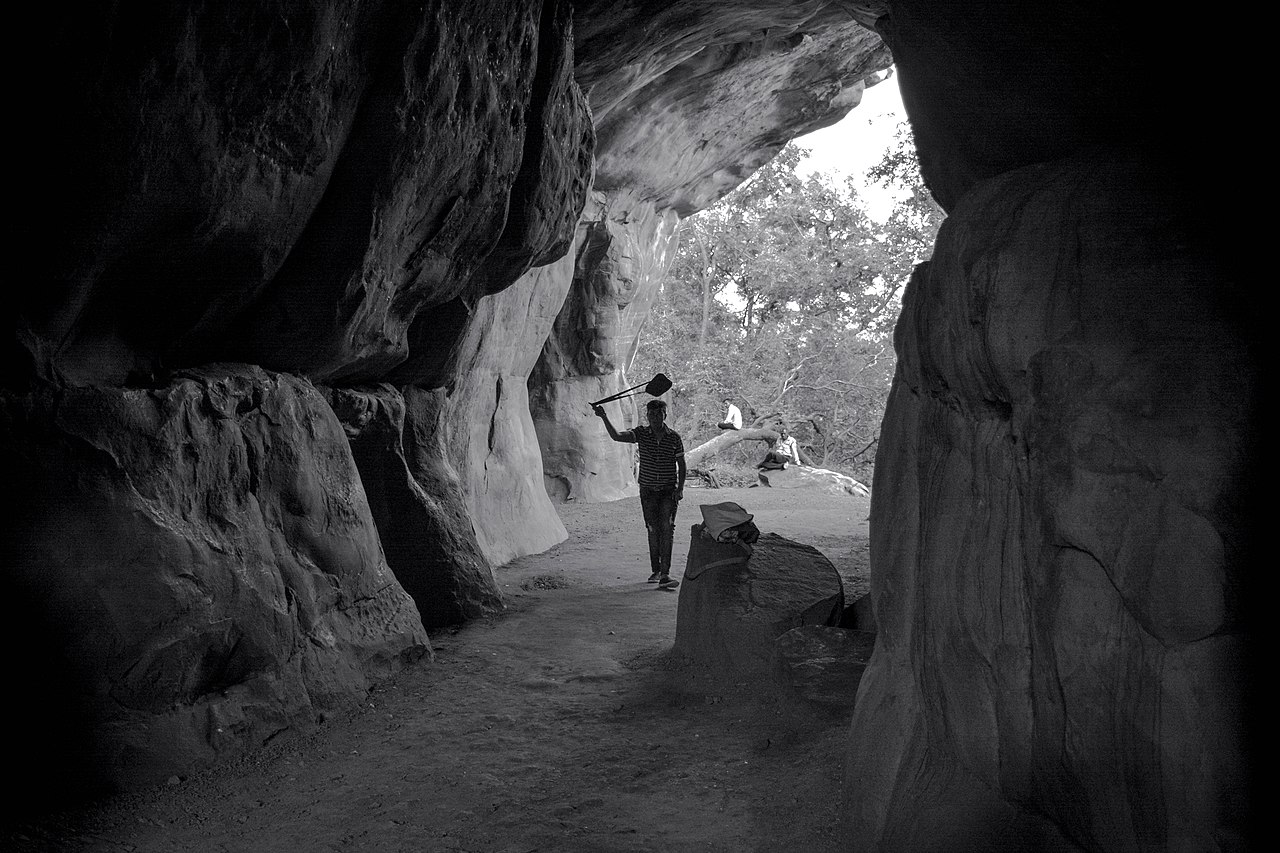
Photo Nikhil2789 · CC BY-SA 3.0Source file on Wikimedia Commons
Overview
About this site
What the sources say
The Bagh Caves are a group of nine rock-cut monuments, situated among the southern slopes of the Vindhya Range in Bagh town of Dhar district in Madhya Pradesh in central India. These monuments are located at a distance of 97 km from Dhar town. These are renowned for mural paintings by master painters of ancient India. The caves are examples of Indian rock-cut architecture, rather than naturally formed.
The Bagh caves, like those at Ajanta, were excavated by master craftsmen on perpendicular sandstone rock face of a hill on the far bank of a seasonal stream, the Baghani. Buddhist in inspiration, of the nine caves, only five have survived. All of them are 'viharas' or resting places of monks monasteries having quadrangular plan. A small chamber, usually at the back, forms the 'chaitya', the prayer hall. Most significant of these five extant caves is the Cave 4, commonly known as the Rang Mahal (Palace of Colors).
The Bagh Caves were quarried in the 5th-6th century AD, in the very late stages of Buddhism in India, and long after most of the Indian Buddhist caves had been built, many of them since the 2nd or 1st centuries BCE.
They are believed to have been built during the 5th-7th century. The Archaeological Survey of India has restored the caves over 17 years.
Read on Wikipedia4 min readCC BY-SA 4.0
Where it sits in time
The site's dated range, placed against world reference points.
The scale is logarithmic: each step to the left is about ten times older than the last.
The full article
Bagh Caves: the whole story
In briefSources for this section
- Wikipedia (English): Bagh CavesCC BY-SA 4.0
Sources for this section
- Wikipedia (English): Bagh CavesCC BY-SA 4.0
The Bagh Caves are a group of nine rock-cut monuments on the southern slopes of the Vindhya Range, in Bagh town of Dhar district in Madhya Pradesh, central India, 97 km from Dhar town. They are renowned for mural paintings by master painters of ancient India. The caves were excavated, not naturally formed, and are examples of Indian rock-cut architecture.
Like those at Ajanta, they were cut by master craftsmen into the perpendicular sandstone rock face of a hill on the far bank of a seasonal stream, the Baghani. They are Buddhist in inspiration, but of the nine caves only five have survived. All are viharas, or resting places of monks, with a quadrangular plan, and a small chamber usually at the back forms the chaitya, the prayer hall. The most significant of the five is Cave 4, commonly known as the Rang Mahal (Palace of Colors).
The caves were quarried in the 5th-6th century AD, in the very late stages of Buddhism in India and long after most Indian Buddhist caves had been built, many of them since the 2nd or 1st centuries BCE. They are believed to have been built during the 5th-7th century. A copperplate inscription of Maharaja Subandhu, recording his donation for the repair of the vihara, was found at Cave 2. Its own date is missing, but his Badwani copperplate is dated to the year (Gupta era) 167 (487), placing the repair of Cave 2 in the late 5th century.
The paintings on the walls and ceilings were executed in tempera, and fragments survive in Cave 3 and Cave 4, with remnants in Caves 2, 5 and 7. The ground was a reddish-brown gritty and thick mud plaster, over which lime-priming was applied. Some of the most beautiful paintings were on the walls of the portico of Cave 4. Their characteristics are like those of the Ajanta Caves, and they are described as materialistic rather than spiritualistic.
Cave 2, the best preserved, is also known as Pandava Cave. Most paintings were carefully removed in 1982 to prevent further loss and can now be seen in the Gujari Mahal Archeological Museum in Gwalior. The Archaeological Survey of India has restored the caves over 17 years.
The paintingsSources for this section
- Wikipedia (English): Bagh CavesCC BY-SA 4.0
Sources for this section
- Wikipedia (English): Bagh CavesCC BY-SA 4.0
The paintings on the wall and ceilings of the Viharas of Bagh, the fragments of which are still visible in Cave 3 and Cave 4 (remnants seen also in Caves 2, 5 and 7), were executed in tempera. Cave 2 is the best preserved cave, also known as "Pandava Cave" These paintings are materialistic rather than spiritualistic. Characteristics of paintings are like those of Ajanta Caves. The ground prepared was a reddish-brown gritty and thick mud plaster, laid out on the walls and ceilings. Over the plaster, lime-priming was done, on which these paintings were executed. Some of the most beautiful paintings were on the walls of the portico of Cave 4. To prevent further loss of the values of Indian classical art, most paintings were carefully removed in 1982 and today can be seen in the Gujari Mahal Archeological Museum, in Gwalior.
DateSources for this section
- Wikipedia (English): Bagh CavesCC BY-SA 4.0
Sources for this section
- Wikipedia (English): Bagh CavesCC BY-SA 4.0
A copperplate inscription of Maharaja Subandhu recording his donation for the repair of the vihara was found at the site of Cave 2. Although the date of the Bagh inscription is missing, his Badwani copperplate inscription is dated in the year (Gupta era) 167 (487); the repair of Cave 2 took place in the late 5th century.
How this page was madeSources for this section
- Wikipedia (English): Bagh CavesCC BY-SA 4.0
Sources for this section
- Wikipedia (English): Bagh CavesCC BY-SA 4.0
The summary at the top of this page was written by Claude Sonnet 5.5 (2026-11-06) from the cited Wikipedia article “Bagh Caves”. The numbers in it were checked automatically against the source text. The rest of the page is the article itself, the structured records and computed distances.
Tradition and region
About this kind of monument
Megalithic burials of India
Megaliths are found in almost every part of South Asia, from the south to the north-eastern hills. Dates in the literature run from before 3000 BCE, with recent finds in southern India claimed back to 5000 BCE, and the southern megalithic cultures correspond in part with the Iron Age. A large fraction are thought to be associated with burial or post-burial rites. The forms are many: stone circles, cists, menhirs, dolmens and rock-cut chambers.
Researchers note that giant human-shaped figures, which usually occur with megalithic monuments in burial grounds, may be connected with ancestor worship, though what they symbolise is unclear. Marks found mostly on potsherds in megalithic burials of central and south India and Sri Lanka, tentatively dated from 1000 BCE to 300 CE, are still debated: there is no consensus on whether they are undeciphered writing or graffiti.
In the east the tradition has lasted longest: the megaliths there show evidence of living megalithic practices until recently. In the Khasi Hills of Meghalaya, Mawphlang ("grassy stone") is one of many settlements named after monoliths, and it is the site of a sacred grove. Visitors should respect local custom.
Dating is the weak point: few have been excavated to modern standards, and many are dated only by comparison with excavated graves.
When visiting, look for rings of stones at the edge of fields, for capstones raised on slabs, and for groups of graves on hillsides.
Paraphrased from Wikipedia: Megalith, Wikipedia: Iron Age in India, Wikipedia: Megalithic graffiti symbols, Wikipedia: Mawphlang · CC BY-SA 4.0
From the article
Dated moments in the story
- 1982
Some of the most beautiful paintings were on the walls of the portico of Cave 4. To prevent further loss of the values of Indian classical art, most paintings were carefully removed in 1982 and today can be seen in the Gujari Mahal Archeological Museum, in Gwalior.
Source
Photographs
8 photographs, each with its author and licence
More photographs
Lore
Evidence & Lore
What the sources actually support — and, kept apart, what has been claimed.
What the evidence supports
Dates
Est. 1500 BCE–900 CEHow this date was established: Type comparisonTypological estimate, not a date for this site: a other in South Asia is normally dated between 1500 BCE and 900 CE (Atlas typological table).Source for this date
Measured facts
- Total caves
- nineSource: Total caves
- Surviving caves
- fiveSource: Surviving caves
- Cave type
- viharas with quadrangular plansSource: Cave type
- Principal surviving cave
- Cave 4, known as the Rang MahalSource: Principal surviving cave
- Distance from Dhar
- 97 kmSource: Distance from Dhar
- Restoration
- carried out by the Archaeological Survey of India over 17 yearsSource: Restoration
- Heritage designation
- Monument of National ImportanceSource: Heritage designation
Where it stands
India
The pin marks the monument itself — its exact point.
- Coordinates
- 22°19′22″ N, 74°48′22″ EFor a GPS or map app: 22.32268, 74.80621
Access is as our sources describe it; we have not visited the site to check.
Nearby
The closest sites in the Atlas, by straight line.




Sources
Every record behind this page, with the link it came from.
3 sources behind this page
- 01Wikidata Q3632765wikidata.org
- 02Fringe claim sourceen.wikipedia.org
- 03Wikipedia (en)en.wikipedia.org
Image files
- Buddhist Caves No.1 to 7 8.JPGNikhil2789CC BY-SA 3.0
- Bagh caves from inside.jpgAbhinandan ShuklaCC BY-SA 4.0
- Bagh caves from outside.jpgAbhinandan ShuklaCC BY-SA 4.0
- Sr Creation 1.jpgSr Creation PhotographyCC BY-SA 4.0
- Sr Creation 2.jpgSr Creation PhotographyCC BY-SA 4.0
- Buddhist Caves No.1 to 7 1.JPGNikhil2789CC BY-SA 3.0
- Bagh Rock Cut Caves, India.jpgProf Ranga SaiCC BY-SA 4.0
- Pillars at Bagh Rock cut caves India.jpgProf Ranga SaiCC BY-SA 4.0
Report a correctionWrong date, name, photograph or source? Tell us and it will be put right.
Credit
Text, licence and sources
Text from the Wikipedia article "Bagh Caves" (English), licensed CC BY-SA 4.0; authors are listed in the page history. Reused under CC BY-SA 4.0. Read on Wikipedia · Edit history and authors
- Wikipedia (English): Bagh CavesCC BY-SA 4.0
- Wikidata Q3632765CC0
- Fringe claim sourceCC BY-SA 4.0