Megalithanlage von Castlemary
No licensed photograph yetWe have no photograph we may publish for this site, so the interpretive 3D view leads instead.
Overview
About this site
Overview
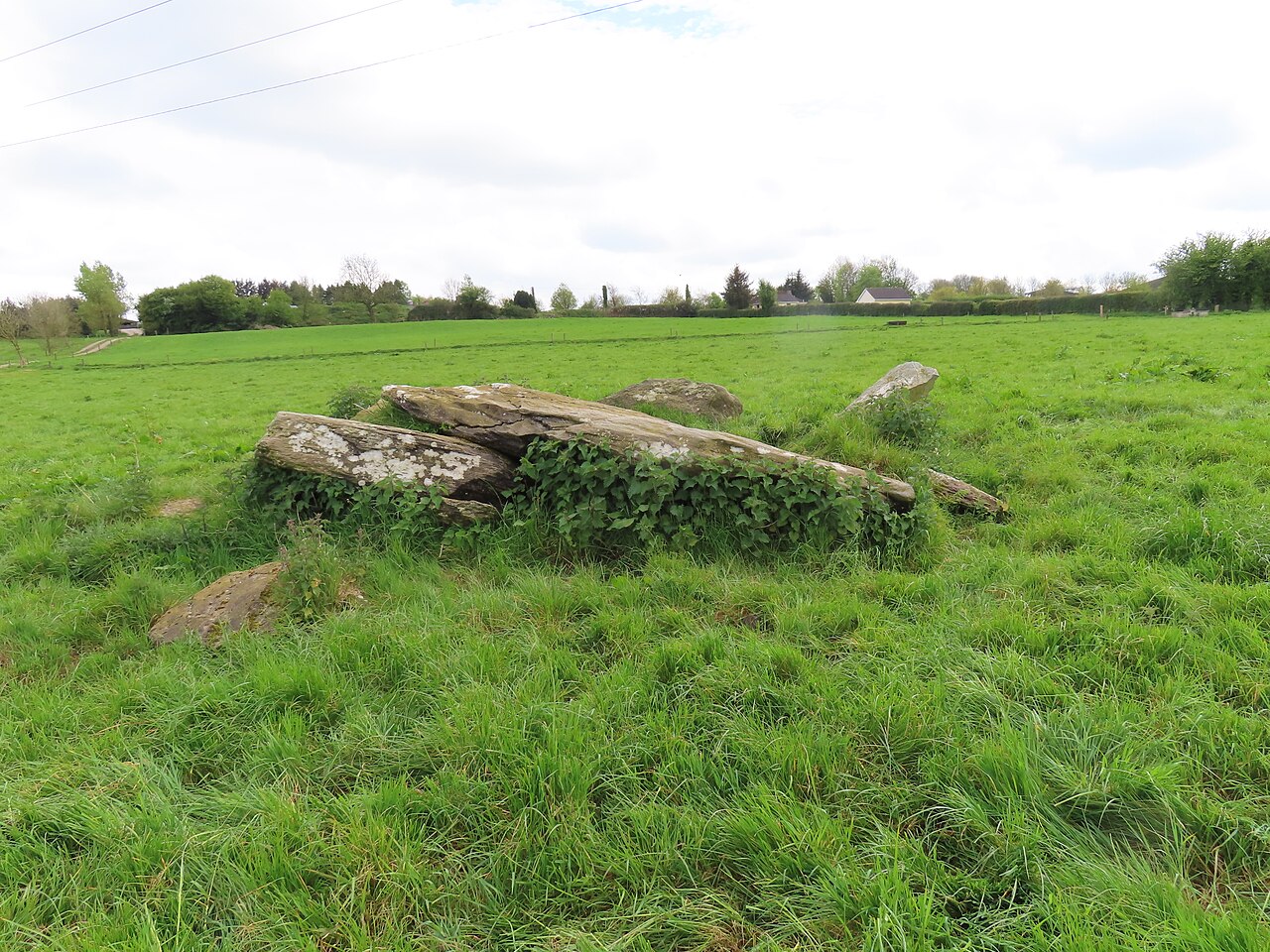
The Castlemary megalithic complex lies north of the R631, about 2 km west of Cloyne and 6.0 km south of Midleton, in the townland of Castlemary (Irish Carraig an Chotaigh), County Cork, Ireland.
It consists of five surviving stones. Whether it represents the remains of a destroyed wedge tomb is disputed.
Read on Wikipedia2 min readCC BY-SA 4.0
Article
Megalithanlage von Castlemary
DescriptionSources for this section
Sources for this section
The largest element is an irregular capstone 4.6 m long and 4.3 m wide, which rests on two supporting stones. One supporter is 1.22 m high, 1.13 m wide and 0.4 m thick, and its south side leans slightly inwards. The other lies horizontally on a bed of stones and is 2.71 m long, 1.4 m wide and 0.64 m thick.
About two metres to the west, two further stones lie one on top of the other. The upper measures 1.63 m in length, 1.22 m in width and 0.32 m in thickness; the lower measures 2.06 m in length, 1.62 m in width and 0.45 m in thickness.
InterpretationSources for this section
Sources for this section
According to O’Kelly, the stones are the remains of a destroyed wedge tomb, but de Valera and Ó Nualláin (1982) doubt this. Antiquarians of the middle of the 19th century report that further stones were present.
ContextSources for this section
Sources for this section
In 1961 the Irish scholars Seán Ó Nualláin and Rúaidhrí de Valera described four categories of megalithic tomb in Ireland: court cairns, portal dolmens, wedge-shaped gallery graves and passage tombs. Each has a different date, shape and geography.
Tradition and region
About this kind of monument
Megalithic tombs of Ireland
Ireland has an unusually rich megalithic heritage, and the Atlas lists several kinds under one heading. In 1961 two Irish scholars, Seán Ó Nualláin and Rúaidhrí de Valera, described four categories of megalithic tomb: court cairns, portal dolmens, wedge-shaped gallery graves and passage tombs. Each has a different date, shape and geography.
Court cairns, with an uncovered courtyard at the front and roofed chambers behind, are the earliest; more than 390 were built in Ireland between 3900 and 3500 BCE, mostly in the north and west. Portal dolmens are single-chamber tombs with tall portal stones, of which Ireland has about 172, with Poulnabrone in the Burren the best known. Passage tombs, with a long passage leading to a chamber, form great cemeteries: Brú na Bóinne, Loughcrew, Carrowkeel and Carrowmore. Wedge tombs, with a chamber that narrows towards the back, are later, built between about 2500 and 2000 BCE, and 500 to 550 survive, mostly in the west and north-west.
Of the Irish megalithic tombs, only passage tombs appear to have a widespread distribution through Europe.
The Atlas gives each tomb its type's date range, which should be taken as approximate unless the site has been excavated.
Folklore: at Proleek in County Louth the dolmen is said, by local legend, to have been carried there by a Scottish giant, who was poisoned by the hero Fionn mac Cumhaill. It is a story, not evidence of date.
When visiting, check which of the four types you are looking at: a courtyard in front means a court cairn, tall portal stones mean a portal tomb, a narrowing chamber a wedge tomb, and a long passage a passage tomb.
Paraphrased from Wikipedia: Passage grave, Wikipedia: Court cairn, Wikipedia: Portal dolmen, Wikipedia: Wedge-shaped gallery grave, Wikipedia: Newgrange, Wikipedia: Poulnabrone dolmen, Wikipedia: Proleek Dolmen, Wikipedia: Carrowmore, Wikipedia: Loughcrew, Wikipedia: Carrowkeel Megalithic Cemetery · CC BY-SA 4.0
From the article
Dated moments in the story
- 1982
Laut O’Kelly handelt es sich um die Reste eines zerstörten Wedge Tombs, aber de Valera und Ó Nualláin (1982) zweifeln dies an.
Source
Where it stands
Ireland
The pin marks the monument itself — its exact point.
- Coordinates
- 51°51′38″ N, 8°09′02″ WFor a GPS or map app: 51.86045, -8.15054
Access is as our sources describe it; we have not visited the site to check.
Nearby
The closest sites in the Atlas, by straight line.
 Carraig á Mhaistin stone3900–3000 BCE
 Wedge Tomb von Ryefield East2500–2000 BCE
- Wedge tombwedge tomb of Island2500–2000 BCE
 Labbacallee wedge tomb2350–2250 BCE
- Wedge tombIsland Wedge Tomb2500–2000 BCE
 Castlenalacht Stone Row4500–1200 BCE
- Court tomb (court cairn)Ballynamona Lower3750–2900 BCE
- Court tomb (court cairn)Caille Beara's House3750–2900 BCE


Sources
Every record behind this page, with the link it came from.
1 source behind this page
- 01Wikidata Q113638984wikidata.org
Report a correctionWrong date, name, photograph or source? Tell us and it will be put right.
Around this place
The ten nearest sites, by compass
Credit
Text, licence and sources
Adapted from the Wikipedia article "Megalithanlage von Castlemary" (German), licensed CC BY-SA 4.0; authors are listed in the page history. Reused under CC BY-SA 4.0. Read on Wikipedia · Edit history and authors