
Labbacallee wedge tomb
Datedc. 2350–2250 BCE
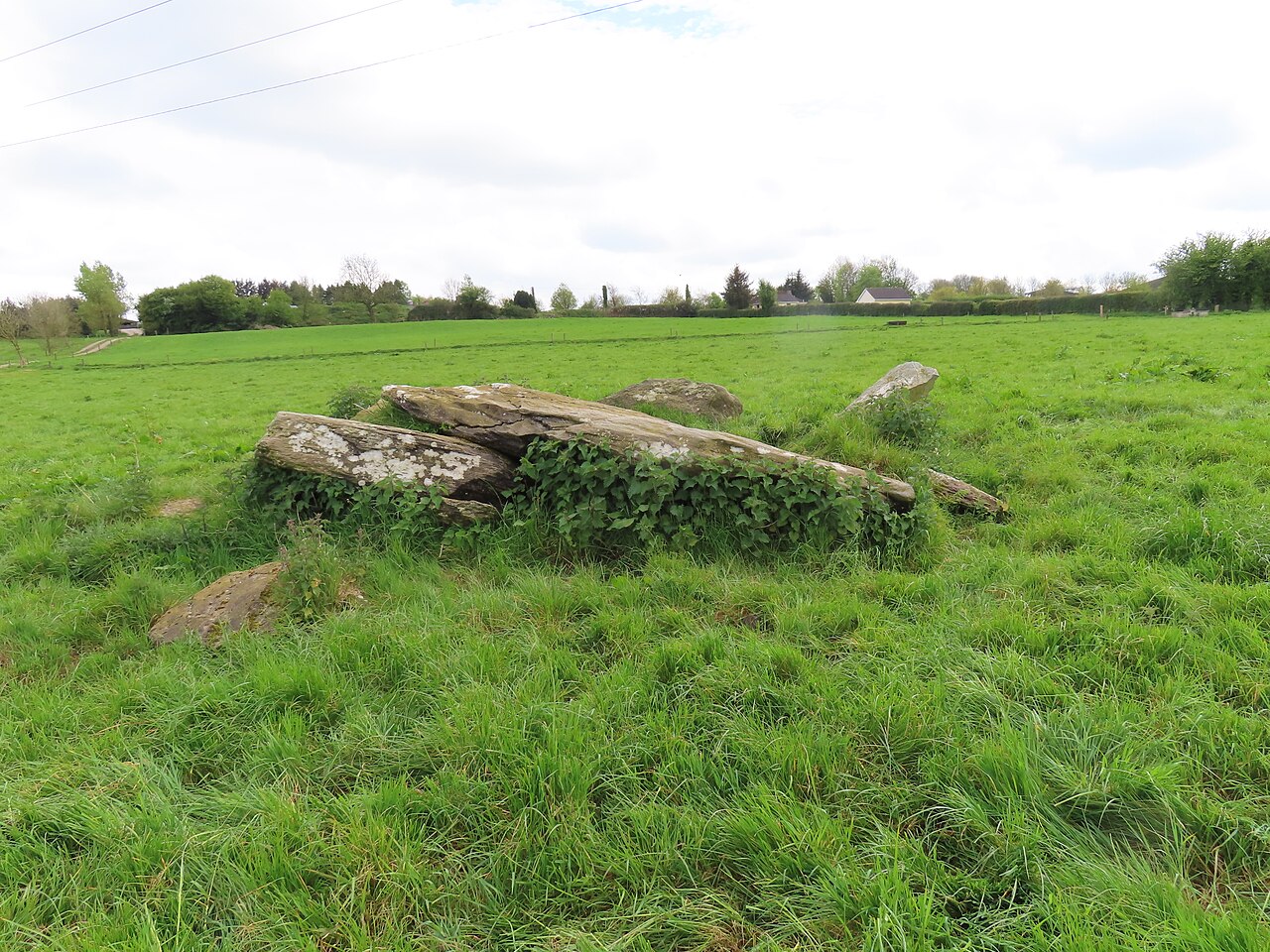
Photo VisionsofthePast · CC BY-SA 4.0Source file on Wikimedia Commons

Overview
About this site
What the sources say
Labbacallee Wedge Tomb (Irish: Leaba Chaillí, meaning 'hag's bed') is a large pre-historic burial monument, located 8 km (5.0 mi) north-west of Fermoy and 2 km (1.2 mi) south-east of Glanworth, County Cork, Ireland. It is the largest Irish wedge tomb and dates from roughly 2300 BC. The tomb is a National Monument in State Care no. 318. It was the first megalithic tomb in the country to be described by an antiquarian writer, in John Aubrey’s manuscript of 1693.
Read on Wikipedia7 min readCC BY-SA 4.0
Age sources
How old this site is, and who says so.
Range across all claimsc. 2350–2250 BCE
EstimatedWhat this badge means
A reading of this site: what its style says, or a statement published about it.
- 2350–2250 BCEPublished sourceThe source assigns the tomb a date of roughly 2300 BC. The source gives one year, so it is shown as a 100-year window (D-08).Source: en.wikipedia.org
- 2300 BCEWikipedia: Labbacallee wedge tomb (infobox)Source: en.wikipedia.org
Where it sits in time
The site's dated range, placed against world reference points.
The scale is logarithmic: each step to the left is about ten times older than the last.
The full article
Labbacallee wedge tomb: the whole story
In briefSources for this section
- Wikipedia (English): Labbacallee wedge tombCC BY-SA 4.0
Sources for this section
- Wikipedia (English): Labbacallee wedge tombCC BY-SA 4.0
Labbacallee Wedge Tomb is a large prehistoric burial monument in County Cork, Ireland. It lies 8 km (5.0 mi) north-west of Fermoy and 2 km (1.2 mi) south-east of Glanworth. Its Irish name, Leaba Chaillí, means 'hag's bed'. It is the largest wedge tomb in Ireland, it dates from roughly 2300 BC, and it is a National Monument in State Care, no. 318.
The tomb has three massive capstones, the largest weighing 10 tonnes, and three large buttress stones at the back. The burial area is a long chamber divided by a large vertical slab into two areas of unequal length. The eastern or inner end, once covered by its capstone, formed a sealed and self-contained burial unit. The main chamber to the west, with two large capstones, was also sealed, by a large 'entrance' stone. The gallery measures about 7.75 meters long, from inside the stone closing its western end to the inner face of the back stone of the eastern chamber.
The tomb appears to have been closed up and abandoned soon after the burials were placed in it. At a later period the chamber was entered through the side wall, near the entrance stone at the west end, where a large corbel was displaced and side stones were moved. The main chamber was then used as a shelter, which disturbed the earlier burials. Animal bones, charcoal and sherds of a cooking pot are the main evidence for this later use.
Labbacallee was one of the first sites excavated under the new National Monuments Act (1930), by Harold Leask and Liam Price in 1934. They found a number of burials, fragments of a late Stone Age decorated pot, and fragments of bone and stone. The west chamber held parts of an adult male and a child, along with a skull believed to belong to the female skeleton in the east chamber. The smallest chamber was filled to the top with rubble, including earth, stones, ash and the bones of animals and humans. Beneath it lay the skeleton of a woman, with a bone pin that might have fastened a garment or shroud. One leg bone was deformed. The tomb was also the first megalithic tomb in Ireland to be described by an antiquarian writer, in John Aubrey's manuscript of 1693.
Folklore says a hag lived here, and she has been linked with the 'Cailleach', a hag goddess of Celtic tradition. In one tale the hag's husband, Mogh Ruith, fell in love with her sister, and in jealousy she chased the druid towards the River Funshion and hurled a boulder that pinned him under the water. She is believed to be buried in the tomb that was once her dwelling. A later tale tells of four local men who came at night to dig for treasure and were terrified by the hag's daughter Aibell, who appeared as a cat with fire bursting from her tail. One of the men fell into the nearby river and drowned.
Wedge tombs are a type of Irish chamber tomb. They take their name from the way the burial chamber narrows at one end, usually decreasing in height and width from west to east, giving a wedge shape in profile.
DescriptionSources for this section
- Wikipedia (English): Labbacallee wedge tombCC BY-SA 4.0
Sources for this section
- Wikipedia (English): Labbacallee wedge tombCC BY-SA 4.0
Labbacallee is the largest wedge tomb in Ireland. The tomb has three massive capstones, with the largest weighing 10 tonnes, and three large buttress stones at the back. The burial area consists of a long chamber, divided by a large vertical slab into two areas of unequal length. The eastern or inner end, when covered by the capstone, formed a sealed and self contained burial unit. The main chamber area, to the west, with two large capstones, was also sealed by a large ‘entrance’ stone. Access to both chambers was only possible by the removal of the end capstone. The gallery measures about 7.75 meters long from inside the stone closing its western end to the inner face of the back stone of the Eastern chamber. The tomb appears to have been closed up and abandoned shortly after the burials were deposited in it. At a later period, the chamber was entered through the side wall, close to the entrance stone at the west end. A large corbel was displaced and side stones were moved to allow access. The main chamber was used as a shelter, resulting in the disturbance of the previous interments. The main evidence for this activity consists of animal bones, charcoal and sherds of cooking pot.
ArchaeologySources for this section
- Wikipedia (English): Labbacallee wedge tombCC BY-SA 4.0
Sources for this section
- Wikipedia (English): Labbacallee wedge tombCC BY-SA 4.0
Labbacallee Wedge Tomb was one of the first sites excavated under the new National Monuments Act (1930) by Harold Leask and Liam Price in 1934. The excavations revealed a number of burials, fragments of a late Stone Age decorated pot, and fragments of bone and stone. The west chamber contained parts of an adult male and a child, along with the skull believed to belong to the female skeleton in the east chamber and several sherds of a single late Stone Age decorated pot. According to the excavation report, at this time the smallest chamber was filled to the top with rubble, including earth, stones, ash and the bones of animals and humans. When these were cleared a skeleton of a woman was exposed, together with a bone pin which might have fastened a garment or shroud. The woman's skull was missing but later found upright in the large main chamber. One of the leg bones of the skeleton was deformed.
Folklore and legendsSources for this section
- Wikipedia (English): Labbacallee wedge tombCC BY-SA 4.0
Sources for this section
- Wikipedia (English): Labbacallee wedge tombCC BY-SA 4.0
The folklore behind the wedge tomb, as the translation "Hag's Bed" suggests, is that a hag lived at the site. She has been associated with the 'Cailleach', a hag goddess from Celtic tradition.
There are a number of different stories about the wedge tomb. In one version of the story, Mogh Ruith, the hag's husband, fell in love with her sister. In a fit of jealously the hag chased the druid towards the River Funshion. He had reached the water and started to cross it, but the hag threw an enormous boulder which struck the druid, toppling him and pinning him down under the water. It is not specified in the tale how the hag died but she is believed to be buried in the tomb which was once her dwelling.
There is also a later tale of a supernatural encounter at Labbacallee. According to the tale, four local men went to the tomb in the middle of the night, with the aim of digging for the treasure that they had heard was buried there. As they started to dig, it is said that the hag's daughter Aibell appeared in the form of a cat, fire bursting from her tail, terrifying the men, who were dazzled by the light emitting from it. Panicking, they ran screaming from the scene, and one of the men fell into the nearby river and drowned. The remaining men lived to tell the tale, and their experience stood as a stark warning to others that they should never, under any circumstances, disturb the resting place of the long dead at this most mysterious of megalithic sites.
How this page was madeSources for this section
- Wikipedia (English): Labbacallee wedge tombCC BY-SA 4.0
Sources for this section
- Wikipedia (English): Labbacallee wedge tombCC BY-SA 4.0
The summary at the top of this page was written by Claude Sonnet 5.5 (2026-11-06) from the cited Wikipedia article “Labbacallee wedge tomb”. The numbers in it were checked automatically against the source text. The rest of the page is the article itself, the structured records and computed distances.
Tradition and region
About this kind of monument
Irish wedge tombs
A wedge tomb, or wedge-shaped gallery grave, is a type of Irish chamber tomb. It takes its name from the way the burial chamber narrows at one end, usually decreasing both in height and in width from west to east, which gives it a wedge shape in profile. An antechamber is separated from the burial area by a simple stone slab. Wedge tombs are one of the four categories of megalithic tomb described by the Irish scholars Seán Ó Nualláin and Rúaidhrí de Valera in their survey of 1961: court cairns, portal dolmens, wedge-shaped gallery graves and passage tombs.
A gallery grave is a megalithic tomb in which the main gallery is entered without first passing through an antechamber or hallway. The gallery graves of western Europe were probably community burial sites, in which family or hamlet members were laid to reinforce the sense of community. Gallery graves can be covered with an earthen mound or a cairn, and there are at least four major types: complex, transepted, segmented and wedge-shaped.
Wedge tombs were built between the Irish late Neolithic and the middle Bronze Age, about 2500 to 2000 BCE. Between 500 and 550 survive, mostly in the west and north-west of Ireland. A distinguishing feature is the double walling of the gallery. They were often covered by round, oval or D-shaped cairns, usually about 1.5 metres high, with a kerb, and are generally found on mountainsides, about three-quarters of the way up. The doorway generally faces west.
When visiting, look at how the walls narrow towards the back of the tomb and at the double wall of the gallery.
Paraphrased from Wikipedia: Wedge-shaped gallery grave, Wikipedia: Gallery grave, Wikipedia: Bell Beaker culture, Wikipedia: Passage grave · CC BY-SA 4.0
From the article
Dated moments in the story
- 2300 BCE
It is the largest Irish wedge tomb and dates from roughly 2300 BC.
Source - 1693
318. It was the first megalithic tomb in the country to be described by an antiquarian writer, in John Aubrey’s manuscript of 1693.
Source - 1930
Labbacallee Wedge Tomb was one of the first sites excavated under the new National Monuments Act (1930) by Harold Leask and Liam Price in 1934. The excavations revealed a number of burials, fragments of a late Stone Age decorated pot, and fragments of bone and stone.
Source
Photographs
8 photographs, each with its author and licence
More photographs


Lore
Evidence & Lore
What the sources actually support — and, kept apart, what has been claimed.
What the evidence supports
Dates
2350–2250 BCEHow this date was established: Stated by the sourceThe source assigns the tomb a date of roughly 2300 BC. The source gives one year, so it is shown as a 100-year window (D-08).Source for this date
Measured facts
- Mainstream position
- Labbacallee is a prehistoric wedge tomb whose excavated contents include burials and a decorated Stone Age vessel.Source: Mainstream position
- Irish name
- Leaba Chaillí, meaning “hag’s bed”Source: Irish name
- Location
- 8 km northwest of Fermoy and 2 km southeast of Glanworth, County CorkSource: Location
- Excavation
- Excavated by Harold Leask and Liam Price in 1934Source: Excavation
- Excavated remains
- Several burials, a decorated Stone Age pot, and fragments of bone and stoneSource: Excavated remains
- Designation
- National Monument in State Care no. 318Source: Designation
- First written description
- Included in John Aubrey’s manuscript of 1693Source: First written description
- Heritage designation
- national monument of IrelandSource: Heritage designation
Alternative claims
Alternative claims about this site, kept in their own block and labelled with where they stand.
A hag lived at the tomb and is buried there in the position that it was once her dwelling.
The hag pursued the druid Mogh Ruith and killed him by throwing an enormous boulder that pinned him beneath the river.
Aibell, the hag’s daughter, appeared as a cat with fire bursting from her tail, causing the men who sought treasure to flee in panic.
Where it stands
Ireland
The pin marks the monument itself — its exact point.
- Coordinates
- 52°10′27″ N, 8°20′04″ WFor a GPS or map app: 52.17418, -8.33454
Access is as our sources describe it; we have not visited the site to check.
Nearby
The closest sites in the Atlas, by straight line.
- Wedge tombIsland Wedge Tomb2500–2000 BCE
- Wedge tombwedge tomb of Island2500–2000 BCE
 Wedge Tomb von Ryefield East2500–2000 BCE
 Wedge Tomb von Kilmaclenine2500–2000 BCE
 Duntryleague3400–2900 BCE
 Shrough Passage Tomb3400–2900 BCE
- DolmenPassage Tomb von Shrough4000–3000 BCE
- Stone row (alignment)Steinreihe von Garrane


Sources
Every record behind this page, with the link it came from.
2 sources behind this page
- 01Wikidata Q1799383wikidata.org
- 02Wikipedia (en)en.wikipedia.org
Image files
- 11. Labbacallee Wedge Tomb, Co. Cork.jpgVisionsofthePastCC BY-SA 4.0
- Burial chamber at Leabacallee.JPGKieranandsarahjordanCC BY-SA 4.0
- Interior Labbacallee Wedge Tomb, North Cork.JPGThe Speckled BirdCC BY-SA 4.0
- Leabacallee - a pile of rocks!.JPGKieranandsarahjordanCC BY-SA 4.0
- Wedge tomb at Leabacallee.JPGKieranandsarahjordanCC BY-SA 4.0
- Labbacallee Wedge Tomb, North Cork.jpgThe Speckled BirdCC BY-SA 4.0
- 01. Labbacallee Wedge Tomb, Co. Cork.jpgVisionsofthePastCC BY-SA 4.0
- 05. Labbacallee Wedge Tomb, Co. Cork.jpgVisionsofthePastCC BY-SA 4.0
Report a correctionWrong date, name, photograph or source? Tell us and it will be put right.
Lore, kept apart
Legends and claims
These are stories and claims reported by the sources. They are not evidence, and they never stand in for the dating above.
- Tradition
The folklore behind the wedge tomb, as the translation "Hag's Bed" suggests, is that a hag lived at the site.
The folklore behind the wedge tomb, as the translation "Hag's Bed" suggests, is that a hag lived at the site. She has been associated with the 'Cailleach', a hag goddess from Celtic tradition. There are a number of different stories about the wedge tomb. In one version of the story, Mogh Ruith, the hag's husband, fell in love with her sister. In a fit of jealously the hag chased the druid towards the River Funshion. He had reached the water and started to cross it, but the hag threw an enormous boulder which struck the druid, toppling him and pinning him down under the water. It is not specified in the tale how the hag died but she is believed to be buried in the tomb which was once her dwelling. There is also a later tale of a supernatural encounter at Labbacallee. According to the tale, four local men went to the tomb in the middle of the night, with the aim of digging for the treasure that they had heard was buried there. As they started to dig, it is said that the hag's daughter Aibell appeared in the form of a cat, fire bursting from her tail, terrifying the men, who were dazzled by the light emitting from it. Panicking, they ran screaming from the scene, and one of the men fell into the nearby river and drowned. The remaining men lived to tell the tale, and their experience stood as a stark warning to others that they should never, under any circumstances, disturb the resting place of the long dead at this most mysterious of megalithic sites.
Source - Tradition
Folklore says a hag lived here, and she has been linked with the 'Cailleach', a hag goddess of Celtic tradition.
Folklore says a hag lived here, and she has been linked with the 'Cailleach', a hag goddess of Celtic tradition. In one tale the hag's husband, Mogh Ruith, fell in love with her sister, and in jealousy she chased the druid towards the River Funshion and hurled a boulder that pinned him under the water. She is believed to be buried in the tomb that was once her dwelling. A later tale tells of four local men who came at night to dig for treasure and were terrified by the hag's daughter Aibell, who appeared as a cat with fire bursting from her tail. One of the men fell into the nearby river and drowned.
Source - Tested: not supported
A hag lived at the tomb and is buried there in the position that it was once her dwelling.
Source - Tested: not supported
The hag pursued the druid Mogh Ruith and killed him by throwing an enormous boulder that pinned him beneath the river.
Source - Tested: not supported
Aibell, the hag’s daughter, appeared as a cat with fire bursting from her tail, causing the men who sought treasure to flee in panic.
Source
Around this place
The ten nearest sites, by compass
Credit
Text, licence and sources
Text from the Wikipedia article "Labbacallee wedge tomb" (English), licensed CC BY-SA 4.0; authors are listed in the page history. Reused under CC BY-SA 4.0. Read on Wikipedia · Edit history and authors
- Wikipedia (English): Labbacallee wedge tombCC BY-SA 4.0
- Wikidata Q1799383CC0