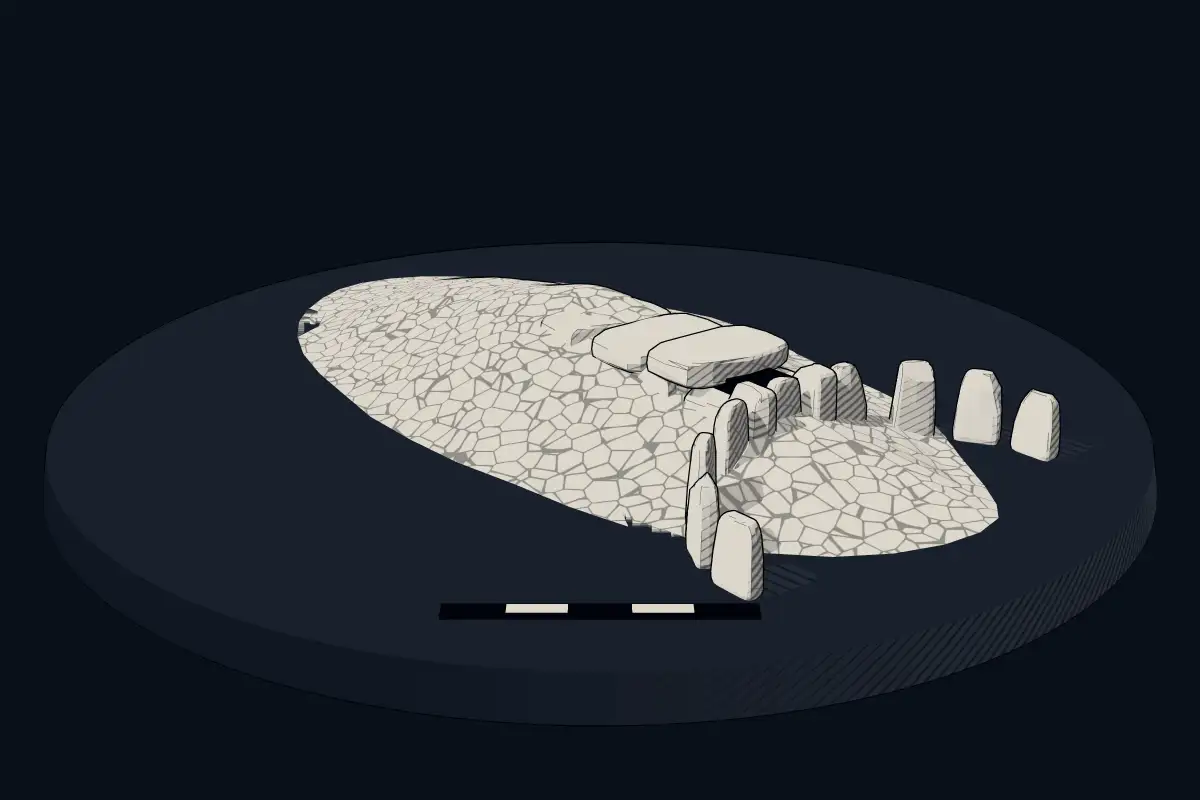
Caille Beara's House
DatedEst. 3750–2900 BCE
No licensed photograph yetWe have no photograph we may publish for this site, so the interpretive 3D view leads instead.
Overview
About this site
Overview
Caille Beara's House (Irish: Tigh Chaille Bhéara), also called Carn Chúirte Bhaile na Móna, is a court tomb at Baile na Móna Íochtarach in the Gaeltacht na nDéise, County Waterford, Republic of Ireland. It was probably built in the Neolithic; the catalogue gives a typological estimate of 3750 to 2900 BCE.
Court tombs are rare in Munster, and this example is unique in County Waterford.
Read on Wikipedia2 min readCC BY-SA 4.0
Where it sits in time
The site's dated range, placed against world reference points.
The scale is logarithmic: each step to the left is about ten times older than the last.
Article
Caille Beara's House
ExcavationsSources for this section
- Wikipedia (Irish): Tigh Chaille BhéaraCC BY-SA 4.0
Sources for this section
- Wikipedia (Irish): Tigh Chaille BhéaraCC BY-SA 4.0
The site was excavated by T.G.E. Powell in 1938. He found cremated bones and pottery.
The monument is recorded in English as Caille Beara's House, from the Irish Tigh Chaille Bhéara.
NameSources for this section
- Wikipedia (Irish): Tigh Chaille BhéaraCC BY-SA 4.0
Sources for this section
- Wikipedia (Irish): Tigh Chaille BhéaraCC BY-SA 4.0
The monument is recorded in English as Caille Beara's House, from the Irish Tigh Chaille Bhéara.
ContextSources for this section
- Wikipedia (Irish): Tigh Chaille BhéaraCC BY-SA 4.0
Sources for this section
- Wikipedia (Irish): Tigh Chaille BhéaraCC BY-SA 4.0
A court cairn or court tomb is a type of chambered cairn identified by an open, uncovered courtyard connected to one or more roofed burial chambers. In the period 3900 to 3500 BCE more than 390 court cairns were built in Ireland, and over 100 in south-west Scotland, where they are called Clyde cairns or Clyde-Carlingford cairns. The courtyard is oval or circular, with U-shaped and semicircular courts also known, and its boundary is typically lined with large standing stones. A narrow stone-lined entry leads from the court into the roofed chambers. Many monuments were built in several phases and later reused in the Early Bronze Age.
Tradition and region
About this kind of monument
Irish and Scottish court tombs
A court cairn or court tomb is a type of chambered cairn identified by an open, uncovered courtyard connected to one or more roofed burial chambers. In the period 3900 to 3500 BCE more than 390 court cairns were built in Ireland and over 100 in south-west Scotland, where they are called Clyde cairns or Clyde-Carlingford cairns. The Clyde cairns are generally considered the earliest chambered cairns in Scotland, and they are distributed from the Solway Firth area north to the southern Hebrides. Many monuments were built in several phases and later reused in the Early Bronze Age.
The courtyard is oval or circular, with U-shaped and semicircular courts also known, and its boundary is typically lined with large standing stones. A narrow stone-lined entry leads from the court into the roofed chambers. At Creevykeel in County Sligo, the first court cairn excavated in Ireland, Harvard archaeologists worked in 1935 and concluded that the Neolithic in Ireland began in 3900 BCE, more than a hundred years before the first appearance of court tombs, and that court tombs were widely reused in the Early Bronze Age. Excavations at court tombs have yielded cremated and unburnt human bone and round-bottomed pottery.
In Scotland, Cairnholy in Dumfries and Galloway is the site of two chambered tombs of the Clyde type on a hillside overlooking Wigtown Bay, 4 kilometres east of Carsluith; the two lie within 150 metres of each other.
Court tombs are dated by radiocarbon dates of the bone they contain and the pottery.
When visiting, look for the standing stones of the forecourt and the entrance to the chambers.
Paraphrased from Wikipedia: Court cairn, Wikipedia: Chambered cairn, Wikipedia: Cairn Holy, Wikipedia: Passage grave · CC BY-SA 4.0
Lore
Evidence & Lore
What the sources actually support — and, kept apart, what has been claimed.
What the evidence supports
Dates
Est. 3750–2900 BCEHow this date was established: Type comparisonTypical range for court tombs in Ireland; this site has not been dated itself. The earliest court cairns were built around 3750 BC and new monuments continued to be built and existing ones enlarged until 2900 BC.Source for this date
Where it stands
Ireland
The pin marks the monument itself — its exact point.
- Coordinates
- 52°00′14″ N, 7°34′55″ WFor a GPS or map app: 52.00385, -7.58203
Access is as our sources describe it; we have not visited the site to check.
Nearby
The closest sites in the Atlas, by straight line.
- Court tomb (court cairn)Ballynamona Lower3750–2900 BCE
- Megalithic complexCoumaraglin
- MegalithSavagetown3300–2900 BCE
 Ballynageeragh Portal Tomb4500–1800 BCE
- Portal tomb (portal dolmen)Portal Tomb von Dunhill4000–3000 BCE
 Matthewstown
- Megalithic mound (tumulus with integral stones)Glennafallia Cairn3700–2900 BCE
- Menhir (standing stone)Menhir von Ballymote2800–1800 BCE


Sources
Every record behind this page, with the link it came from.
2 sources behind this page
- 01Wikidata Q112135801wikidata.org
- 02Source for this dateen.wikipedia.org
Report a correctionWrong date, name, photograph or source? Tell us and it will be put right.
Around this place
The ten nearest sites, by compass
Credit
Text, licence and sources
Adapted from the Wikipedia article "Tigh Chaille Bhéara" (Irish), licensed CC BY-SA 4.0; authors are listed in the page history. Reused under CC BY-SA 4.0. Read on Wikipedia · Edit history and authors
- Wikipedia (Irish): Tigh Chaille BhéaraCC BY-SA 4.0
- Wikidata Q112135801CC0