
Passage tomb (passage grave)Fringe site
Dowth
Also known asDowth Passage Tomb · Dowth Tumulus
Datedc. 3200–2900 BCE
Photo William Ellison · CC BY-SA 4.0Source file on Wikimedia Commons

Overview
About this site
What the sources say
Dowth (Irish: Dubhadh) is the site of Neolithic passage tombs near the River Boyne in County Meath, Ireland. It is one of the three main tombs of the Brú na Bóinne World Heritage Site, along with Newgrange and Knowth. Its features align it with the other passage tombs, which date from around 3200 BC. Unlike its neighbours, Dowth has mostly been left as a ruin, although its smaller inner chambers are largely intact. The Royal Irish Academy carried out a botched excavation in 1847, leaving a large crater in the mound that has never been repaired.
Read on Wikipedia7 min readCC BY-SA 4.0
Age sources
How old this site is, and who says so.
Range across all claimsc. 3200–2900 BCE
EstimatedWhat this badge means
A reading of this site: what its style says, or a statement published about it.
- 3200–2900 BCEStylistic datingThe range is assigned through the tomb's architectural alignment with neighbouring passage tombs.Source: en.wikipedia.org
- 3200 BCEAtlas research notesc. 3200 BCESource: en.wikipedia.org
Where it sits in time
The site's dated range, placed against world reference points.
The scale is logarithmic: each step to the left is about ten times older than the last.
The full article
Dowth: the whole story
In briefSources for this section
- Wikipedia (English): DowthCC BY-SA 4.0
Sources for this section
- Wikipedia (English): DowthCC BY-SA 4.0
Dowth (Irish: Dubhadh) is the site of Neolithic passage tombs near the River Boyne in County Meath, Ireland. It is one of the three main tombs of the Brú na Bóinne World Heritage Site, along with Newgrange and Knowth. Its features align it with the other passage tombs, which date from around 3200 BC. Unlike its neighbours, Dowth has mostly been left as a ruin, although its smaller inner chambers are largely intact.
The cairn is about 85 metres (280 ft) in diameter and 15 metres (50 ft) high, surrounded by large kerbstones, some decorated. About 115 kerbstones originally surrounded it, and kerbstone 51, the Stone of the Seven Suns, carries radial circular carvings like those at Loughcrew. Three stone-lined passages lead in from the west: two passage tombs, Dowth North and Dowth South, and a souterrain. Dowth North is 18.2 metres long, crossed by 3 sill-stones, and ends in a cruciform chamber with a lintelled roof. Its stones are decorated with spirals, chevrons, lozenges and rayed circles, and a single stone basin, 1.4m x 1m, stands on the floor.
Dowth South is 3.5 metres long and ends in a roughly circular chamber with a modern concrete roof, the original having collapsed. A kerbstone with cup-marks, a spiral and a flower-like design marks its entrance. The third entrance is an early Christian souterrain, constructed around the 10th or 11th century. The Annals refer to Norsemen plundering the cave of Dowth around 862, which may mean this souterrain.
The Royal Irish Academy excavated in 1847 and almost completely dug out and dynamited the middle of the mound, leaving a large crater that has never been repaired. Unlike Newgrange and Knowth, Dowth has not been independently dated, but its features suggest between approximately 3200 and 2900 BC. In 1970 Peter Harbison dated the tomb at 2500 – 2000 BC. Surveys of the entire site were carried out from 2012 to 2015, and in July 2018 another passage tomb in the grounds of nearby Dowth Hall was excavated, revealing Neolithic rock art.
Martin Brennan records that from November to February the evening sun reaches into Dowth South, and that at the winter solstice its light moves along the passage into the chamber, lighting three stones, and withdraws after about two hours. The medieval Dindsenchas tells that king Bresal Bó-Díbad forced the men of Ireland to build a tower to heaven in a day, and that his sister's spell made the sun stand still until the incest between them broke it. The sun set, the builders left, and so the place is named Dubhadh ('darkening').
DescriptionSources for this section
- Wikipedia (English): DowthCC BY-SA 4.0
Sources for this section
- Wikipedia (English): DowthCC BY-SA 4.0
The cairn or tumulus is about 85 metres (280 ft) in diameter and 15 metres (50 ft) high, and surrounded by large kerbstones, some of which are decorated. Quartz was found fallen outside the kerbing, suggesting that the entrance to this tomb was surrounded by glittering white stone, as at Knowth and Newgrange. Three stone-lined passages lead into the mound from the west. These comprise two passage tombs (known as Dowth North and Dowth South) and a souterrain.
The longest of the passages (Dowth North) is 18.2 metres in length and is crossed by 3 sill-stones and ends in a cruciform chamber with a lintelled (not corbelled as in Newgrange or Knowth) roof. Dowth South is 3.5 metres long and ends in a roughly circular chamber with a modern concrete roof (the original roof having collapsed). In Dowth North, several of the orthostats (upright stones) of the passage and chamber are decorated with spirals, chevrons, lozenges and rayed circles. On the floor stands a single stone basin, 1.4m x 1m in size. The right-hand arm of the cross leads into another long rectangular chamber with an L-shaped extension entered over a low sill, sometimes referred to as 'the annex'. This may be the earliest part of the tomb, later brought within the design of the cruciform tomb. This annex is floored with a 2.4 metre-long flagstone containing an oval bullaun (artificial depression). Until recently, the cruciform tomb was reached by climbing down a ladder in an iron cage, and crawling about over loose stones. Now, access is restricted, and all the features are guarded by metal grilles.
A kerbstone with cup-marks, a spiral, and a flower-like design marks the entrance to Dowth South. While the current roof is modern, it is possible the original one was corbelled, as at Newgrange. This tomb has a few decorated stones and a large right-hand recess.
The third entrance visible on the west side of Dowth is an early Christian souterrain. It leads into the passage of Dowth North and was constructed around the 10th or 11th century. The Annals of Ulster and the Annals of the Four Masters refer to Norsemen plundering the "cave‟ of Dowth around 862; the "cave" in this description may refer to the souterrain as the Irish word for cave and souterrain are the same: Uaimh
The mound originally had about 115 kerbstones surrounding it. Kerbstone 51, sometimes called the Stone of the Seven Suns, features a number of radial circular carvings, similar to those at Loughcrew.
ArchaeologySources for this section
- Wikipedia (English): DowthCC BY-SA 4.0
Sources for this section
- Wikipedia (English): DowthCC BY-SA 4.0
Dowth was excavated in 1847 by the Royal Irish Academy. In this botched investigation, the middle of the mound was almost completely dug out and dynamited. It was not filled in again, and some of the stone was then quarried. This large crater has still not been repaired.
Unlike Newgrange and Knowth, Dowth has not been independently dated, but its features align it with the other passage tombs which date from between approximately 3200 and 2900 BC. In 1970, archaeologist Peter Harbison dated the tomb at 2500 – 2000 BC.
Archaeological and geophysical field surveys of the entire site, including later monuments, were carried out episodically from 2012 to 2015. In July 2018, another passage tomb in the grounds of nearby Dowth Hall was excavated, revealing significant examples of Neolithic rock art similar to those at Dowth and the other Brú na Bóinne sites.
Astronomy and alignmentsSources for this section
- Wikipedia (English): DowthCC BY-SA 4.0
Sources for this section
- Wikipedia (English): DowthCC BY-SA 4.0
Like its better known neighbour Newgrange, the monument has a significant astronomical alignment. In The Stars and the Stones: Ancient Art and Astronomy in Ireland, Martin Brennan (1942–2023, an Irish-American author and artist) records a remarkable alignment. From November to February, the rays of the evening sun reach into the passage and then the chamber of Dowth South. Brennan reports that, during the winter solstice, the light of the low sun moves along the left side of the passage, then into the circular chamber, where three stones are lit up by its rays. The convex central stone reflects the sunlight in to a dark recess, illuminating the decorated stones there. The rays then recede slowly along the right side of the passage and after about two hours the sun withdraws from Dowth South.
Folklore and legendsSources for this section
- Wikipedia (English): DowthCC BY-SA 4.0
Sources for this section
- Wikipedia (English): DowthCC BY-SA 4.0
The medieval Dindsenchas (lore of places) has a story about Dowth (Dubhadh). It says that king Bresal Bó-Díbad compelled the men of Ireland to build a tower to heaven within a day. As this was not enough time, his sister cast a spell, making the sun stand still so that one day lasted indefinitely. However, Bresal then commits incest with his sister, which breaks the spell. The sun sets and the builders leave, hence the name Dubhadh ('darkening'). This tale has been linked with solstice alignments at Brú na Bóinne. It has also been linked with DNA analysis in 2020, which found that a man buried at nearby Newgrange had parents who were most likely siblings. This could mean that knowledge of the events survived for thousands of years before being recorded as a myth in the Middle Ages.
How this page was madeSources for this section
- Wikipedia (English): DowthCC BY-SA 4.0
Sources for this section
- Wikipedia (English): DowthCC BY-SA 4.0
The summary at the top of this page was written by Claude Sonnet 5.5 (2026-11-06) from the cited Wikipedia article “Dowth”. The numbers in it were checked automatically against the source text. The rest of the page is the article itself, the structured records and computed distances.
Tradition and region
About this kind of monument
Irish and British passage tombs
A passage tomb is a burial chamber covered in earth or stone, with a narrow access passage made of large stones. The type is found along the Atlantic seaboard of Europe, and in Ireland and Britain passage tombs often lie in large clusters, called cemeteries. Ireland has four great ones, known as the "big four": Brú na Bóinne in the Boyne Valley, Loughcrew, Carrowkeel and Carrowmore, each with its own character. Most were built in the fourth millennium BCE.
The Boyne Valley is the heart of the tradition. Brú na Bóinne in County Meath comprises at least ninety monuments, dominated by Newgrange, Knowth and Dowth, built in the 32nd century BCE. Newgrange, built around 3100 BCE, is older than Stonehenge and the Egyptian pyramids. It has a façade of white quartz cobbles ringed by engraved kerbstones, and is aligned so that the rising sun on the winter solstice shines through a "roofbox" above the entrance and floods the inner chamber. Knowth, a large passage tomb surrounded by 17 smaller ones, holds the largest assemblage of megalithic art in Europe and is ringed by 127 kerbstones. Dowth has mostly been left as a ruin, with a crater from an 1847 excavation.
Across the Irish Sea, Bryn Celli Ddu on Anglesey is considered one of the finest passage tombs in Wales. Visitors can go through its stone passage into the chamber, and the site was once a henge with a stone circle; it may have been used to mark the summer solstice. Barclodiad y Gawres, "the giantess's apronful", on the same island is a cruciform passage grave with decorated stones.
When visiting, look at the kerbstones for carved spirals and lozenges, at the direction of the passage, and at the quartz and other stones that came from far away.
Paraphrased from Wikipedia: Passage grave, Wikipedia: Newgrange, Wikipedia: Knowth, Wikipedia: Brú na Bóinne, Wikipedia: Dowth, Wikipedia: Bryn Celli Ddu, Wikipedia: Barclodiad y Gawres, Wikipedia: Loughcrew, Wikipedia: Carrowmore · CC BY-SA 4.0
From the article
Dated moments in the story
- 3200 BCE
Its features align it with the other passage tombs, which date from around 3200 BC.
Source - 2900 BCE
Unlike Newgrange and Knowth, Dowth has not been independently dated, but its features align it with the other passage tombs which date from between approximately 3200 and 2900 BC.
Source - 2000 BCE
In 1970, archaeologist Peter Harbison dated the tomb at 2500 – 2000 BC.
Source - 862 CE
The Annals of Ulster and the Annals of the Four Masters refer to Norsemen plundering the "cave‟ of Dowth around 862; the "cave" in this description may refer to the souterrain as the Irish word for cave and souterrain are the same: Uaimh The mound originally had about 115 kerbstones surrounding it.
Source - 1847
The Royal Irish Academy carried out a botched excavation in 1847, leaving a large crater in the mound that has never been repaired.
Source - 1847
Dowth was excavated in 1847 by the Royal Irish Academy.
Source - 1942
In The Stars and the Stones: Ancient Art and Astronomy in Ireland, Martin Brennan (1942–2023, an Irish-American author and artist) records a remarkable alignment.
Source - 2012
Archaeological and geophysical field surveys of the entire site, including later monuments, were carried out episodically from 2012 to 2015. In July 2018, another passage tomb in the grounds of nearby Dowth Hall was excavated, revealing significant examples of Neolithic rock art similar to those at Dowth and the...
Source
See it in 3D
An interpretive reconstruction of the monument, standing on the real ground at its exact point, under the sun for that place and season. Drag to look around it.
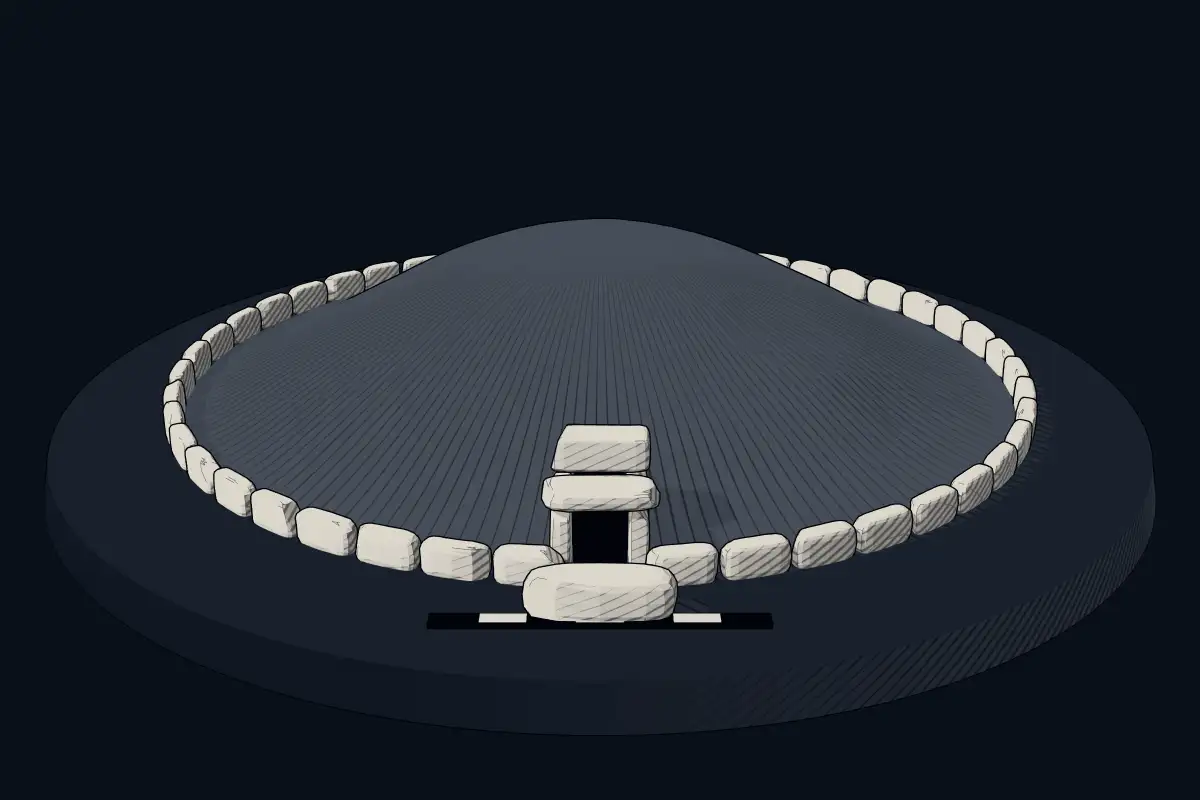
The reconstruction is ours, not a survey: it shows what a monument of this type looks like, at the size the record gives for this one.
Photographs
8 photographs, each with its author and licence
More photographs


Lore
Evidence & Lore
What the sources actually support — and, kept apart, what has been claimed.
What the evidence supports
Dates
3200–2900 BCEHow this date was established: Artefact styleThe range is assigned through the tomb's architectural alignment with neighbouring passage tombs.Source for this date
Measured facts
- Mainstream position
- Dowth is understood as a Neolithic passage tomb whose architectural features place it within the Brú na Bóinne group, although it has not been independently dated.Source: Mainstream position
- Location
- Near the River Boyne, County Meath, IrelandSource: Location
- Heritage complex
- One of the three main Brú na Bóinne tombsSource: Heritage complex
- Excavation
- Royal Irish Academy excavation in 1847Source: Excavation
- Condition
- Mostly a ruin, with smaller inner chambers largely intactSource: Condition
- Field surveys
- Carried out from 2012 to 2015Source: Field surveys
- Nearby rock art
- Significant Neolithic examples found in 2018Source: Nearby rock art
- Heritage designation
- national monument of IrelandSource: Heritage designation
Alternative claims
Alternative claims about this site, kept in their own block and labelled with where they stand.
King Bresal Bó-Díbad compelled the men of Ireland to build a tower to heaven within a day, and his sister prolonged the day with a spell.
The story preserves knowledge of events that occurred thousands of years earlier and was recorded as medieval myth.
Where it stands
Ireland
The pin marks the monument itself — its exact point.
- Coordinates
- 53°42′11″ N, 6°26′57″ WFor a GPS or map app: 53.70292, -6.44917
Access is as our sources describe it; we have not visited the site to check.
Nearby
The closest sites in the Atlas, by straight line.
- Megalithic mound (tumulus with integral stones)Dowth Mound3700–2900 BCE
 Newgrange3150–3050 BCE
 Townleyhall passage grave3400–2900 BCE
 Knowth2617 BCE–768 CE
- Passage tomb (passage grave)Ardmulchan Passage Tomb3400–2900 BCE
 Steinreihe von Baltray3300–2900 BCE
- Megalithic mound (tumulus with integral stones)Alexander Reid mound3700–2900 BCE
- Megalithic mound (tumulus with integral stones)Ninch Barrow15–245 CE


Sources
Every record behind this page, with the link it came from.
2 sources behind this page
- 01Wikidata Q1253443wikidata.org
- 02Fringe claim sourceen.wikipedia.org
Image files
- Tumulus de Dowth 1.JPGWilliam EllisonCC BY-SA 4.0
- Dowth Passage Tomb.1.JPGRaemond CarolanCC BY-SA 4.0
- Dowth Passage Tomb.2.JPGRaemond CarolanCC BY-SA 4.0
- Dowth chamber entrance 2014 2.jpgKafka Liz at English WikipediaCC BY-SA 3.0
- Dowth2014 1.JPGKafka LizCC BY-SA 3.0
- Dowth - 403885635.jpgRowan McLaughlinCC BY 2.0
- Dowth - 27765094409.jpgMalcolm MannersCC BY 2.0
- Dowth - 38832391894.jpgMalcolm MannersCC BY 2.0
Report a correctionWrong date, name, photograph or source? Tell us and it will be put right.
Lore, kept apart
Legends and claims
These are stories and claims reported by the sources. They are not evidence, and they never stand in for the dating above.
- Tradition
The medieval Dindsenchas (lore of places) has a story about Dowth (Dubhadh).
The medieval Dindsenchas (lore of places) has a story about Dowth (Dubhadh). It says that king Bresal Bó-Díbad compelled the men of Ireland to build a tower to heaven within a day. As this was not enough time, his sister cast a spell, making the sun stand still so that one day lasted indefinitely. However, Bresal then commits incest with his sister, which breaks the spell. The sun sets and the builders leave, hence the name Dubhadh ('darkening'). This tale has been linked with solstice alignments at Brú na Bóinne. It has also been linked with DNA analysis in 2020, which found that a man buried at nearby Newgrange had parents who were most likely siblings. This could mean that knowledge of the events survived for thousands of years before being recorded as a myth in the Middle Ages.
Source - Tested: not supported
King Bresal Bó-Díbad compelled the men of Ireland to build a tower to heaven within a day, and his sister prolonged the day with a spell.
Source - Tested: not supported
The story preserves knowledge of events that occurred thousands of years earlier and was recorded as medieval myth.
Source
Around this place
The ten nearest sites, by compass
Credit
Text, licence and sources
Text from the Wikipedia article "Dowth" (English), licensed CC BY-SA 4.0; authors are listed in the page history. Reused under CC BY-SA 4.0. Read on Wikipedia · Edit history and authors
- Wikipedia (English): DowthCC BY-SA 4.0
- Wikidata Q1253443CC0