
Passage tomb (passage grave)Fringe site
Knowth
Datedc. 3200 BCE–768 CE
Photo Sitomon · Public domainSource file on Wikimedia Commons

Overview
About this site
What the sources say
Knowth (; Irish: Cnóbha) is a prehistoric tomb overlooking the River Boyne in County Meath, Ireland. It comprises a large passage tomb surrounded by 17 smaller tombs, built during the Neolithic era around 3200 BC. It contains the largest assemblage of megalithic art in Europe. Knowth is part of the Brú na Bóinne complex, a World Heritage Site that also includes the similar passage tombs of Newgrange and Dowth.
After its initial period of use, Knowth gradually became a ruin, although the area continued to be a site of ritual activity in the Bronze Age. During the early Middle Ages, a royal residence was built on top of the great mound, which became the seat of the Kings of Knowth or Northern Brega. Archaeologist George Eogan led an extensive investigation of the site from the 1960s to 1980s, and parts of the monument were reconstructed.
Read on Wikipedia9 min readCC BY-SA 4.0
Age sources
How old this site is, and who says so.
Range across all claimsc. 3200 BCE–768 CE
MeasuredWhat this badge means
A physical measurement of this site: a radiocarbon date, a tree-ring count, a luminescence date, or a record that can itself be dated.
- 2617 BCE–768 CERadiocarbon dating75 radiocarbon dates in the p3k14c database (Bird et al. 2022, Scientific Data 9:27 (p3k14c radiocarbon database)) between 344 and 6835 BP; the range shown is tSource: p3k14c.org
- 3200 BCEAtlas research notesc. 3200 BCESource: en.wikipedia.org
Where it sits in time
The site's dated range, placed against world reference points.
The scale is logarithmic: each step to the left is about ten times older than the last.
The full article
Knowth: the whole story
In briefSources for this section
- Wikipedia (English): KnowthCC BY-SA 4.0
Sources for this section
- Wikipedia (English): KnowthCC BY-SA 4.0
Knowth (Cnóbha in Irish) is a prehistoric tomb overlooking the River Boyne in County Meath, Ireland. It comprises a large passage tomb surrounded by 17 smaller tombs, built during the Neolithic around 3200 BC. It contains the largest assemblage of megalithic art in Europe and is part of the Brú na Bóinne World Heritage Site, which also includes Newgrange and Dowth.
The large mound is about 12 metres (40 ft) high and 67 metres (220 ft) in diameter, covering roughly a hectare. It contains two independent passages on an east–west line, leading to separate burial chambers, and is encircled by 127 kerbstones, of which three are missing and four badly damaged. The eastern passage reaches a cruciform chamber with three recesses and basin stones in which cremated remains were placed. The western passage ends in an undifferentiated chamber separated by a sill stone.
Knowth holds more than a third of the megalithic art of all Western Europe, with over 200 decorated stones found. Much is abstract and lies on the kerbstones near the passage entrances. Motifs include spirals, lozenges, serpentiform lines, crescent shapes and the oldest known illustration of the moon in history. Much of it was carved on the backs of stones, known as hidden art, which may mean it was meant to be hidden or that stones were simply recycled.
The east–west passages suggest an alignment with the equinoxes, which does not occur today, partly because later settlers destroyed or distorted the original entrances. After its initial use the mound fell into disuse, and a grooved ware timber circle near the eastern entrance was used for ritual, with votive offerings. Some 35 cist graves were found. In the late Iron Age and early Christian period it became a hill fort with ditches and souterrains, with ogham names carved, and became the capital of the Kingdom of Northern Brega.
The Normans used Knowth as a motte in the 12th century, and it later passed to the Cistercian monks of Mellifont Abbey as a grange. Most of the site was taken over by the state in 1939. The first thorough excavations began in 1962 under George Eogan of University College Dublin, who led work from the 1960s to 1980s, and parts were reconstructed. The site is 9 km west of Drogheda and open by guided tour only, from the Brú na Bóinne Visitor Centre in Donore.
DescriptionSources for this section
- Wikipedia (English): KnowthCC BY-SA 4.0
Sources for this section
- Wikipedia (English): KnowthCC BY-SA 4.0
The large mound has been estimated to date from c. 3200 BC. The mound is about 12 metres (40 ft) high and 67 metres (220 ft) in diameter, covering roughly a hectare. It contains two passages placed along an east–west line and is encircled by 127 kerbstones, of which three are missing, and four badly damaged. The passages are independent of each other, leading to separate burial chambers. The eastern passage arrives at a cruciform chamber, not unlike that found at Newgrange, which contains three recesses and basin stones into which the cremated remains of the dead were placed. The right-hand recess is larger and more elaborately decorated with megalithic art than the others, which is typical for Irish passage graves of this type. The western passage ends in an undifferentiated chamber, which is separated from the passage by a sill stone. The chamber seems to have also contained a basin stone which was later removed and is now located about two-thirds down the passageway.
Megalithic art
Knowth contains more than a third of the total number of examples of megalithic art in all of Western Europe; over 200 decorated stones were found during excavations. Much of the artwork is of an abstract style and is found on the kerbstones, particularly approaching the entrances to the passages.
Many of the motifs are typical: spirals, lozenges and serpentiform. However, the megalithic art at Knowth contains a wide variety of images, such as crescent shapes, and the oldest known illustration of the moon in history. Much of this artwork was carved on the backs of the stones; a type of megalithic art known as hidden art. This suggests all manner of theories as regards the function of megalithic art within the Neolithic community who built the monuments in the Boyne valley. It is possible that they intended the art to be hidden. It is also possible that they simply recycled the stones and reused the other side.
Astronomical alignments
The east–west orientation of the passages at Knowth suggests astronomical alignment with the equinoxes. The alignment at Knowth does not occur today. This is due to a number of factors. First of all, the passages were discovered by later settlers and were, to some extent, destroyed or incorporated into souterrains. In this way, the original entrances to the passages were distorted or destroyed, making it difficult to establish if an alignment ever existed. Further, excavations since 1962 under George Eogan resulted in the erection of a concrete slab wall inside the mound's west entrance, restricting any investigation into the possible alignments. It seems likely that the passages were intended to align. Also, the alignments of ancient monuments can change due to Milankovitch cycles. The most extensive research on alignments and astronomy at Knowth was carried out by American-Irish researcher Martin Brennan.
History and datingSources for this section
- Wikipedia (English): KnowthCC BY-SA 4.0
Sources for this section
- Wikipedia (English): KnowthCC BY-SA 4.0
There is some evidence for late Neolithic and Bronze Age activity on the site. Most of this stems from the existence of a grooved ware timber circle located near the entrance to the eastern passage. Archeological evidence suggests that this was used as a ritual or sacred area after the great mound at Knowth had already fallen into disuse. Evidence for ritual consists of a large number of votive offerings found in and around the immediate areas of the timbers that formed the circle.
4r[2
The hill at Knowth fell into disrepair, and the mound or cairn slipped, causing the entrances to both passages to be covered. The site remained practically unused for a period of two thousand years. The site was briefly used as a burial site; some 35 cist graves were found on the site during excavations.
In the late Iron Age and early Christian period, it became a hill fort with encircling ditches and souterrains added. Knowth became a habitational site for the first time. Two ditches were dug, one at the base of the mound behind the kerbstones, and the other at the top. At this stage, the entrances to both passages seem to have been discovered. Evidence includes early Christian graffiti on the stones in the eastern chamber, and four names were carved in ogham. It seems it was at this stage that the basin stone from the western chamber was moved in an attempt to remove it and was abandoned in the passage because it got stuck. Knowth became a significant political site and the capital of the Kingdom of Northern Brega.
Knowth was called Cnogba in Old Irish, whose meaning is unclear. This later became Cnoghbha, and finally Cnóbha in modern Irish. In the medieval Triads of Ireland, Úam Chnogba ('caves of Knowth'), Úam Slángæ (probably Rathcoran) and Dearc Fearna (probably Dunmore Cave) are listed as "the three darkest places in Ireland".
After a brief military interlude following the Norman invasion of Ireland, when the Normans used Knowth as a motte in the 12th century, the site came into the possession of the Cistercian monks of Mellifont Abbey. It seems that the mound was then again used as a grange or farm. Stone walls were built over the mound, and stone buildings within the walls. After the dissolution of the monasteries, the site was used mainly for agriculture until most of the site was taken over by the state in 1939.
ArchaeologySources for this section
- Wikipedia (English): KnowthCC BY-SA 4.0
Sources for this section
- Wikipedia (English): KnowthCC BY-SA 4.0
A brief excavation of the site was carried out in 1941 by Macallister. However, the first thorough archaeological investigation and excavations of Knowth began in 1962 and were led by George Eogan of University College Dublin. When his excavations began, very little was known about the full extent of the site. The entrances to the western and eastern passages were discovered in 1967 and 1968 respectively, and, slowly, the layers of activity at the site of Knowth were uncovered. The excavation has produced numerous books and reports on the findings. Following the excavation, conservation, restoration and reconstruction works took place.
A layer of white quartz stones was found at the entrances to the great mound. The same was found at the entrance to Newgrange, and the archaeologists there concluded that it had made up a white façade or revetment on the front of the monument that had fallen. This white quartz front was reconstructed at Newgrange. However, George Eogan did not believe Neolithic people could have built such a revetment without it collapsing. He suggested that most or all of the white quartz had been spread on the ground, and so it was left on the ground at Knowth. While some archaeologists have supported this decision, other archaeologists argue that both Knowth and Newgrange had white quartz façades, such as Robert Hensey and Elizabeth Shee Twohig in their paper "Facing the cairn at Newgrange" (2017). They note that the quartz layers at both sites were thickest nearest the kerbstones, suggesting it had slid down the mound rather than being laid flat. They also contend that if the builders quarried and brought the quartz a long distance, they likely would have used it to "maximum effect" as a striking façade, rather than laying it on the ground where it could not be seen as well. Along with archaeologist Carleton Jones, Hensey and Twohig note that passage tombs in Brittany have similar near-vertical dry stone fronts, such as Gavrinis and Barnenez.
VisitingSources for this section
- Wikipedia (English): KnowthCC BY-SA 4.0
Sources for this section
- Wikipedia (English): KnowthCC BY-SA 4.0
The site is 9 km west of Drogheda. Access is by guided tour only. Tours begin at the Brú na Bóinne Visitor Centre in Donore. Visitors can look down the eastern passage and visit the nearby modern interpretive room.
How this page was madeSources for this section
- Wikipedia (English): KnowthCC BY-SA 4.0
Sources for this section
- Wikipedia (English): KnowthCC BY-SA 4.0
The summary at the top of this page was written by Claude Sonnet 5.5 (2026-11-06) from the cited Wikipedia article “Knowth”. The numbers in it were checked automatically against the source text. The rest of the page is the article itself, the structured records and computed distances.
Tradition and region
About this kind of monument
Irish and British passage tombs
A passage tomb is a burial chamber covered in earth or stone, with a narrow access passage made of large stones. The type is found along the Atlantic seaboard of Europe, and in Ireland and Britain passage tombs often lie in large clusters, called cemeteries. Ireland has four great ones, known as the "big four": Brú na Bóinne in the Boyne Valley, Loughcrew, Carrowkeel and Carrowmore, each with its own character. Most were built in the fourth millennium BCE.
The Boyne Valley is the heart of the tradition. Brú na Bóinne in County Meath comprises at least ninety monuments, dominated by Newgrange, Knowth and Dowth, built in the 32nd century BCE. Newgrange, built around 3100 BCE, is older than Stonehenge and the Egyptian pyramids. It has a façade of white quartz cobbles ringed by engraved kerbstones, and is aligned so that the rising sun on the winter solstice shines through a "roofbox" above the entrance and floods the inner chamber. Knowth, a large passage tomb surrounded by 17 smaller ones, holds the largest assemblage of megalithic art in Europe and is ringed by 127 kerbstones. Dowth has mostly been left as a ruin, with a crater from an 1847 excavation.
Across the Irish Sea, Bryn Celli Ddu on Anglesey is considered one of the finest passage tombs in Wales. Visitors can go through its stone passage into the chamber, and the site was once a henge with a stone circle; it may have been used to mark the summer solstice. Barclodiad y Gawres, "the giantess's apronful", on the same island is a cruciform passage grave with decorated stones.
When visiting, look at the kerbstones for carved spirals and lozenges, at the direction of the passage, and at the quartz and other stones that came from far away.
Paraphrased from Wikipedia: Passage grave, Wikipedia: Newgrange, Wikipedia: Knowth, Wikipedia: Brú na Bóinne, Wikipedia: Dowth, Wikipedia: Bryn Celli Ddu, Wikipedia: Barclodiad y Gawres, Wikipedia: Loughcrew, Wikipedia: Carrowmore · CC BY-SA 4.0
From the article
Dated moments in the story
- 3200 BCE
It comprises a large passage tomb surrounded by 17 smaller tombs, built during the Neolithic era around 3200 BC.
Source - 3200 BCE
The large mound has been estimated to date from c. 3200 BC.
Source - 1939
After the dissolution of the monasteries, the site was used mainly for agriculture until most of the site was taken over by the state in 1939.
Source - 1941
A brief excavation of the site was carried out in 1941 by Macallister.
Source - 1962
Further, excavations since 1962 under George Eogan resulted in the erection of a concrete slab wall inside the mound's west entrance, restricting any investigation into the possible alignments.
Source - 1962
However, the first thorough archaeological investigation and excavations of Knowth began in 1962 and were led by George Eogan of University College Dublin.
Source - 1967
The entrances to the western and eastern passages were discovered in 1967 and 1968 respectively, and, slowly, the layers of activity at the site of Knowth were uncovered.
Source - 2017
While some archaeologists have supported this decision, other archaeologists argue that both Knowth and Newgrange had white quartz façades, such as Robert Hensey and Elizabeth Shee Twohig in their paper "Facing the cairn at Newgrange" (2017).
Source
See it in 3D
An interpretive reconstruction of the monument, standing on the real ground at its exact point, under the sun for that place and season. Drag to look around it.
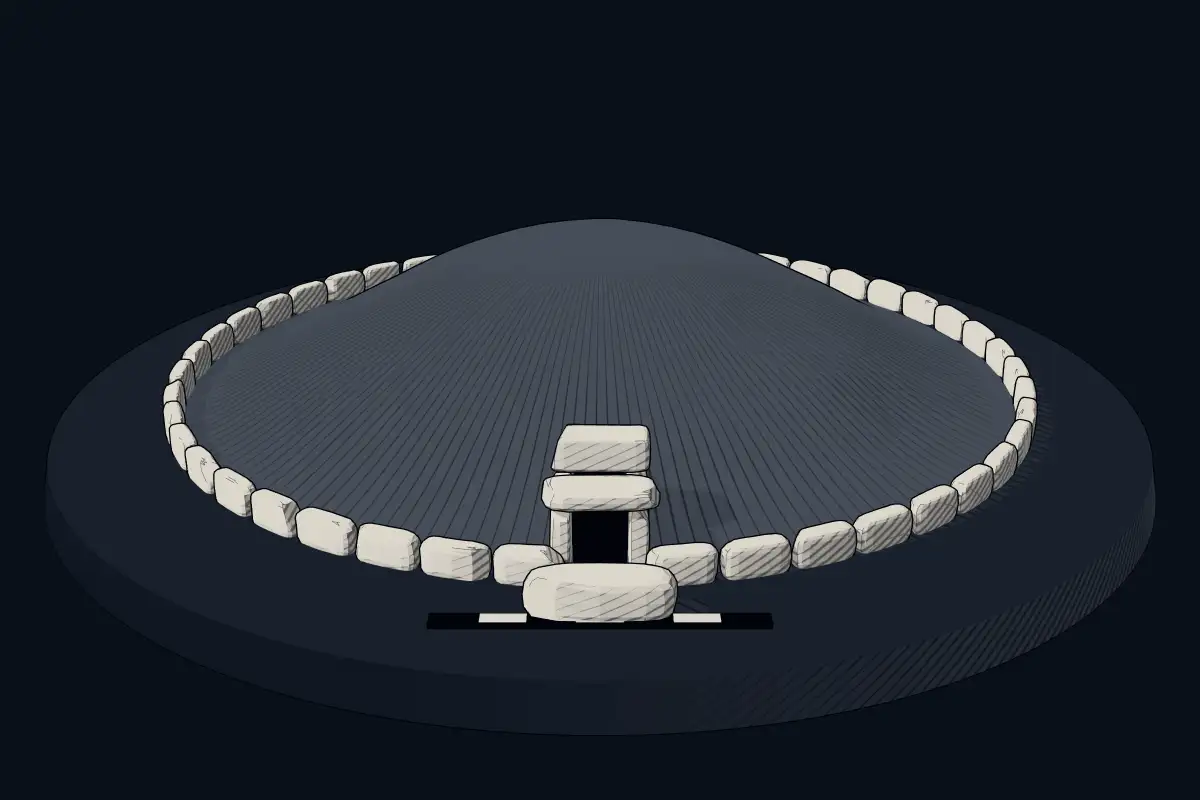
The reconstruction is ours, not a survey: it shows what a monument of this type looks like, at the size the record gives for this one.
Photographs
8 photographs, each with its author and licence
More photographs


Lore
Evidence & Lore
What the sources actually support — and, kept apart, what has been claimed.
What the evidence supports
Dates
2617 BCE–768 CEHow this date was established: Radiocarbon dating75 radiocarbon dates in the p3k14c database (Bird et al. 2022, Scientific Data 9:27 (p3k14c radiocarbon database)) between 344 and 6835 BP; the range shown is the middle half of the measurements; uncalibrated ages, shown as calendar years with the conventional BP + 1950 conversion.Source for this date
Measured facts
- Mainstream position
- George Eogan suggested that most or all of the white quartz was spread on the ground and therefore left undisturbed at Knowth.Source: Mainstream position
- Tomb count
- one large passage tomb and 17 smaller tombsSource: Tomb count
- Megalithic art
- the largest assemblage in EuropeSource: Megalithic art
- World heritage complex
- Brú na BóinneSource: World heritage complex
- Cist graves found
- about 35Source: Cist graves found
- Excavation leadership
- George Eogan of University College Dublin, beginning in 1962Source: Excavation leadership
- Passage entrances found
- western in 1967 and eastern in 1968Source: Passage entrances found
- Heritage designation
- national monument of IrelandSource: Heritage designation
Alternative claims
Alternative claims about this site, kept in their own block and labelled with where they stand.
The entrance quartz at Knowth and Newgrange formed white façades that later slid down the mounds.
Where it stands
Ireland
The pin marks the monument itself — its exact point.
- Coordinates
- 53°42′06″ N, 6°29′30″ WFor a GPS or map app: 53.70167, -6.49167
Access is as our sources describe it; we have not visited the site to check.
Nearby
The closest sites in the Atlas, by straight line.
 Newgrange3150–3050 BCE
 Dowth3200–2900 BCE
- Megalithic mound (tumulus with integral stones)Dowth Mound3700–2900 BCE
 Townleyhall passage grave3400–2900 BCE
- Passage tomb (passage grave)Ardmulchan Passage Tomb3400–2900 BCE
- Megalithic mound (tumulus with integral stones)Alexander Reid mound3700–2900 BCE
 Portal Tomb von Rathkenny3300–2900 BCE
- Menhir (standing stone)Hurlstone (Lochstein)2800–1800 BCE


Sources
Every record behind this page, with the link it came from.
3 sources behind this page
- 01Wikidata Q1482124wikidata.org
- 02Fringe claim sourceen.wikipedia.org
- 03Source for this datep3k14c.org
Image files
- Knowth01.jpgSitomonPublic domain
- Knowth from the southeast.jpgRob HursonCC BY-SA 4.0
- 2019-06-07 06-22 Irland 124 Brú na Bóinne, Knowth, Megalithic Tombs.jpgAllie_CaulfieldCC BY 2.0
- 20130808 bru na boinne30.JPGJean HousenCC BY-SA 3.0
- 20130808 bru na boinne31.JPGJean HousenCC BY-SA 3.0
- 177 Knowth, Coutny Meath.jpgXeresNelroCC BY-SA 4.0
- 196 Knowth, Coutny Meath.jpgXeresNelroCC BY-SA 4.0
- 1A 0073- Knowth.jpgstannateCC BY-SA 2.0
Report a correctionWrong date, name, photograph or source? Tell us and it will be put right.
Lore, kept apart
Legends and claims
These are stories and claims reported by the sources. They are not evidence, and they never stand in for the dating above.
- Tested: not supported
The entrance quartz at Knowth and Newgrange formed white façades that later slid down the mounds.
Source
Around this place
The ten nearest sites, by compass
Credit
Text, licence and sources
Text from the Wikipedia article "Knowth" (English), licensed CC BY-SA 4.0; authors are listed in the page history. Reused under CC BY-SA 4.0. Read on Wikipedia · Edit history and authors
- Wikipedia (English): KnowthCC BY-SA 4.0
- Wikidata Q1482124CC0