
Santa Maria statue menhir
DatedEst. 4500–1500 BCE
Photo Pierre Bona · CC BY-SA 3.0Source file on Wikimedia Commons
Overview
About this site
What the sources say
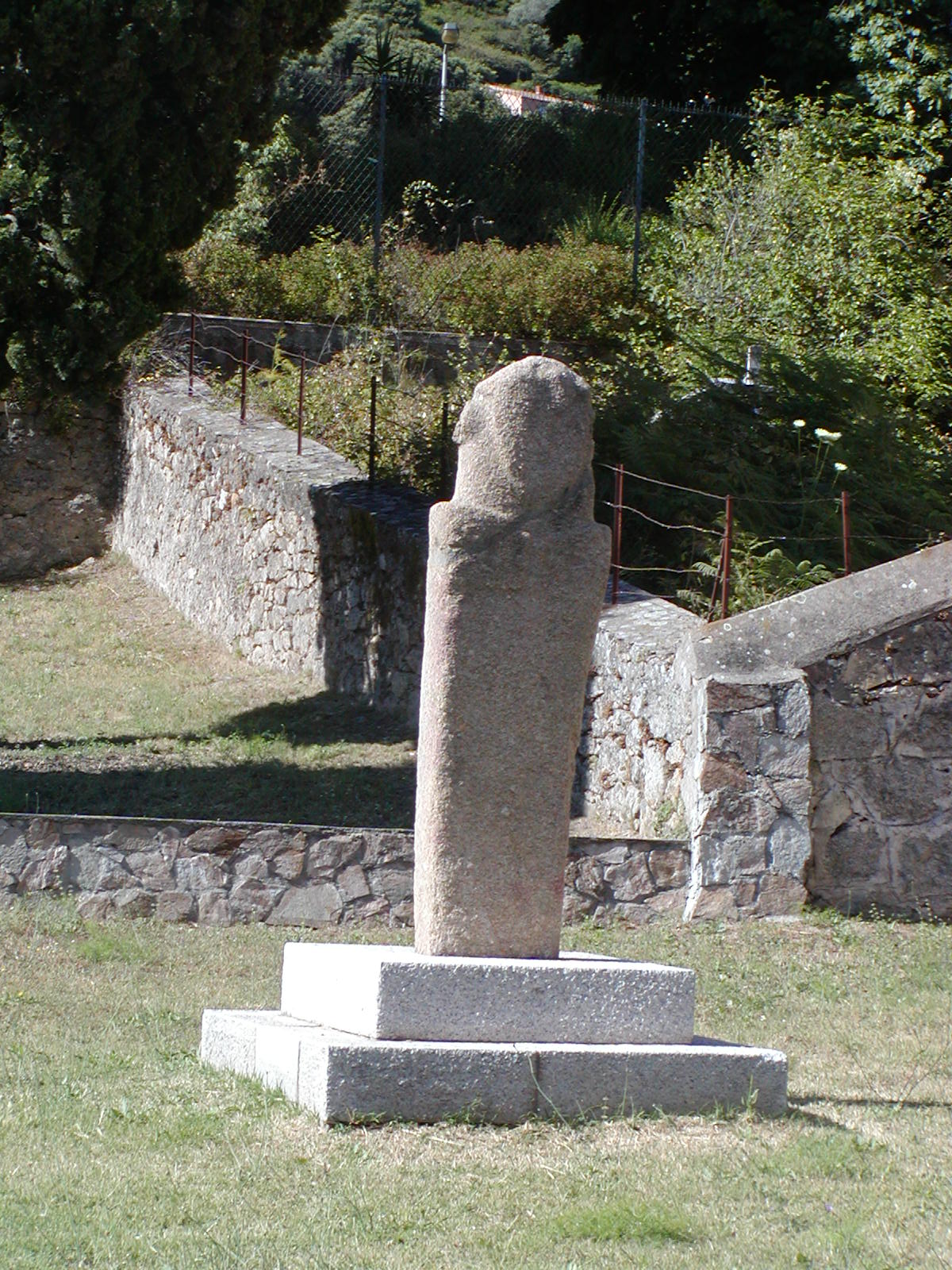
The statue-menhir of Santa Maria is a statue-menhir belonging to the Corsican group, discovered in Cambia, in the Haute-Corse department of France
Read on Wikipedia3 min readCC BY-SA 4.0
Where it sits in time
The site's dated range, placed against world reference points.
The scale is logarithmic: each step to the left is about ten times older than the last.
The full article
Santa Maria statue menhir: the whole story
In briefSources for this section
Sources for this section
The Santa Maria statue-menhir belongs to the Corsican group of statue-menhirs. It was discovered at Cambia, in the Haute-Corse department of France, and was reported in 1893. It seems to have remained at its original location, a crossroads of paths, where a small Romanesque chapel was later built that gave the statue its name. The Petra Frisgiata, a stone decorated with rock engravings, lies a few hundred meters further north.
The statue is slender, measuring 2.10 m in height by 0.35 m in width and 0.12 m, and it is carved from a block of shale. It is very damaged: the head is broken on both sides and the face has almost disappeared. Only the right eye remains, while the nose and mouth can still be made out but are badly eroded.
In the extension of the chin, a relief pattern in the shape of an inverted T may be an ornamental element. Many cups are visible on the barrel of the statue, on a side face and on the back, including two at the level of the breasts. At some later point the statue was Christianized by the addition of a small cross on the axis of the barrel.
According to a local legend, the statue is of a young girl who was turned to stone after desecrating a grave by planting a stick in it.
A statue menhir is a carved standing stone of the later European Neolithic, with a stylised human figure cut into a vertical slab or pillar, sometimes with hints of clothing or weapons. They are most commonly found in southern and western France, Catalonia, Corsica, Sardinia, Italy and the Alps. The catalogue gives a typological estimate of 4500 to 1500 BCE for this one.
The Petra Frisgiata, a stone decorated with rock engravings, is located a few hundred meters further north.
DescriptionSources for this section
Sources for this section
It was reported in 1893. It seems to have remained at its original location, a crossroads of paths, where was later built a small Romanesque chapel that gave it its name.The Petra Frisgiata, a stone decorated with rock engravings, is located a few hundred meters further north.
Of slender shape, the statue measures 2.10 m in height by 0.35 m in width and 0.12 m It was carved into a block of shale The statue is very damaged, as the head is broken on both sides and the face has almost disappeared. It remains only the right eye; the nose and mouth are still discernible but very eroded. In the extension of the chin, an inverted "T" shaped relief pattern may correspond to an ornamental element. Many cups are visible on the barrel of the statue side face, including two at the level of the breasts, and on the back side. The statue was Christianized by the addition of a small cross in the axis of the barrel.
Folklore and legendsSources for this section
Sources for this section
According to a local legend, the statue is of a young girl who was turned to stone after desecrating a grave by planting a stick in it.
How this page was madeSources for this section
Sources for this section
The summary at the top of this page was written by Claude Sonnet 5.5 (2026-11-06) from the cited Wikipedia article “Statue-menhir of Santa Maria”. The numbers in it were checked automatically against the source text. The rest of the page is the article itself, the structured records and computed distances.
Tradition and region
About this kind of monument
Statue menhirs of France
A statue menhir is a carved standing stone of the later European Neolithic, in which a vertical slab or pillar has a stylised human figure cut into it, sometimes with hints of clothing or weapons. They are most commonly found in southern and western France, Catalonia, Corsica, Sardinia, Italy and the Alps, and France has most of the Atlas's records. A group from the Iron Age is also known in Liguria and Lunigiana in Italy, and there are two on Guernsey. One of them, La Gran'mère du Chimquière, "the grandmother of the cemetery", stands in a churchyard.
A well-known site is on Corsica. Filitosa, in the south of the island, is a megalithic site occupied from the end of the Neolithic and the beginning of the Bronze Age until about Roman times. Arrowheads and pottery date the earliest habitation to 3300 BCE. Around 1500 BCE menhirs 2 to 3 metres high were erected there, carved with human faces, armour and weapons. About twenty menhirs of various periods have been counted. One interpretation, by Roger Grosjean, was that they were set up to ward off an invasion by a people he called the Torréens, who threw them down, broke them up and reused some as building stone, and then built the circular stone structures called torri; later researchers disputed this theory.
Dating rests on comparison with the Arco stelae, six Copper Age statue menhirs found in Trentino in 1989, which are similar in style to other anthropomorphic stelae of the fourth and third millennia BCE.
When visiting, look at the weapons and belt carved on the stone.
Paraphrased from Wikipedia: Statue menhir, Wikipedia: Filitosa, Wikipedia: Arco stelae · CC BY-SA 4.0
From the article
Dated moments in the story
- 1893
It was reported in 1893. It seems to have remained at its original location, a crossroads of paths, where was later built a small Romanesque chapel that gave it its name.The Petra Frisgiata, a stone decorated with rock engravings, is located a few hundred meters further north.
Source
Photographs
1 photograph, each with its author and licence
Lore
Evidence & Lore
What the sources actually support — and, kept apart, what has been claimed.
What the evidence supports
Dates
Est. 4500–1500 BCEHow this date was established: Type comparisonTypological estimate, not a date for this site: a statue menhir in France and the Low Countries is normally dated between 4500 BCE and 1500 BCE (Atlas typological table).Source for this date
Measured facts
- Mainstream position
- The source identifies it as a statue-menhir belonging to the Corsican group.Source: Mainstream position
- Type
- Statue-menhirSource: Type
- Group
- Corsican groupSource: Group
- Location
- Cambia, Haute-Corse, FranceSource: Location
Alternative claims
Alternative claims about this site, kept in their own block and labelled with where they stand.
The statue is of a young girl who was turned to stone after desecrating a grave by planting a stick in it.
Where it stands
France
The pin marks the monument itself — its exact point.
- Coordinates
- 42°22′26″ N, 9°17′25″ EFor a GPS or map app: 42.37390, 9.29040
Access is as our sources describe it; we have not visited the site to check.
Nearby
The closest sites in the Atlas, by straight line.




Sources
Every record behind this page, with the link it came from.
2 sources behind this page
- 01Wikidata Q20191277wikidata.org
- 02Wikipedia (en)en.wikipedia.org
Image files
- Cambia-menhir.jpgPierre BonaCC BY-SA 3.0
Report a correctionWrong date, name, photograph or source? Tell us and it will be put right.
Lore, kept apart
Legends and claims
These are stories and claims reported by the sources. They are not evidence, and they never stand in for the dating above.
- Tradition
According to a local legend, the statue is of a young girl who was turned to stone after desecrating a grave by planting a stick in it.
Source - Tradition
According to a local legend, the statue is of a young girl who was turned to stone after desecrating a grave by planting a stick in it.
Source - Tested: not supported
The statue is of a young girl who was turned to stone after desecrating a grave by planting a stick in it.
Source
Around this place
The ten nearest sites, by compass
Credit
Text, licence and sources
Text from the Wikipedia article "Statue-menhir of Santa Maria" (English), licensed CC BY-SA 4.0; authors are listed in the page history. Reused under CC BY-SA 4.0. Read on Wikipedia · Edit history and authors