
Lit de Saint-Eneour
DatedEst. 4500–3300 BCE
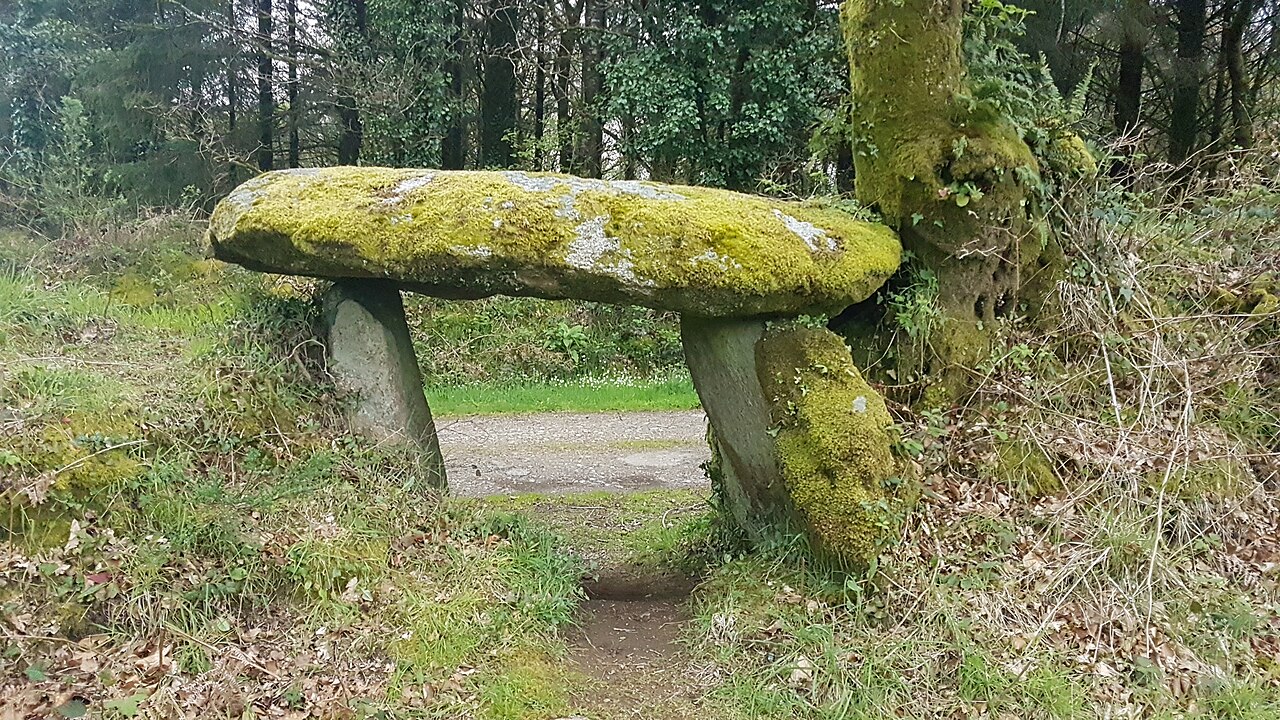
Photo Original uploader was Hoel1 at fr.wikipedia · Public domainSource file on Wikimedia Commons

Overview
About this site
What the sources say
Le lit de Saint-Enéour est une grande pierre couchée légèrement concave située dans la commune de Plounéour-Ménez, dans le Finistère, en Bretagne.
Article in FrenchRead on Wikipedia2 min readCC BY-SA 4.0
Where it sits in time
The site's dated range, placed against world reference points.
The scale is logarithmic: each step to the left is about ten times older than the last.
The full article
Lit de Saint-Eneour: the whole story
In briefSources for this section
- Wikipedia (French): Lit de Saint-EneourCC BY-SA 4.0
Sources for this section
- Wikipedia (French): Lit de Saint-EneourCC BY-SA 4.0
The Lit de Saint-Eneour is a large recumbent stone with a slightly concave surface. It stands in Plounéour-Ménez in the Finistère department of Brittany, France, about one kilometre north of the church and three hundred metres east of the manoir du Penhoat.
The stone has a visible hollow in the rock. According to the local legend, this feature formed the bed in which Saint Enéour slept. Beyond this description and the traditional association with the saint, no further details of the stone’s structure or survival are given.
The monument is dated by typological estimate to 4500 BCE to 3300 BCE. Its catalogue classification is a megalith, while the local legend connects its name and hollow with Saint Enéour, the namesake saint of the parish of Plounéour.
More broadly, megalithic monuments in France include dolmens, covered alleys, menhirs, cromlechs, tumuli, groups of stones and polissoirs. Some of the oldest monuments in Europe are in western France, and Brittany’s Carnac stones form a collection of more than 3,000 prehistoric standing stones.
No English Wikipedia article exists for it; the full text below is the French article "Lit de Saint-Eneour", shown in the original language.
Summary in EnglishSources for this section
- Wikipedia (French): Lit de Saint-EneourCC BY-SA 4.0
Sources for this section
- Wikipedia (French): Lit de Saint-EneourCC BY-SA 4.0
Lit de Saint-Eneour is a megalith (abstract root) in Plounéour-Ménez, France. Wikidata describes it as: megalith in Plounéour-Ménez, France. A typological estimate: 4500 BCE to 3300 BCE. No English Wikipedia article exists for it; the full text below is the French article "Lit de Saint-Eneour", shown in the original language.
SituationSources for this section
- Wikipedia (French): Lit de Saint-EneourCC BY-SA 4.0
Sources for this section
- Wikipedia (French): Lit de Saint-EneourCC BY-SA 4.0
Le lit de Saint-Enéour est situé à environ un kilomètre au nord de l’église, et à trois cents mètres à l’est du manoir du Penhoat, à Plounéour-Ménez.
LégendeSources for this section
- Wikipedia (French): Lit de Saint-EneourCC BY-SA 4.0
Sources for this section
- Wikipedia (French): Lit de Saint-EneourCC BY-SA 4.0
Selon la légende, Saint Enéour, saint éponyme de la paroisse de Plounéour, avait pour habitude de se retirer en ce lieu pour prier et dormir.
DescriptionSources for this section
- Wikipedia (French): Lit de Saint-EneourCC BY-SA 4.0
Sources for this section
- Wikipedia (French): Lit de Saint-EneourCC BY-SA 4.0
On peut voir une concavité dans la roche qui aurait formé le lit du saint.
RéférencesSources for this section
- Wikipedia (French): Lit de Saint-EneourCC BY-SA 4.0
Sources for this section
- Wikipedia (French): Lit de Saint-EneourCC BY-SA 4.0
Portail de la géologie Portail du Finistère
How this page was madeSources for this section
- Wikipedia (French): Lit de Saint-EneourCC BY-SA 4.0
Sources for this section
- Wikipedia (French): Lit de Saint-EneourCC BY-SA 4.0
The summary at the top of this page was written by MiniMax-M3 (2026-11-08) from the cited Wikipedia article “Lit de Saint-Eneour”, translated from French. The numbers in it were checked automatically against the source text. The rest of the page is the article itself, the structured records and computed distances.
Tradition and region
About this kind of monument
French megaliths
The Atlas's general "megalith" records for France cover a range of monuments: dolmens and covered alleys (allées couvertes), menhirs, cromlechs, tumuli, groups of stones, and polissoirs. Some of the oldest monuments in Europe are in western France, and the Carnac stones in Brittany, with more than 3,000 prehistoric standing stones, are the largest collection in the world.
A polissoir, "polisher", is a Neolithic stone tool used for polishing and sharpening stone objects, especially axes, adzes and chisels. They date to about 5,000 years ago. Polissoirs are typically large stones with smooth, concave surfaces or grooves, made of hard and abrasive rocks such as sandstone, granite or quartzite, and the surface often shows distinctive wear patterns from the back-and-forth motion used to refine the edges of tools. They come in two types: earthfast, large and immovable and found in their original position, and portable. A polissoir is not strictly a megalith, but it is recorded with them because it is a large stone of the same period.
In the Atlas a record with an unspecified type receives a broad Neolithic range, since it cannot be tied to a particular phase. Many small dolmens survive only as a few stones in a field and cannot be dated closely.
Folklore: La Roche-aux-Fées near Essé takes its name, "the fairies' rock", from a legend that fairies placed the stones.
When visiting, look for the polished grooves on boulders near dolmens, and for the way a capstone is propped.
Paraphrased from Wikipedia: Dolmen, Wikipedia: Menhir, Wikipedia: Carnac stones, Wikipedia: Polissoir, Wikipedia: La Roche-aux-Fées · CC BY-SA 4.0
Photographs
2 photographs, each with its author and licence
More photographs

Lore
Evidence & Lore
What the sources actually support — and, kept apart, what has been claimed.
What the evidence supports
Dates
Est. 4500–3300 BCEHow this date was established: Type comparisonTypical range for megaliths in France; this site has not been dated itself. The megaliths of north-west France are among the oldest in Europe; the Carnac stones date from 4500-3300 BC.Source for this date
Where it stands
France
The pin marks the monument itself — its exact point.
- Coordinates
- 48°27′01″ N, 3°54′10″ WFor a GPS or map app: 48.45028, -3.90277
Access is as our sources describe it; we have not visited the site to check.
Nearby
The closest sites in the Atlas, by straight line.
 Mougau-Bihan gallery grave4500–3300 BCE
 Tumulii de Kerelcun5000–3000 BCE
 dolmen de Quinoualc'h4000–3000 BCE
- Menhir (standing stone)menhir de Kerelcun2800–1800 BCE
 Ti ar Boutiged4000–3000 BCE
 Menhir de Roquinarc'h2800–1800 BCE
 La Noce de Pierres3300–2500 BCE
- Megalithic mound (tumulus with integral stones)tumulus du Réuniou5000–3000 BCE


Sources
Every record behind this page, with the link it came from.
2 sources behind this page
- 01Wikidata Q3256516wikidata.org
- 02Source for this dateen.wikipedia.org
Image files
- Image 018.lit de Saint-Eneour.jpgOriginal uploader was Hoel1 at fr.wikipediaPublic domain
- Image 024.lit St-Eneour.jpgHoel1 at French WikipediaPublic domain
Report a correctionWrong date, name, photograph or source? Tell us and it will be put right.
Lore, kept apart
Legends and claims
These are stories and claims reported by the sources. They are not evidence, and they never stand in for the dating above.
- Tradition
Selon la légende, Saint Enéour, saint éponyme de la paroisse de Plounéour, avait pour habitude de se retirer en ce lieu pour prier et dormir.
Source - Tradition
The stone has a visible hollow in the rock.
The stone has a visible hollow in the rock. According to the local legend, this feature formed the bed in which Saint Enéour slept. Beyond this description and the traditional association with the saint, no further details of the stone’s structure or survival are given.
Source - Tradition
The monument is dated by typological estimate to 4500 BCE to 3300 BCE.
The monument is dated by typological estimate to 4500 BCE to 3300 BCE. Its catalogue classification is a megalith, while the local legend connects its name and hollow with Saint Enéour, the namesake saint of the parish of Plounéour.
Source
Around this place
The ten nearest sites, by compass
Credit
Text, licence and sources
Text from the Wikipedia article "Lit de Saint-Eneour" (French), licensed CC BY-SA 4.0; authors are listed in the page history. Reused under CC BY-SA 4.0. Read on Wikipedia · Edit history and authors
- Wikipedia (French): Lit de Saint-EneourCC BY-SA 4.0
- Wikidata Q3256516CC0