_de_Longar_(49268303387).jpg/1920px-Dolmen_(hipogeo)_de_Longar_(49268303387).jpg 1920w)
Longar
Also known asHipogeo de Longar
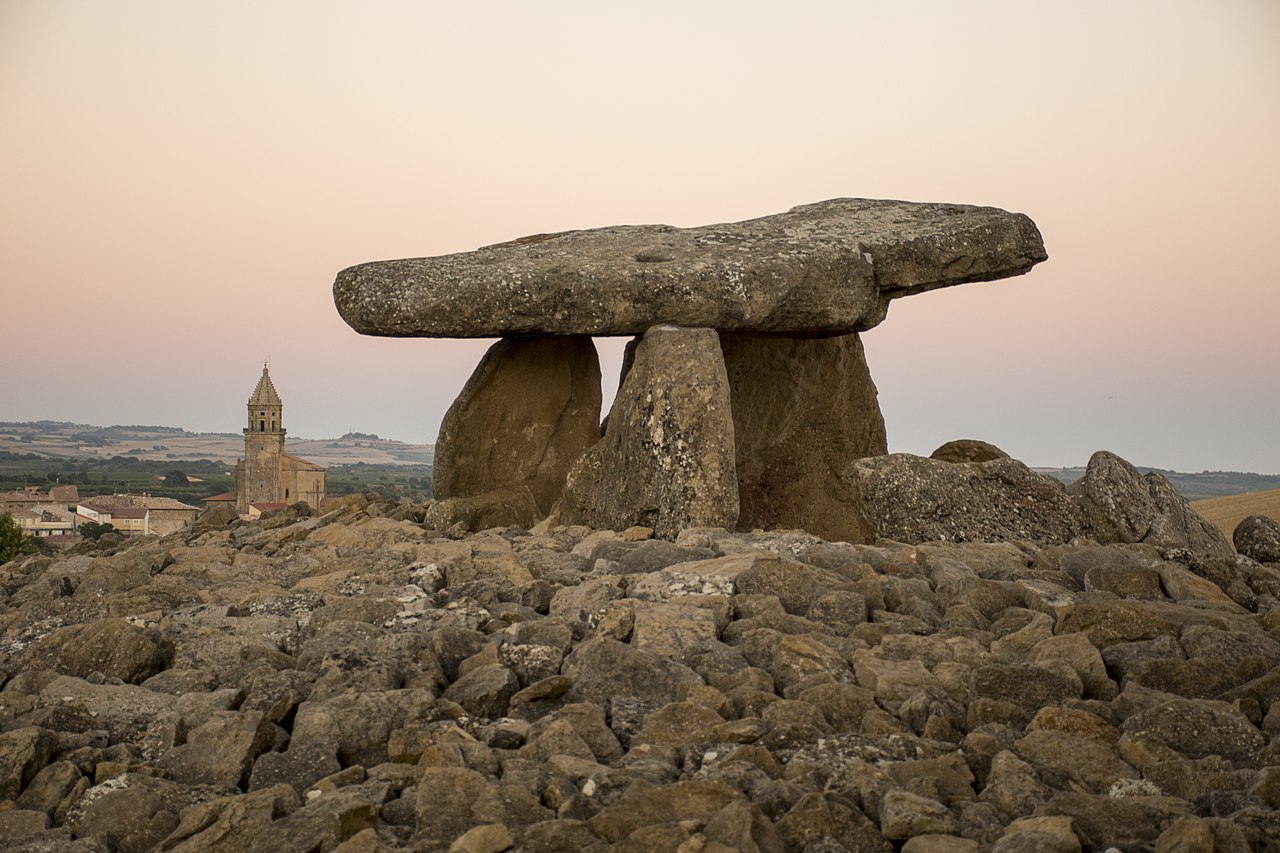
Photo Ángel M. Felicísimo from Mérida, España · CC BY 2.0Source file on Wikimedia Commons

Overview
About this site
Overview
The hypogeum of Longar (Hipogeo de Longar) is a rock-cut megalithic burial chamber in the municipality of Viana, in Navarre, Spain. It is dated to the end of the Neolithic, in the middle of the third millennium BCE, or to the beginning of the Copper Age, and it is protected as a bien de interés cultural.
Human remains, stone tools and evidence of farming have been found inside. The monument was found in 1985 by Luis Arazuri Izquierdo, a resident of Viana, and was excavated in campaigns in 1991, 1992 and 1993 under Javier Armendáriz Martija and Susana Irigaray Soto.
Read on Wikipedia4 min readCC BY-SA 4.0
Article
Longar
The hypogeum stands on the south face of the Alto de los Bojes at 750 m above sea level, reached by a signposted track from the road between Viana and Aras.
SettingSources for this section
- Wikipedia (Spanish): Hipogeo de Longar (Viana)CC BY-SA 4.0
Sources for this section
- Wikipedia (Spanish): Hipogeo de Longar (Viana)CC BY-SA 4.0
The hypogeum stands on the south face of the Alto de los Bojes at 750 m above sea level, reached by a signposted track from the road between Viana and Aras. The position suggests that its builders wished it to be visible and to dominate the territory: the view reaches the Ebro valley, and the monument lies close to the settlement.
DescriptionSources for this section
- Wikipedia (Spanish): Hipogeo de Longar (Viana)CC BY-SA 4.0
Sources for this section
- Wikipedia (Spanish): Hipogeo de Longar (Viana)CC BY-SA 4.0
Access to the chamber is by a corridor oriented to the south and lined with upright stones (orthostats), four on each side. The entrance to the chamber was marked by a vertical slab with a circular opening of about fifty centimetres in diameter, probably meant to seal the burial from the outside with a closure of stone or wood and so keep scavenging animals from the bodies. Only the lower part of this slab survives.
The chamber is dug into clay and has a floor of beaten earth. Its walls are lined with small, irregular sandstone masonry laid dry, without mortar, and the head of the chamber is circular. The roof consists of two large, roughly worked sandstone slabs from rocks outcropping nearby, which together weigh almost seven tonnes. The slab nearest the entrance split in half and buried the hypogeum, which favoured its preservation. By its type the monument has been compared with megalithic monuments of Extremadura, Andalucía and the Algarve, although those seem to be later.
ArchaeologySources for this section
- Wikipedia (Spanish): Hipogeo de Longar (Viana)CC BY-SA 4.0
Sources for this section
- Wikipedia (Spanish): Hipogeo de Longar (Viana)CC BY-SA 4.0
The chamber held the remains of 114 people, men, women and children, none older than forty. They were placed there over about 130 years, between 2630 and 2500 BCE, according to a funerary ritual centred on the hypogeum. The bodies were laid in a foetal position, and the limbs were probably tied with cords soon after death.
Thirty-one flint arrowheads were recovered, four of them still lodged in bone: in the face, the spine and the shoulder, wounds that would have been fatal, and in a rib that shows signs of healing. All these remains belong to males and attest to violence, either within the group or in clashes with another community. No change in working techniques or cultural habits was observed during the period of use.
FindsSources for this section
- Wikipedia (Spanish): Hipogeo de Longar (Viana)CC BY-SA 4.0
Sources for this section
- Wikipedia (Spanish): Hipogeo de Longar (Viana)CC BY-SA 4.0
The grave goods are scarce and always of stone, with no metal, together with the remains of a handmade pottery vessel. Personal goods and ornaments are notably absent. Flint flakes and blades, some showing the wear known as cereal sheen from use in reaping, show that the people of the surrounding area grew cereals, although hunting, fishing and the gathering of wild fruits probably continued. Study of the monument has also drawn on radiocarbon dating, anthropological and pathological analysis of the remains, fossil pollen and the traces of use on the stone grave goods.
Later historySources for this section
- Wikipedia (Spanish): Hipogeo de Longar (Viana)CC BY-SA 4.0
Sources for this section
- Wikipedia (Spanish): Hipogeo de Longar (Viana)CC BY-SA 4.0
A Roman settlement was later established where the hypogeum stands, and a population with its own parish is recorded in the twelfth century. In 1219 it was incorporated into Viana by decision of Sancho VII, together with other nearby settlements. It was abandoned late in the fourteenth century because of the border wars between the kingdoms of Navarre and Castile.
The monument was restored in 1994, and its surroundings were adapted for visitors.
ContextSources for this section
- Wikipedia (Spanish): Hipogeo de Longar (Viana)CC BY-SA 4.0
Sources for this section
- Wikipedia (Spanish): Hipogeo de Longar (Viana)CC BY-SA 4.0
A hypogeum is literally an underground temple or tomb. In the Neolithic and Copper Age of western Europe, the same communities built megalithic tombs above ground and dug chambers below it.
Tradition and region
About this kind of monument
Neolithic and Copper Age hypogea of western Europe
A hypogeum is literally an "underground" temple or tomb, often with niches for cremated remains or loculi for burials. In the Neolithic and Copper Age of western Europe, the same communities built megalithic tombs above ground and dug chambers below it; this article covers the underground examples and the sites where the two meet.
In Andalusia, the Copper Age site of Los Millares near Almería was in use from about 3025 to 2000 BCE and probably supported around 1,000 people. It was discovered in 1891 during the construction of a railway and first excavated by Luis Siret. It is the type site of the Millaran culture. Three concentric lines of stone walls surround the site, the outer ring running more than 200 metres with 19 bastions, and there is an extensive cemetery of eighty passage grave tombs; radiocarbon dating shows that one wall collapsed and was rebuilt about 3025 BCE.
In Malta, the Hypogeum of Ħal Saflieni is a Neolithic subterranean structure of the Saflieni phase (3300 to 3000 BCE) in Paola. It is thought to have been a sanctuary and necropolis, with the remains of more than 7,000 people estimated, and is among the best-preserved examples of the Maltese temple culture that also produced the megalithic temples and the Xagħra stone circle.
Dating rests on radiocarbon dates, as at Los Millares, and on the objects found with the dead.
When visiting, check opening hours in advance, since some hypogea limit visitor numbers.
Paraphrased from Wikipedia: Hypogeum, Wikipedia: Hypogeum of Ħal-Saflieni, Wikipedia: Los Millares · CC BY-SA 4.0
From the article
Dated moments in the story
- 750 CE
Se encuentra en la cara sur del Alto de los Bojes, a 750 [[m s. n. m.]] Su emplazamiento muestra la voluntad de los constructores de darle visibilidad, de dominar el territorio, ya que la visión alcanza al valle del Ebro, además de situarlo cerca del poblado.
Source - 1219
En 1219 fue incorporada, por decisión de Sancho VII, junto con otras poblaciones de los alrededores, a Viana.
Source - 1985
Fue hallado en 1985 por Luis Arazuri Izquierdo, vecino de Viana.
Source - 1989
El conjunto fue descubierto en 1989, excavado a partir de 1991 y tres años más tarde restaurado y adecuado su entorno para visitas.
Source - 1991
Se realizaron tres campañas de excavaciones arqueológicas (1991, 1992 y 1993) y se restauró en 1994. Todo ello dirigido por Javier Armendáriz Martija y Susana Irigaray Soto.
Source
Photographs
7 photographs, each with its author and licence
More photographs


Where it stands
Spain
The pin marks the monument itself — its exact point.
- Coordinates
- 42°34′39″ N, 2°23′36″ WFor a GPS or map app: 42.57747, -2.39347
Access is as our sources describe it; we have not visited the site to check.
Nearby
The closest sites in the Atlas, by straight line.
- Menhir (standing stone)Valverde (movido de su sitio)2800–1800 BCE
- DolmenSancho Martín I4000–3000 BCE
 dolmen Los Llanos4000–3000 BCE
- DolmenDolmen d'El Encinal4000–3000 BCE
 Sorginaren Txabola4000–3000 BCE
 Dolmen del Alto de la Huesera4000–3000 BCE
 Dolmen San Martin4000–3000 BCE
 El Sotillo dolmen4000–3000 BCE


Sources
Every record behind this page, with the link it came from.
1 source behind this page
- 01Wikidata Q66123025wikidata.org
Image files
- Dolmen (hipogeo) de Longar (49268303387).jpgÁngel M. Felicísimo from Mérida, EspañaCC BY 2.0
- Hipogeo de Longar, cámara sepulcral.jpgLozano ManzanedoCC BY-SA 4.0
- Dolmen (hipogeo) de Longar (49267723118).jpgÁngel M. Felicísimo from Mérida, EspañaCC BY 2.0
- Interior hipogeo Longar - panoramio.jpgborjaperCC BY-SA 3.0
- Hipogeo de Longar, exterior 1.jpgCliomanoCC BY-SA 4.0
- Hipogeo de Longar, exterior 2.jpgCliomanoCC BY-SA 4.0
- Hipogeo de Longar, cubierta de losas.jpgLozano ManzanedoCC BY-SA 4.0
Report a correctionWrong date, name, photograph or source? Tell us and it will be put right.
Around this place
The ten nearest sites, by compass
Credit
Text, licence and sources
Adapted from the Wikipedia article "Hipogeo de Longar (Viana)" (Spanish), licensed CC BY-SA 4.0; authors are listed in the page history. Reused under CC BY-SA 4.0. Read on Wikipedia · Edit history and authors