Dolmen del Mas Clamí
DatedEst. 4000–3000 BCE
No licensed photograph yetWe have no photograph we may publish for this site, so the interpretive 3D view leads instead.
Overview
About this site
What the sources say
Der Dolmen del Mas Clamí ist eine Nord-Süd orientierte rechteckige, allseitig geschlossene zwischen 2200 und 1800 v. Chr. entstandene Steinkiste. Sie liegt in einem gut erhaltenen Rundhügel nordwestlich von Castellterçol in der Comarca Vallès Oriental in der Provinz Barcelona in Katalonien in Spanien.
Die im Hügel stark eingetiefte Kiste besteht an drei Seiten aus je einem Stein, an der Nordwestseite sind es zwei. Die Steine der Langseiten haben Überlänge. Die Steine der kurzen Seiten stehen zwischen den Langseitensteinen sind, bestimmen die innere Breite uns sind leicht einwärts geneigt. Der teilweise abgeschlagene kurze Stein der Eingangsseite wurde von Josep Colominas und lokalen Anhängern ausgegraben. Der reguläre Zugang erfolgte über die Deckenplatte. Weil diese abgenommen wurde, durfte sie nicht zu schwer sein, daher sind katalanische Steinkisten normalerweise nicht sehr groß. Ein gutes Beispiel ist die Cista de Creu de Parròquia.
Die in der Kiste aufgefundenen Knochenreste entsprechen acht Bestattungen. Zwei Anhänger aus Muscheln (Pektiniden), eine teilweise grüne Steinhalskette und drei große weiße Halsketten. Eine dunkle Schale und verschiedene rote und/oder schwarze Fragmente, teils mit Einschnitten, einmal mit Fingerabdrücken und einmal mit Nageldekor.
Article in GermanRead on Wikipedia3 min readCC BY-SA 4.0
Where it sits in time
The site's dated range, placed against world reference points.
The scale is logarithmic: each step to the left is about ten times older than the last.
The full article
Dolmen del Mas Clamí: the whole story
In briefSources for this section
- Wikipedia (German): Dolmen del Mas ClamíCC BY-SA 4.0
Sources for this section
- Wikipedia (German): Dolmen del Mas ClamíCC BY-SA 4.0
The Dolmen del Mas Clamí is a north-south-oriented, rectangular stone burial chamber in a well-preserved circular mound northwest of Castellterçol, in the Comarca Vallès Oriental, Barcelona province, Catalonia, Spain.
The chamber is completely enclosed on all sides. Three sides each consist of one stone, while the northwest side has two. The long-side stones project beyond the chamber, and the short-side stones stand between them, slightly leaning inward. The partly broken short stone on the entrance side was excavated by Josep Colominas and local supporters.
The chamber was built between 2200 and 1800 v. Chr. Its regular entrance was through the roof slab. Because this slab had to be removed, it could not be too heavy; stone chambers in Catalonia are therefore normally not very large. The Cista de Creu de Parròquia is given as a good example of this type.
The remains found inside represent eight burials. Finds included two shell pendants made from Pectinidae, a partly green stone necklace, and three large white necklaces. There was also a dark bowl and red and/or black fragments, some incised, one bearing fingerprints and another nail decoration. A typological estimate places the monument broadly between 4000 BCE and 3000 BCE.
No English Wikipedia article exists for it; the full text below is the German article "Dolmen del Mas Clamí", shown in the original language.
Summary in EnglishSources for this section
- Wikipedia (German): Dolmen del Mas ClamíCC BY-SA 4.0
Sources for this section
- Wikipedia (German): Dolmen del Mas ClamíCC BY-SA 4.0
Dolmen del Mas Clamí is a dolmen in Castellterçol, Spain. A typological estimate: 4000 BCE to 3000 BCE. No English Wikipedia article exists for it; the full text below is the German article "Dolmen del Mas Clamí", shown in the original language.
How this page was madeSources for this section
- Wikipedia (German): Dolmen del Mas ClamíCC BY-SA 4.0
Sources for this section
- Wikipedia (German): Dolmen del Mas ClamíCC BY-SA 4.0
The summary at the top of this page was written by MiniMax-M3 (2026-11-08) from the cited Wikipedia article “Dolmen del Mas Clamí”, translated from German. The numbers in it were checked automatically against the source text. The rest of the page is the article itself, the structured records and computed distances.
Tradition and region
About this kind of monument
Dolmens of Andalusia, Extremadura and Galicia
Spain has a great many megalithic tombs, and the Atlas's Spanish dolmens run from Andalusia in the south to Galicia in the north-west. The finest are at Antequera in Andalusia, where the Dolmen of Menga, dated to about 3750 to 3650 BCE, is among the largest ancient megalithic structures in Europe. It is 27.5 metres long, 6 metres wide and 3.5 metres high, built with thirty-two megaliths, the largest weighing about 180 tonnes. After the chamber was finished it was covered with soil and built up into the hill seen today; when it was opened in the nineteenth century archaeologists found the skeletons of several hundred people. The Dolmen of Viera stands 70 metres away, and the tholos of El Romeral lies about 4 kilometres off; the three were inscribed as the Antequera Dolmens Site, a UNESCO World Heritage Site, in 2016.
In the south-west, the Dolmen de Soto at Trigueros in Huelva province is a Neolithic tomb estimated to date between 3000 and 2500 BCE, one of about 200 Neolithic burial sites in the province. It was found in 1922 when its owner, Armando de Soto Morillas, wanted to build a house; the German archaeologist Hugo Obermaier found eight bodies in a fetal position with artefacts, and its engraved and painted uprights have been studied more recently.
In Galicia and Portugal a dolmen is an anta, and in Catalan-speaking areas dolmens have folk names such as cova (cave), caixa (crate or coffin), taula (table) and arca (chest). These names are tradition: they record what people made of the monuments, not what they were built for.
When visiting Menga, look at the great capstones from inside the corridor, and at the way the mound was built up over the chamber.
Paraphrased from Wikipedia: Dolmen of Menga, Wikipedia: Dolmen of Viera, Wikipedia: Antequera Dolmens Site, Wikipedia: Dolmen de Soto, Wikipedia: Dolmen · CC BY-SA 4.0
From the article
Dated moments in the story
- 1800 BCE
Der Dolmen del Mas Clamí ist eine Nord-Süd orientierte rechteckige, allseitig geschlossene zwischen 2200 und 1800 v. Chr. entstandene Steinkiste.
Source
See it in 3D
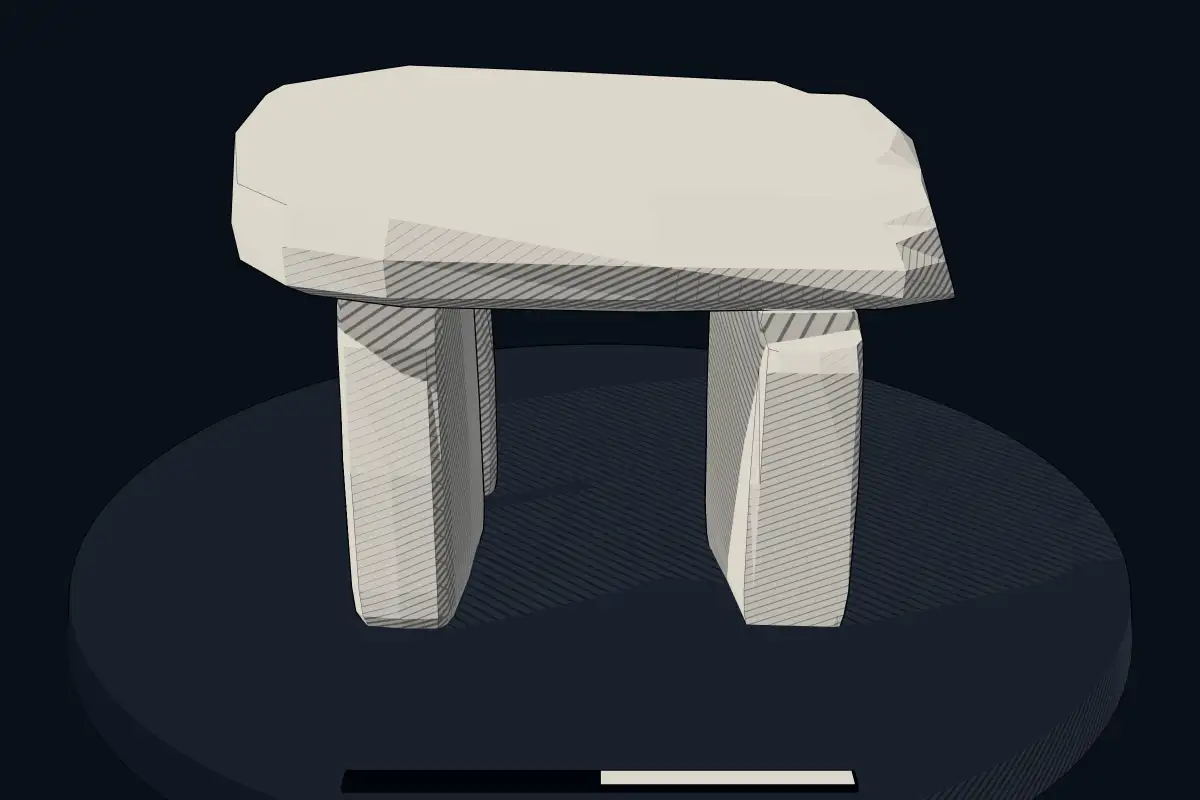
An interpretive reconstruction of the monument, standing on the real ground at its exact point, under the sun for that place and season. Drag to look around it.
The reconstruction is ours, not a survey: it shows what a monument of this type looks like, at the size the record gives for this one.
Lore
Evidence & Lore
What the sources actually support — and, kept apart, what has been claimed.
What the evidence supports
Dates
Est. 4000–3000 BCEHow this date was established: Type comparisonTypical range for dolmens in Spain; this site has not been dated itself. Most dolmens date from the Late Neolithic period (4000-3000 BCE); the Dolmen of Menga in Andalusia dates to about 3750-3650 BCE.Source for this date
Where it stands
Spain
The pin marks the monument itself — its exact point.
- Coordinates
- 41°45′44″ N, 2°05′41″ EFor a GPS or map app: 41.76222, 2.09472
Access is as our sources describe it; we have not visited the site to check.
Nearby
The closest sites in the Atlas, by straight line.
 Dolmen del Gavatx4000–3000 BCE
- DolmenDolmen de les Humbertes4000–3000 BCE
- DolmenDolmen de la Clusella4000–3000 BCE
- DolmenDolmen del Trompo4000–3000 BCE
- DolmenDolmen de Santa Magdalena4000–3000 BCE
- DolmenDolmen de la Casa Nova4000–3000 BCE
 Dolmen de Trullars4000–3000 BCE
- Menhir (standing stone)Tomba del Moro2800–1800 BCE


Sources
Every record behind this page, with the link it came from.
2 sources behind this page
- 01Wikidata Q50689087wikidata.org
- 02Source for this dateen.wikipedia.org
Report a correctionWrong date, name, photograph or source? Tell us and it will be put right.
Around this place
The ten nearest sites, by compass
Credit
Text, licence and sources
Text from the Wikipedia article "Dolmen del Mas Clamí" (German), licensed CC BY-SA 4.0; authors are listed in the page history. Reused under CC BY-SA 4.0. Read on Wikipedia · Edit history and authors
- Wikipedia (German): Dolmen del Mas ClamíCC BY-SA 4.0
- Wikidata Q50689087CC0