
Dolmen de Trullars
DatedEst. 4000–3000 BCE
Photo Gustau Erill i Pinyot · CC BY-SA 3.0Source file on Wikimedia Commons

Overview
About this site
What the sources say
Le dolmen de Trullars est situé dans la municipalité de Monistrol de Calders, dans la comarque de Moianès de la province de Barcelone, en Espagne.
Il est inscrit à l'Inventaire du patrimoine architectural de Catalogne.
Article in FrenchRead on Wikipedia4 min readCC BY-SA 4.0
Where it sits in time
The site's dated range, placed against world reference points.
The scale is logarithmic: each step to the left is about ten times older than the last.
The full article
Dolmen de Trullars: the whole story
In briefSources for this section
- Wikipedia (French): Dolmen de TrullarsCC BY-SA 4.0
Sources for this section
- Wikipedia (French): Dolmen de TrullarsCC BY-SA 4.0
The Dolmen de Trullars is in the municipality of Monistrol de Calders, in the comarca of Moianès in the province of Barcelona, Spain. It is listed in the Inventory of the Architectural Heritage of Catalonia. It lies on the Pla de Trullars, at the southern end of Moianès, in a dominant position over its surroundings, at an altitude of 711 m.
It is a megalith with a simple burial chamber, of fairly large dimensions. The chamber measures 3.22 × 1.73 m and differs from more complex megalithic structures. It is a rectangular box of large orthostats set into the ground, topped by another slab that serves as the lid of the burial chamber. Around the chamber there was a circular mound of earth and stones about 11 m in diameter. This type of tomb dates from the Late Neolithic and the Bronze Age, between 2000 and 1500 BC.
The first scientific approach dates to 1920, with excavations by the walking centre of Vic. Before the fires of summer 2003 ravaged the site, it was surrounded by pines and undergrowth. The surroundings were then cleared to bring the dolmen to light. Excavations begun in early 2003 aimed to include it in a tourist and cultural route. Restoration was only completed in 2006, and the route itself, which includes a walking circuit passing vine-growers' huts, in 2008.
The excavations affected what remained of the surrounding mound and the inside of the chamber. Details indicate that access to the interior was through a slab removed at the time of burial.
The finds include 45 fragments of small-format handmade pottery, four fragments of smooth black pottery, four rim fragments of undetermined beakers with a smooth surface, and one fragment of reddish pottery decorated with incised groups of four parallel lines. Human remains consist of 34 tooth fragments and seven adult teeth, along with a fragment of lower jaw with six tooth sockets.
Spain has a great many megalithic tombs, from Andalusia in the south to Galicia in the north-west. The finest are at Antequera, where the Dolmen of Menga, dated to about 3750 to 3650 BCE, is among the largest ancient megalithic structures in Europe.
No English Wikipedia article exists for it; the full text below is the French article "Dolmen de Trullars", shown in the original language.
Summary in EnglishSources for this section
- Wikipedia (French): Dolmen de TrullarsCC BY-SA 4.0
Sources for this section
- Wikipedia (French): Dolmen de TrullarsCC BY-SA 4.0
Dolmen de Trullars is a dolmen in Monistrol de Calders, Spain. A typological estimate: 4000 BCE to 3000 BCE. Elevation: 711 m. No English Wikipedia article exists for it; the full text below is the French article "Dolmen de Trullars", shown in the original language.
HistoriqueSources for this section
- Wikipedia (French): Dolmen de TrullarsCC BY-SA 4.0
Sources for this section
- Wikipedia (French): Dolmen de TrullarsCC BY-SA 4.0
Ce dolmen est situé dans le Pla de Trullars, sur la commune de Monistrol de Calders, à l'extrémité sud de Moianès, et occupe une position dominante par rapport aux environs, à une altitude de 711 m.
La première approche scientifique remonte à 1920, avec les fouilles du centre de randonnée de Vic. Avant d'être ravagé par les incendies de l'été 2003, le site était entouré de pins et de sous-bois. L'environnement fut alors aménagé pour permettre la mise au jour du dolmen. Les fouilles, entreprises début 2003, visaient à l'intégrer à un itinéraire touristique et culturel. La restauration ne fut achevée qu'en 2006, et l'itinéraire lui-même, qui comprend un circuit pédestre traversant des cabanes de vignerons, qu'en 2008.
DescriptionSources for this section
- Wikipedia (French): Dolmen de TrullarsCC BY-SA 4.0
Sources for this section
- Wikipedia (French): Dolmen de TrullarsCC BY-SA 4.0
Il s'agit d'un mégalithe à chambre funnéraire simple, de dimensions assez importantes. Ce type de tombe date du néolithique final et de l'âge du bronze, entre 2000 et 1500 av. J.-C..
Ce dolmen à chambre simple de 3,22 × 1,73 m, différent des structures mégalithiques plus complexes, est composé d'une boîte rectangulaire aux grands orthostate]s encastrés dans le sol, surmontée d'une autre dalle servant de couvercle à la chambre sépulcrale. Autour de la chambre se trouvait un monticule circulaire de terre et de pierres d'environ 11 m de diamètre..
Les fouilles ont affecté les vestiges du tumulus environnant et l'intérieur de la chambre. Des détails indiquent que l'accès à l'intérieur se faisait par une dalle extraite lors de l'inhumation.
Objets en céramique : 45 fragments de céramique artisanale de petit format, quatre fragments de céramique noire lisse, quatre fragments de bords de gobelets indéterminés à surface lisse ; un fragment de céramique rougeâtre à décor incisé de quatre groupes de lignes parallèles.
Restes osseux : 34 fragments de dents et sept dents d’adultes, ainsi qu’un fragment de mâchoire inférieure avec six alvéoles dentaires .
How this page was madeSources for this section
- Wikipedia (French): Dolmen de TrullarsCC BY-SA 4.0
Sources for this section
- Wikipedia (French): Dolmen de TrullarsCC BY-SA 4.0
The summary at the top of this page was written by Claude Sonnet 5.5 (2026-11-06) from the cited Wikipedia article “Dolmen de Trullars”, translated from French. The numbers in it were checked automatically against the source text. The rest of the page is the article itself, the structured records and computed distances.
Tradition and region
About this kind of monument
Dolmens of Andalusia, Extremadura and Galicia
Spain has a great many megalithic tombs, and the Atlas's Spanish dolmens run from Andalusia in the south to Galicia in the north-west. The finest are at Antequera in Andalusia, where the Dolmen of Menga, dated to about 3750 to 3650 BCE, is among the largest ancient megalithic structures in Europe. It is 27.5 metres long, 6 metres wide and 3.5 metres high, built with thirty-two megaliths, the largest weighing about 180 tonnes. After the chamber was finished it was covered with soil and built up into the hill seen today; when it was opened in the nineteenth century archaeologists found the skeletons of several hundred people. The Dolmen of Viera stands 70 metres away, and the tholos of El Romeral lies about 4 kilometres off; the three were inscribed as the Antequera Dolmens Site, a UNESCO World Heritage Site, in 2016.
In the south-west, the Dolmen de Soto at Trigueros in Huelva province is a Neolithic tomb estimated to date between 3000 and 2500 BCE, one of about 200 Neolithic burial sites in the province. It was found in 1922 when its owner, Armando de Soto Morillas, wanted to build a house; the German archaeologist Hugo Obermaier found eight bodies in a fetal position with artefacts, and its engraved and painted uprights have been studied more recently.
In Galicia and Portugal a dolmen is an anta, and in Catalan-speaking areas dolmens have folk names such as cova (cave), caixa (crate or coffin), taula (table) and arca (chest). These names are tradition: they record what people made of the monuments, not what they were built for.
When visiting Menga, look at the great capstones from inside the corridor, and at the way the mound was built up over the chamber.
Paraphrased from Wikipedia: Dolmen of Menga, Wikipedia: Dolmen of Viera, Wikipedia: Antequera Dolmens Site, Wikipedia: Dolmen de Soto, Wikipedia: Dolmen · CC BY-SA 4.0
From the article
Dated moments in the story
- 1920
La première approche scientifique remonte à 1920, avec les fouilles du centre de randonnée de Vic.
Source - 2000
Ce type de tombe date du néolithique final et de l'âge du bronze, entre 2000 et 1500 av.
Source - 2003
Avant d'être ravagé par les incendies de l'été 2003, le site était entouré de pins et de sous-bois.
Source - 2003
Les fouilles, entreprises début 2003, visaient à l'intégrer à un itinéraire touristique et culturel.
Source - 2006
La restauration ne fut achevée qu'en 2006, et l'itinéraire lui-même, qui comprend un circuit pédestre traversant des cabanes de vignerons, qu'en 2008.
Source
See it in 3D
An interpretive reconstruction of the monument, standing on the real ground at its exact point, under the sun for that place and season. Drag to look around it.
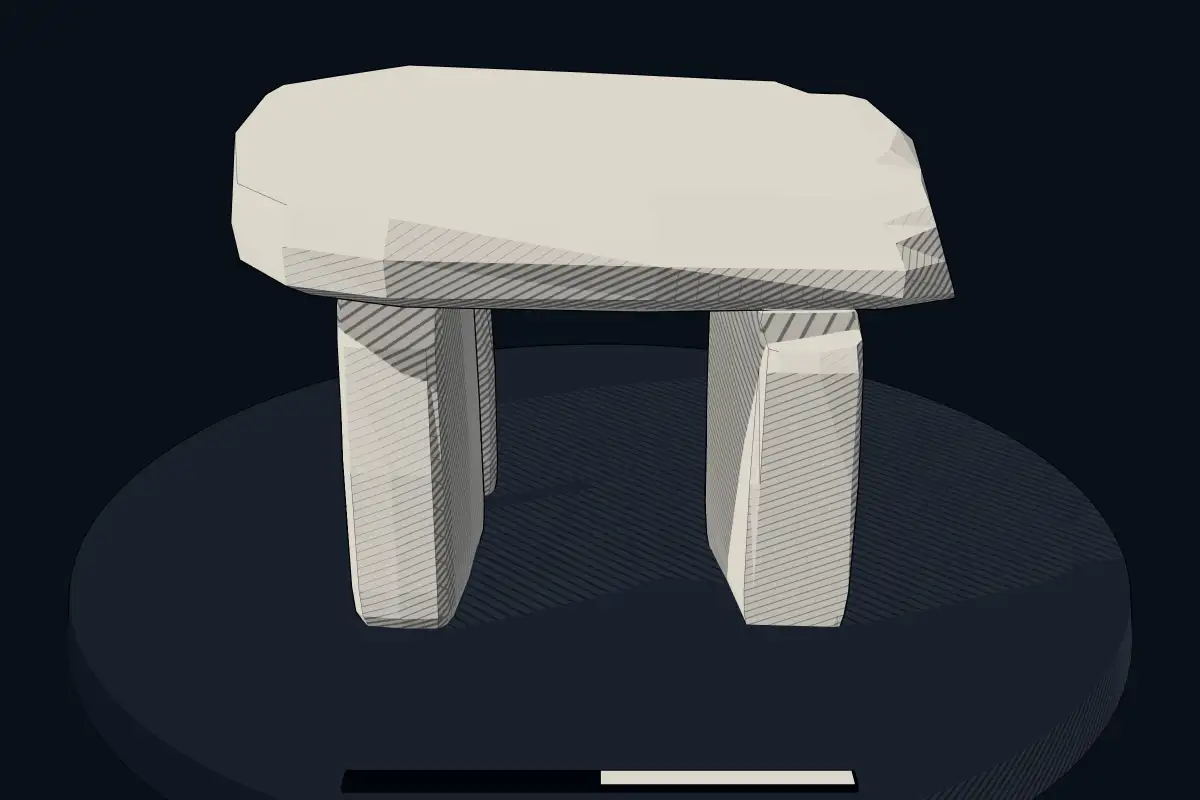
The reconstruction is ours, not a survey: it shows what a monument of this type looks like, at the size the record gives for this one.
Photographs
1 photograph, each with its author and licence
Lore
Evidence & Lore
What the sources actually support — and, kept apart, what has been claimed.
What the evidence supports
Dates
Est. 4000–3000 BCEHow this date was established: Type comparisonTypical range for dolmens in Spain; this site has not been dated itself. Most dolmens date from the Late Neolithic period (4000-3000 BCE); the Dolmen of Menga in Andalusia dates to about 3750-3650 BCE.Source for this date
Where it stands
Spain
The pin marks the monument itself — its exact point.
- Coordinates
- 41°44′41″ N, 2°02′05″ EFor a GPS or map app: 41.74486, 2.03466
Access is as our sources describe it; we have not visited the site to check.
Nearby
The closest sites in the Atlas, by straight line.
- Menhir (standing stone)Tomba del Moro2800–1800 BCE
- DolmenDolmen de la Clusella4000–3000 BCE
- DolmenDolmen del Trompo4000–3000 BCE
- DolmenDolmen del Mas Clamí4000–3000 BCE
- DolmenDolmen de Sant Amanç4000–3000 BCE
 Dolmen de Roca Sareny4000–3000 BCE
- DolmenDolmen de Santa Magdalena4000–3000 BCE
 Dolmen del Gavatx4000–3000 BCE


Sources
Every record behind this page, with the link it came from.
2 sources behind this page
- 01Wikidata Q11917569wikidata.org
- 02Source for this dateen.wikipedia.org
Image files
- Dolmen de Trullars 3.JPGGustau Erill i PinyotCC BY-SA 3.0
Report a correctionWrong date, name, photograph or source? Tell us and it will be put right.
Around this place
The ten nearest sites, by compass
Credit
Text, licence and sources
Text from the Wikipedia article "Dolmen de Trullars" (French), licensed CC BY-SA 4.0; authors are listed in the page history. Reused under CC BY-SA 4.0. Read on Wikipedia · Edit history and authors
- Wikipedia (French): Dolmen de TrullarsCC BY-SA 4.0
- Wikidata Q11917569CC0