
Dolmen del Barranc
DatedEst. 4000–3000 BCE
Photo Josep Bello · Public domainSource file on Wikimedia Commons
Overview
About this site
What the sources say
El Dolmen del Barranc es una construcción megalítica prehistórica situada en el municipio español de Espolla (Gerona). Forma parte del conjunto de los dólmenes de Espolla. Está situado en el paraje del Barranc, cercano a la línea divisoria con el término municipal de Rabós y en un lugar de paso muy antiguo, como indican los restos de un camino de trazado medieval que actualmente ha quedado en desuso, así como también este eje de comunicación en la sierra de la Albera. Fue construido entre el 3.200 y 2.700 a. C.
Se trata de un sepulcro megalítico de inhumación múltiple. Sus losas son de pizarra y presenta una cámara trapezoidal y corredor de pared seca con vestíbulo semicircular en la entrada. La losa de cubierta se encuentra partida por la mitad y en ella es posible observar numerosos grabados rupestres, algunos de los cuales representan figuras humanas y otras formas geométricas y cruces antropomórficas. Fue restaurado en el año 1984 y consolidado en 1986 por Rafael Insa bajo la dirección de J. Tarrús y J. Chinchilla.
Article in SpanishRead on Wikipedia3 min readCC BY-SA 4.0
Where it sits in time
The site's dated range, placed against world reference points.
The scale is logarithmic: each step to the left is about ten times older than the last.
The full article
Dolmen del Barranc: the whole story
In briefSources for this section
- Wikipedia (Spanish): Dolmen del BarrancCC BY-SA 4.0
Sources for this section
- Wikipedia (Spanish): Dolmen del BarrancCC BY-SA 4.0
The Dolmen del Barranc is a prehistoric megalithic construction in the municipality of Espolla, in the province of Girona, Spain, and forms part of the dolmens of Espolla. It stands in the locality called el Barranc, close to the boundary with the municipality of Rabós.
It lies on a very old route of passage. The remains of a medieval track, now disused, still show this, as does the communication axis through the Albera range. The monument was built between 3,200 and 2,700 BCE, and the Atlas gives a typological estimate of 4000 to 3000 BCE.
It is a megalithic tomb for multiple burials. Its slabs are of slate, and it has a trapezoidal chamber and a dry-stone corridor with a semicircular vestibule at the entrance.
The covering slab is split in half. On it can be seen numerous engravings, some showing human figures and others geometric shapes and anthropomorphic crosses.
The dolmen was restored in 1984 and consolidated in 1986 by Rafael Insa, under the direction of J. Tarrús and J. Chinchilla. Nothing is recorded of what excavation found inside. Spain has a great many megalithic tombs, and those of Espolla show the tradition in the north-east of the country.
No English Wikipedia article exists for it; the full text below is the Spanish article "Dolmen del Barranc", shown in the original language.
Summary in EnglishSources for this section
- Wikipedia (Spanish): Dolmen del BarrancCC BY-SA 4.0
Sources for this section
- Wikipedia (Spanish): Dolmen del BarrancCC BY-SA 4.0
Dolmen del Barranc is a dolmen in Espolla, Spain. A typological estimate: 4000 BCE to 3000 BCE. Elevation: 212 m. No English Wikipedia article exists for it; the full text below is the Spanish article "Dolmen del Barranc", shown in the original language.
How this page was madeSources for this section
- Wikipedia (Spanish): Dolmen del BarrancCC BY-SA 4.0
Sources for this section
- Wikipedia (Spanish): Dolmen del BarrancCC BY-SA 4.0
The summary at the top of this page was written by Claude Sonnet 5.5 (2026-11-06) from the cited Wikipedia article “Dolmen del Barranc”, translated from Spanish. The numbers in it were checked automatically against the source text. The rest of the page is the article itself, the structured records and computed distances.
Tradition and region
About this kind of monument
Dolmens of Andalusia, Extremadura and Galicia
Spain has a great many megalithic tombs, and the Atlas's Spanish dolmens run from Andalusia in the south to Galicia in the north-west. The finest are at Antequera in Andalusia, where the Dolmen of Menga, dated to about 3750 to 3650 BCE, is among the largest ancient megalithic structures in Europe. It is 27.5 metres long, 6 metres wide and 3.5 metres high, built with thirty-two megaliths, the largest weighing about 180 tonnes. After the chamber was finished it was covered with soil and built up into the hill seen today; when it was opened in the nineteenth century archaeologists found the skeletons of several hundred people. The Dolmen of Viera stands 70 metres away, and the tholos of El Romeral lies about 4 kilometres off; the three were inscribed as the Antequera Dolmens Site, a UNESCO World Heritage Site, in 2016.
In the south-west, the Dolmen de Soto at Trigueros in Huelva province is a Neolithic tomb estimated to date between 3000 and 2500 BCE, one of about 200 Neolithic burial sites in the province. It was found in 1922 when its owner, Armando de Soto Morillas, wanted to build a house; the German archaeologist Hugo Obermaier found eight bodies in a fetal position with artefacts, and its engraved and painted uprights have been studied more recently.
In Galicia and Portugal a dolmen is an anta, and in Catalan-speaking areas dolmens have folk names such as cova (cave), caixa (crate or coffin), taula (table) and arca (chest). These names are tradition: they record what people made of the monuments, not what they were built for.
When visiting Menga, look at the great capstones from inside the corridor, and at the way the mound was built up over the chamber.
Paraphrased from Wikipedia: Dolmen of Menga, Wikipedia: Dolmen of Viera, Wikipedia: Antequera Dolmens Site, Wikipedia: Dolmen de Soto, Wikipedia: Dolmen · CC BY-SA 4.0
From the article
Dated moments in the story
- 1984
Fue restaurado en el año 1984 y consolidado en 1986 por Rafael Insa bajo la dirección de J.
Source
See it in 3D
An interpretive reconstruction of the monument, standing on the real ground at its exact point, under the sun for that place and season. Drag to look around it.
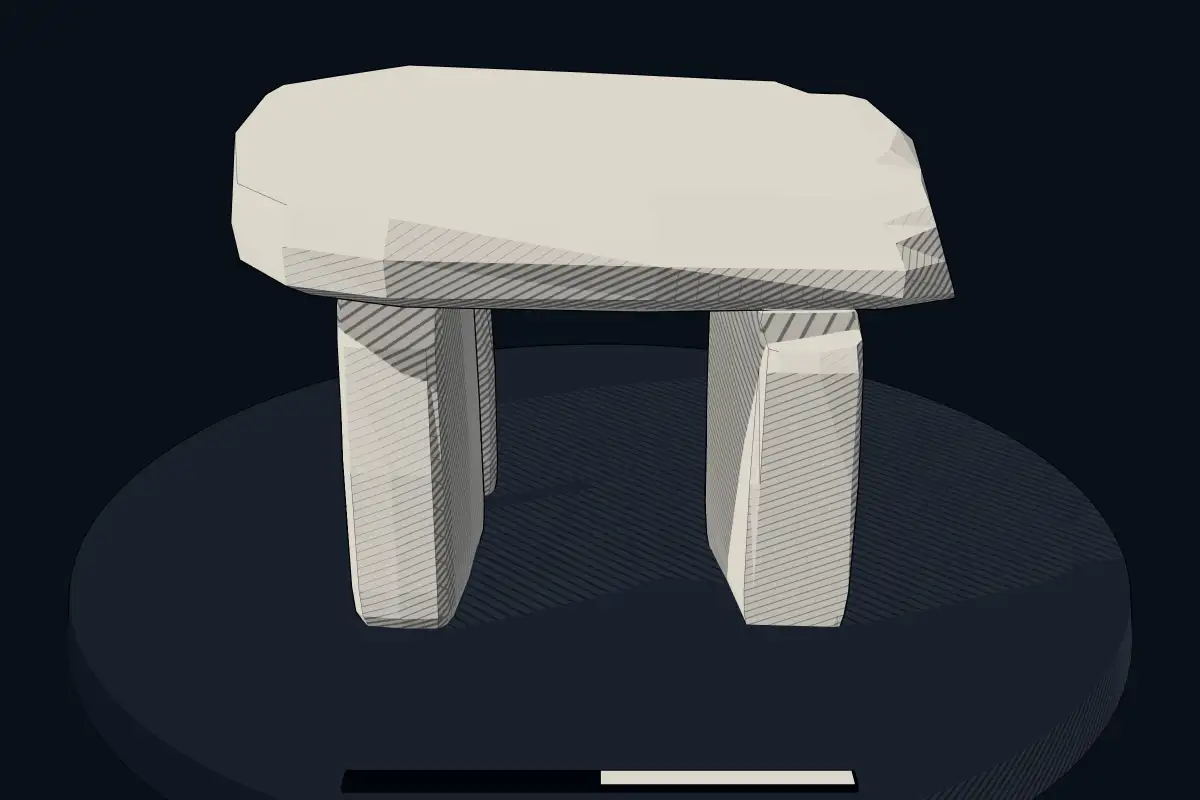
The reconstruction is ours, not a survey: it shows what a monument of this type looks like, at the size the record gives for this one.
Photographs
1 photograph, each with its author and licence
Lore
Evidence & Lore
What the sources actually support — and, kept apart, what has been claimed.
What the evidence supports
Dates
Est. 4000–3000 BCEHow this date was established: Type comparisonTypical range for dolmens in Spain; this site has not been dated itself. Most dolmens date from the Late Neolithic period (4000-3000 BCE); the Dolmen of Menga in Andalusia dates to about 3750-3650 BCE.Source for this date
Where it stands
Spain
The pin marks the monument itself — its exact point.
- Coordinates
- 42°24′32″ N, 3°00′58″ EFor a GPS or map app: 42.40889, 3.01611
Access is as our sources describe it; we have not visited the site to check.
Nearby
The closest sites in the Atlas, by straight line.


Sources
Every record behind this page, with the link it came from.
2 sources behind this page
- 01Wikidata Q8561496wikidata.org
- 02Source for this dateen.wikipedia.org
Image files
- Dolmen del Barranc.JPGJosep BelloPublic domain
Report a correctionWrong date, name, photograph or source? Tell us and it will be put right.
Around this place
The ten nearest sites, by compass
- Dolmen de Mas Girarols I1.1 km N
- Dolmen de Mas Girarols II1.2 km N
- Dolmen de Puig Balaguer1.6 km N
- Dolmen de la Coma de Felis1.8 km SE
- Dolmen de les Morelles2.0 km NW
- Mas Roqué menhir2.7 km E
- Dolmen del Solar d'en Gibert2.7 km NE
- Dolmen d'Arreganyats2.9 km NW
- Dolmen de la Gutina/Puig del Pal2.9 km SW
- Menhir del Castellà3.0 km W
Credit
Text, licence and sources
Text from the Wikipedia article "Dolmen del Barranc" (Spanish), licensed CC BY-SA 4.0; authors are listed in the page history. Reused under CC BY-SA 4.0. Read on Wikipedia · Edit history and authors
- Wikipedia (Spanish): Dolmen del BarrancCC BY-SA 4.0
- Wikidata Q8561496CC0