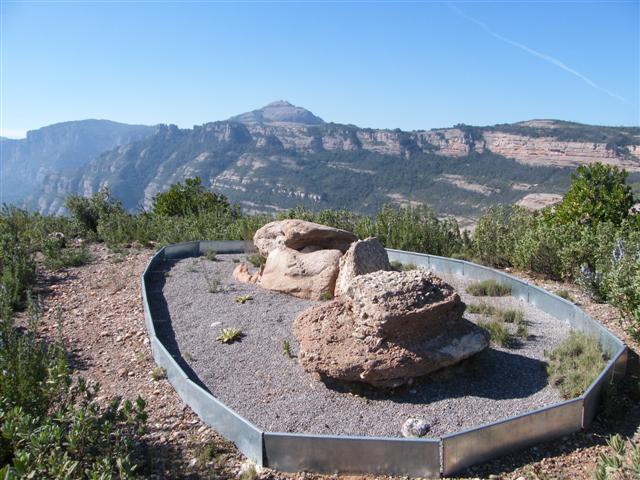
Dolmen de Roca Sareny
DatedEst. 4000–3000 BCE
Photo Catalaalatac · CC BY-SA 4.0Source file on Wikimedia Commons

Overview
About this site
What the sources say
Roca Sareny, escrit també a vegades Roca Sereny, és un turó situat al vessant nord del massís de Sant Llorenç del Munt. El cim és allargassat i forma una carena rocosa de pocs metres d'amplada i de gairebé uns 300 metres de llargada que discorre de sud-oest a nord-est. Té una alçada d'uns 800 m i el punt més alt té una elevació de 804,4 m. La carena marca el límit municipal i comarcal entre Mura (Bages), al vessant oest, i Sant Llorenç Savall (Vallès Occidental), al vessant est.
És dins del límit del Parc Natural de Sant Llorenç del Munt i l'Obac, creat el 1972. Des del 2000 també forma part de l'Inventari d'espais d'interès geològic de Catalunya inventariat com espai d'interès geològic en el conjunt de la geozona Sant Llorenç del Munt i l'Obac, la qual forma part del parc natural majoritàriament.
El 13 d'agost de 1970 resultà afectat per l'incendi de la Muntada. Està inclòs al repte dels «100 Cims» de la Federació d'Entitats Excursionistes de Catalunya.
Article in CatalanRead on Wikipedia9 min readCC BY-SA 4.0
Where it sits in time
The site's dated range, placed against world reference points.
The scale is logarithmic: each step to the left is about ten times older than the last.
The full article
Dolmen de Roca Sareny: the whole story
In briefSources for this section
- Wikipedia (Catalan): Roca SarenyCC BY-SA 4.0
Sources for this section
- Wikipedia (Catalan): Roca SarenyCC BY-SA 4.0
The Dolmen de Roca Sareny stands on a spur on the south side of Roca Sareny, a hill in the municipality of Sant Llorenç Savall, Spain. It lies at an altitude of 760 m and a little over 100 metres from the hilltop. The site forms part of the wider landscape of the Serra de Sant Llorenç del Munt, whose geology is linked to sediments laid down in a vanished inland sea.
The tomb is a megalithic burial chamber built from stone blocks. Its polygonal chamber was formed by three slabs, two of conglomerate and one of sandstone, forming the head and east side, while medium-sized blocks closed the rest of the perimeter. A conglomerate block formed the roof. The funerary space measures 1.5 m long, 60 cm wide and 50 cm high, and is oriented from south-east to north-west with the head at the north-west.
The chamber is dated to the Eneolithic or Early Bronze Age, 2200 aC – 1500 aC, and is the first megalithic structure found in the vall del Ripoll. The tomb was reused on several occasions, and remains of at least six individuals were found with funerary goods, including pottery fragments, polished stone tools, a small flint blade and two perforated triangular bone buttons. Excavation and consolidation work took place in 2006 and 2007, and the monument now sits in a small artificial gravel-covered mound.
Spain has a great many megalithic tombs, and the Atlas's Spanish dolmens run from Andalusia in the south to Galicia in the north-west. The finest are at Antequera in Andalusia, where the Dolmen of Menga, dated to about 3750 to 3650 BCE, is among the largest ancient megalithic structures in Europe. The Dolmen de Roca Sareny is listed in the Cultural Heritage Map of the Diputació de Barcelona, though it has no legal protection.
No English Wikipedia article exists for it; the full text below is the Catalan article "Roca Sareny", shown in the original language.
Summary in EnglishSources for this section
- Wikipedia (Catalan): Roca SarenyCC BY-SA 4.0
Sources for this section
- Wikipedia (Catalan): Roca SarenyCC BY-SA 4.0
Dolmen de Roca Sareny is a dolmen in Sant Llorenç Savall, Spain. A typological estimate: 4000 BCE to 3000 BCE. Elevation: 760 m. No English Wikipedia article exists for it; the full text below is the Catalan article "Roca Sareny", shown in the original language.
ToponímiaSources for this section
- Wikipedia (Catalan): Roca SarenyCC BY-SA 4.0
Sources for this section
- Wikipedia (Catalan): Roca SarenyCC BY-SA 4.0
L'origen del nom de Roca Sareny ve del mot areny, probablement del llatí vulgar ARENĔUS ('arenós'), derivat d'ARĒNA ('arena'), o potser haplologia d'un antic areneny, derivat d'arena amb el sufix -eny, de rendiment reduït. Els arenys és com popularment es coneixien les zones on hi havia abundància de gresos, un tipus de roca sedimentària present a Sant Llorenç del Munt.
GeologiaSources for this section
- Wikipedia (Catalan): Roca SarenyCC BY-SA 4.0
Sources for this section
- Wikipedia (Catalan): Roca SarenyCC BY-SA 4.0
La formació de Roca Sareny va intrínsecament lligada a la formació del massís de Sant Llorenç del Munt. L'origen del massís s'inicià a l'Ipresià, el primer estatge geològic de l'Eocè, fa uns 55,8 ± 0,2 milions d'anys, i que acabà fa 48,6 ± 0,2 milions d'anys. Llavors, un riu cabalós desembocava a un delta on avui se situa aquest massís, que era a una línia costanera d'un mar interior desaparegut, abocant-hi sediments com ara còdols, roques, sorres, argiles, etc.
Posteriorment, el moviment tectònic de plaques va fer desaparèixer aquell mar interior, i el delta que havia creat el riu s'aixecà fins a esdevenir la forma primitiva del massís de Sant Llorenç del Munt, el qual s'anà modelant a causa dels agents atmosfèrics.
Roca Sareny presenta diversos estrats de conglomerat i gresos vermells intercalats.
SituacióSources for this section
- Wikipedia (Catalan): Roca SarenyCC BY-SA 4.0
Sources for this section
- Wikipedia (Catalan): Roca SarenyCC BY-SA 4.0
Roca Sareny forma part d'un dels contraforts del nord-est de la serra dels Emprius (883,3 m), al qual s'uneix al cap d'uns 550 metres a través de l'Era Ventosa (736,2 m) i el coll de Pregona (743,5 m), i des d'on surt la serra de les Garses en direcció nord. És un dels límits naturals de la vall d'Horta, al seu nord-oest. Des de Roca Sareny i en sentit nord, la carena va perdent alçada progressivament fins al coll de la Casilla (644,8 m), lloc per on passa la carretera B-124, que va de Sabadell a Calders.
En direcció est des de Roca Sareny i passant pel coll de la Costa (673,5 m) s'uneix a la carena del castell de Pera, on hi ha les restes del castell de Pera (740,6 m), d'estil romànic. Seguint en sentit sud-est i passant pel coll d'Agramunt (654 m) la carena va perdent alçada progressivament i passa pel turó de Baiarols (696,1 m) i Puig Cornador (586,5 m), ambdós a l'oest de Sant Llorenç Savall.
La carena de Roca Sareny fa de divisòria de les conques hidrogràfiques del Llobregat i del Besòs. Al vessant nord-oest, diversos torrents baixen fins a descarregar al torrent del Soler, el qual desemboca a la riera de les Refardes, tributària de la riera de Talamanca, la qual s'aboca a la riera de Mura i finalment al riu Llobregat. A la banda sud-est, hi ha el torrent de Pregona i el torrent del Romeu, que són tributaris de la riera d'Horta, a la vall d'Horta, la qual desemboca al riu Ripoll, afluent del Besòs.
Al peu de Roca Sareny, al sud, hi ha les masies de Pregona i del Romeu, i al sud-est hi ha la masia d'Agramunt. Les tres masies es troben a la capçalera de la vall d'Horta. Roca Sareny és a 2,4 km del cim del Montcau (1.056 m) i a 5,9 km del cim de la Mola (1.103,2 m), els dos cims més alts del massís de Sant Llorenç del Munt.
JacimentsSources for this section
- Wikipedia (Catalan): Roca SarenyCC BY-SA 4.0
Sources for this section
- Wikipedia (Catalan): Roca SarenyCC BY-SA 4.0
Dolmen de Roca Sareny
El dolmen de Roca Sareny és un dolmen situat a un contrafort del vessant sud de Roca Sareny, al municipi de Sant Llorenç Savall. Es troba a una alçada de 760 m i a una distància de poc més de 100 metres del cim del turó. Es tracta d'un sepulcre megalític en blocs consistent en una caixa de forma rectangular datada del període Eneolític al Bronze Antic (2200 aC – 1500 aC) i és la primera construcció megalítica trobada a la vall del Ripoll. Es creu que hi hagué un poblat permanent a la rodalia del dolmen, al marge del Ripoll o a la mateixa vall d'Horta, tal com indica el fet que la tomba es reutilitzés en diverses ocasions. Gràcies a les restes que s'hi trobaren resulta evident que existia una certa manufactura d'objectes de ceràmica, d'eines de pedra polida i de determinats elements ornamentals que devien estar vinculats a alguna xarxa comercial amb els poblats veïns.
Les lloses i blocs que formaven la cambra sepulcral s'assentaven en un petit encaix en el terreny, subjectades amb blocs i còdols de mida mitjana i petita, disposats a la banda externa a la estructura. Té una planta poligonal, construïda per tres lloses (dues de conglomerat i una de gres) que configuraven la capçalera i el lateral est. La resta del perímetre arquitectònic quedava tancat per blocs de pedra de mida mitjana. La coberta la formava un bloc de conglomerat. L'espai funerari té unes dimensions d'1,5 m de llargada, 60 cm d'amplada i 50 cm d'alçada, i està orientat de sud-est a nord-oest, amb la capçalera al nord-oest.
Fou localitzat casualment per uns excursionistes de la Unió Excursionista de Sabadell l'estiu del 2005 en haver quedat al descobert arran de l'incendi forestal de Sant Llorenç Savall que hi hagué l'agost del 2003. La troballa fou comunicada a l'Ajuntament de Sant Llorenç Savall i corroborada posteriorment per especialistes. La tardor del 2005 s'hi va fer una campanya arqueològica i entre el 2006 i el 2007 Atics SL va fer-hi una intervenció promoguda pel Servei d'Arqueologia de la Generalitat de Catalunya. Primer, l'abril del 2006 s'hi va duu a terme una intervenció d'urgència a càrrec de Roser Pou Calvet i el 2007 s'hi efectuaren unes obres d'adequació i consolidació a càrrec de Cesc Busquets i Maria Cardenal. En el moment de la descoberta estava inviolat però malmès per la intempèrie i s'hi trobaren restes d'almenys sis individus amb aixovar funerari, a més d'una petita làmina de sílex, dos botons triangulars d'os en perforació i diversos fragments de ceràmica. Després de la intervenció arqueològica s'emmarcà amb unes tanques metàl·liques i actualment està situat a un petit túmul artificial reomplert de grava.
Està inventariat com a element de patrimoni immoble al Mapa de Patrimoni Cultural de la Diputació de Barcelona, tot i que no té cap protecció legal.
La Costa
La Costa, o els Corralots d'Agramunt, són les restes d'un habitatge de l'edat mitjana construït aprofitant la bauma obrada de la Costa, o dels Corralots d'Agramunt, situada a un cingle del vessant de llevant de Roca Sareny. Es troba a sota la pista forestal que mena al dolmen de Roca Sareny i al nord-oest de la masia d'Agramunt.
Les restes consisteixen en un mur de pedra que tanca la bauma, amb un rengle d'espitlleres a la part inferior que demostren que antigament hi hagué un altre nivell del terra. L'espai interior és d'uns 13 metres de llargada i uns 5 metres d'amplada. Als voltants hi ha teules trencades i altres restes d'obra. A prop, hi ha dos forns de calç, els quals podrien haver estat fets com a modus vivendi de la casa-bauma. Pel mig del cingle, quan plou, s'hi forma l'inici d'una torrentera, que antigament deuria proveir mínimament d'aigua. La utilització d'aquesta bauma com a habitatge està documentada per primera vegada l'any 1207, i sembla que al segle XIV, arran de la Pesta Negra, va quedar deshabitada. Des d'aleshores només ha estat ocupada molt ocasionalment com a refugi, aixopluc, corral de bestiar o amagatall en temps de guerres.
Durant l'edat mitjana, la Costa pertanyia al monestir de Sant Llorenç del Munt i el castell de Pera en un domini compartit, una solució de compromís habitual a les zones de contacte entre poders feudals. Més tard, un cop la Costa ja era un mas rònec, va incorporar-se al mas Permanyer, després anomenat Can Brossa, situat a la part alta de la vall d'Horta.
El gran incendi forestal de Sant Llorenç del Munt que hi hagué l'agost del 2003 va cremar l'entorn deixant l'estructura més feble i al descobert, ja que fins llavors era protegida per arbres i vegetació. Actualment el mur que en resta està força inclinat i té perill d'esfondrar-se.
Vegeu tambéSources for this section
- Wikipedia (Catalan): Roca SarenyCC BY-SA 4.0
Sources for this section
- Wikipedia (Catalan): Roca SarenyCC BY-SA 4.0
Els Emprius
Castell de Pera
El Montcau
Enllaços externsSources for this section
- Wikipedia (Catalan): Roca SarenyCC BY-SA 4.0
Sources for this section
- Wikipedia (Catalan): Roca SarenyCC BY-SA 4.0
Roca Sareny al mapa de l'Institut Cartogràfic i Geològic de Catalunya
Mapa de Sant Llorenç del Munt i l'Obac Arxivat 2021-01-20 a Wayback Machine.
Vista 360° des de Roca Sareny (Sant Llorenç de Munt) a YouTube
How this page was madeSources for this section
- Wikipedia (Catalan): Roca SarenyCC BY-SA 4.0
Sources for this section
- Wikipedia (Catalan): Roca SarenyCC BY-SA 4.0
The summary at the top of this page was written by MiniMax-M3 (2026-11-07) from the cited Wikipedia article “Roca Sareny”, translated from Catalan. The numbers in it were checked automatically against the source text. The rest of the page is the article itself, the structured records and computed distances.
Tradition and region
About this kind of monument
Dolmens of Andalusia, Extremadura and Galicia
Spain has a great many megalithic tombs, and the Atlas's Spanish dolmens run from Andalusia in the south to Galicia in the north-west. The finest are at Antequera in Andalusia, where the Dolmen of Menga, dated to about 3750 to 3650 BCE, is among the largest ancient megalithic structures in Europe. It is 27.5 metres long, 6 metres wide and 3.5 metres high, built with thirty-two megaliths, the largest weighing about 180 tonnes. After the chamber was finished it was covered with soil and built up into the hill seen today; when it was opened in the nineteenth century archaeologists found the skeletons of several hundred people. The Dolmen of Viera stands 70 metres away, and the tholos of El Romeral lies about 4 kilometres off; the three were inscribed as the Antequera Dolmens Site, a UNESCO World Heritage Site, in 2016.
In the south-west, the Dolmen de Soto at Trigueros in Huelva province is a Neolithic tomb estimated to date between 3000 and 2500 BCE, one of about 200 Neolithic burial sites in the province. It was found in 1922 when its owner, Armando de Soto Morillas, wanted to build a house; the German archaeologist Hugo Obermaier found eight bodies in a fetal position with artefacts, and its engraved and painted uprights have been studied more recently.
In Galicia and Portugal a dolmen is an anta, and in Catalan-speaking areas dolmens have folk names such as cova (cave), caixa (crate or coffin), taula (table) and arca (chest). These names are tradition: they record what people made of the monuments, not what they were built for.
When visiting Menga, look at the great capstones from inside the corridor, and at the way the mound was built up over the chamber.
Paraphrased from Wikipedia: Dolmen of Menga, Wikipedia: Dolmen of Viera, Wikipedia: Antequera Dolmens Site, Wikipedia: Dolmen de Soto, Wikipedia: Dolmen · CC BY-SA 4.0
From the article
Dated moments in the story
- 1207
La utilització d'aquesta bauma com a habitatge està documentada per primera vegada l'any 1207, i sembla que al segle XIV, arran de la Pesta Negra, va quedar deshabitada.
Source - 1500
Es tracta d'un sepulcre megalític en blocs consistent en una caixa de forma rectangular datada del període Eneolític al Bronze Antic (2200 aC – 1500 aC) i és la primera construcció megalítica trobada a la vall del Ripoll.
Source - 1970
El 13 d'agost de 1970 resultà afectat per l'incendi de la Muntada.
Source - 1972
És dins del límit del Parc Natural de Sant Llorenç del Munt i l'Obac, creat el 1972. Des del 2000 també forma part de l'Inventari d'espais d'interès geològic de Catalunya inventariat com espai d'interès geològic en el conjunt de la geozona Sant Llorenç del Munt i l'Obac, la qual forma part del parc natural...
Source - 2003
El gran incendi forestal de Sant Llorenç del Munt que hi hagué l'agost del 2003 va cremar l'entorn deixant l'estructura més feble i al descobert, ja que fins llavors era protegida per arbres i vegetació.
Source - 2005
Fou localitzat casualment per uns excursionistes de la Unió Excursionista de Sabadell l'estiu del 2005 en haver quedat al descobert arran de l'incendi forestal de Sant Llorenç Savall que hi hagué l'agost del 2003. La troballa fou comunicada a l'Ajuntament de Sant Llorenç Savall i corroborada posteriorment per...
Source - 2005
La tardor del 2005 s'hi va fer una campanya arqueològica i entre el 2006 i el 2007 Atics SL va fer-hi una intervenció promoguda pel Servei d'Arqueologia de la Generalitat de Catalunya.
Source - 2006
Primer, l'abril del 2006 s'hi va duu a terme una intervenció d'urgència a càrrec de Roser Pou Calvet i el 2007 s'hi efectuaren unes obres d'adequació i consolidació a càrrec de Cesc Busquets i Maria Cardenal.
Source - 2021
Roca Sareny al mapa de l'Institut Cartogràfic i Geològic de Catalunya Mapa de Sant Llorenç del Munt i l'Obac Arxivat 2021-01-20 a Wayback Machine.
Source
See it in 3D
An interpretive reconstruction of the monument, standing on the real ground at its exact point, under the sun for that place and season. Drag to look around it.
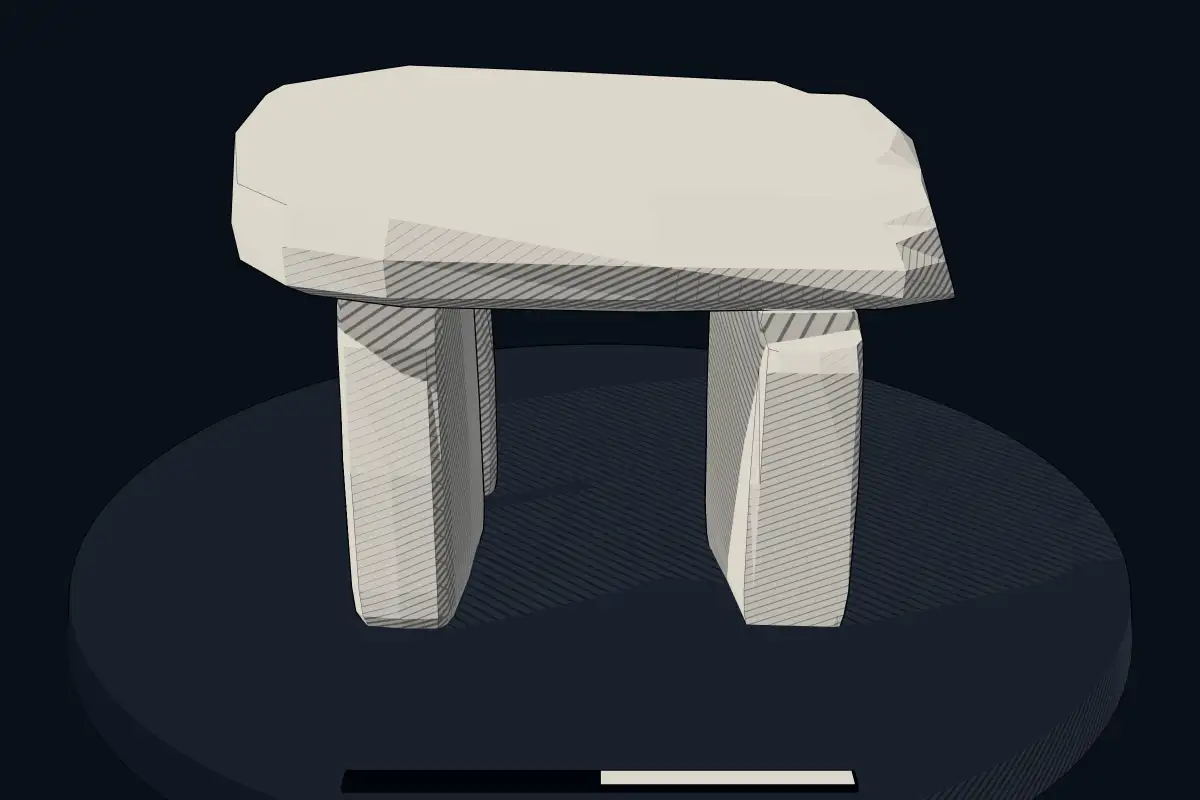
The reconstruction is ours, not a survey: it shows what a monument of this type looks like, at the size the record gives for this one.
Photographs
1 photograph, each with its author and licence
Lore
Evidence & Lore
What the sources actually support — and, kept apart, what has been claimed.
What the evidence supports
Dates
Est. 4000–3000 BCEHow this date was established: Type comparisonTypical range for dolmens in Spain; this site has not been dated itself. Most dolmens date from the Late Neolithic period (4000-3000 BCE); the Dolmen of Menga in Andalusia dates to about 3750-3650 BCE.Source for this date
Where it stands
Spain
The pin marks the monument itself — its exact point.
- Coordinates
- 41°41′37″ N, 2°01′06″ EFor a GPS or map app: 41.69365, 2.01844
Access is as our sources describe it; we have not visited the site to check.
Nearby
The closest sites in the Atlas, by straight line.
- Menhir (standing stone)Tomba del Moro2800–1800 BCE
 Dolmen de Trullars4000–3000 BCE
- DolmenDolmen de la Clusella4000–3000 BCE
- DolmenDolmen del Trompo4000–3000 BCE
 Dolmen del Gavatx4000–3000 BCE
- DolmenDolmen del Mas Clamí4000–3000 BCE
 Dolmen de Serra Cavallera4000–3000 BCE
- Menhir (standing stone)Pedra de les Creus2800–1800 BCE


Sources
Every record behind this page, with the link it came from.
2 sources behind this page
- 01Wikidata Q102018494wikidata.org
- 02Source for this dateen.wikipedia.org
Image files
- Dolmen de Roca Sareny.jpgCatalaalatacCC BY-SA 4.0
Report a correctionWrong date, name, photograph or source? Tell us and it will be put right.
Around this place
The ten nearest sites, by compass
Credit
Text, licence and sources
Text from the Wikipedia article "Roca Sareny" (Catalan), licensed CC BY-SA 4.0; authors are listed in the page history. Reused under CC BY-SA 4.0. Read on Wikipedia · Edit history and authors
- Wikipedia (Catalan): Roca SarenyCC BY-SA 4.0
- Wikidata Q102018494CC0