

Overview
About this site
What the sources say
Die Speckseite ist ein vorgeschichtlicher Menhir in Aschersleben im Salzlandkreis in Sachsen-Anhalt.
Article in GermanRead on Wikipedia4 min readCC BY-SA 4.0
Where it sits in time
The site's dated range, placed against world reference points.
The scale is logarithmic: each step to the left is about ten times older than the last.
The full article
Speckseite: the whole story
In briefSources for this section
- Wikipedia (German): Speckseite (Aschersleben)CC BY-SA 4.0
Sources for this section
- Wikipedia (German): Speckseite (Aschersleben)CC BY-SA 4.0
The Speckseite is a prehistoric menhir in Aschersleben in Salzlandkreis in Sachsen-Anhalt, Germany. It stands in the southeast of the town, immediately south of Schierstedter Straße, about 100 m east of the railway crossing. The stone was set on a natural rise within a man-made burial mound, with the menhir crowning the mound.
The Speckseite is made of Braunkohlenquarzit. It measures 190 cm high, although only 90 cm rises above the ground, and is 190 cm wide and 20 cm deep. It is oriented roughly north to south and shaped like an irregular slab. Numerous nail holes appear on its broad faces, especially the western one, although most were recorded on the south side in the 1950s.
The stone was toppled and re-erected in 1575 and 1720. Archaeological excavations in 1885 and 1932 found that it stood directly over a stone-packed grave. Because the grave contained no grave goods, it could only be dated generally to the Late Neolithic or Early Bronze Age; a typological estimate places the menhir between 2800 BCE and 1800 BCE. Nearby burials belonged to the Middle Ages.
The name is said to refer both to the stone’s shape and its shiny surface. A local legend says that nails were driven into it to calm pagan gods in response to the belief that stones softened during thunderstorms. In later medieval practice, travelling journeymen were made to hammer nails into the stone without bending them. Medieval courts were also held here, and finds around the stone span many periods from the Bandkeramik to the Middle Ages.
Summary in EnglishSources for this section
- Wikipedia (German): Speckseite (Aschersleben)CC BY-SA 4.0
Sources for this section
- Wikipedia (German): Speckseite (Aschersleben)CC BY-SA 4.0
Speckseite is a menhir (standing stone) in Aschersleben, Germany. Wikidata describes it as: menhir in Aschersleben, Germany. A typological estimate: 2800 BCE to 1800 BCE. No English Wikipedia article exists for it; the full text below is the German article "Speckseite (Aschersleben)", shown in the original language.
Lage und BeschreibungSources for this section
- Wikipedia (German): Speckseite (Aschersleben)CC BY-SA 4.0
Sources for this section
- Wikipedia (German): Speckseite (Aschersleben)CC BY-SA 4.0
Der Stein befindet sich im Südosten von Aschersleben, unmittelbar südlich der Schierstedter Straße, etwa 100 m östlich des Bahnübergangs. Er steht dort auf einer natürlichen Anhöhe, auf der ein künstlicher Grabhügel errichtet wurde, dem der Menhir als Bekrönung diente. Der mehrfach umgekippte Stein wurde 1575 und 1720 wieder aufgerichtet. 1885 und 1932 fanden archäologische Grabungen statt. Dabei wurde festgestellt, dass er direkt auf einem Steinpackungsgrab stand. Da es keine Beigaben enthielt, konnte es nur allgemein ins Endneolithikum oder in die frühe Bronzezeit datiert werden. Weitere Gräber im Umfeld der Speckseite stammten aus dem Mittelalter.
Der Menhir besteht aus Braunkohlenquarzit. Seine Höhe beträgt 190 cm (hiervon ragen nur 90 cm aus der Erde), die Breite 190 cm und die Tiefe 20 cm. Er ist etwa nord-südlich orientiert, hat die Form einer unregelmäßigen Platte und weist an den Breitseiten, vor allem an der westlichen, zahlreiche Nägel auf. Möglicherweise wurde der Stein in jüngerer Zeit gedreht, da Waldtraut Schrickel in den 1950er Jahren die meisten Nägel auf der Südseite verortete.
Funde aus der Umgebung des Steins stammen aus der Bandkeramik, der Baalberger Kultur, der Bernburger Kultur, der Schnurkeramikkultur, der Glockenbecherkultur, der Aunjetitzer Kultur, der Vollbronzezeit, der La-Tène-Zeit und aus dem Mittelalter.
Der Name des Steins soll sowohl auf seine Form als auch auf seine glänzende Oberfläche zurückgehen. Im Mittelalter wurden hier Gaugerichte abgehalten.
Der Menhir in regionalen SagenSources for this section
- Wikipedia (German): Speckseite (Aschersleben)CC BY-SA 4.0
Sources for this section
- Wikipedia (German): Speckseite (Aschersleben)CC BY-SA 4.0
Um die Speckseite rankt sich eine Sage, die mit dem einst verbreiteten Aberglauben zusammenhängt, Steine würden bei Gewitter weich werden. Zur Besänftigung der heidnischen Götter sollen dann Nägel in den Stein getrieben worden sein. Dieser Brauch wurde in abgewandelter Form bis ins Mittelalter praktiziert: Wandernde Gesellen sollten hier ihre Geschicklichkeit beweisen, indem sie Nägel in den Stein trieben, ohne diese zu verbiegen. Allmählich uferte dieser Brauch allerdings aus und junge Fuhrknechte und Rosstreiber wurden genötigt, ihr Geschick zu beweisen. Gelang es ihnen nicht, wurden sie verprügelt und mussten das Nageln solange wiederholen, bis es ihnen gelang oder sie sich freikauften. Eine Variante dieser Sage berichtet, dass zwei Gesellen von einer Horde Raufbolde festgehalten und genötigt wurden, einen Nagel in den Stein zu schlagen, ohne dass er sich verbiege. Sollten sie versagen, sei ihr Leben verwirkt. Die beiden Gesellen beteten zu Gott, worauf sie nicht nur ihre Probe bestanden, sondern auch noch ungeheure Kräfte bekamen und somit die Raufbolde in die Flucht schlagen konnten.
How this page was madeSources for this section
- Wikipedia (German): Speckseite (Aschersleben)CC BY-SA 4.0
Sources for this section
- Wikipedia (German): Speckseite (Aschersleben)CC BY-SA 4.0
The summary at the top of this page was written by MiniMax-M3 (2026-11-08) from the cited Wikipedia article “Speckseite (Aschersleben)”, translated from German. The numbers in it were checked automatically against the source text. The rest of the page is the article itself, the structured records and computed distances.
Tradition and region
About this kind of monument
Central and southern European menhirs
Outside the Atlantic fringe, menhirs also occur across central and southern Europe. In the Czech Republic there are about 40 real menhirs and dozens of stones that could also be menhirs, and others have been erected recently. The largest real menhir is Kamenný pastýř, the "stony shepherd", near Klobuky, 3.3 metres high; the Czech menhirs are probably the last outcrop of a tradition that ran across northern Germany. Some of the Czech stones in the Atlas may be natural boulders.
Italy has its most famous menhirs in Sardinia, where at least 332 standing stones can be seen. They include elaborate "statue-menhirs" that show a human face at the top and gendered symbols on the flat front; over a hundred of this standardised type have been found, mostly around the village of Laconi. In the Sardinian language they are called perdas fittas or perdas lungas. In Switzerland, in the canton of Vaud, several menhirs form linear patterns at Clendy in Yverdon-les-Bains, and date back to the third millennium BCE.
A statue menhir is a carved standing stone of the later European Neolithic, in which a slab or pillar has a stylised human figure cut into it, sometimes with hints of clothing or weapons. They are most commonly found in southern and western France, Catalonia, Corsica, Sardinia, Italy and the Alps.
Menhirs are usually difficult to date, and those without excavation can only be given a broad range. A stone's present position is not always its original one.
When visiting, check whether a stone stands in its original position and look for signs of shaping.
Paraphrased from Wikipedia: Menhir, Wikipedia: List of menhirs, Wikipedia: Statue menhir · CC BY-SA 4.0
See it in 3D
An interpretive reconstruction of the monument, standing on the real ground at its exact point, under the sun for that place and season. Drag to look around it.
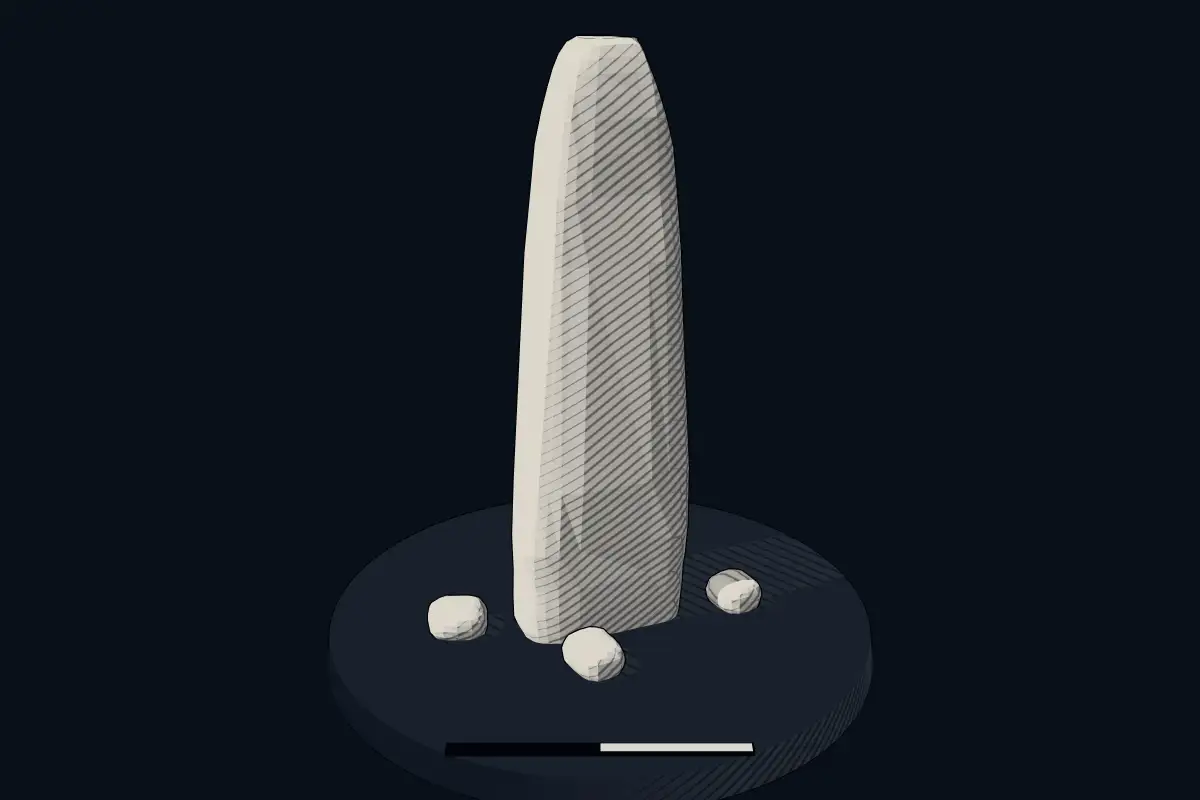
The reconstruction is ours, not a survey: it shows what a monument of this type looks like, at the size the record gives for this one.
Photographs
4 photographs, each with its author and licence
More photographs


Lore
Evidence & Lore
What the sources actually support — and, kept apart, what has been claimed.
What the evidence supports
Dates
Est. 2800–1800 BCEHow this date was established: Type comparisonTypical range for menhirs in Germany; this site has not been dated itself. Standing stones are associated with the Beaker people of the European late Neolithic and early Bronze Age c. 2800-1800 BC.Source for this date
Where it stands
Germany
The pin marks the monument itself — its exact point.
- Coordinates
- 51°45′00″ N, 11°28′47″ EFor a GPS or map app: 51.74997, 11.47967
Access is as our sources describe it; we have not visited the site to check.
Nearby
The closest sites in the Atlas, by straight line.
- Megalithic mound (tumulus with integral stones)Grüner Hügel3500–500 BCE
 Blaue Gans2800–1800 BCE
- DolmenGroßsteingräber bei Ermsleben3500–2800 BCE
 Nagelstein von Ermsleben2800–1800 BCE
 Güsten menhir2800–1800 BCE
 Der verworrene Stein2800–1800 BCE
- Megalithic mound (tumulus with integral stones)Stockhof3500–500 BCE
- Menhir (standing stone)Menhir von Strenznaundorf2800–1800 BCE


Sources
Every record behind this page, with the link it came from.
2 sources behind this page
- 01Wikidata Q22693969wikidata.org
- 02Source for this dateen.wikipedia.org
Image files
- Speckseite ASL.JPGIngo DironCC BY-SA 2.0 de
- Aschersleben Speckseite-02.jpgRadler59 ( talk )CC BY-SA 4.0
- Aschersleben Speckseite-01.jpgRadler59 ( talk )CC BY-SA 4.0
- Aschersleben Speckseite-03.jpgRadler59 ( talk )CC BY-SA 4.0
Report a correctionWrong date, name, photograph or source? Tell us and it will be put right.
Lore, kept apart
Legends and claims
These are stories and claims reported by the sources. They are not evidence, and they never stand in for the dating above.
- Tradition
Um die Speckseite rankt sich eine Sage, die mit dem einst verbreiteten Aberglauben zusammenhängt, Steine würden bei Gewitter weich werden.
Um die Speckseite rankt sich eine Sage, die mit dem einst verbreiteten Aberglauben zusammenhängt, Steine würden bei Gewitter weich werden. Zur Besänftigung der heidnischen Götter sollen dann Nägel in den Stein getrieben worden sein. Dieser Brauch wurde in abgewandelter Form bis ins Mittelalter praktiziert: Wandernde Gesellen sollten hier ihre Geschicklichkeit beweisen, indem sie Nägel in den Stein trieben, ohne diese zu verbiegen. Allmählich uferte dieser Brauch allerdings aus und junge Fuhrknechte und Rosstreiber wurden genötigt, ihr Geschick zu beweisen. Gelang es ihnen nicht, wurden sie verprügelt und mussten das Nageln solange wiederholen, bis es ihnen gelang oder sie sich freikauften. Eine Variante dieser Sage berichtet, dass zwei Gesellen von einer Horde Raufbolde festgehalten und genötigt wurden, einen Nagel in den Stein zu schlagen, ohne dass er sich verbiege. Sollten sie versagen, sei ihr Leben verwirkt. Die beiden Gesellen beteten zu Gott, worauf sie nicht nur ihre Probe bestanden, sondern auch noch ungeheure Kräfte bekamen und somit die Raufbolde in die Flucht schlagen konnten.
Source - Tradition
The name is said to refer both to the stone’s shape and its shiny surface.
The name is said to refer both to the stone’s shape and its shiny surface. A local legend says that nails were driven into it to calm pagan gods in response to the belief that stones softened during thunderstorms. In later medieval practice, travelling journeymen were made to hammer nails into the stone without bending them. Medieval courts were also held here, and finds around the stone span many periods from the Bandkeramik to the Middle Ages.
Source
Around this place
The ten nearest sites, by compass
Credit
Text, licence and sources
Text from the Wikipedia article "Speckseite (Aschersleben)" (German), licensed CC BY-SA 4.0; authors are listed in the page history. Reused under CC BY-SA 4.0. Read on Wikipedia · Edit history and authors