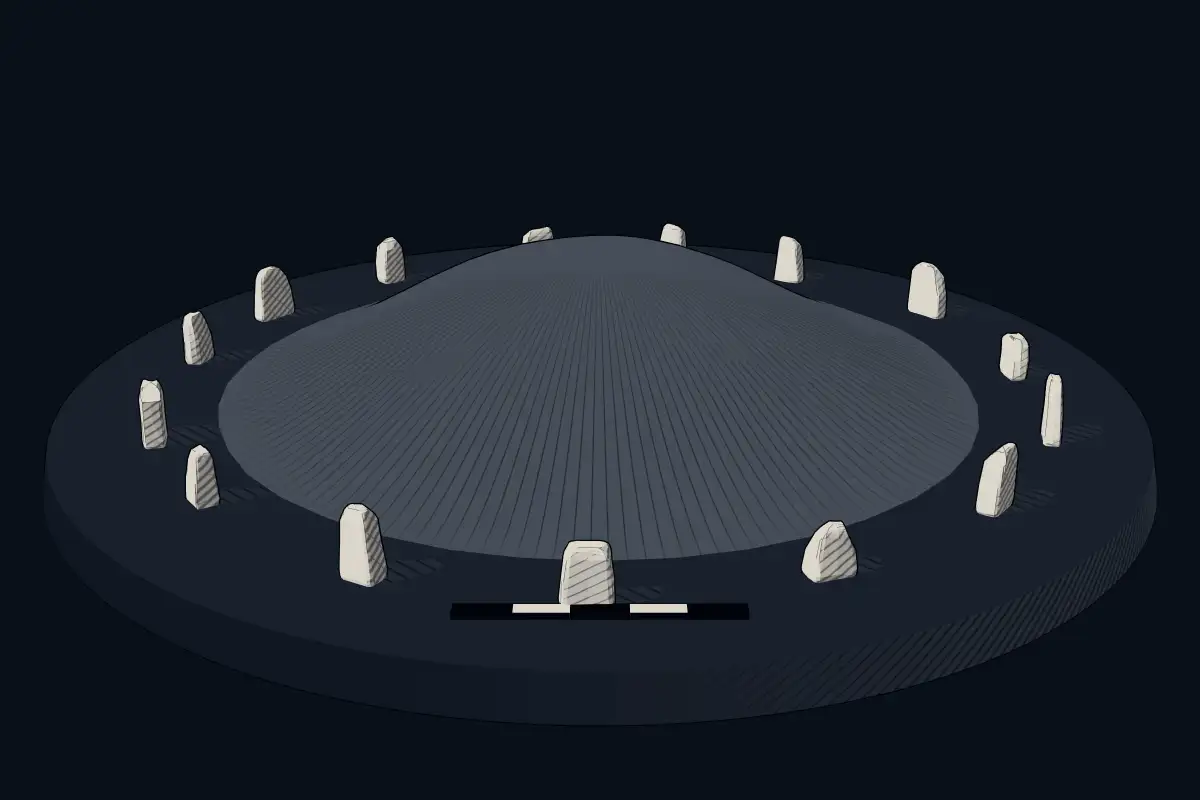
Megalithic mound (tumulus with integral stones)
Stockhof
DatedEst. 3500–500 BCE
No licensed photograph yetWe have no photograph we may publish for this site, so the interpretive 3D view leads instead.
Overview
About this site
What the sources say
Der Stockhof ist ein Grabhügel der spätneolithischen Bernburger Kultur bei Gröna, einem Ortsteil von Bernburg (Saale) im Salzlandkreis, Sachsen-Anhalt. 1884 wurde der Hügel archäologisch untersucht. Hierbei wurde ein zentrales Mauerkammergrab mit mehreren Bestattungen und zahlreichen Beigaben gefunden. Weiterhin wurde in der Hügelschüttung noch eine Nachbestattung aus der Völkerwanderungszeit entdeckt.
Article in GermanRead on Wikipedia5 min readCC BY-SA 4.0
Where it sits in time
The site's dated range, placed against world reference points.
The scale is logarithmic: each step to the left is about ten times older than the last.
The full article
Stockhof: the whole story
In briefSources for this section
- Wikipedia (German): Stockhof (Gröna)CC BY-SA 4.0
Sources for this section
- Wikipedia (German): Stockhof (Gröna)CC BY-SA 4.0
Stockhof is a megalithic burial mound, or tumulus with integral stones, at Gröna, a district of Bernburg (Saale) in Salzlandkreis, Sachsen-Anhalt, Germany. It was built as a grave mound of the late Neolithic Bernburger Kultur. The estimated dating is 3500 BCE to 500 BCE.
The mound is aligned southwest to northeast and originally appears to have been oval. When excavated in 1884 it measured 30 m in length and 7 m in width, although its eastern side had already been heavily ploughed and it was probably wider originally. Excavation and the construction of a power line in the 1960s further changed its appearance, and it is now very flattened.
Excavations took place in 1884 during three days. A central stone-lined chamber grave was found, with only its north and south walls surviving. It contained several adult and child burials, placed in crouched positions in two zones. Among the grave goods were more than 60 ceramic vessels, some flint blades, and numerous perforated canine teeth; 60 teeth were found inside a vessel. The finds were recovered only partly, and most of the pottery went to the Schlossmuseum Bernburg.
A later burial from the Völkerwanderungszeit, dated to the 5th/6th century AD, lay 1.6 m from the southern edge of the mound. The extended skeleton was about 2 m long, with an iron ring, two ceramic vessels, and a three-tier ivory comb. The Stockhof finds helped form the basis for the first definition of a Bernburger ceramic style by Alfred Götze in 1892.
Summary in EnglishSources for this section
- Wikipedia (German): Stockhof (Gröna)CC BY-SA 4.0
Sources for this section
- Wikipedia (German): Stockhof (Gröna)CC BY-SA 4.0
Stockhof is a megalithic mound (tumulus with integral stones) in Bernburg, Germany. A typological estimate: 3500 BCE to 500 BCE. No English Wikipedia article exists for it; the full text below is the German article "Stockhof (Gröna)", shown in the original language.
LageSources for this section
- Wikipedia (German): Stockhof (Gröna)CC BY-SA 4.0
Sources for this section
- Wikipedia (German): Stockhof (Gröna)CC BY-SA 4.0
Der Hügel befindet sich wenige hundert Meter hinter dem östlichen Ortsausgang von Gröna direkt an einer Stromtrasse. Er ist über einen Feldweg erreichbar.
ForschungsgeschichteSources for this section
- Wikipedia (German): Stockhof (Gröna)CC BY-SA 4.0
Sources for this section
- Wikipedia (German): Stockhof (Gröna)CC BY-SA 4.0
Der Stockhof wurde 1884 in nur drei Tagen ausgegraben. Anlass hierfür war eine eintägige Exkursion der Berliner Gesellschaft für Anthropologie, Ethnologie und Urgeschichte unter Leitung von Rudolf Virchow nach Bernburg am 29. Juni. Hierbei wurde der südliche Teil des Hügels untersucht. Der Bernburger Altertumsverein setzte diese Grabungen am 29. September und am 1. Oktober unter der Leitung von Paul Höfer und Otto Merkel fort. Die Keramikgefäße aus dem Stockhof bildeten gemeinsam mit anderen Fundinventaren 1892 die Grundlage für die erstmalige Definition eines Bernburger Keramikstils durch Alfred Götze.
BeschreibungSources for this section
- Wikipedia (German): Stockhof (Gröna)CC BY-SA 4.0
Sources for this section
- Wikipedia (German): Stockhof (Gröna)CC BY-SA 4.0
Der Hügel ist südwest-nordöstlich orientiert und hatte ursprünglich wohl eine ovale Form. Zum Zeitpunkt der Grabung hatte er eine Länge von 30 m und eine Breite von 7 m. Seine östliche Seite war bereits stark angepflügt, sodass davon auszugehen ist, dass der Hügel ursprünglich deutlich breiter war. Die archäologische Untersuchung und der Bau einer Stromtrasse in den 1960er Jahren haben sein Aussehen zusätzlich in Mitleidenschaft gezogen. Die Anlage weist heute insgesamt ein sehr verflachtes Erscheinungsbild auf. Ein auffälliger großer Stein, der aus dem Hügel ragt, gehört nicht zum ursprünglichen Grab, sondern gelangte erst in späterer Zeit hierher. Erhard Schröter sah in ihm einen Menhir. Der Stein hat die Form einer unregelmäßigen Platte und ist eher breit als hoch.
Im Zentrum der Hügelschüttung wurde ein Mauerkammergrab aus geschichteten Steinen festgestellt, von dem nur noch die Nord- und Südwand erhalten waren. Diese Kammer enthielt zahlreiche menschliche Skelette, wobei die genaue Zahl aber nicht ermittelt wurde. Es waren sowohl erwachsene Individuen als auch Kinder vertreten. Die Toten waren in zwei Zonen beigesetzt. Die Skelette lagen in Hockerstellung und waren teils eng ineinander verschlungen. An Grabbeigaben traten über 60 Keramikgefäße, einige Feuerstein-Klingen und zahlreiche durchbohrte Reißzähne von Caniden zutage. Die Caniden-Zähne wurden allerdings nur in der südlichen Zone gefunden. Diese lagen zum Teil direkt bei den Toten, 60 Stück wurden aber auch im Inneren eines Gefäßes gefunden. Ein anderes Gefäß wurde von einem der Toten in der nördlichen Zone in Händen gehalten. Ein anderer Toter hielt eine Feuerstein-Klinge.
Im südlichen Bereich der Hügelschüttung wurde nur 1,6 m vom Rand entfernt am ersten Grabungstag ein menschliches Skelett gefunden, das als Nachbestattung aus der Völkerwanderungszeit (5./6. Jahrhundert n. Chr.) identifiziert werden konnte. Es lag in gestreckter Haltung von Westnordwest nach Ostsüdost. Der Tote hatte eine Körperlänge von 2 m. An Grabbeigaben wurden ein eiserner Ring oberhalb des linken Arms sowie zwei Keramikgefäße und ein Dreilagenkamm aus Elfenbein oberhalb des Schädels gefunden. Als Unterlage für den Toten diente eine Bank aus mehreren Steinplatten.
Südwestlich dieser Nachbestattung lag ein weiteres, nordwest-südöstlich orientiertes Skelett in Hockerstellung, dessen zeitliche Einordnung mangels Beigaben unklar bleibt. Etwa auf halbem Weg zwischen diesen beiden Bestattungen und der zentralen Mauerkammer wurde ein einzelnes Keramikgefäß gefunden, über das aber keine genauere Beschreibung vorliegt. Am dritten Grabungstag wurden schließlich noch an der nördlichen Seite der Mauerkammer kurz unter der Oberfläche des Hügels zwei beigabenlose, nicht orientierte Skelette in gestreckter Lage gefunden.
Die Funde aus dem Stockhof wurden nur unvollständig geborgen. Die Skelette blieben größtenteils vor Ort. Die Beigaben hingegen – vor allem die Gefäße – kamen ins Schlossmuseum Bernburg.
How this page was madeSources for this section
- Wikipedia (German): Stockhof (Gröna)CC BY-SA 4.0
Sources for this section
- Wikipedia (German): Stockhof (Gröna)CC BY-SA 4.0
The summary at the top of this page was written by MiniMax-M3 (2026-11-08) from the cited Wikipedia article “Stockhof (Gröna)”, translated from German. The numbers in it were checked automatically against the source text. The rest of the page is the article itself, the structured records and computed distances.
Tradition and region
About this kind of monument
German Hügelgräber and megalithic mounds
Burial mounds are found across Germany, from the northern plain to the south. Those of the Middle Bronze Age give a whole culture its name: the Tumulus culture (Hügelgräberkultur), which was dominant in Central Europe from about 1600 to 1300 BCE and buried its dead beneath mounds. It descended from the Unetice culture and covered parts of southern Germany, the Czech Republic, Austria, Switzerland, Poland and France. Its society was a warrior society, as the weapons in the graves show. The Late Bronze Age Urnfield culture, which followed it, preferred cremation, and the Hallstatt culture of the Early Iron Age revived the great mound for chieftains.
Hallstatt-period mounds can be spectacular. The Hochdorf grave in Baden-Württemberg, of about 530 BCE, was found in 1968 and excavated in 1978 to 1979. Its mound, originally 6 metres high and about 60 metres across, had been worn down to about 1 metre. Inside lay a man of about fifty on a bronze recliner with eight wheels, wearing a gold-plated torc, with a four-wheeled wagon and drinking horns.
In the north, many mounds are older and belong to the Funnel Beaker culture, whose stone-chambered tombs are described in the articles on northern German megalithic tombs. Here a mound may cover a megalithic chamber, and the Atlas's classification sometimes cannot tell the two apart without a field visit.
Dating usually combines typology, pottery and metalwork and, where timber survives, tree-ring dating. Many mounds have been ploughed down, as Hochdorf shows.
When visiting, look for mounds in groups in woodland, where they survive best, for the hollow of an old central trench, and for kerbs of stone.
Paraphrased from Wikipedia: Tumulus culture, Wikipedia: Hallstatt culture, Wikipedia: Funnel beaker culture, Wikipedia: Tumulus, Wikipedia: Heuneburg, Wikipedia: Hochdorf Chieftain's Grave · CC BY-SA 4.0
From the article
Dated moments in the story
- 1884
1884 wurde der Hügel archäologisch untersucht.
Source - 1884
Der Stockhof wurde 1884 in nur drei Tagen ausgegraben.
Source - 1892
Die Keramikgefäße aus dem Stockhof bildeten gemeinsam mit anderen Fundinventaren 1892 die Grundlage für die erstmalige Definition eines Bernburger Keramikstils durch Alfred Götze.
Source
See it in 3D
An interpretive reconstruction of the monument, standing on the real ground at its exact point, under the sun for that place and season. Drag to look around it.
The reconstruction is ours, not a survey: it shows what a monument of this type looks like, at the size the record gives for this one.
Lore
Evidence & Lore
What the sources actually support — and, kept apart, what has been claimed.
What the evidence supports
Dates
Est. 3500–500 BCEHow this date was established: Type comparisonTypical range for megalithic mounds in Germany; this site has not been dated itself. German barrows ( Hugelgraber) run from the Neolithic (construction in central and south-west Germany c. 3500 BC and northern and central Germany c. 3400 BC) to the Late Bronze and Iron Age.Source for this date
Where it stands
Germany
The pin marks the monument itself — its exact point.
- Coordinates
- 51°45′51″ N, 11°42′23″ EFor a GPS or map app: 51.76430, 11.70643
Access is as our sources describe it; we have not visited the site to check.
Nearby
The closest sites in the Atlas, by straight line.


Sources
Every record behind this page, with the link it came from.
2 sources behind this page
- 01Wikidata Q22694068wikidata.org
- 02Source for this dateen.wikipedia.org
Report a correctionWrong date, name, photograph or source? Tell us and it will be put right.
Around this place
The ten nearest sites, by compass
Credit
Text, licence and sources
Text from the Wikipedia article "Stockhof (Gröna)" (German), licensed CC BY-SA 4.0; authors are listed in the page history. Reused under CC BY-SA 4.0. Read on Wikipedia · Edit history and authors
- Wikipedia (German): Stockhof (Gröna)CC BY-SA 4.0
- Wikidata Q22694068CC0