.jpg/1920px-Nagelstein_Markt_(Ermsleben).jpg 1920w)
Nagelstein von Ermsleben
DatedEst. 2800–1800 BCE
Photo Migebert · CC BY-SA 4.0Source file on Wikimedia Commons

Overview
About this site
Overview
The Nagelstein (nail stone) of Ermsleben is a standing stone about 2.3 m high on the market square of Ermsleben, a district of Falkenstein/Harz in the Landkreis Harz, Saxony-Anhalt, Germany. It stands against the west side of the town hall and is a listed monument (Kulturdenkmal).
From its form it is considered originally to have been a menhir. Countless nails have been driven into its sides and flat top, and in the Middle Ages it served in trials by ordeal.
Read on Wikipedia2 min readCC BY-SA 4.0
Where it sits in time
The site's dated range, placed against world reference points.
The scale is logarithmic: each step to the left is about ten times older than the last.
Article
Nagelstein von Ermsleben
DescriptionSources for this section
- Wikipedia (German): Nagelstein von ErmslebenCC BY-SA 4.0
Sources for this section
- Wikipedia (German): Nagelstein von ErmslebenCC BY-SA 4.0
The stone is broken in its lower third and was probably once taller. Over time countless nails were driven into its sides and into its flat upper surface. The catalogue gives a typological estimate of 2800 to 1800 BCE.
Several legends, some of them contradictory, are told about the stone and the metal pins in it.
FolkloreSources for this section
- Wikipedia (German): Nagelstein von ErmslebenCC BY-SA 4.0
Sources for this section
- Wikipedia (German): Nagelstein von ErmslebenCC BY-SA 4.0
Several legends, some of them contradictory, are told about the stone and the metal pins in it. According to one, the stone becomes so soft in rain, especially during thunderstorms, that a nail can be driven into it without effort. The tradition possibly connects the stone with a pre-Christian deity.
A secular explanation, mentioned in historical writings, is that the stone contains cavities filled with clay. The clay softens in rain and allows nails to be driven in at these places. It is regarded as relatively certain that nail stones were used for cultic acts in prehistoric times.
Later historySources for this section
- Wikipedia (German): Nagelstein von ErmslebenCC BY-SA 4.0
Sources for this section
- Wikipedia (German): Nagelstein von ErmslebenCC BY-SA 4.0
In the Middle Ages the stone was used as an aid in trials by ordeal. The accused had to drive a nail into the stone, and if he succeeded he was held to be innocent. Later, courts were held at the stone. The last hearing took place in March 1715, when several people were sentenced to death for murder.
In 1902 the stone was rededicated as a Bismarck monument, after it had been set up at the old castle. The outline of the bronze plaque and its fixing are still visible; the plaque was lost after the end of the Second World War. In the early 1950s the stone was also used for ideological purposes in the GDR, as a Fünfjahrplandenkmal (five-year-plan monument). In 2005 it was set up on the west wall of the town hall and supplied with an information board.
ContextSources for this section
- Wikipedia (German): Nagelstein von ErmslebenCC BY-SA 4.0
Sources for this section
- Wikipedia (German): Nagelstein von ErmslebenCC BY-SA 4.0
Nail stones are found in Saxony (11), in Saxony-Anhalt and Thuringia (at Schnellmannshausen), and in Bavaria (6). A comparable stone stands at Sangerhausen.
Tradition and region
About this kind of monument
Central and southern European menhirs
Outside the Atlantic fringe, menhirs also occur across central and southern Europe. In the Czech Republic there are about 40 real menhirs and dozens of stones that could also be menhirs, and others have been erected recently. The largest real menhir is Kamenný pastýř, the "stony shepherd", near Klobuky, 3.3 metres high; the Czech menhirs are probably the last outcrop of a tradition that ran across northern Germany. Some of the Czech stones in the Atlas may be natural boulders.
Italy has its most famous menhirs in Sardinia, where at least 332 standing stones can be seen. They include elaborate "statue-menhirs" that show a human face at the top and gendered symbols on the flat front; over a hundred of this standardised type have been found, mostly around the village of Laconi. In the Sardinian language they are called perdas fittas or perdas lungas. In Switzerland, in the canton of Vaud, several menhirs form linear patterns at Clendy in Yverdon-les-Bains, and date back to the third millennium BCE.
A statue menhir is a carved standing stone of the later European Neolithic, in which a slab or pillar has a stylised human figure cut into it, sometimes with hints of clothing or weapons. They are most commonly found in southern and western France, Catalonia, Corsica, Sardinia, Italy and the Alps.
Menhirs are usually difficult to date, and those without excavation can only be given a broad range. A stone's present position is not always its original one.
When visiting, check whether a stone stands in its original position and look for signs of shaping.
Paraphrased from Wikipedia: Menhir, Wikipedia: List of menhirs, Wikipedia: Statue menhir · CC BY-SA 4.0
From the article
Dated moments in the story
- 1715
Die letzte Verhandlung fand im März 1715 statt, wobei mehrere Personen wegen Mordes zum Tode verurteilt wurden.
Source - 1902
Im Jahr 1902 widmete man den Nagelstein zu einem Bismarckdenkmal um, nachdem der Stein am alten Schloss aufgestellt worden war.
Source - 2005
Im Jahr 2005 wurde er an der Westwand des Rathauses aufgestellt und mit einer Informationstafel ergänzt.
Source
See it in 3D
An interpretive reconstruction of the monument, standing on the real ground at its exact point, under the sun for that place and season. Drag to look around it.
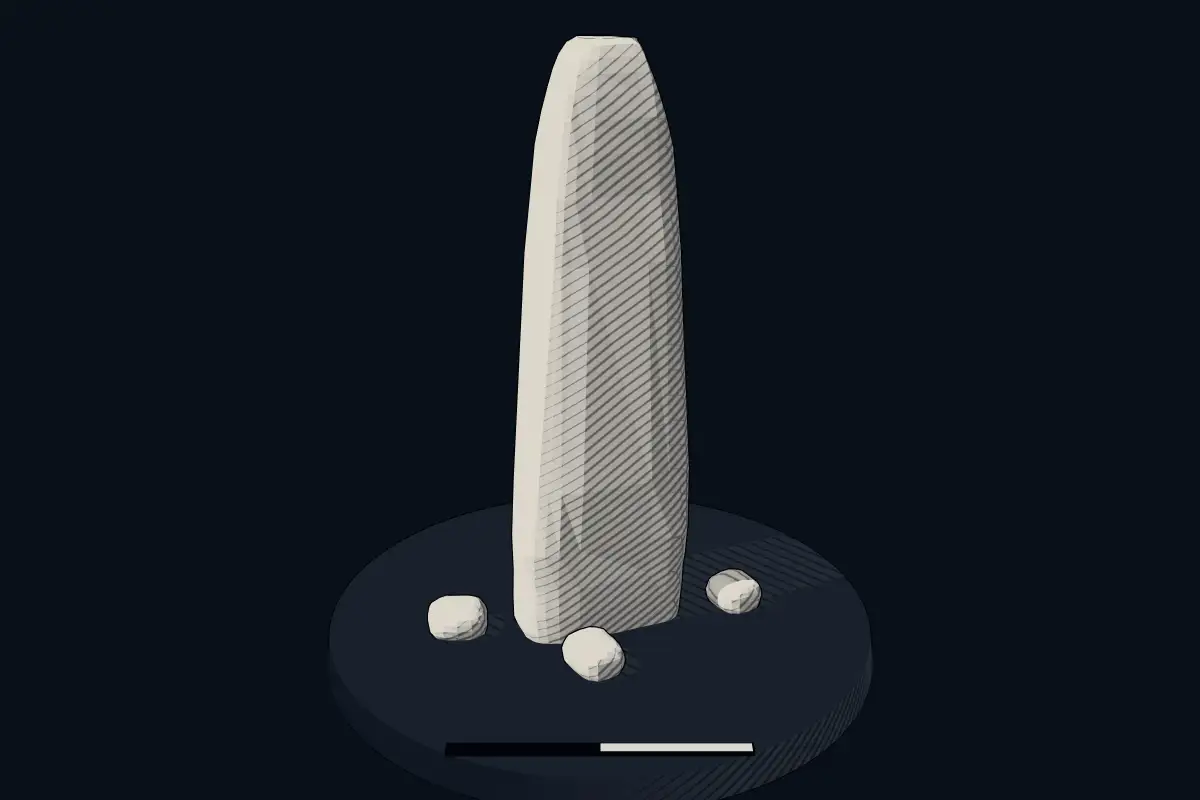
The reconstruction is ours, not a survey: it shows what a monument of this type looks like, at the size the record gives for this one.
Photographs
2 photographs, each with its author and licence
More photographs

Lore
Evidence & Lore
What the sources actually support — and, kept apart, what has been claimed.
What the evidence supports
Dates
Est. 2800–1800 BCEHow this date was established: Type comparisonTypical range for menhirs in Germany; this site has not been dated itself. Standing stones are associated with the Beaker people of the European late Neolithic and early Bronze Age c. 2800-1800 BC.Source for this date
Where it stands
Germany
The pin marks the monument itself — its exact point.
- Coordinates
- 51°43′55″ N, 11°20′40″ EFor a GPS or map app: 51.73188, 11.34431
Access is as our sources describe it; we have not visited the site to check.
Nearby
The closest sites in the Atlas, by straight line.
- DolmenGroßsteingräber bei Ermsleben3500–2800 BCE
 Speckseite2800–1800 BCE
- Megalithic mound (tumulus with integral stones)Grüner Hügel3500–500 BCE
 Blaue Gans2800–1800 BCE
- Menhir (standing stone)Menhir von Quedlinburg2800–1800 BCE
 Der verworrene Stein2800–1800 BCE
- Stone circleSteinkreis im Eselstall3300–2500 BCE
 Güsten menhir2800–1800 BCE


Sources
Every record behind this page, with the link it came from.
2 sources behind this page
- 01Wikidata Q20191084wikidata.org
- 02Source for this dateen.wikipedia.org
Image files
Report a correctionWrong date, name, photograph or source? Tell us and it will be put right.
Lore, kept apart
Legends and claims
These are stories and claims reported by the sources. They are not evidence, and they never stand in for the dating above.
- Tradition
Der etwa 2,3 m hohe Nagelstein von Ermsleben steht auf dem Marktplatz von Ermsleben, einem Ortsteil von Falkenstein/Harz im Landkreis Harz in Sachsen-Anhalt an der Westseite des Rathauses.
Der etwa 2,3 m hohe Nagelstein von Ermsleben steht auf dem Marktplatz von Ermsleben, einem Ortsteil von Falkenstein/Harz im Landkreis Harz in Sachsen-Anhalt an der Westseite des Rathauses. Er ist im unteren Drittel zerbrochen und war einst vermutlich größer. In seine Seiten und den oberen flachen Bereich wurden im Laufe der Zeit unzählige Nägel geschlagen. Nach der Form sollte es sich ursprünglich um einen Menhir handeln. Verschiedene, sich teilweise widersprechende Sagen und Erzählungen ranken sich um den Nagelstein und die in ihm befindlichen Metallstifte. Angeblich wird der Stein bei Regen, vor allem bei Gewitter so weich, dass man in ihn mühelos einen Nagel einschlagen kann. Die Überlieferung stellt eventuell den Bezug zu einer vorchristlichen Gottheit her. Als weltliche Erklärung wird in historischen Schriften erwähnt, dass der Steine Hohlräume habe, welche mit Ton gefüllt seien. Dieser Ton wird bei Regen weich und erlaubt an diesen Stellen das Einschlagen der Nägel. Relativ sicher ist, dass Nagelsteine in vorgeschichtlicher Zeit für kultische Handlungen genutzt wurden. Im Mittelalter diente der Stein als Hilfsmittel für Gottesurteile. Der Beschuldigte musste einen Nagel in den Stein schlagen. Wenn ihm dies gelang, galt er als unschuldig. Später hielt man am Nagelstein Gericht. Die letzte Verhandlung fand im März 1715 statt, wobei mehrere Personen wegen Mordes zum Tode verurteilt wurden. Im Jahr 1902 widmete man den Nagelstein zu einem Bismarckdenkmal um, nachdem der Stein am alten Schloss aufgestellt worden war. Die Konturen der Bronzeplatte und ihre Befestigung sind noch erkennbar. Nach Ende des Zweiten Weltkrieges ging die Tafel verloren. Anfang der 1950er Jahre wurde der Stein in der DDR auch für ideologische Zwecke als „Fünfjahrplandenkmal“ benutzt. Im Jahr 2005 wurde er an der Westwand des Rathauses aufgestellt und mit einer Informationstafel ergänzt. Nagelsteine findet man in Sachsen (11), Sachsen-Anhalt und Thüringen (in Schnellmannshausen), sowie in Bayern (6).
Source
Around this place
The ten nearest sites, by compass
Credit
Text, licence and sources
Adapted from the Wikipedia article "Nagelstein von Ermsleben" (German), licensed CC BY-SA 4.0; authors are listed in the page history. Reused under CC BY-SA 4.0. Read on Wikipedia · Edit history and authors