
Megalithic mound (tumulus with integral stones)The Copper Age
Huthügel
DatedEst. 3500–500 BCE
Photo Aschroet · CC0Source file on Wikimedia Commons

Overview
About this site
Overview
The Huthügel, also called the Häuschenhügel, is a burial mound of the Late Neolithic Corded Ware culture (2800-2200 BCE) near Kalbsrieth in the Kyffhäuserkreis, Thuringia, Germany. It was excavated in 1901 under the archaeologist Armin Möller (1865-1938), and the excavation was published in 1912.
Read on Wikipedia4 min readCC BY-SA 4.0
Where it sits in time
The site's dated range, placed against world reference points.
The scale is logarithmic: each step to the left is about ten times older than the last.
Article
Huthügel
Another burial mound, the Derfflinger Hügel, lies 800 m to the south; it was used for burial over several millennia, including by members of the Corded Ware culture.
SettingSources for this section
- Wikipedia (German): HuthügelCC BY-SA 4.0
Sources for this section
- Wikipedia (German): HuthügelCC BY-SA 4.0
The mound lies 1.3 km east-south-east of Kalbsrieth, on raised ground directly beside a field track. Another burial mound, the Derfflinger Hügel, lies 800 m to the south; it was used for burial over several millennia, including by members of the Corded Ware culture. Further Corded Ware burials have been found in at least five places in the surrounding area, and single finds come from several locations in the parish.
DescriptionSources for this section
- Wikipedia (German): HuthügelCC BY-SA 4.0
Sources for this section
- Wikipedia (German): HuthügelCC BY-SA 4.0
The ground beneath the mound consists of humus mixed with sand and limestone, with a layer of gravel beginning at about 40 cm depth. The mound fill is made of the same material as the surrounding soil, and a darker layer runs between the natural soil and the fill.
In the course of the land consolidation (Separation) of the 19th century the edges of the mound were cut back, except on the south side, so that it now has a roughly square outline 27 m long and 26.15 m wide. The amount of material removed is thought to have been small, and the original diameter of the once round mound probably did not greatly exceed its present dimensions. The mound is now 2.55 m high, and its surface is very uneven. Möller found no larger disturbance, apart from a possible secondary burial and the hut.
ExcavationsSources for this section
- Wikipedia (German): HuthügelCC BY-SA 4.0
Sources for this section
- Wikipedia (German): HuthügelCC BY-SA 4.0
Between July and October 1901 Armin Möller, curator of the Stadtmuseum Weimar, carried out extensive excavations over six weeks at the neighbouring Derfflinger Hügel and examined the Huthügel on the same occasion. Both excavations were published in 1912.
FindsSources for this section
- Wikipedia (German): HuthügelCC BY-SA 4.0
Sources for this section
- Wikipedia (German): HuthügelCC BY-SA 4.0
The original burial lay in the centre of the mound, in an oval pit oriented east-west, cut 55 cm deep into the natural ground with almost vertical walls. There was no stone lining or stone fittings. The dead person lay in a crouched position on the left side, with the head to the west. The skeleton could not be studied in detail because, despite being protected with sacks and earth, it was destroyed during the night after its discovery. The only grave goods found directly with the skeleton were two triangular arrowheads, lying between the knees and the right elbow.
At ground level 4.5 m east of the grave lay a block of carboniferous quartzite 90 cm long, 55 cm wide and 30 cm thick. Directly beneath it was a faceted axe of grey-green serpentine, 17.3 cm long, 5.1 cm wide and 4.3 cm thick. At ground level 3.75 m west of the grave lay a second stone, a sandstone slab 55 cm long and 25 cm thick. Beneath it, in a small pit, stood a cord-decorated beaker 9.3 cm high, with a diameter of 5 cm at the base, 8.4 cm at the belly and 7 cm at the mouth. Next to the beaker was a small piece of iron ochre that crumbled when it was recovered but was kept. Whether these two features are directly connected with the main grave could not be established with certainty, but because they were found at the same level a connection is very probable.
About 50 cm below the top of the mound, above the main grave, a partly preserved cup was found, consisting of the lower part with a strongly marked break between belly and shoulder and the start of a handle. Its diameter is 5.2 cm at the base and 10.6 cm at the widest point. The cup probably belongs to the Early Bronze Age Aunjetitz culture (2300-1550 BCE).
On the north-west side of the mound, at 40 cm depth, Möller identified the remains of the hut that gives the mound its name: some angular limestones, a partly preserved pot and further potsherds. The hut was probably built in the 19th century or earlier. The finds from the mound are kept in the Museum für Ur- und Frühgeschichte Thüringens in Weimar (inventory numbers H 2040-2045).
NameSources for this section
- Wikipedia (German): HuthügelCC BY-SA 4.0
Sources for this section
- Wikipedia (German): HuthügelCC BY-SA 4.0
The name of the mound probably derives from a small hut (Hütte) that a shepherd had built there.
FolkloreSources for this section
- Wikipedia (German): HuthügelCC BY-SA 4.0
Sources for this section
- Wikipedia (German): HuthügelCC BY-SA 4.0
No legends specific to the Huthügel are recorded. Of the neighbouring Derfflinger Hügel, however, it is told that a coach with headless horses drives past on the nearby track, and the same has occasionally been reported of the track that runs past the Huthügel.
Tradition and region
About this kind of monument
German Hügelgräber and megalithic mounds
Burial mounds are found across Germany, from the northern plain to the south. Those of the Middle Bronze Age give a whole culture its name: the Tumulus culture (Hügelgräberkultur), which was dominant in Central Europe from about 1600 to 1300 BCE and buried its dead beneath mounds. It descended from the Unetice culture and covered parts of southern Germany, the Czech Republic, Austria, Switzerland, Poland and France. Its society was a warrior society, as the weapons in the graves show. The Late Bronze Age Urnfield culture, which followed it, preferred cremation, and the Hallstatt culture of the Early Iron Age revived the great mound for chieftains.
Hallstatt-period mounds can be spectacular. The Hochdorf grave in Baden-Württemberg, of about 530 BCE, was found in 1968 and excavated in 1978 to 1979. Its mound, originally 6 metres high and about 60 metres across, had been worn down to about 1 metre. Inside lay a man of about fifty on a bronze recliner with eight wheels, wearing a gold-plated torc, with a four-wheeled wagon and drinking horns.
In the north, many mounds are older and belong to the Funnel Beaker culture, whose stone-chambered tombs are described in the articles on northern German megalithic tombs. Here a mound may cover a megalithic chamber, and the Atlas's classification sometimes cannot tell the two apart without a field visit.
Dating usually combines typology, pottery and metalwork and, where timber survives, tree-ring dating. Many mounds have been ploughed down, as Hochdorf shows.
When visiting, look for mounds in groups in woodland, where they survive best, for the hollow of an old central trench, and for kerbs of stone.
Paraphrased from Wikipedia: Tumulus culture, Wikipedia: Hallstatt culture, Wikipedia: Funnel beaker culture, Wikipedia: Tumulus, Wikipedia: Heuneburg, Wikipedia: Hochdorf Chieftain's Grave · CC BY-SA 4.0
From the article
Dated moments in the story
- 2300 BCE
Die Tasse ist wahrscheinlich der frühbronzezeitlichen Aunjetitzer Kultur (2300 v. Chr.–1550 v. Chr.) zuzuordnen.
Source - 2200 BCE
Der Huthügel (auch Häuschenhügel genannt) ist ein Grabhügel der endneolithischen Schnurkeramischen Kultur (2800–2200 v. Chr.) bei Kalbsrieth im Kyffhäuserkreis, Thüringen.
Source - 1901
1901 erfolgte eine archäologische Grabung unter Leitung des Archäologen Armin Möller (1865–1938), die 1912 publiziert wurde.
Source - 1901
Zwischen Juli und Oktober 1901 führte Armin Möller, Kustos des Stadtmuseums Weimar, sechs Wochen lang umfangreiche Grabungen am benachbarten Derfflinger Hügel durch und untersuchte bei dieser Gelegenheit auch den Huthügel.
Source - 1912
Beide Grabungen wurden 1912 publiziert.
Source
See it in 3D
An interpretive reconstruction of the monument, standing on the real ground at its exact point, under the sun for that place and season. Drag to look around it.
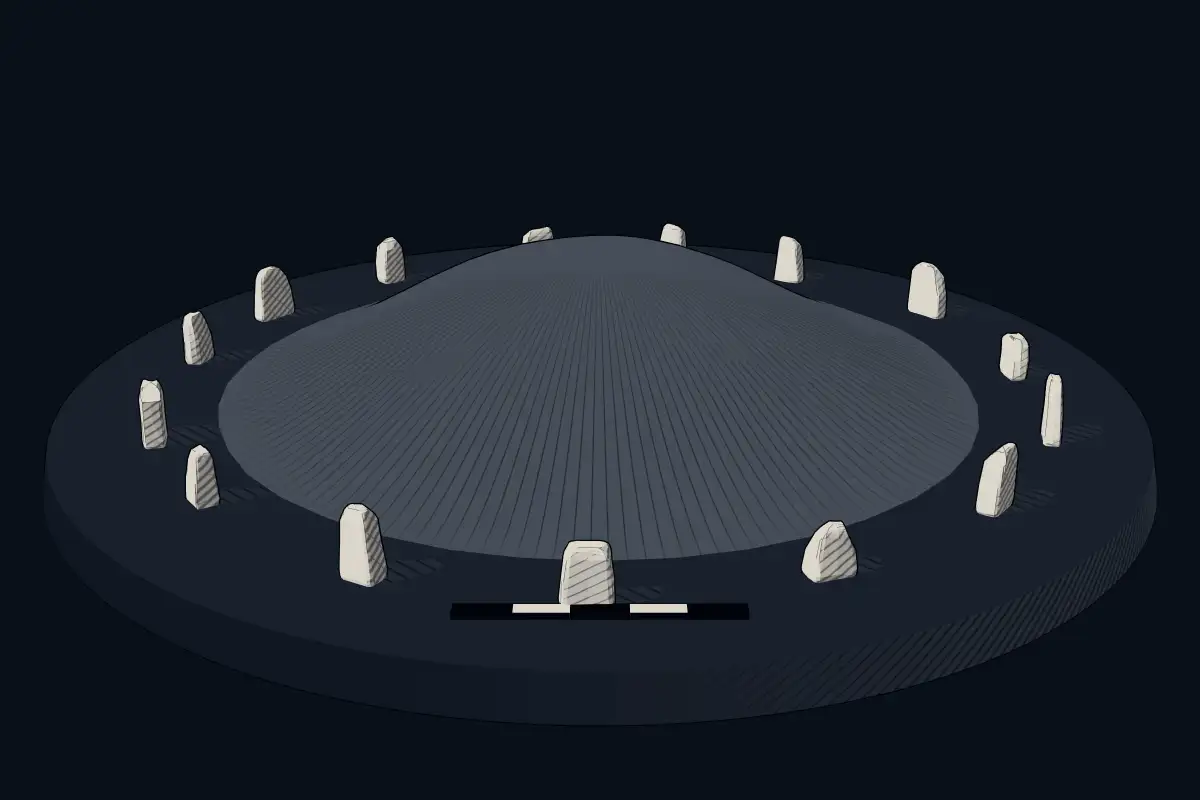
The reconstruction is ours, not a survey: it shows what a monument of this type looks like, at the size the record gives for this one.
Photographs
3 photographs, each with its author and licence
More photographs


Lore
Evidence & Lore
What the sources actually support — and, kept apart, what has been claimed.
What the evidence supports
Dates
Est. 3500–500 BCEHow this date was established: Type comparisonTypical range for megalithic mounds in Germany; this site has not been dated itself. German barrows ( Hugelgraber) run from the Neolithic (construction in central and south-west Germany c. 3500 BC and northern and central Germany c. 3400 BC) to the Late Bronze and Iron Age.Source for this date
Where it stands
Germany
The pin marks the monument itself — its exact point.
- Coordinates
- 51°20′13″ N, 11°21′26″ EFor a GPS or map app: 51.33681, 11.35721
Access is as our sources describe it; we have not visited the site to check.
Nearby
The closest sites in the Atlas, by straight line.
 Derfflinger Hügel3500–500 BCE
 Hackpfüffel menhir2800–1800 BCE
- Megalithic mound (tumulus with integral stones)Hallonge3500–500 BCE
 Wegweiserstein2800–1800 BCE
 Leubingen tumulus1992–1892 BCE
 Leubingen tumulus3500–500 BCE
- Megalithic complexGrabhügel von Tröbsdorf3500–2800 BCE
- Menhir (standing stone)Menhir von Schraplau2800–1800 BCE


Sources
Every record behind this page, with the link it came from.
2 sources behind this page
- 01Wikidata Q55189559wikidata.org
- 02Source for this dateen.wikipedia.org
Image files
- Huthügel 3.jpgAschroetCC0
- Huthügel 1.jpgAschroetCC0
- Huthügel 2.jpgAschroetCC0
Report a correctionWrong date, name, photograph or source? Tell us and it will be put right.
Lore, kept apart
Legends and claims
These are stories and claims reported by the sources. They are not evidence, and they never stand in for the dating above.
- Tradition
Eigenständige Sagen zum Huthügel sind nicht überliefert.
Eigenständige Sagen zum Huthügel sind nicht überliefert. Über den benachbarten Derfflinger Hügel ist jedoch die Sage bekannt, dass am nahe gelegenen Weg eine Kutsche mit kopflosen Pferden vorbeifahren soll. Dies wurde auch gelegentlich über den Weg berichtet, der am Huthügel vorbei führt.
Source
Around this place
The ten nearest sites, by compass
Credit
Text, licence and sources
Adapted from the Wikipedia article "Huthügel" (German), licensed CC BY-SA 4.0; authors are listed in the page history. Reused under CC BY-SA 4.0. Read on Wikipedia · Edit history and authors
- Wikipedia (German): HuthügelCC BY-SA 4.0
- Wikidata Q55189559CC0