Megalithic mound (tumulus with integral stones)The Copper Age
Hallonge
DatedEst. 3500–500 BCE
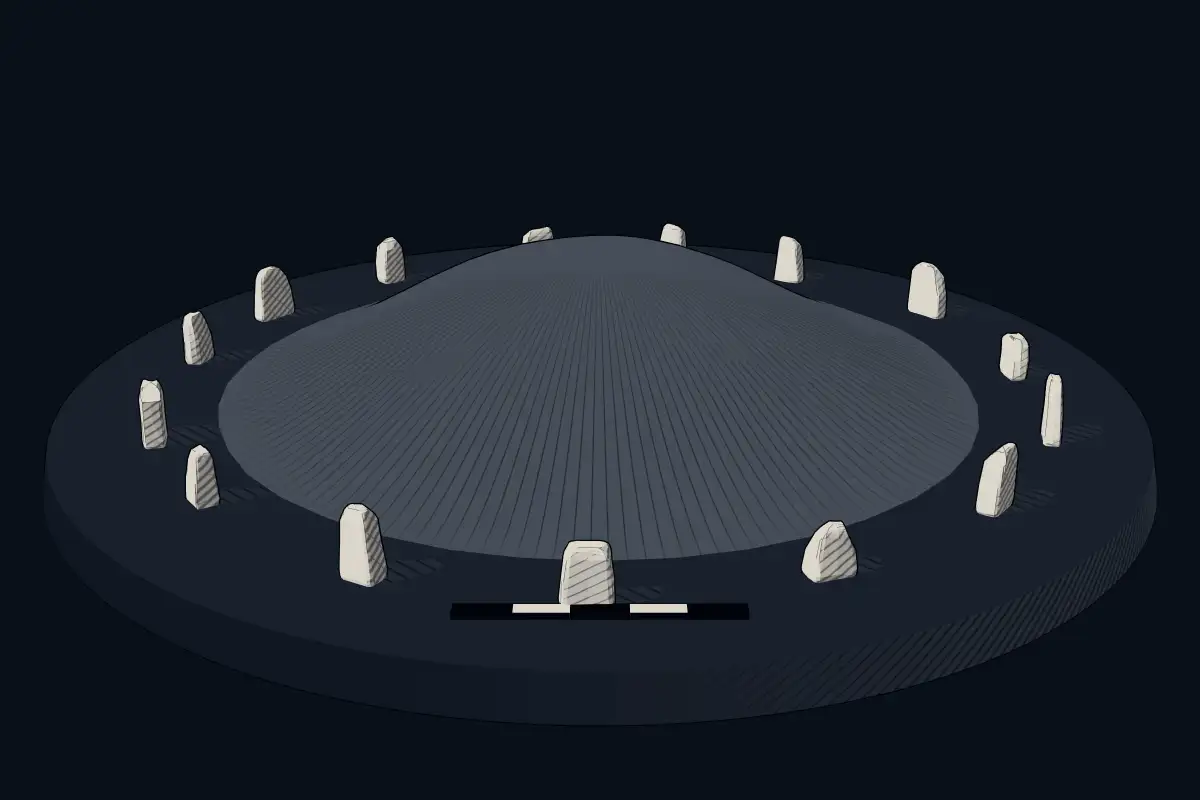
No licensed photograph yetWe have no photograph we may publish for this site, so the interpretive 3D view leads instead.
Overview
About this site
Overview
The Hallonge, also called the Hallunke, is a prehistoric burial mound at Battgendorf in the district of Sömmerda, Thuringia, Germany. It lies beside the sports ground in the south-east of the village, on a flat spur belonging to a foothill of the lower slope of the Gottesberg.
The mound is dated to the second half of the third millennium BCE and was built in the Corded Ware period. It is now only a flat Neolithic mound 22 metres in diameter.
Read on Wikipedia2 min readCC BY-SA 4.0
Where it sits in time
The site's dated range, placed against world reference points.
The scale is logarithmic: each step to the left is about ten times older than the last.
Article
Hallonge
The monument has been known as Hallunke since 1883, the year in which excavations took place in the mound.
ExcavationsSources for this section
- Wikipedia (German): HallongeCC BY-SA 4.0
Sources for this section
- Wikipedia (German): HallongeCC BY-SA 4.0
The monument has been known as Hallunke since 1883, the year in which excavations took place in the mound. A skull from the mound was in the possession of Medizinalrat Kalkhoff of Kölleda. No further prehistoric grave finds are known, but a needle recorded at Battgendorf probably belongs to this burial mound as well.
Later historySources for this section
- Wikipedia (German): HallongeCC BY-SA 4.0
Sources for this section
- Wikipedia (German): HallongeCC BY-SA 4.0
In the Roman Imperial period, in the 1st to 3rd century CE, further burials were made at the mound. The original settlement of Battgendorf was first mentioned in 1168 and probably included a fortified manor house on a motte. Traces in the terrain around the mound point to this.
Lindens stood on the Hallonge until the ground around it was greatly altered by the building of the sports ground, and they had to be removed. Two planted lindens have stood on the mound again since 1998. The linden was used as the symbol of the municipality on seals and stamps from 1840 to 1950, and since 1996 it has appeared in the arms of the Battgendorf voluntary fire brigade.
FindsSources for this section
- Wikipedia (German): HallongeCC BY-SA 4.0
Sources for this section
- Wikipedia (German): HallongeCC BY-SA 4.0
Other prehistoric finds around Battgendorf include a large isolated stone slab 4 feet high with a pierced hole at the top (the Menhir von Battgendorf), a faceted stone hammer dated to the Corded Ware period, and a thin bronze pin with a single rolled head, damaged, from a burial mound dated to the Bronze Age.
ContextSources for this section
- Wikipedia (German): HallongeCC BY-SA 4.0
Sources for this section
- Wikipedia (German): HallongeCC BY-SA 4.0
Burial mounds are found across Germany, from the northern plain to the south. Those of the Middle Bronze Age give a whole culture its name: the Tumulus culture (Hügelgräberkultur), which was dominant in Central Europe from about 1600 to 1300 BCE and buried its dead beneath mounds.
Tradition and region
About this kind of monument
German Hügelgräber and megalithic mounds
Burial mounds are found across Germany, from the northern plain to the south. Those of the Middle Bronze Age give a whole culture its name: the Tumulus culture (Hügelgräberkultur), which was dominant in Central Europe from about 1600 to 1300 BCE and buried its dead beneath mounds. It descended from the Unetice culture and covered parts of southern Germany, the Czech Republic, Austria, Switzerland, Poland and France. Its society was a warrior society, as the weapons in the graves show. The Late Bronze Age Urnfield culture, which followed it, preferred cremation, and the Hallstatt culture of the Early Iron Age revived the great mound for chieftains.
Hallstatt-period mounds can be spectacular. The Hochdorf grave in Baden-Württemberg, of about 530 BCE, was found in 1968 and excavated in 1978 to 1979. Its mound, originally 6 metres high and about 60 metres across, had been worn down to about 1 metre. Inside lay a man of about fifty on a bronze recliner with eight wheels, wearing a gold-plated torc, with a four-wheeled wagon and drinking horns.
In the north, many mounds are older and belong to the Funnel Beaker culture, whose stone-chambered tombs are described in the articles on northern German megalithic tombs. Here a mound may cover a megalithic chamber, and the Atlas's classification sometimes cannot tell the two apart without a field visit.
Dating usually combines typology, pottery and metalwork and, where timber survives, tree-ring dating. Many mounds have been ploughed down, as Hochdorf shows.
When visiting, look for mounds in groups in woodland, where they survive best, for the hollow of an old central trench, and for kerbs of stone.
Paraphrased from Wikipedia: Tumulus culture, Wikipedia: Hallstatt culture, Wikipedia: Funnel beaker culture, Wikipedia: Tumulus, Wikipedia: Heuneburg, Wikipedia: Hochdorf Chieftain's Grave · CC BY-SA 4.0
From the article
Dated moments in the story
- 1168
Zur ursprünglichen Siedlung Battgendorf, die im Jahr 1168 ersterwähnt wurde, hat vermutlich ein befestigter Herrensitz (Hochmotte) gehört.
Source - 1840
Die Linde wurde von 1840 bis 1950 auch als Symbol der Gemeinde in Siegeln und Stempeln verwendet, seit 1996 ist sie im Wappen der Freiwilligen Feuerwehr Battgendorf enthalten.
Source - 1883
Das Bodendenkmal Hallonge, seit 1883 als Hallunke überliefert, ist ein heute nur noch flacher jungsteinzeitlicher Grabhügel mit 22 Metern Durchmesser.
Source - 1883
Im Jahr 1883 fanden in dem Hügel Ausgrabungen statt.
Source - 1998
Seit dem Jahr 1998 stehen auf dem Hügel wieder zwei angepflanzte Linden.
Source
See it in 3D
An interpretive reconstruction of the monument, standing on the real ground at its exact point, under the sun for that place and season. Drag to look around it.
The reconstruction is ours, not a survey: it shows what a monument of this type looks like, at the size the record gives for this one.
Lore
Evidence & Lore
What the sources actually support — and, kept apart, what has been claimed.
What the evidence supports
Dates
Est. 3500–500 BCEHow this date was established: Type comparisonTypical range for megalithic mounds in Germany; this site has not been dated itself. German barrows ( Hugelgraber) run from the Neolithic (construction in central and south-west Germany c. 3500 BC and northern and central Germany c. 3400 BC) to the Late Bronze and Iron Age.Source for this date
Where it stands
Germany
The pin marks the monument itself — its exact point.
- Coordinates
- 51°12′12″ N, 11°15′42″ EFor a GPS or map app: 51.20327, 11.26170
Access is as our sources describe it; we have not visited the site to check.
Nearby
The closest sites in the Atlas, by straight line.


Sources
Every record behind this page, with the link it came from.
2 sources behind this page
- 01Wikidata Q105679736wikidata.org
- 02Source for this dateen.wikipedia.org
Report a correctionWrong date, name, photograph or source? Tell us and it will be put right.
Around this place
The ten nearest sites, by compass
Credit
Text, licence and sources
Adapted from the Wikipedia article "Hallonge" (German), licensed CC BY-SA 4.0; authors are listed in the page history. Reused under CC BY-SA 4.0. Read on Wikipedia · Edit history and authors
- Wikipedia (German): HallongeCC BY-SA 4.0
- Wikidata Q105679736CC0