
Großsteingrab Steinbeck
DatedEst. 3500–2800 BCE
Photo Einsamer Schütze · CC BY-SA 4.0Source file on Wikimedia Commons
Overview
About this site
Overview
The Großsteingrab Steinbeck, also called the Hünenschloss, is a megalithic tomb of the Neolithic Funnel Beaker culture at Steinbeck, a district of Buchholz in der Nordheide in the district of Harburg, Lower Saxony, Germany. It is catalogued as Sprockhoff number 674.
The monument was largely destroyed in the early nineteenth-century road works described below, and only a modest remnant survives. Descriptions from before its destruction record an exceptionally large tomb.
Read on Wikipedia2 min readCC BY-SA 4.0
Where it sits in time
The site's dated range, placed against world reference points.
The scale is logarithmic: each step to the left is about ten times older than the last.
Article
Großsteingrab Steinbeck
The tomb stands in the village of Steinbeck, west of the Bundesstraße 75 and south of the Wenzendorfer Straße.
SettingSources for this section
- Wikipedia (German): Großsteingrab SteinbeckCC BY-SA 4.0
Sources for this section
- Wikipedia (German): Großsteingrab SteinbeckCC BY-SA 4.0
The tomb stands in the village of Steinbeck, west of the Bundesstraße 75 and south of the Wenzendorfer Straße.
DescriptionSources for this section
- Wikipedia (German): Großsteingrab SteinbeckCC BY-SA 4.0
Sources for this section
- Wikipedia (German): Großsteingrab SteinbeckCC BY-SA 4.0
A detailed description was published by C. Einfeld in 1855, based on a report by the Hofbraurat Wittmann of 1813. The tomb was largely destroyed at that time, when Napoleon I had the Bremer Straße (today's B 75) widened into a chaussee. According to the report, the tomb had a Hünenbett (long barrow with a stone kerb) oriented north-west to south-east, 70 m long and 5.4 m wide. Of the kerb, 34 stones were still present, fewer than a quarter of the original number.
The burial chamber lay 11 m from one end of the Hünenbett. It was 10.5 m long, 2.4 m wide and 1.75 m high, and was of the type known as an Emsland chamber. It had 15 wall stones and four capstones, of which three were still present in 1813. The chamber floor was paved with pebbles.
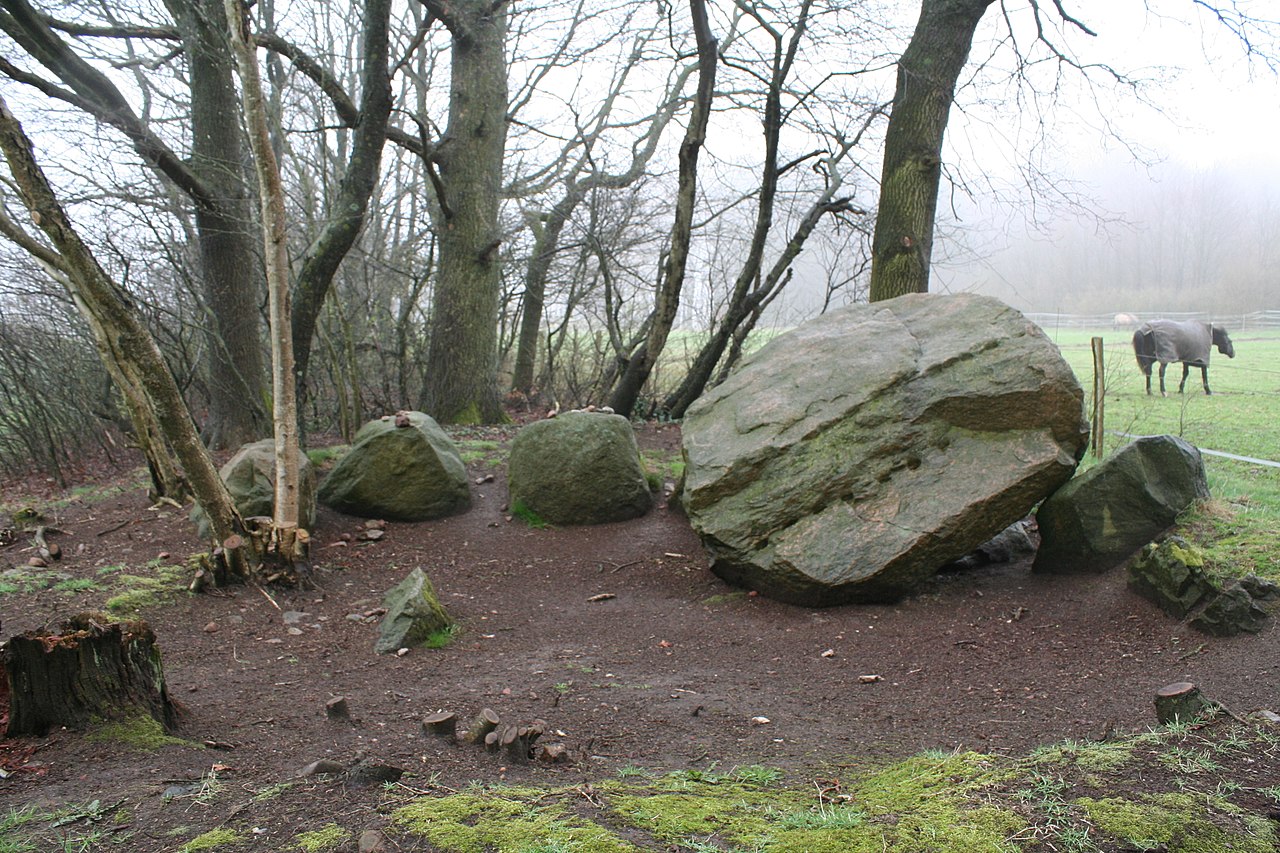
When Ernst Sprockhoff recorded the site in 1967, only three kerb stones of the south-western long side and the western corner stone of the north-western short side remained in situ. A further stone standing in situ is built into the corner of a house. Three other stones are no longer in their original position, and one of them is split.
FindsSources for this section
- Wikipedia (German): Großsteingrab SteinbeckCC BY-SA 4.0
Sources for this section
- Wikipedia (German): Großsteingrab SteinbeckCC BY-SA 4.0
The finds from the chamber were flint daggers and knives and broken pottery.
FolkloreSources for this section
- Wikipedia (German): Großsteingrab SteinbeckCC BY-SA 4.0
Sources for this section
- Wikipedia (German): Großsteingrab SteinbeckCC BY-SA 4.0
According to a legend recorded since the eighteenth century, the Hünenschloss is the tomb of Arminius.
Tradition and region
About this kind of monument
German and Dutch Hünengräber (hunebedden)
The megalithic tombs of northern Germany and the Netherlands were built by the Funnel Beaker culture (about 4100 to 2800 BCE), and the style, called Nordic megalith architecture, emerged between 3500 and 2800 BCE. In the Netherlands the tombs are the hunebedden, built between 3470 and 3250 BCE by the western group of the Funnel Beaker culture and used until about 2760 BCE. Of an estimated 100 original tombs, 54 are preserved, 52 of them in the province of Drenthe and two in Groningen. After the Funnel Beaker culture ended the sites were reused by the Single Grave and Bell Beaker cultures in the Early Bronze Age and, to a lesser extent, into the Middle Ages.
In Mecklenburg-Vorpommern up to 5,000 megalith tombs were erected, and more than 1,000 are preserved and protected by law; they belong to the youngest and easternmost part of the western European tradition. Most are dolmens, often lying inside a circular or trapezoid frame of standing stones. Locally they are known as Hünengräber, "giants' tombs", or Großsteingräber, "large stone tombs"; the trapezoid frame is a Hünenbett, "giants' bed", and the circular one a Bannkreis. Between 1964 and 1974 Ewald Schuldt excavated over a hundred sites there and sorted them into simple dolmens, extended dolmens, passage graves, great dolmens, unchambered long barrows and stone cists.
Folklore: the German and Dutch names, with Hüne meaning "giant", carry the old idea that giants were buried here. This is a tradition; the stones were placed by Neolithic farmers.
When visiting, look for the capstones on their supports and the frame of kerbstones around them.
Paraphrased from Wikipedia: Megaliths in the Netherlands, Wikipedia: Megaliths in Mecklenburg-Vorpommern, Wikipedia: Nordic megalith architecture, Wikipedia: Funnel beaker culture, Wikipedia: Dolmen · CC BY-SA 4.0
From the article
Dated moments in the story
- 674 CE
Es trägt die Sprockhoff-Nummer 674.
Source - 1813
Von letzteren waren 1813 noch drei vorhanden.
Source - 1855
Einfeld lieferte 1855 eine eingehende Beschreibung des Grabes, die sich auf einen Bericht des Hofbraurats Wittmann aus dem Jahr 1813 stützt.
Source - 1967
Ernst Sprockhoff konnte bei seiner Aufnahme im Jahr 1967 nur noch drei Umfassungssteine der südwestlichen Langseite und den westlichen Eckstein der nordwestlichen Schmalseite in situ vorfinden.
Source
See it in 3D
An interpretive reconstruction of the monument, standing on the real ground at its exact point, under the sun for that place and season. Drag to look around it.
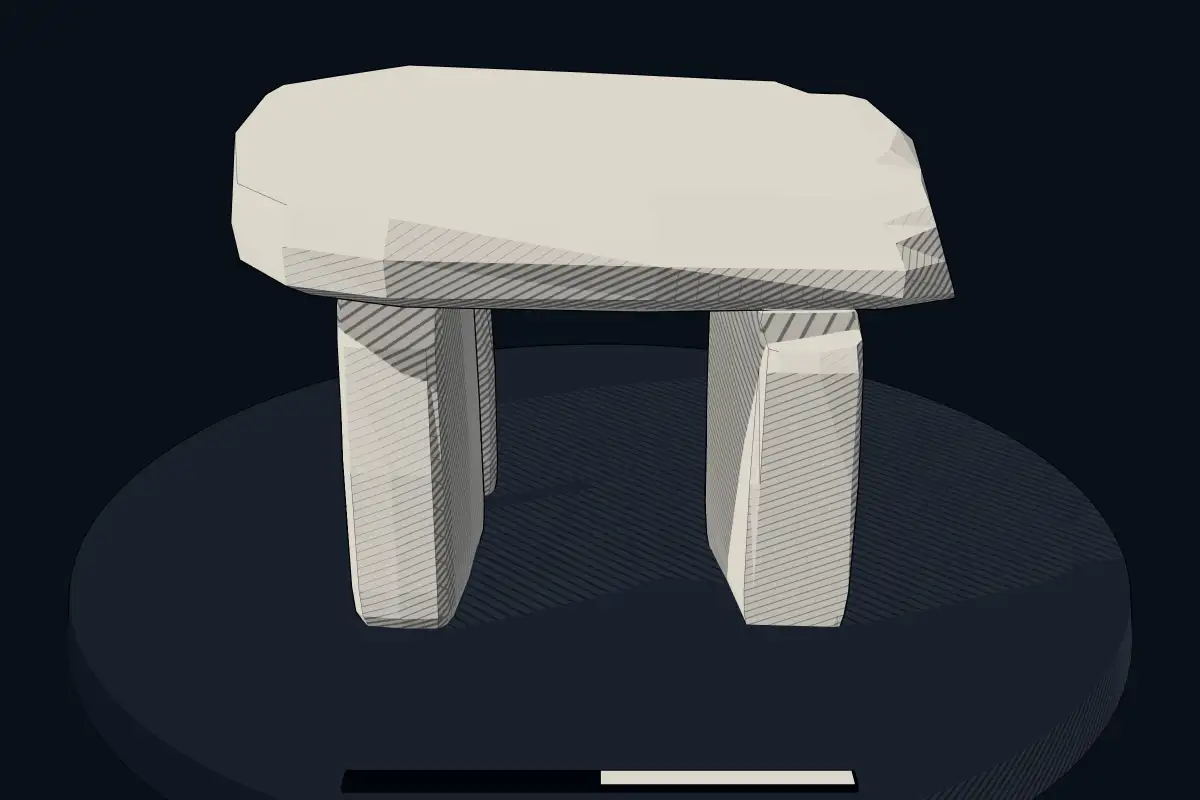
The reconstruction is ours, not a survey: it shows what a monument of this type looks like, at the size the record gives for this one.
Photographs
4 photographs, each with its author and licence
More photographs
Lore
Evidence & Lore
What the sources actually support — and, kept apart, what has been claimed.
What the evidence supports
Dates
Est. 3500–2800 BCEHow this date was established: Type comparisonTypical range for dolmens in Germany; this site has not been dated itself. German dolmens (Huengrab) belong to the Nordic megalith tradition which emerged predominantly between 3500 and 2800 BC.Source for this date
Where it stands
Germany
The pin marks the monument itself — its exact point.
- Coordinates
- 53°20′37″ N, 9°51′01″ EFor a GPS or map app: 53.34365, 9.85015
Access is as our sources describe it; we have not visited the site to check.
Nearby
The closest sites in the Atlas, by straight line.



Sources
Every record behind this page, with the link it came from.
2 sources behind this page
- 01Wikidata Q15623721wikidata.org
- 02Source for this dateen.wikipedia.org
Image files
- Großsteingrab Steinbeck 01.jpgEinsamer SchützeCC BY-SA 4.0
- Großsteingrab Steinbeck 02.jpgEinsamer SchützeCC BY-SA 4.0
- Großsteingrab Steinbeck 03.jpgEinsamer SchützeCC BY-SA 4.0
- Großsteingrab Steinbeck 04.jpgEinsamer SchützeCC BY-SA 4.0
Report a correctionWrong date, name, photograph or source? Tell us and it will be put right.
Lore, kept apart
Legends and claims
These are stories and claims reported by the sources. They are not evidence, and they never stand in for the dating above.
- Tradition
Nach einer seit dem 18.
Nach einer seit dem 18. Jahrhundert belegten Sage soll es sich beim Hünenschloss um „das Grabmal des Arminius“ handeln.
Source
Around this place
The ten nearest sites, by compass
Credit
Text, licence and sources
Adapted from the Wikipedia article "Großsteingrab Steinbeck" (German), licensed CC BY-SA 4.0; authors are listed in the page history. Reused under CC BY-SA 4.0. Read on Wikipedia · Edit history and authors