
Dolmen Nenndorf
DatedEst. 3500–2800 BCE
Photo Megalitho · CC BY-SA 4.0Source file on Wikimedia Commons
Overview
About this site
Overview
The Großsteingrab Nenndorf is a passage grave of the Neolithic Funnel Beaker culture, built between 3500 and 2800 BCE. It lies near Emsen, a district of the municipality of Rosengarten in the Landkreis Harburg, Lower Saxony, Germany, and carries the Sprockhoff number 673.
The tomb lies within a Hünenbett 55 m long. Its chamber was excavated in 1949, and the finds are held by the Archäologisches Museum Hamburg.
Read on Wikipedia2 min readCC BY-SA 4.0
Where it sits in time
The site's dated range, placed against world reference points.
The scale is logarithmic: each step to the left is about ten times older than the last.
Article
Dolmen Nenndorf
The tomb lies west of Emsen in the Nenndorfer Interessentenforst, just under 500 m north of the A 1.
SettingSources for this section
- Wikipedia (German): Großsteingrab NenndorfCC BY-SA 4.0
Sources for this section
- Wikipedia (German): Großsteingrab NenndorfCC BY-SA 4.0
The tomb lies west of Emsen in the Nenndorfer Interessentenforst, just under 500 m north of the A 1.
DescriptionSources for this section
- Wikipedia (German): Großsteingrab NenndorfCC BY-SA 4.0
Sources for this section
- Wikipedia (German): Großsteingrab NenndorfCC BY-SA 4.0
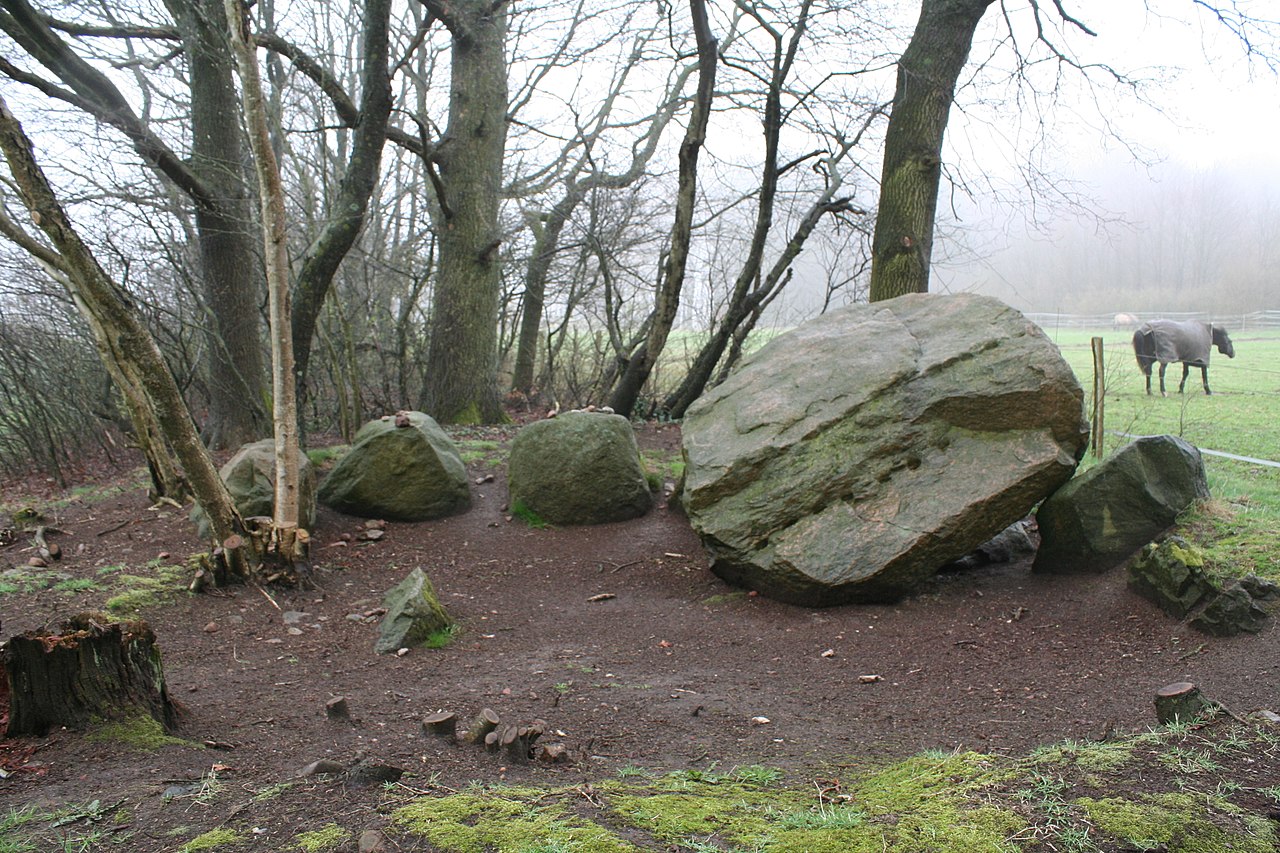
The Hünenbett is oriented north-east to south-west. It is 55 m long and 8 m wide, and narrows slightly towards the north-east. The mound is 0.8 m high in the south-west and 0.4 m high in the north-east. All the kerbstones are missing, but numerous traces of their positions can still be seen, and on the south side there are remains of two rows of edge stones.
The burial chamber lies in the south-western part of the Hünenbett. It is 5 m long, 1.5 m wide and 1.5 m high. It has one end stone at each narrow side and four pairs of wall stones on the long sides. Between the two north-eastern stones of the south-eastern long side there is a gap, to which a pair of wall stones belonging to the passage connects. Of the capstones only two fitting fragments were found; they are held together by a steel girder and mounted at the east end of the chamber.
ExcavationsSources for this section
- Wikipedia (German): Großsteingrab NenndorfCC BY-SA 4.0
Sources for this section
- Wikipedia (German): Großsteingrab NenndorfCC BY-SA 4.0
The chamber was excavated in 1949 by Willi Wegewitz and Ernst Sprockhoff. All the wall stones were found in situ.
FindsSources for this section
- Wikipedia (German): Großsteingrab NenndorfCC BY-SA 4.0
Sources for this section
- Wikipedia (German): Großsteingrab NenndorfCC BY-SA 4.0
The finds could for the most part be assigned to the Funnel Beaker culture, and the grave goods in the chamber date from the final phase of that culture. Fragments of an urn containing cremated remains, dating from the pre-Roman Iron Age, were found in the mound. The finds are now held by the Archäologisches Museum Hamburg.
ContextSources for this section
- Wikipedia (German): Großsteingrab NenndorfCC BY-SA 4.0
Sources for this section
- Wikipedia (German): Großsteingrab NenndorfCC BY-SA 4.0
A passage grave consists of one or more burial chambers covered in earth or stone and having a narrow access passage made of large stones. Such tombs usually date from the Neolithic. In Germany the passage graves belong to the Funnel Beaker culture.
Tradition and region
About this kind of monument
Passage graves of northern Europe and elsewhere
A passage grave consists of one or more burial chambers covered in earth or stone and having a narrow access passage made of large stones. These tombs usually date from the Neolithic and are found largely in Western Europe, in Ireland, Britain, Scandinavia, northern Germany and the Drenthe area of the Netherlands, and also in Iberia, parts of the Mediterranean and along the north coast of Africa. When covered in earth a passage grave is a kind of burial mound, and when covered in stone it is a cairn. The earliest passage tombs seem to take the form of small dolmens, though not all dolmens are passage graves.
In Germany the passage graves belong to the Funnel Beaker culture, and in Mecklenburg-Vorpommern archaeologists have divided them into several kinds. Ewald Schuldt, who excavated over a hundred sites between 1964 and 1974, listed passage graves among the types he found there, together with simple dolmens, extended dolmens, great dolmens, unchambered long barrows and stone cists.
Some passages are aligned so that the sun shines through into the chamber at a significant point in the year. Newgrange in Ireland is aligned to the winter solstice sunrise, and several other Irish passage tombs are aligned on solstices and equinoxes.
The tradition is believed to have originated in Brittany, and to have been introduced to other regions by colonists from there. The early dates of Breton tombs such as Gavrinis, built around 4200 to 4000 BCE, fit that idea, though it remains a hypothesis.
Dating is by pottery, radiocarbon on bone, and form.
When visiting, look for the passage, the capstones that roof the chamber, and the kerbstones around the base.
Paraphrased from Wikipedia: Passage grave, Wikipedia: Nordic megalith architecture, Wikipedia: Funnel beaker culture, Wikipedia: Newgrange, Wikipedia: Gavrinis · CC BY-SA 4.0
From the article
Dated moments in the story
- 2800 BCE
Das Großsteingrab Nenndorf ist eine zwischen 3500 und 2800 v. Chr. entstandene megalithische Grabanlage der jungsteinzeitlichen Trichterbecherkultur (TBK) bei Emsen, einem Ortsteil der Gemeinde Rosengarten im Landkreis Harburg, Niedersachsen.
Source - 673 CE
Es trägt die Sprockhoff-Nummer 673.
Source - 1949
Die Kammer wurde 1949 durch Willi Wegewitz und Ernst Sprockhoff ausgegraben.
Source
Photographs
8 photographs, each with its author and licence
More photographs
Lore
Evidence & Lore
What the sources actually support — and, kept apart, what has been claimed.
What the evidence supports
Dates
Est. 3500–2800 BCEHow this date was established: Type comparisonTypical range for passage tombs in Germany; this site has not been dated itself. German passage graves belong to the Nordic megalith tradition which emerged predominantly between 3500 and 2800 BC.Source for this date
Where it stands
Germany
The pin marks the monument itself — its exact point.
- Coordinates
- 53°22′34″ N, 9°50′16″ EFor a GPS or map app: 53.37615, 9.83771
Access is as our sources describe it; we have not visited the site to check.
Nearby
The closest sites in the Atlas, by straight line.



Sources
Every record behind this page, with the link it came from.
2 sources behind this page
- 01Wikidata Q15812995wikidata.org
- 02Source for this dateen.wikipedia.org
Image files
- Ganggrab Nenndorf Bild 1.jpgMegalithoCC BY-SA 4.0
- Ganggrab Emsen 100 Bild01.jpgTraceyRCC BY-SA 4.0
- Ganggrab Nenndorf Bild 2.jpgMegalithoCC BY-SA 4.0
- NLD Großsteingrab Nenndorf 01.jpgUwe Neupert, Niedersächsisches Landesamt für DenkmalpflegeCC BY-SA 4.0
- NLD Großsteingrab Nenndorf 02.jpgUwe Neupert, Niedersächsisches Landesamt für DenkmalpflegeCC BY-SA 4.0
- Sprockhoff No. 673 Nenndorf 2.jpgMegalithoCC BY-SA 4.0
- Sprockhoff No. 673 Nenndorf.jpgMegalithoCC BY-SA 4.0
- Decksteinfragmente mit Stahlträgern.pngTraceyRCC BY-SA 4.0
Report a correctionWrong date, name, photograph or source? Tell us and it will be put right.
Around this place
The ten nearest sites, by compass
Credit
Text, licence and sources
Adapted from the Wikipedia article "Großsteingrab Nenndorf" (German), licensed CC BY-SA 4.0; authors are listed in the page history. Reused under CC BY-SA 4.0. Read on Wikipedia · Edit history and authors
- Wikipedia (German): Großsteingrab NenndorfCC BY-SA 4.0
- Wikidata Q15812995CC0