
cist in the Feldmark Rade
DatedEst. 3500–2800 BCE
Photo Aeroid · CC BY-SA 4.0Source file on Wikimedia Commons
Overview
About this site
Overview
The cist in the Feldmark Rade is a megalithic stone cist in the district of Harburg in Lower Saxony, Germany. It belongs to a rather rare form of megalithic grave and is most readily compared with the stone cist of Fehrenbruch. It is dated on typological grounds to about 3500 to 2800 BCE, although the finds point to a burial of the Single Grave culture.
The cist was found in 1949 by W. Rüland in the south-eastern corner of the Grauener Bauernholz near Rade. In 2014 it was given maintenance work by the AG praktische Archäologie Landkreis Harburg.
Read on Wikipedia3 min readCC BY-SA 4.0
Where it sits in time
The site's dated range, placed against world reference points.
The scale is logarithmic: each step to the left is about ten times older than the last.
Article
cist in the Feldmark Rade
When the thin layer of humus was removed, a packing of rounded stones, six metres in diameter, was found, which formed the mantle of the cist.
DescriptionSources for this section
Sources for this section
Rüland first noticed a stone setting that suggested a cist sunk into the ground. When the thin layer of humus was removed, a packing of rounded stones, six metres in diameter, was found, which formed the mantle of the cist.
The cist was sunk into the natural subsoil and measured 2,8 m in length, 1,5 m in mean width and 0,8 m in height. Along each long side there originally stood three supporting stones, as in other megalithic structures, with the flat face turned inwards; one of them is missing. The gaps were narrow or filled with dry walling. The strong inward lean of the supporting stones is unusual. Because all lean at the same angle, it is assumed that this was done so that shorter capstones could be used. All the capstones have been lost.
The south-eastern narrow side was formed by two narrow stones, one of which reached only half the height of the neighbouring supporting stone, and an entrance of the kind seen at dolmens may be suggested. The north-western narrow side had no wall stone but was closed by a packing of pebbles with no sign of disturbance. A similar arrangement was observed at the stone cist of Deinste in the district of Stade, where a wall stone was likewise replaced by rounded stones.
FindsSources for this section
Sources for this section
Apart from slight disturbance the contents of the cist were intact. It was filled up to the level of the natural ground with loamy sand from the surroundings. The fill contained many smashed pieces of flint, a number of them burnt, especially between the floor paving of flat, fire-split and unworked field stones. It also held pieces of charcoal and 30 small pieces of cremated bone, scattered so loosely that they gave no impression of a closed burial, and seven small pottery sherds.
In the north-west lay a large tubular amber bead pierced lengthways and crossways, and beneath it an overturned small clay bowl broken in two. Four further tubular or disc-shaped amber beads were found, as well as a small flint axe lying a few centimetres above the paving and a flint blade with a retouched front edge. It cannot be said whether the bowl, axe, knife and beads belong to a single set of grave goods. The cremated bone appears to be a later burial in the chamber and is probably unrelated to the grave goods.
DatingSources for this section
Sources for this section
This form of cist stands at the end of the developmental series. The grave goods, especially the tubular amber beads, point to a burial of the Single Grave culture. The finds probably belong to the latest part of the Neolithic, the Final Neolithic, which corresponds to the first stage of the Central European Bronze Age.
ConservationSources for this section
Sources for this section
After the investigation the excavated wall stone was set back into the gap on the south-western long side, and the cist was filled with earth so that the floor paving is protected from damage.
ContextSources for this section
Sources for this section
A cist is a small stone-built coffin-like box used to hold the bodies of the dead. In Nordic megalith architecture it is one of the recognised types alongside dolmens and passage graves, and ornaments found in excavated cists often show the wealth or prominence of the person buried.
Tradition and region
About this kind of monument
Scandinavian and German stone cists
A cist, or kist, is a small stone-built coffin-like box used to hold the bodies of the dead. It may once have been covered by a cairn or a long barrow, and several cists are sometimes found together within the same cairn or barrow. Ornaments are often found in excavated cists, which shows the wealth or prominence of the person buried. In Scandinavia the stone cist is called the hellekiste in Danish and hällkista in Swedish, and in Nordic megalith architecture it is one of the recognised types alongside dolmens and passage graves.
The most spectacular cist in Scandinavia is the central chamber of the King's Grave at Kivik in Scania, from about the fifteenth century BCE. It is about 4 metres long and 1.5 metres wide, made of ten upright slabs of which eight are decorated with carvings of people, ships, birds, fish, horses, axes and a chariot. It was opened in 1748 by farmers who were taking stone for field walls.
Other cists are much smaller. Associated with Nordic Bronze Age settlements are burial cairns, mounds and cemeteries, with interments including oak coffins and urn burials. The cists in the Atlas, many of them in Sweden and Denmark, are usually single graves under a cairn or a barrow.
Dating relies on the objects in the cist and on radiocarbon dating of any surviving bone.
When visiting, look for a box formed by slabs, exposed where its covering mound has gone.
Paraphrased from Wikipedia: Cist, Wikipedia: Kivik grave, Wikipedia: Nordic megalith architecture, Wikipedia: Nordic Bronze Age · CC BY-SA 4.0
From the article
Dated moments in the story
- 2014
Sie wurde 2014 durch die AG praktische Archäologie Landkreis Harburg einer Pflege unterzogen.
Source
See it in 3D
An interpretive reconstruction of the monument, standing on the real ground at its exact point, under the sun for that place and season. Drag to look around it.
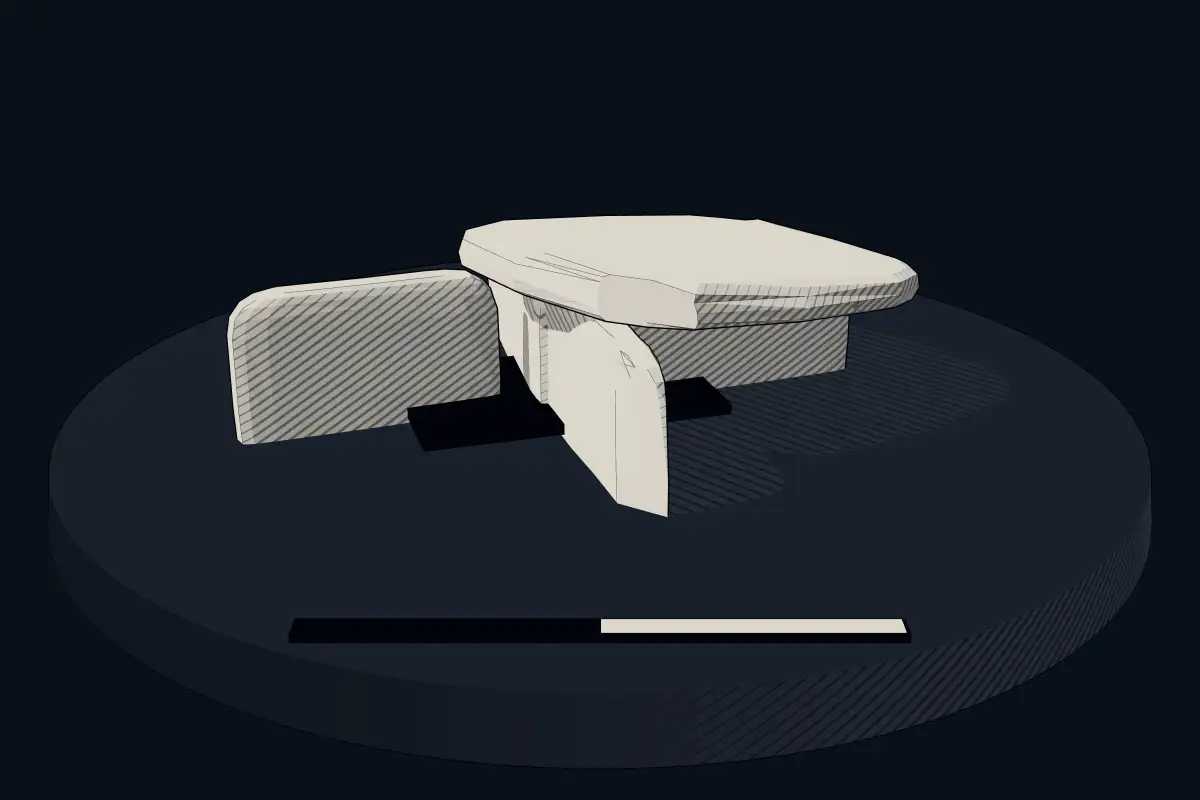
The reconstruction is ours, not a survey: it shows what a monument of this type looks like, at the size the record gives for this one.
Photographs
4 photographs, each with its author and licence
More photographs
Lore
Evidence & Lore
What the sources actually support — and, kept apart, what has been claimed.
What the evidence supports
Dates
Est. 3500–2800 BCEHow this date was established: Type comparisonTypical range for cists in Germany; this site has not been dated itself. German stone cists (Steinkisten) belong to the Nordic megalith tradition which emerged predominantly between 3500 and 2800 BC.Source for this date
Where it stands
Germany
The pin marks the monument itself — its exact point.
- Coordinates
- 53°22′46″ N, 9°48′57″ EFor a GPS or map app: 53.37950, 9.81572
Access is as our sources describe it; we have not visited the site to check.
Nearby
The closest sites in the Atlas, by straight line.


Sources
Every record behind this page, with the link it came from.
2 sources behind this page
- 01Wikidata Q2341088wikidata.org
- 02Source for this dateen.wikipedia.org
Image files
Report a correctionWrong date, name, photograph or source? Tell us and it will be put right.
Lore, kept apart
Legends and claims
These are stories and claims reported by the sources. They are not evidence, and they never stand in for the dating above.
- Tradition
Bis auf eine geringe Störung war der Inhalt der Kiste unversehrt.
Bis auf eine geringe Störung war der Inhalt der Kiste unversehrt. Sie war bis zur Höhe des gewachsenen Bodens mit lehmigem Sand aus der Umgebung angefüllt. Bis zu einer Tiefe von 10 cm unter der Oberfläche hatte die stellenweise wie eine gestampfte Tenne harte Füllerde eine gleichmäßige Beschaffenheit. Darunter lag hellbrauner Sand mit hellen und dunklen Flecken. Er enthielt viele zerschlagene Feuersteinstücke, von denen eine Anzahl zerbrannt war. Zerbrannter Feuerstein lag besonders zwischen der Bodenpflasterung aus plattigen, durch Feuer gespaltenen und unbearbeiteten Feldsteinen. An manchen Stellen lag der gebrannte Feuerstein haufenförmig. In der Füllerde wurden Holzkohlestücke und 30 kleine Stücke Leichenbrand angetroffen. Die gebrannten Knochen lagen so verstreut, dass man nicht den Eindruck einer geschlossenen Beisetzung hatte. Ferner wurden in der Füllerde sieben kleine Gefäßscherben gefunden. Der Leichenbrand wurde nur in der mittleren Schicht beobachtet. Im Nordwesten lag eine große röhrenförmige Bernsteinperle mit Längs- und Querdurchbohrung. Darunter wurde eine umgedrehte in zwei Teile zerbrochene kleine Tonschale freigelegt. Außer der großen wurden vier röhren- oder scheibenförmige Bernsteinperlen gefunden. Ein kleines Feuersteinbeil lag wenige Zentimeter über dem Bodenpflaster. Etwas höher lag eine Feuersteinklinge mit retuschierter Vorderkante. Ob die Tonschale, das Feuersteinbeil, das Feuersteinmesser und die Bernsteinperlen zu einer einzigen Grabausstattung gehören, lässt sich nicht sagen. Die Beschaffenheit der Füllerde lässt vermuten, dass die Einfüllung der Kammer nicht in einem Vorgang erfolgt ist. Der in der mittleren Schicht eingestreute Leichenbrand scheint als Nachbestattung in die Kammer gelangt zu sein und dürfte nicht mit den Grabbeigaben in Verbindung stehen. Die geringe Menge des Leichenbrandes muss nicht gegen eine Bestattung sprechen, da der Leichenbrand in lockerer Streuung von Pflanzenwurzeln aufgelöst werden kann.
Source
Around this place
The ten nearest sites, by compass
Credit
Text, licence and sources
Adapted from the Wikipedia article "Steinkiste in der Feldmark Rade" (German), licensed CC BY-SA 4.0; authors are listed in the page history. Reused under CC BY-SA 4.0. Read on Wikipedia · Edit history and authors