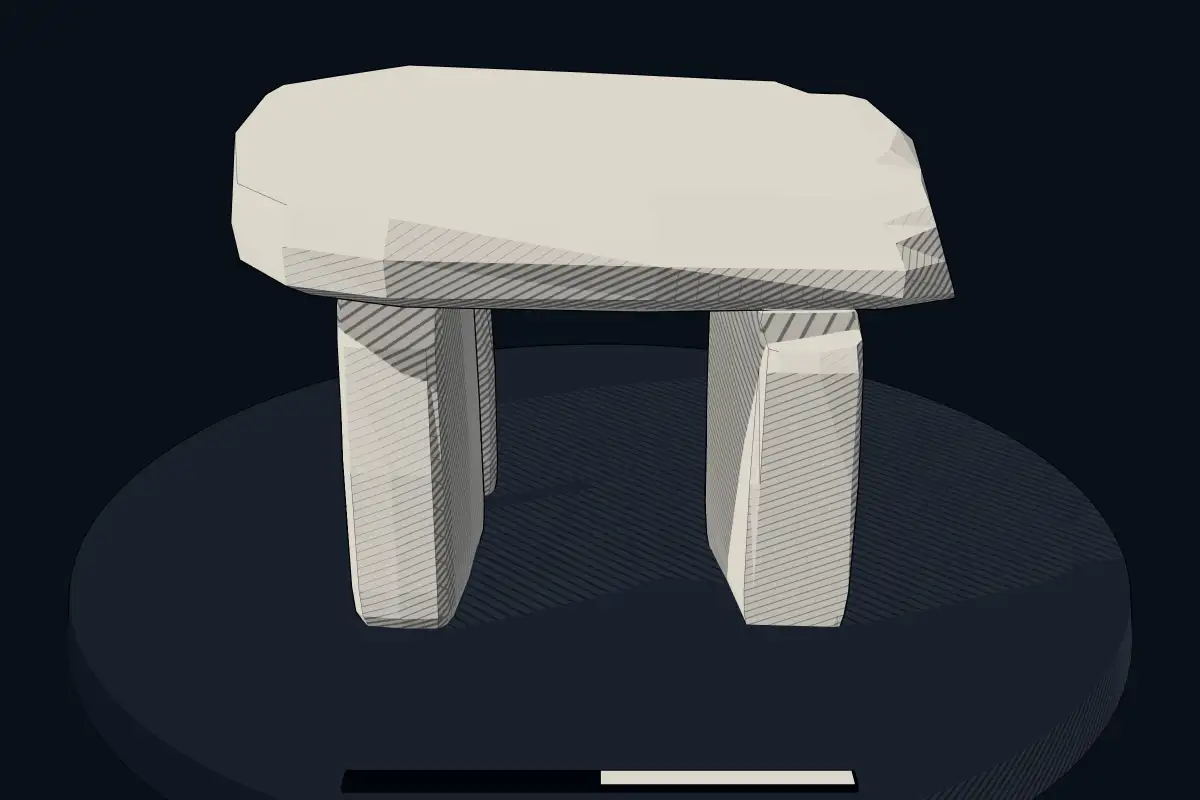
Dolmen D31a
DatedEst. 3500–2800 BCE
No licensed photograph yetWe have no photograph we may publish for this site, so the interpretive 3D view leads instead.
Overview
About this site
What the sources say
Die Steinkiste von Exloo-Zuiderveld war ein Steinkistengrab der jungsteinzeitlichen Trichterbecherkultur bei Exloo, einem Ortsteil der Gemeinde Borger-Odoorn in der niederländischen Provinz Drenthe. Die Anlage wurde 1843 entdeckt und wahrscheinlich in den folgenden Jahrzehnten zerstört. Das Grab und seine Überreste wurden mehrfach archäologisch untersucht. Es trägt die van-Giffen-Nummer D31a. Die Anlage wurde von Albert Egges van Giffen ursprünglich als Großsteingrab klassifiziert, Jan N. Lanting klassifiziert sie hingegen als Steinkiste.
Article in GermanRead on Wikipedia4 min readCC BY-SA 4.0
Where it sits in time
The site's dated range, placed against world reference points.
The scale is logarithmic: each step to the left is about ten times older than the last.
The full article
Dolmen D31a: the whole story
In briefSources for this section
Sources for this section
Steinkiste von Exloo-Zuiderveld, also known as Dolmen D31a, was a stone-cist grave of the late Funnel Beaker culture. It stood south of Exloo, a district of the municipality of Borger-Odoorn in Drenthe, Netherlands, within a wooded area. The nearby Exloo-Zuid dolmen, D31, still survives to the west. The site is catalogued as dating from 3500 BCE to 2800 BCE by typological estimate.
The monument was first recorded in 1843 and was probably destroyed during the following decades. Leonhardt Johannes Friedrich Janssen examined it in 1846 and made a drawing. The last stones were removed between 1855 and 1875. Jan Evert Musch rediscovered the remains in 1968, and Jan N. Lanting carried out another investigation in 1993.
Lanting found a pit 1,3 m deep and about 4 m across, surrounded by a mound originally about 11 m wide and 1,4 m high. The mound was enlarged to a height of 2 m during the Middle Bronze Age, when its edge was lined with large stones. According to Janssen, the chamber had two wall stones and a roof stone. Its floor was paved with small stones, but no post holes remained; Lanting thought the chamber was already incomplete by 1846. During the Second World War, a shelter was made in the middle of the mound.
Janssen found a rounded concentration of cremated remains, possibly held in cloth. Lanting recovered sherds from about 40 Funnel Beaker vessels, two intersecting arrowheads, and a stone axe. The pottery belonged typologically to the earliest stage of the Funnel Beaker culture in the Netherlands. Albert Egges van Giffen originally classified the site as a large dolmen, while Jan N. Lanting identified it as a stone cist.
No English Wikipedia article exists for it; the full text below is the German article "Steinkiste von Exloo-Zuiderveld", shown in the original language.
Summary in EnglishSources for this section
Sources for this section
Dolmen D31a is a dolmen in Borger-Odoorn, Germany. Wikidata describes it as: dolmen in the Netherlands. A typological estimate: 3500 BCE to 2800 BCE. No English Wikipedia article exists for it; the full text below is the German article "Steinkiste von Exloo-Zuiderveld", shown in the original language.
LageSources for this section
Sources for this section
Das Grab befand sich südlich von Exloo in einem Waldgebiet. Westlich befindet sich das noch erhaltene Großsteingrab Exloo-Zuid (D31).
ForschungsgeschichteSources for this section
Sources for this section
Die Anlage wurde erstmals 1843 erwähnt. Leonhardt Johannes Friedrich Janssen, Kurator am Rijksmuseum van Oudheden in Leiden, führte 1846 eine Untersuchung durch und fertigte eine Zeichnung an. Zwischen 1855 und 1875 wurden die letzten Steine des Grabes entfernt. Die Überreste der Anlage wurden 1968 von Jan Evert Musch wiederentdeckt. 1993 erfolgte eine Nachuntersuchung durch Jan N. Lanting.
BeschreibungSources for this section
Sources for this section
Lanting stellte bei seiner Grabung eine 1,3 m tiefe Grube mit einem Durchmesser von etwa 4 m fest. Das Grab besaß ursprünglich eine Hügelschüttung mit einem Durchmesser von etwa 11 m und einer Höhe von 1,4 m, die in der Mittleren Bronzezeit auf eine Höhe von 2 m erweitert wurde. Gleichzeitig mit der Erweiterung wurde der Hügelrand mit großen Steinen eingefasst. Die Grabkammer bestand nach Janssen aus zwei Wandsteinen und einem Deckstein. Lanting konnte bei seiner Untersuchung keine Standlöcher mehr feststellen, ging aber davon aus, dass die Kammer bereits bei Janssens Untersuchung nicht mehr vollständig war und die ersten Zerstörungen wohl schon in der Bronzezeit erfolgten. Der Kammerboden war mit Steingrus gepflastert. Während des Zweiten Weltkriegs wurde in der Mitte des Hügels ein Unterstand angelegt.
FundeSources for this section
Sources for this section
Bei der Grabung von Janssen wurde eine kugelförmige Ansammlung von Leichenbrand gefunden. Möglicherweise waren die Knochensplitter in einem vergangenen Stück Stoff beigesetzt worden. Lanting fand Keramikscherben von etwa 40 Gefäßen der Trichterbecherkultur, zwei querschneidige Pfeilspitzen und ein Steinbeil. Typologisch gehört die Keramik in die älteste Stufe der Trichterbecherkultur in den Niederlanden.
How this page was madeSources for this section
Sources for this section
The summary at the top of this page was written by MiniMax-M3 (2026-11-08) from the cited Wikipedia article “Steinkiste von Exloo-Zuiderveld”, translated from German. The numbers in it were checked automatically against the source text. The rest of the page is the article itself, the structured records and computed distances.
Tradition and region
About this kind of monument
German and Dutch Hünengräber (hunebedden)
The megalithic tombs of northern Germany and the Netherlands were built by the Funnel Beaker culture (about 4100 to 2800 BCE), and the style, called Nordic megalith architecture, emerged between 3500 and 2800 BCE. In the Netherlands the tombs are the hunebedden, built between 3470 and 3250 BCE by the western group of the Funnel Beaker culture and used until about 2760 BCE. Of an estimated 100 original tombs, 54 are preserved, 52 of them in the province of Drenthe and two in Groningen. After the Funnel Beaker culture ended the sites were reused by the Single Grave and Bell Beaker cultures in the Early Bronze Age and, to a lesser extent, into the Middle Ages.
In Mecklenburg-Vorpommern up to 5,000 megalith tombs were erected, and more than 1,000 are preserved and protected by law; they belong to the youngest and easternmost part of the western European tradition. Most are dolmens, often lying inside a circular or trapezoid frame of standing stones. Locally they are known as Hünengräber, "giants' tombs", or Großsteingräber, "large stone tombs"; the trapezoid frame is a Hünenbett, "giants' bed", and the circular one a Bannkreis. Between 1964 and 1974 Ewald Schuldt excavated over a hundred sites there and sorted them into simple dolmens, extended dolmens, passage graves, great dolmens, unchambered long barrows and stone cists.
Folklore: the German and Dutch names, with Hüne meaning "giant", carry the old idea that giants were buried here. This is a tradition; the stones were placed by Neolithic farmers.
When visiting, look for the capstones on their supports and the frame of kerbstones around them.
Paraphrased from Wikipedia: Megaliths in the Netherlands, Wikipedia: Megaliths in Mecklenburg-Vorpommern, Wikipedia: Nordic megalith architecture, Wikipedia: Funnel beaker culture, Wikipedia: Dolmen · CC BY-SA 4.0
From the article
Dated moments in the story
- 1843
Die Anlage wurde 1843 entdeckt und wahrscheinlich in den folgenden Jahrzehnten zerstört.
Source - 1843
Die Anlage wurde erstmals 1843 erwähnt.
Source - 1846
Leonhardt Johannes Friedrich Janssen, Kurator am Rijksmuseum van Oudheden in Leiden, führte 1846 eine Untersuchung durch und fertigte eine Zeichnung an.
Source - 1855
Zwischen 1855 und 1875 wurden die letzten Steine des Grabes entfernt.
Source - 1968
Die Überreste der Anlage wurden 1968 von Jan Evert Musch wiederentdeckt.
Source - 1993
1993 erfolgte eine Nachuntersuchung durch Jan N.
Source
See it in 3D
An interpretive reconstruction of the monument, standing on the real ground at its exact point, under the sun for that place and season. Drag to look around it.
The reconstruction is ours, not a survey: it shows what a monument of this type looks like, at the size the record gives for this one.
Lore
Evidence & Lore
What the sources actually support — and, kept apart, what has been claimed.
What the evidence supports
Dates
Est. 3500–2800 BCEHow this date was established: Type comparisonTypical range for dolmens in Germany; this site has not been dated itself. German dolmens (Huengrab) belong to the Nordic megalith tradition which emerged predominantly between 3500 and 2800 BC.Source for this date
Where it stands
Germany
The pin marks the monument itself — its exact point.
- Coordinates
- 52°52′06″ N, 6°52′45″ EFor a GPS or map app: 52.86842, 6.87929
Access is as our sources describe it; we have not visited the site to check.
Nearby
The closest sites in the Atlas, by straight line.


Sources
Every record behind this page, with the link it came from.
2 sources behind this page
- 01Wikidata Q30140421wikidata.org
- 02Source for this dateen.wikipedia.org
Report a correctionWrong date, name, photograph or source? Tell us and it will be put right.
Around this place
The ten nearest sites, by compass
Credit
Text, licence and sources
Text from the Wikipedia article "Steinkiste von Exloo-Zuiderveld" (German), licensed CC BY-SA 4.0; authors are listed in the page history. Reused under CC BY-SA 4.0. Read on Wikipedia · Edit history and authors