
Overview
About this site
What the sources say
Hunebed D37 ligt samen met hunebed D36 aan de rand van de Ooster esch ten zuiden van Valthe in de Nederlandse provincie Drenthe.
De hunebedden D36 en D37 worden ook wel De Valther Tweeling genoemd. De hunebedden lagen aan de rand van de Kampervenen (een moeras). De hunebedden zijn te bereiken vanaf de Hoofdstraat in Valthe via een zandweg uit het dorp Valthe.
Article in DutchRead on Wikipedia6 min readCC BY-SA 4.0
Where it sits in time
The site's dated range, placed against world reference points.
The scale is logarithmic: each step to the left is about ten times older than the last.
The full article
D37: the whole story
In briefSources for this section
- Wikipedia (Dutch): D37 (hunebed)CC BY-SA 4.0
Sources for this section
- Wikipedia (Dutch): D37 (hunebed)CC BY-SA 4.0
D37 is a dolmen in the Dutch province of Drenthe, near the village of Valthe. Together with D36, it forms the pair known as De Valther Tweeling, the Valthe Twins. Both lie at the edge of the Ooster esch, close to the Kampervenen marsh, and can be reached from the Hoofdstraat in Valthe along a sandy track. The monument is attributed to the Funnel Beaker culture and is dated by typological estimate to about 3500–2800 BCE. D37 is 11.4 metres long and 3.7 metres wide, with its entrance on the south side.
D37 is less well preserved than its twin. Its stones lie scattered and unevenly, and three capstones are missing. Two capstones remain, but both lie on the ground; most of the supporting stones are still in place. The two dolmens lie in line with one another and are 8.2 metres apart. It is likely that they were once covered by a single burial mound, and a prehistoric route ran close past D37. Both monuments are owned by the province of Drenthe, which bought them from the Valthe farmers’ common land in 1871.
The dolmens were first recorded on the Hottingerkaart map of 1788–1792 and were described by Nicolaas Westendorp in 1822, who noted that both had been dug into. When Van Giffen examined D37, it was in a badly damaged condition: three capstones lay in the burial chamber and others were missing. The chamber’s contents have never been investigated, and a small restoration took place in 1952. Archaeological work began in 2012 in a protected area next to the monument, after accidental digging in 2011 created the opportunity. Excavations funded by the Dienst Landelijk Gebied and carried out by the Groninger Instituut voor Archeologie with students and volunteers recovered 133 Neolithic pottery sherds decorated with Funnel Beaker motifs, along with two baking plates. Fragments of burnt flint axes lay in the entrance space, and traces of buildings from the Funnel Beaker period and the Iron Age were found.
Concern in nineteenth-century England about restoration in the Netherlands led the director of the Society of Antiquaries in London to ask William Collings Lukis and Sir Henry Dryden to record the condition of the dolmens. They visited Drenthe in July 1878, surveyed forty dolmens on the Hondsrug, and took measurements, descriptions and watercolours. Their report was never printed, but their material is held by the Society of Antiquaries, the Guernsey Museum & Art Gallery and the Drents Museum, with copies at the Ashmolean Museum in Oxford. Drenthe archaeologist Wijnand van der Sanden published the work in 2015 with an extensive introduction, judging it to be of high quality, and the Drents Museum held an exhibition on it that year. D37 appears on Plan XXVIII. On their visit, Lukis and Dryden saw that it still had three capstones, one of them broken, out of an original six, with twelve supporting stones and remains of a burial mound visible.
Summary in EnglishSources for this section
- Wikipedia (Dutch): D37 (hunebed)CC BY-SA 4.0
Sources for this section
- Wikipedia (Dutch): D37 (hunebed)CC BY-SA 4.0
D37 is a dolmen in Borger-Odoorn, Germany. Wikidata describes it as: dolmen in the Netherlands. A typological estimate: 3500 BCE to 2800 BCE. No English Wikipedia article exists for it; the full text below is the Dutch article "D37 (hunebed)", shown in the original language.
BouwSources for this section
- Wikipedia (Dutch): D37 (hunebed)CC BY-SA 4.0
Sources for this section
- Wikipedia (Dutch): D37 (hunebed)CC BY-SA 4.0
Het hunebed wordt toegeschreven aan de trechterbekercultuur.
D37 is minder gaaf dan zijn tweelingbroer, de stenen liggen schots en scheef en er ontbreekt een drietal dekstenen. Er zijn nog twee dekstenen aanwezig, maar deze liggen op de grond. De meeste draagstenen zijn nog aanwezig. Het hunebed is 11,4 meter lang en 3,7 meter breed.
De hunebedden liggen in elkaars verlengde. Waarschijnlijk hebben de hunebedden ooit onder één dekheuvel gelegen en liep een prehistorische route vlak langs D37. De ingangen liggen aan de zuidzijde.
GeschiedenisSources for this section
- Wikipedia (Dutch): D37 (hunebed)CC BY-SA 4.0
Sources for this section
- Wikipedia (Dutch): D37 (hunebed)CC BY-SA 4.0
De hunebedden worden voor het eerst vermeld op de Hottingerkaart (1788-1792). Nicolaas Westendorp beschrijft de beide hunebedden in 1822,
hij vermeldt dat in beide hunebedden gegraven is
In 1871 kocht de provincie Drenthe beide hunebedden van de boermarke van Valthe.
Van Giffen vond dit hunebed in zeer geschonden toestand. Dekstenen 1, 4 en 6 liggen in de grafkelder, de andere dekstenen ontbreken.
De kelderinhoud is nooit onderzocht; in 1952 vond een kleine restauratie plaats.
In 2012 werd onderzoek gedaan in een gebied wat grenst aan het hunebed. In dit beschermde gebied werd in 2011 per ongeluk gegraven en hierdoor was er een kans om het gebied archeologisch te onderzoeken. De opgraving werd bekostigd door Dienst Landelijk Gebied en werd uitgevoerd door het Groninger Instituut voor Archeologie (Rijksuniversiteit Groningen), met de medewerking van archeologiestudenten en vrijwilligers. Tijdens de opgraving zijn 133 met trechterbekermotieven versierde neolithische aardewerkscherven geborgen. Ook werden twee bakplaten gevonden In de ruimte voor de ingang lagen brokstukken van verbrande vuurstenen bijlen. Er zijn ook sporen van gebouwen uit de Trechterbekerperiode en de ijzertijd aangetroffen.
Society of AntiquariesSources for this section
- Wikipedia (Dutch): D37 (hunebed)CC BY-SA 4.0
Sources for this section
- Wikipedia (Dutch): D37 (hunebed)CC BY-SA 4.0
In Engeland ontstond in de jaren zeventig van de 19e eeuw bezorgdheid over de wijze waarop in Nederland hunebedden werden gerestaureerd. In die kringen was men vooral bezorgd dat met de restauraties het oorspronkelijk beeld van de situatie verloren zou gaan. De directeur van de Society of Antiquaries in Londen verzocht de oudheidkundigen William Collings Lukis en sir Henry Dryden om de staat waarin de hunebedden zich op dat moment bevonden nauwkeurig vast te leggen. Zij bezochten in juli 1878 Drenthe en brachten veertig hunebedden op de Hondsrug in kaart. Ze hebben opmetingen verricht en beschreven de aangetroffen situatie, die zij tevens vastlegden in een serie aquarellen. Hun rapportage aan de Society of Antiquaries verscheen echter niet in druk. Hun materiaal werd bewaard bij de Society of Antiquaries, het Guernsey Museum & Art Gallery en het Drents Museum. Het Ashmolean Museum in Oxford bezit kopieën van hun werk. In 2015 publiceerde de Drentse archeoloog dr. Wijnand van der Sanden alsnog hun werk. Hij voorzag hun materiaal van een uitgebreide inleiding. Ook schetste hij de ontwikkelingen met betrekking tot het archeologisch onderzoek van de hunebedden na hun onderzoek tot 2015. Hij gaf als oordeel dat het werk van Lukis en Dryden van hoge kwaliteit was. In het Drents Museum was in 2015 een tentoonstelling over het werk.
Hunebed D37 is weergegeven op Plan XXVIII. Lukis en Dryden bezochten de hunebedden op 19 juli 1878. Het hunebed had nog drie dekstenen (waarvan één gebroken was). Oorspronkelijk waren er zes dekstenen. De drie dekstenen lagen in de grafkelder. Er waren twaalf draagstenen. De ingang lagen aan de zuidzijde. De overblijfselen van een dekheuvel waren zichtbaar.
Lukis en Dryden merkten op dat volgens de archeoloog Janssen in een van de hunebedden een kleine urn gevonden zou zijn. Ook stelden zij dat Janssen de oriëntatie van de beide hunebedden fout heeft beschreven. Beide hunebedden zijn eigendom van de provincie. De hunebedden liggen 8,2 meter uit elkaar.
How this page was madeSources for this section
- Wikipedia (Dutch): D37 (hunebed)CC BY-SA 4.0
Sources for this section
- Wikipedia (Dutch): D37 (hunebed)CC BY-SA 4.0
The summary at the top of this page was written by MiniMax-M3 (2026-11-07) from the cited Wikipedia article “D37 (hunebed)”, translated from Dutch. The numbers in it were checked automatically against the source text. The rest of the page is the article itself, the structured records and computed distances.
Tradition and region
About this kind of monument
German and Dutch Hünengräber (hunebedden)
The megalithic tombs of northern Germany and the Netherlands were built by the Funnel Beaker culture (about 4100 to 2800 BCE), and the style, called Nordic megalith architecture, emerged between 3500 and 2800 BCE. In the Netherlands the tombs are the hunebedden, built between 3470 and 3250 BCE by the western group of the Funnel Beaker culture and used until about 2760 BCE. Of an estimated 100 original tombs, 54 are preserved, 52 of them in the province of Drenthe and two in Groningen. After the Funnel Beaker culture ended the sites were reused by the Single Grave and Bell Beaker cultures in the Early Bronze Age and, to a lesser extent, into the Middle Ages.
In Mecklenburg-Vorpommern up to 5,000 megalith tombs were erected, and more than 1,000 are preserved and protected by law; they belong to the youngest and easternmost part of the western European tradition. Most are dolmens, often lying inside a circular or trapezoid frame of standing stones. Locally they are known as Hünengräber, "giants' tombs", or Großsteingräber, "large stone tombs"; the trapezoid frame is a Hünenbett, "giants' bed", and the circular one a Bannkreis. Between 1964 and 1974 Ewald Schuldt excavated over a hundred sites there and sorted them into simple dolmens, extended dolmens, passage graves, great dolmens, unchambered long barrows and stone cists.
Folklore: the German and Dutch names, with Hüne meaning "giant", carry the old idea that giants were buried here. This is a tradition; the stones were placed by Neolithic farmers.
When visiting, look for the capstones on their supports and the frame of kerbstones around them.
Paraphrased from Wikipedia: Megaliths in the Netherlands, Wikipedia: Megaliths in Mecklenburg-Vorpommern, Wikipedia: Nordic megalith architecture, Wikipedia: Funnel beaker culture, Wikipedia: Dolmen · CC BY-SA 4.0
From the article
Dated moments in the story
- 1788
De hunebedden worden voor het eerst vermeld op de Hottingerkaart (1788-1792).
Source - 1822
Nicolaas Westendorp beschrijft de beide hunebedden in 1822, hij vermeldt dat in beide hunebedden gegraven is In 1871 kocht de provincie Drenthe beide hunebedden van de boermarke van Valthe.
Source - 1878
Zij bezochten in juli 1878 Drenthe en brachten veertig hunebedden op de Hondsrug in kaart.
Source - 1878
Lukis en Dryden bezochten de hunebedden op 19 juli 1878. Het hunebed had nog drie dekstenen (waarvan één gebroken was).
Source - 1952
De kelderinhoud is nooit onderzocht; in 1952 vond een kleine restauratie plaats.
Source - 2012
In 2012 werd onderzoek gedaan in een gebied wat grenst aan het hunebed.
Source - 2015
In 2015 publiceerde de Drentse archeoloog dr.
Source - 2015
Ook schetste hij de ontwikkelingen met betrekking tot het archeologisch onderzoek van de hunebedden na hun onderzoek tot 2015. Hij gaf als oordeel dat het werk van Lukis en Dryden van hoge kwaliteit was.
Source - 2015
In het Drents Museum was in 2015 een tentoonstelling over het werk.
Source
See it in 3D
An interpretive reconstruction of the monument, standing on the real ground at its exact point, under the sun for that place and season. Drag to look around it.
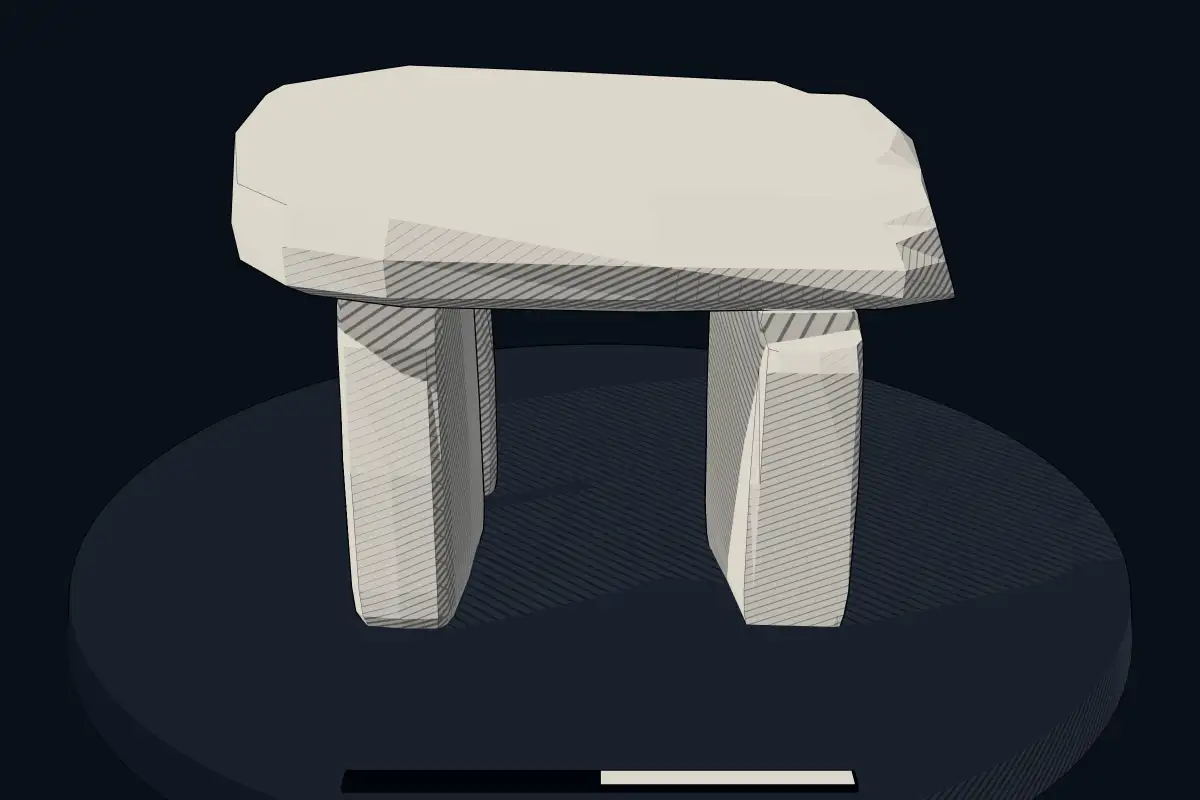
The reconstruction is ours, not a survey: it shows what a monument of this type looks like, at the size the record gives for this one.
Photographs
8 photographs, each with its author and licence
More photographs
Lore
Evidence & Lore
What the sources actually support — and, kept apart, what has been claimed.
What the evidence supports
Dates
Est. 3500–2800 BCEHow this date was established: Type comparisonTypical range for dolmens in Germany; this site has not been dated itself. German dolmens (Huengrab) belong to the Nordic megalith tradition which emerged predominantly between 3500 and 2800 BC.Source for this date
Where it stands
Germany
The pin marks the monument itself — its exact point.
- Coordinates
- 52°50′23″ N, 6°53′41″ EFor a GPS or map app: 52.83971, 6.89467
Access is as our sources describe it; we have not visited the site to check.
Nearby
The closest sites in the Atlas, by straight line.


Sources
Every record behind this page, with the link it came from.
2 sources behind this page
- 01Wikidata Q2168977wikidata.org
- 02Source for this dateen.wikipedia.org
Image files
- Hunebed D37 bij Valthe.jpgGouwenaarPublic domain
- Hunebed D37 bij Valthe2.jpgGouwenaarPublic domain
- D36 en D37.jpgEncyachtCC BY-SA 4.0
- D37 en op de achtergrond D36.jpgEncyachtCC BY-SA 4.0
- Hunebed D37 (links) en hunebed D36 met daarachter het in 2012 onderzochte gebied.jpgEncyachtCC BY-SA 4.0
- Overzicht - Valthe - 20238567 - RCE.jpgG.Th. DelemarreCC BY-SA 4.0
- Overzicht - Valthe - 20238568 - RCE.jpgG.Th. DelemarreCC BY-SA 4.0
- Hunebed D37 Goedeljee.jpgJan Goedeljee (1824-1905)CC BY 4.0
Report a correctionWrong date, name, photograph or source? Tell us and it will be put right.
Around this place
The ten nearest sites, by compass
Credit
Text, licence and sources
Text from the Wikipedia article "D37 (hunebed)" (Dutch), licensed CC BY-SA 4.0; authors are listed in the page history. Reused under CC BY-SA 4.0. Read on Wikipedia · Edit history and authors
- Wikipedia (Dutch): D37 (hunebed)CC BY-SA 4.0
- Wikidata Q2168977CC0