Аязмо Малка Богородица (Минерални Бани)
No licensed photograph yetWe have no photograph we may publish for this site, so the interpretive 3D view leads instead.
Overview
About this site
Overview
The Аязмо Малка Богородица (Little Mother of God holy spring) is a Christianised pagan megalithic sanctuary in the village of Mineralni bani, Haskovo Province, Bulgaria. It lies 200 m south-west of the ancient and medieval fortress of Sveti Duh.
It grew up around a spring of curative mineral water issuing from a natural round hole in a monolithic rock. Visitors have traditionally passed through an opening in the rock for health, and a small chapel dedicated to the Holy Mother of God stands against it.
Read on Wikipedia3 min readCC BY-SA 4.0
Article
Аязмо Малка Богородица (Минерални Бани)
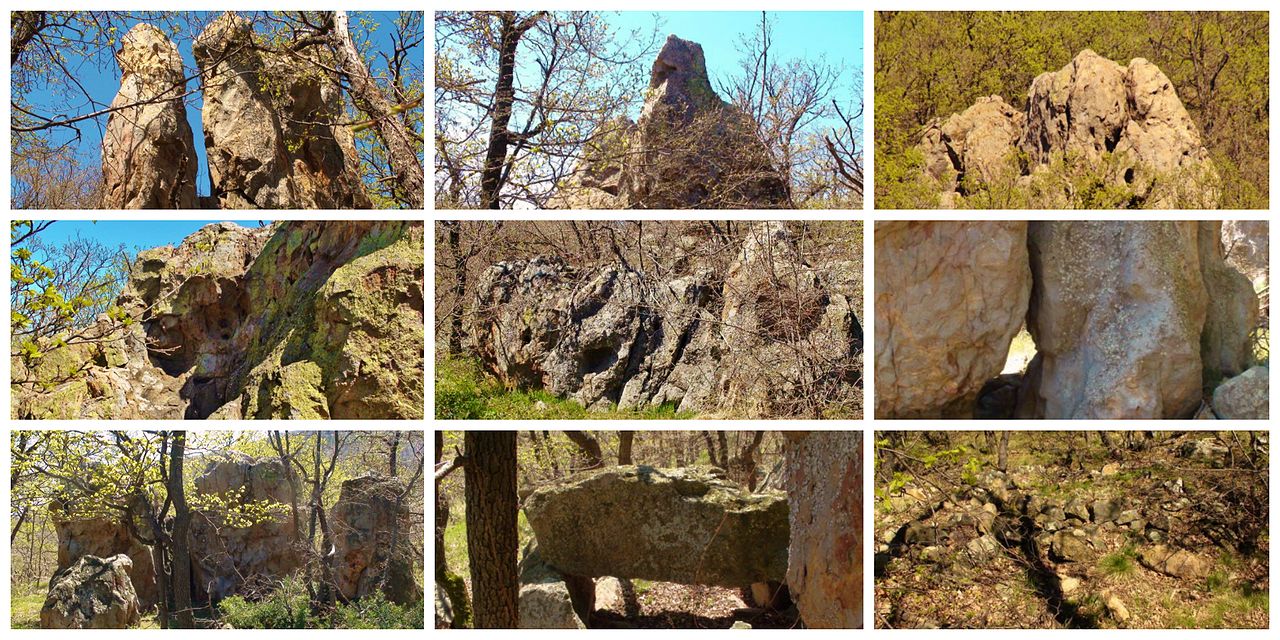
The monolithic rock around which the sacred spring arose consists of two parts joined in a T-shape.
DescriptionSources for this section
Sources for this section
The monolithic rock around which the sacred spring arose consists of two parts joined in a T-shape. The upper part runs east-west and the lower descends from north to south towards the bed of the river. The visible length of the two rocks is about 15 m, and the height is 3 m along most of its length, reaching 4 m in places. Today the spring is captured and its water is led to a large fountain on the bank of the nearby Banska river.
The upper part of the rock is buried on its southern side in an artificial mound, in places reinforced on the west by dry walls of large unworked stones. At the start of the western slope, six steps of a stairway were roughly cut along the back of the buried rock, leading to the levelled top of the hill, which occupies an area of about half a decare.
The central feature of this cult complex of rock, healing water and height is a round opening (a passage), formed where the upper rock meets the lower. It lies 0.60 m above the base of the rock; its diameter is 0.90 m and its depth 0.70 m. The upper part has the natural shape of a vault and the lower part is hollowed in an arc. Many egg-shaped niches are also cut on the eastern side of the rock; they are heavily weathered but still visible.
FolkloreSources for this section
Sources for this section
In the past the opening was visited regularly, mainly by women from the surrounding villages, who crawled through it for health. According to tradition, pilgrims pass through three times so that the bad stays here, the pilgrim emerging at the other end purified. The passage is entered from the west and left to the east. To reach the height of the opening, two steps are cut in the rock in front of it.
Later historySources for this section
Sources for this section
A small chapel dedicated to the Holy Mother of God is attached to the rock; its feast day is 8 September, the Nativity of the Holy Mother of God. It is not known when the chapel was built. During the totalitarian communist regime, between 1944 and 1989, the place was neglected and almost abandoned. Towards the end of the 1990s the old chapel was demolished and a new one built in its place. A small grave monument with a cross in relief on its face is sunk in front of its entrance.
Tradition and region
About this kind of monument
Thracian rock sanctuaries of Bulgaria
In the Eastern Rhodope and Strandzha mountains of Bulgaria, rocks have been cut, carved and used as sanctuaries for thousands of years, and the Atlas lists many of them as "megaliths". The Thracians were an Indo-European-speaking people who inhabited large parts of south-eastern Europe in ancient times, including modern Bulgaria, Romania, North Macedonia, northern Greece and European Turkey, and they reused many of the sites. Strandzha has a large concentration of ruins of Thracian sanctuaries, sacrificial altars and dolmens.
Perperikon, in the Eastern Rhodope Mountains 15 kilometres north-east of Kardzhali, is an ancient Thracian city on a rocky hill 470 metres high, thought to have been a sacred place; it is described as the largest megalith ensemble site in the Balkans. In the Middle Ages it served as a fortress. Beglik Tash, a prehistoric rock sanctuary on the southern Black Sea coast north of Primorsko, was reused by Thracian tribes in the Iron Age.
Many of the places listed as megaliths here are natural rock formations. Beglik Tash is a natural rock formation of megaliths of hardened magma, from a volcano of the Mesozoic era; most of the megaliths have traces of carving for Thracian rituals, and there are the remains of a labyrinth and a "Thracian sun-clock" formed of huge stones, as well as a 150-ton rock. It is often hard to tell where nature ends and human work begins.
Dating depends on the finds in the few excavated parts, and most sites are listed with a broad range.
When visiting, look for traces of carving on the rock, and for steps and niches.
Paraphrased from Wikipedia: Thracians, Wikipedia: Perperikon, Wikipedia: Beglik Tash, Wikipedia: Strandzha · CC BY-SA 4.0
Where it stands
Bulgaria
The pin marks the monument itself — its exact point.
- Coordinates
- 41°56′31″ N, 25°21′14″ EFor a GPS or map app: 41.94190, 25.35380
Access is as our sources describe it; we have not visited the site to check.
Nearby
The closest sites in the Atlas, by straight line.




Sources
Every record behind this page, with the link it came from.
1 source behind this page
- 01Wikidata Q26206039wikidata.org
Report a correctionWrong date, name, photograph or source? Tell us and it will be put right.
Around this place
The ten nearest sites, by compass
Credit
Text, licence and sources
Adapted from the Wikipedia article "Аязмо Малка Богородица (Минерални бани)" (Bulgarian), licensed CC BY-SA 4.0; authors are listed in the page history. Reused under CC BY-SA 4.0. Read on Wikipedia · Edit history and authors