
Lilac rock sanctuary
Photo Eola · CC BY-SA 4.0Source file on Wikimedia Commons
Overview
About this site
What the sources say
Люляковото светилище се намира в полите на Средна гора, в землището на село Розовец, под връх Градището, област Пловдив. На неговата територия се намира единствената в България запазена мегалитна стела.
Article in BulgarianRead on Wikipedia5 min readCC BY-SA 4.0
The full article
Lilac rock sanctuary: the whole story
In briefSources for this section
- Wikipedia (Bulgarian): Люляково светилищеCC BY-SA 4.0
Sources for this section
- Wikipedia (Bulgarian): Люляково светилищеCC BY-SA 4.0
Люляково светилище lies in the fields of Средна гора, in the territory of the village Розовец, below the summit Градището in Пловдив district. It is a cult megalithic sanctuary named after the nearby lilac grove. The site is part of the wider area associated with the Thracian Odrysians, near the villages Розовец and Бабек, where Thracian finds were first recorded in the 1850-ти години.
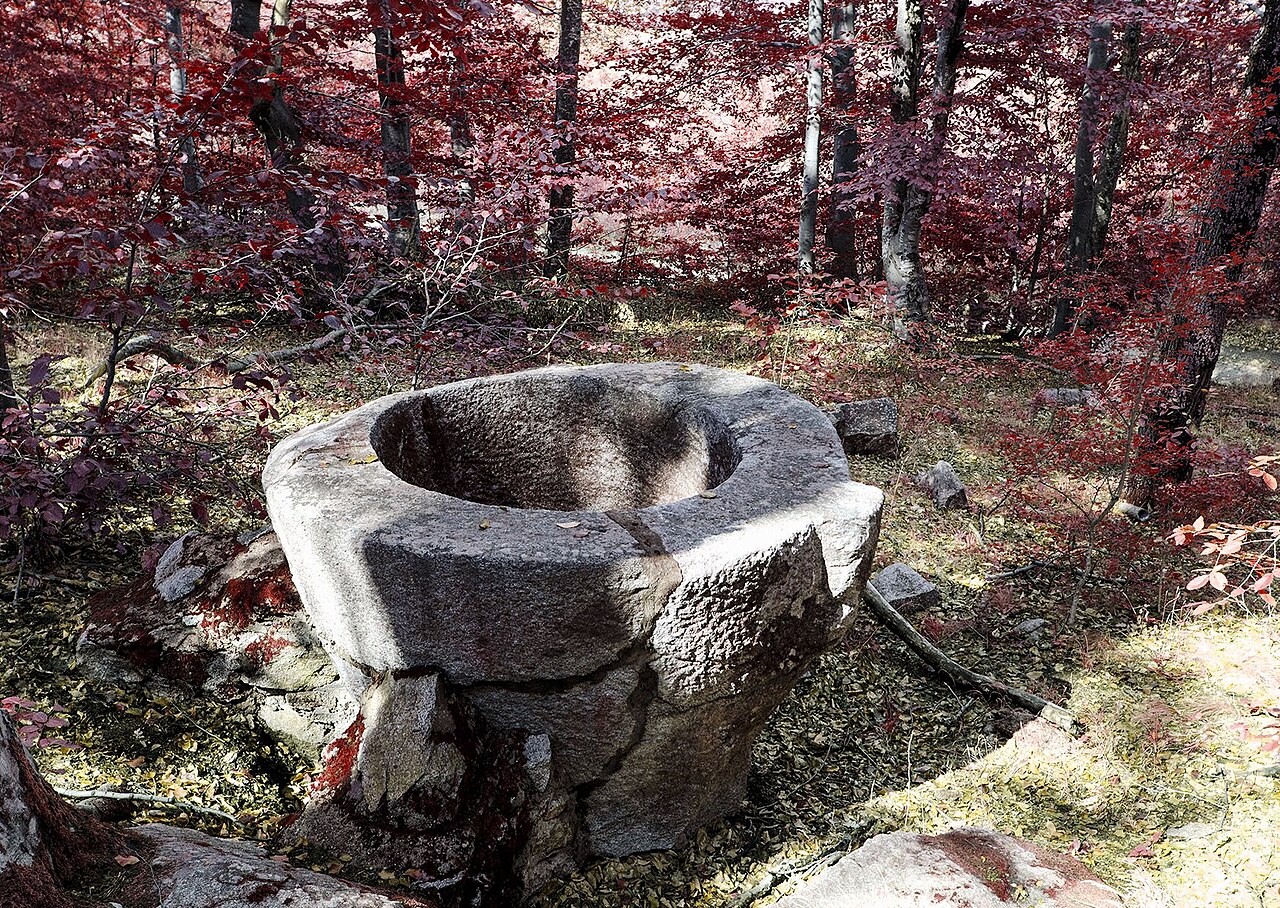
The sanctuary includes granite rock altars, a seat-like throne, carved channels and a round hollow resembling a шарапан. Its main feature is a well-preserved megalithic stela, the only one of its kind preserved in Bulgaria. The stela is 2 m high and stands in a specially shaped rock bed on a rocky slope facing south, with a narrow platform in front of it. It is turned toward Пловдивското поле.
Prof. Валерия Фол interpreted the site as a typical extra-settlement sanctuary with a summit. She proposed that ceremonies there honoured the god Слънце and the Велика Богиня майка, with young people presenting offerings of fruit, herbs and flowers at the summer solstice. She regarded the stela as an important place of regional belief and ritual, while noting that its full function remains a question for future research. This interpretation is hypothetical and is not based on archaeological excavations.
The Брезово municipality first organised a “Празник на лятното слънцестоене” at the sanctuary in 2011 г. on 22 юни. The reconstructed ritual included offerings of dried fruit, wine, milk and water, followed by the placing of gifts before the Слънчевата стела. It lasts one hour. A marked walking route from Бабек takes about 30 minutes. In this region, the wider landscape also includes Bulgaria’s largest dolmen at Плочата and megalithic structures at Купелът.
No English Wikipedia article exists for it; the full text below is the Bulgarian article "Люляково светилище", shown in the original language.
Summary in EnglishSources for this section
- Wikipedia (Bulgarian): Люляково светилищеCC BY-SA 4.0
Sources for this section
- Wikipedia (Bulgarian): Люляково светилищеCC BY-SA 4.0
Lilac rock sanctuary is a megalith (abstract root) in Rozovets, Bulgaria. No English Wikipedia article exists for it; the full text below is the Bulgarian article "Люляково светилище", shown in the original language.
Описание и особеностиSources for this section
- Wikipedia (Bulgarian): Люляково светилищеCC BY-SA 4.0
Sources for this section
- Wikipedia (Bulgarian): Люляково светилищеCC BY-SA 4.0
Наименованието на култовото мегалитно светилище идва от намиращата се наблизо люлякова гора. На място се наблюдават характерните за светилищата на територията на Средна гора моделирани в гранитната скала жертвеници, седалка-трон, издълбани улеи и кръгло издълбаване напомнящо шарапана. Добре оформената мегалитна стела е издигната в специално оформено в скалата легло на скалист склон, обърнат на юг. Височината на стелата е 2 m, като пред нея е оформена тясна площадка. Стелата е единствената добре запазена и документирана на територията на мегалитно светилище в България. Тя е обърната към Пловдивското поле.
ИнтерпретацияSources for this section
- Wikipedia (Bulgarian): Люляково светилищеCC BY-SA 4.0
Sources for this section
- Wikipedia (Bulgarian): Люляково светилищеCC BY-SA 4.0
Според проф.Валерия Фол „Люляковото светилище“ е типично извънселищно светилище с връх. Тя разглежда скалните олтари на подхода на светилището като място, където е извършван обред в чест на Бога Слънце и на Великата Богиня майка. Обредът е имал за цел – да прослави божествата, да се пречистят хората чрез него, след което – да поставят пред стелата своите дарове – плодове, билки, цветя. Обредността, която се извършва по време на лятното слънцестоене, винаги е свързана с младежката инициационна обредност. С младите хора, които са достатъчно съзрели, за да могат да поемат по своя път, и да взимат решения.
Проф. Фол разглежда слънчевата стела като един от важните топоси на вяра и обредност на региона и според нея пълното изясняване на функционалността му е въпрос на бъдещи изследвания.
Интерпретацията на Валерия Фол за въпросния древен сакрален обект е хипотетична и не почива на археологически разкопки.
В района на Брезово, при селата Розовец и Бабек, са първите находки на траките през 1850-те години, когато България е все още част от Османската империя. Физикогеографските условия в Средна гора и в полетата, закътани между нея и Стара планина, предопределят формирането през древността на локално политически центрове, със статут на парадинастически центрове на Одринското царство. Според българските траколози това е първият установен политически и религиозен център на тракийското племе одриси, където вероятно е имало парадинастически дом. Тук в полите на крепостта, наречена Градището са разположени няколко светилища – измежду които най-големият долмен на българска територия в местността „Плочата“, както и мегалитните съоръжения от местността „Купелът“. Според проф. Валерия Фол цялата тази територия и това, което се вижда от Пловдивското поле, е владяна от този паравладетел – член на династическото семейство, който управлява една територия, събира данъците, и служи във войската му.
Опазване и социализацияSources for this section
- Wikipedia (Bulgarian): Люляково светилищеCC BY-SA 4.0
Sources for this section
- Wikipedia (Bulgarian): Люляково светилищеCC BY-SA 4.0
Община Брезово организира за пръв път през 2011 г. на 22 юни „Празник на лятното слънцестоене“ на 22 юни, който се чества на Люляковото светилище в едноименната местност между с. Розовец и с. Бабек.
На място се провежда възстановява на древния обред изпълняван от древните траки – ритуалът представлява принасяне в жертва на боговете на сушени плодове, вино, мляко, вода. Когато мине ритуалът, всеки оставя пред Слънчевата стела дарове, които трябва да донесе. Ритуалът е с продължителност от един час. Празникът на слънцето се организира с помощта на проф. Валерия Фол.
Пешеходният маршрут до мястото отнема около 30 минути от село Бабек – пътеката е маркирана.
Вижте същоSources for this section
- Wikipedia (Bulgarian): Люляково светилищеCC BY-SA 4.0
Sources for this section
- Wikipedia (Bulgarian): Люляково светилищеCC BY-SA 4.0
Долмен Плочата
Кутелът
Мегалит над село Бузовград
Одриси
Кулата (светилище)
Скумсале
Светилище Гарванов камък (Старосел)
Качулата
How this page was madeSources for this section
- Wikipedia (Bulgarian): Люляково светилищеCC BY-SA 4.0
Sources for this section
- Wikipedia (Bulgarian): Люляково светилищеCC BY-SA 4.0
The summary at the top of this page was written by MiniMax-M3 (2026-11-07) from the cited Wikipedia article “Люляково светилище”, translated from Bulgarian. The numbers in it were checked automatically against the source text. The rest of the page is the article itself, the structured records and computed distances.
Tradition and region
About this kind of monument
Thracian rock sanctuaries of Bulgaria
In the Eastern Rhodope and Strandzha mountains of Bulgaria, rocks have been cut, carved and used as sanctuaries for thousands of years, and the Atlas lists many of them as "megaliths". The Thracians were an Indo-European-speaking people who inhabited large parts of south-eastern Europe in ancient times, including modern Bulgaria, Romania, North Macedonia, northern Greece and European Turkey, and they reused many of the sites. Strandzha has a large concentration of ruins of Thracian sanctuaries, sacrificial altars and dolmens.
Perperikon, in the Eastern Rhodope Mountains 15 kilometres north-east of Kardzhali, is an ancient Thracian city on a rocky hill 470 metres high, thought to have been a sacred place; it is described as the largest megalith ensemble site in the Balkans. In the Middle Ages it served as a fortress. Beglik Tash, a prehistoric rock sanctuary on the southern Black Sea coast north of Primorsko, was reused by Thracian tribes in the Iron Age.
Many of the places listed as megaliths here are natural rock formations. Beglik Tash is a natural rock formation of megaliths of hardened magma, from a volcano of the Mesozoic era; most of the megaliths have traces of carving for Thracian rituals, and there are the remains of a labyrinth and a "Thracian sun-clock" formed of huge stones, as well as a 150-ton rock. It is often hard to tell where nature ends and human work begins.
Dating depends on the finds in the few excavated parts, and most sites are listed with a broad range.
When visiting, look for traces of carving on the rock, and for steps and niches.
Paraphrased from Wikipedia: Thracians, Wikipedia: Perperikon, Wikipedia: Beglik Tash, Wikipedia: Strandzha · CC BY-SA 4.0
Photographs
4 photographs, each with its author and licence
More photographs
Where it stands
Bulgaria
The pin marks the monument itself — its exact point.
- Coordinates
- 42°27′53″ N, 25°04′28″ EFor a GPS or map app: 42.46470, 25.07440
Access is as our sources describe it; we have not visited the site to check.
Nearby
The closest sites in the Atlas, by straight line.


Sources
Every record behind this page, with the link it came from.
1 source behind this page
- 01Wikidata Q25478680wikidata.org
Image files
Report a correctionWrong date, name, photograph or source? Tell us and it will be put right.
Around this place
The ten nearest sites, by compass
Credit
Text, licence and sources
Text from the Wikipedia article "Люляково светилище" (Bulgarian), licensed CC BY-SA 4.0; authors are listed in the page history. Reused under CC BY-SA 4.0. Read on Wikipedia · Edit history and authors
- Wikipedia (Bulgarian): Люляково светилищеCC BY-SA 4.0
- Wikidata Q25478680CC0