
MegalithFringe site
Spiro Mounds
Datedc. 900–1450 CE
Photo Craig Skinner of the Northwest Research Obsidian Studies Laboratory · CC BY 4.0Source file on Wikimedia Commons
Overview
About this site
Overview
Spiro Mounds (34 LF 40) is an Indigenous archaeological site in present-day eastern Oklahoma, United States. It was built by people of the Arkansas Valley Caddoan culture, part of the Mississippian culture, and occupies a 150-acre site in the floodplain on the southern side of the Arkansas River.
Between the 9th and 15th centuries the local people created a religious and political center there, culturally linked to the Southeastern Ceremonial Complex. The site is listed on the National Register of Historic Places.
Read on Wikipedia4 min readCC BY-SA 4.0
Where it sits in time
The site's dated range, placed against world reference points.
The scale is logarithmic: each step to the left is about ten times older than the last.
Article
Spiro Mounds
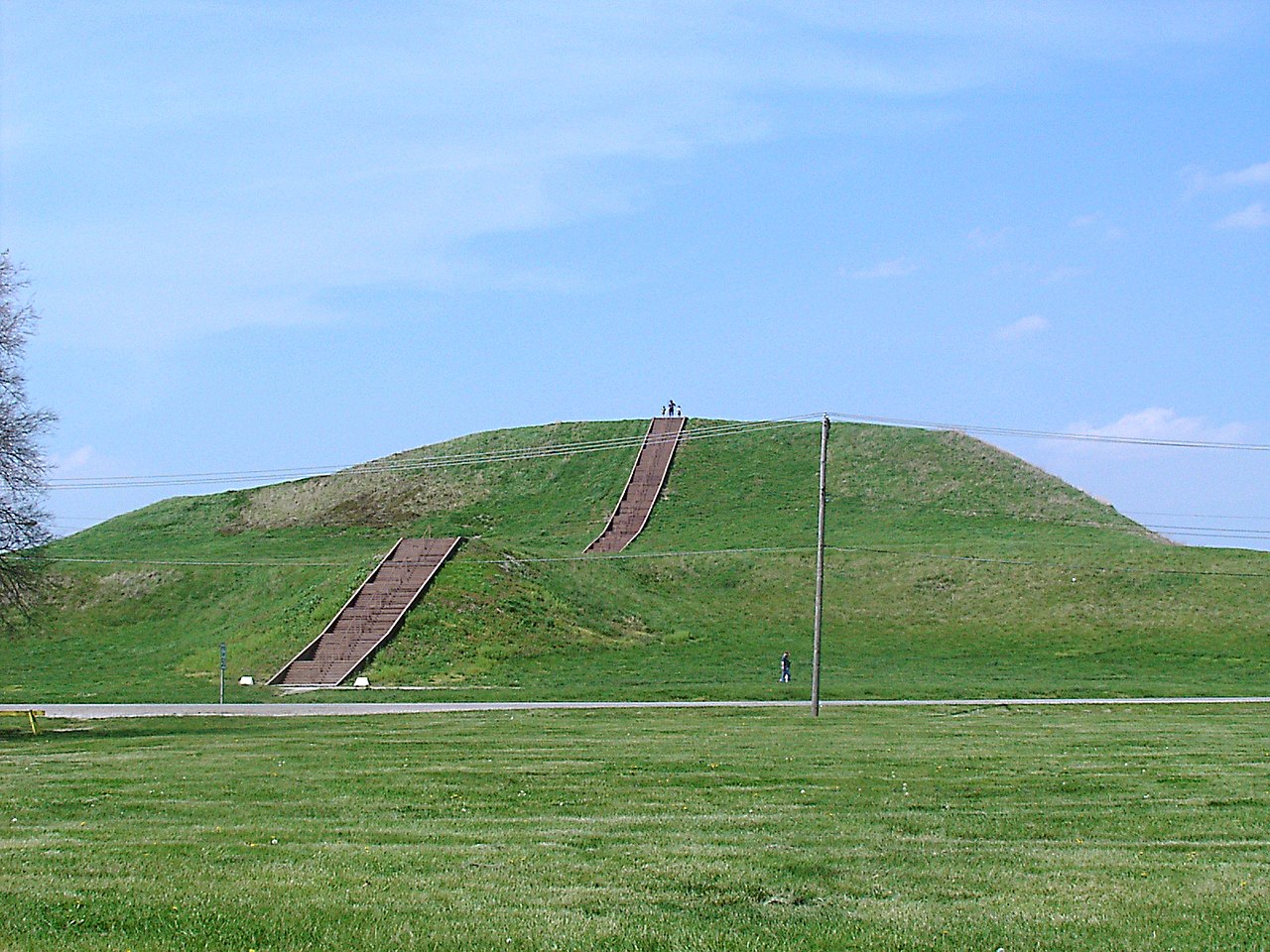
The site includes 12 earthen mounds, built from basketfuls of dirt, layer by layer: one burial mound, two temple mounds and nine house mounds.
DescriptionSources for this section
- Wikipedia (English): Spiro MoundsCC BY-SA 4.0
Sources for this section
- Wikipedia (English): Spiro MoundsCC BY-SA 4.0
The site includes 12 earthen mounds, built from basketfuls of dirt, layer by layer: one burial mound, two temple mounds and nine house mounds. They surround a large, planned and leveled central plaza, where religious rituals, the game of chunkey and other community activities were carried out. The population lived in a village bordering the plaza, and more than twenty related village sites have been found within five miles of the main town. Brown Mound, the largest platform mound, lies on the eastern side of the plaza and had an earthen ramp giving access to the summit from the north. Spiro has been the site of human activity for at least 8,000 years.
DatingSources for this section
- Wikipedia (English): Spiro MoundsCC BY-SA 4.0
Sources for this section
- Wikipedia (English): Spiro MoundsCC BY-SA 4.0
The history of the site is divided into the Evans Phase (900-1050 CE), the Harlan Phase (1050-1250 CE), the Norman Phase (1250-1350 CE) and the Spiro phase (1350-1450 CE). Most of the mounds were built during the Harlan Phase. Residential construction decreased dramatically around 1250 CE, and the people resettled in nearby villages. Spiro continued to be used as a ceremonial and mortuary center through 1450 and was abandoned about 1450, although nearby communities persisted until 1600 CE. Spiro was at the peak of its cultural importance in the 13th and 14th centuries.
FindsSources for this section
- Wikipedia (English): Spiro MoundsCC BY-SA 4.0
Sources for this section
- Wikipedia (English): Spiro MoundsCC BY-SA 4.0
Craig Mound, also called "The Spiro Mound", is the second-largest mound and the only burial mound. Elite individuals were buried there between 950 and 1450. It lies approximately 1,500 feet (460 m) southeast of the plaza. A hollow chamber inside it, known as the "Great Mortuary", was approximately 10 feet (3.0 m) high and 15 feet (4.6 m) wide and allowed almost perfect preservation of fragile objects of wood, conch shell and copper, and of basketry, woven fabric, lace, fur and feathers. The chamber was created as a circle of cedar posts sunk in the ground and angled together at the top, covered with layers of earth. No other Mississippian mound has been found with such a hollow space or such preservation.
The objects recovered include stone effigy pipes, polished stone maces, flint knives and arrow points, chunkey stones, copper effigy axes, copper plates, mica effigy cut-outs, engraved conch shell gorgets and cups, pearl bead necklaces, stone earspools, shell-inlaid wood carvings and mortuary pottery. Some materials came from far away: colored flint from New Mexico, copper from the Great Lakes, conch shells from the Gulf Coast, mica from the Carolinas and green obsidian from Pachuca, Mexico. Mineralogical analysis shows that some of the stone effigy pipes, including the "Grizzly Man" or "Kneeling Rattler" pipe, came from Cahokia.
ExcavationsSources for this section
- Wikipedia (English): Spiro MoundsCC BY-SA 4.0
Sources for this section
- Wikipedia (English): Spiro MoundsCC BY-SA 4.0
In 1936 a group of five prospectors leased the site for $300, formed the Pocola Mining Company and tunneled into Craig Mound, removing thousands of pounds of artifacts. They discarded human remains, textiles, basketry and feathers, most of which disintegrated before scholars could analyze them, and the company destroyed about one-third of the artifacts found in the mound. They then dynamited the burial chamber and sold the commercially valuable objects to collectors in the United States and overseas. Most of these objects are lost, though some have been returned through donation and documented.
Funded by the Works Progress Administration, archaeologists from the University of Oklahoma excavated parts of the site between 1936 and 1941.
ConservationSources for this section
- Wikipedia (English): Spiro MoundsCC BY-SA 4.0
Sources for this section
- Wikipedia (English): Spiro MoundsCC BY-SA 4.0
The Oklahoma Historical Society established the Spiro Mounds Archaeological Center in 1978, and the site is preserved as Oklahoma's only Archeological State Park and its only pre-contact Native American site open to the public. Some artifacts sold by the treasure hunters were returned to regional museums and the Caddo Nation, but many have never been accounted for.
ContextSources for this section
- Wikipedia (English): Spiro MoundsCC BY-SA 4.0
Sources for this section
- Wikipedia (English): Spiro MoundsCC BY-SA 4.0
The Mississippian period in eastern North America, from the end of the tenth century to the sixteenth, brought maize farming, large towns and platform mounds on which temples and chiefs' houses stood. Mounds of this kind are earthworks of piled soil, not megaliths.
Tradition and region
About this kind of monument
Native American earthen mounds
Eastern North America has many earthen mounds, built over several thousand years by Native American peoples. They are not megaliths, but earthworks of piled soil, and they served as graves, platforms and symbols. The Adena culture of the Early Woodland period, from 500 BCE to 100 CE and centred on Ohio, built burial mounds and shared a ceremonial system. The Hopewell tradition, a network of cultures from 100 BCE to 500 CE, exchanged goods from Lake Ontario to Florida and raised burial mounds and geometric enclosures. The Mississippian period, from the end of the tenth century to the sixteenth, brought maize farming, large towns, and platform mounds on which temples and chiefs' houses stood.
The grandest is Monks Mound at Cahokia, Illinois, the largest pre-Columbian earthwork in the Americas. Its construction began between 900 and 955 CE; it is about 30 metres high and 291 metres long including the access ramp, with a base about the size of the Great Pyramid of Giza. Effigy mounds are mounds shaped as animals or symbols; the effigy mound builders are mainly associated with 550 to 1200 CE, though radiocarbon dating puts the origin of some as far back as 320 BCE. The Great Serpent Mound in Ohio, 411 metres long and about 1.2 metres high, is the largest serpent effigy known, surveyed in 1848 by Squier and Davis.
Mounds are dated by radiocarbon dating of charcoal and by pottery; many were levelled by farming and by antiquarian digging. Nineteenth-century theories of a vanished race of Mound Builders have no support: the mounds were raised by Native American peoples.
When visiting, remember that many mounds are sacred places. Look for platform tops, the flat summits of mounds that held buildings, and for the ramps and plazas around them.
Paraphrased from Wikipedia: Adena culture, Wikipedia: Hopewell tradition, Wikipedia: Mississippian culture, Wikipedia: Serpent Mound, Wikipedia: Monks Mound, Wikipedia: Effigy mound, Wikipedia: Poverty Point, Wikipedia: Mound Builders · CC BY-SA 4.0
From the article
Dated moments in the story
- 950 CE
Elite individuals were buried at the Craig Mound in Spiro between 950 and 1450. It is located approximately 1,500 feet (460 m) southeast of the plaza.
Source - 1050
Typically, the history of the Spiro culture is divided into archaeological phases: Evans Phase (900–1050 CE) Harlan Phase (1050–1250 CE) Norman Phase (1250–1350 CE) Spiro phase (1350–1450 CE) Residential construction at Spiro decreased dramatically around 1250 CE, and the people resettled in nearby villages, such...
Source - 1250
Archaeologists have shown that Spiro had a large resident population until about 1250. Around that time, the Little Ice Age caused seasonal rains to become less predictable.
Source - 1450
It was a major Mississippian settlement from 800 to 1450 AD.
Source - 1450
Spiro continued to be used as a regional ceremonial center and burial ground until about 1450. Its ceremonial and mortuary functions continued and seem to have increased after the main population moved away. Craig Mound—also called "The Spiro Mound"—is the second-largest mound on the site and the only burial mound.
Source - 1600
Spiro continued to be used as a ceremonial and mortuary center through 1450. The mound area was abandoned about 1450, but nearby communities persisted until 1600 CE.
Source - 1936
Funded by the Works Progress Administration (WPA), archaeologists from the University of Oklahoma excavated parts of the site between 1936 and 1941. The Oklahoma Historical Society established the Spiro Mounds Archaeological Center in 1978 that continues to operate.
Source - 1936
In 1936, a group of five prospectors were able to lease Spiro Mounds for $300. The group created The Pocola Mining Company.
Source
Photographs
5 photographs, each with its author and licence
More photographs
Lore
Evidence & Lore
What the sources actually support — and, kept apart, what has been claimed.
What the evidence supports
Dates
900–1450 CEHow this date was established: Stated by the sourceThe range follows the archaeological phases and the stated duration of ceremonial use.Source for this date
Measured facts
- Location
- Present-day eastern OklahomaSource: Location
- Site area
- 150 acresSource: Site area
- Cultural affiliation
- Arkansas Valley Caddoan and Mississippian culturesSource: Cultural affiliation
- Regional centers
- One of four, with Cahokia, Moundville, and EtowahSource: Regional centers
- Burial chamber
- Exposed in Craig Mound by treasure huntersSource: Burial chamber
- Protection
- Protected by the Oklahoma Historical SocietySource: Protection
- Culture
- Mississippian cultureSource: Culture
- Heritage designation
- National Register of Historic Places listed placeSource: Heritage designation
Where it stands
United States
The pin marks the monument itself — its exact point.
- Coordinates
- 35°18′43″ N, 94°34′07″ WFor a GPS or map app: 35.31194, -94.56861
Access is as our sources describe it; we have not visited the site to check.
Nearby
The closest sites in the Atlas, by straight line.




Sources
Every record behind this page, with the link it came from.
2 sources behind this page
- 01Wikidata Q2044290wikidata.org
- 02Fringe claim sourceen.wikipedia.org
Image files
- Spiro Mounds Obsidian Scraper with Mesoamerican origin, Ventral, Craig Skinner of the Northwest Research Obsidian Studies Laboratory.jpgCraig Skinner of the Northwest Research Obsidian Studies LaboratoryCC BY 4.0
- Spiro Craig Mound HRoe.jpgHerb Roe, www.chromesun.comCC BY-SA 3.0
- House at spiro mounds.jpgSmallchiefCC BY-SA 3.0
- Mill Creek chert bifaces Spiro HRoe 01.jpgHerb Roe, www.chromesun.comCC BY-SA 3.0
- Smoker effigy pipe Spiro HRoe 01.jpgHerb Roe, www.chromesun.comCC BY-SA 3.0
Report a correctionWrong date, name, photograph or source? Tell us and it will be put right.
Lore, kept apart
Legends and claims
These are stories and claims reported by the sources. They are not evidence, and they never stand in for the dating above.
- Tradition
Anthropologists have tried in recent years to interpret the meaning of the ritual artifacts and artistic imagery found at Spiro and other Mississippian sites.
Anthropologists have tried in recent years to interpret the meaning of the ritual artifacts and artistic imagery found at Spiro and other Mississippian sites. While reaching firm conclusions about the meanings of works of art made centuries ago by people of an extinct culture is difficult, they have made some compelling interpretations by comparing Mississippian artistic imagery with the myths, religious rituals, art, and iconography of historic Native American groups. One of the most prominent symbols at Spiro is the "Birdman", a winged human figure representing a warrior or chunkey player. Chunkey has been played by tribes from the far Southeastern Woodlands to the Northern Plains. Based upon historic records, the game consisted of players rolling a stone disk for a considerable distance and then hurling spears as close as they could to the point where the stone stopped. Another Spiro icon is the "Great Serpent", a being said to inhabit the Under World, the spiritual domain on the opposite side of the Mississippian universe. The Great Serpent is portrayed in Mississippian art with a serpent's body, but also with wings or horns. Similar beings were the subject of myth in historic times among the Micmac, Huron, Kickapoo, Cherokee, Muscogee Creek, Caddo, and other Native American tribes, representing at least three major language families. The spiritual beings of the Under World were thought to be in constant opposition to those in the Upper World. Humans had to fear these beings, according to Native American mythology, but they could also gain great power from them in certain circumstances. Mississippian art also features the cedar tree or striped-center-pole motifs, which researchers have interpreted as the axis mundi, the point at which the three parts of the Mississippian spiritual universe come together: the Upper World, the Under World, and the Middle World where humans dwell. Often, the cedar tree, or the striped-center-pole, is found on engraved conch shell gorgets, with human or animal figures positioned on either side. The concept of an axis mundi—the point where different cosmic domains converge—is found in many cultures around the world. It is frequently represented as a tree (including the Tree of Life), since trees pass through the surface of the earth and connect the subsurface and the sky. The fact that the Great Mortuary at Spiro was built with cedar (or cedar elm) posts suggests that the burial chamber was meant to be a point of departure from one spiritual domain to another, as cedar was a sacred wood. Archaeologists found that one of the conch shell cups from Craig Mound had a black residue in the bottom. This suggests that the Spiro people may have practiced a version of the Black Drink Ceremony, a purification ritual that was also performed in historic times by their descendants—the Southeastern tribes. Participants drank a tea made from the Yaupon Holly from conch shell cups.
Source
Credit
Text, licence and sources
Adapted from the Wikipedia article "Spiro Mounds" (English), licensed CC BY-SA 4.0; authors are listed in the page history. Reused under CC BY-SA 4.0. Read on Wikipedia · Edit history and authors
- Wikipedia (English): Spiro MoundsCC BY-SA 4.0
- Wikidata Q2044290CC0